This is a sample of If You Love Me: How Christians Have Betrayed Jesus for the False Apostle Paul by John Alan Martinson. The PRINT version is available through Lulu.com, and the DIGITAL version can be purchased through my Payhip store.. This sample includes the Introduction and the first chapter.

Introduction
“If you love me, keep my commandments.” — John 14:15.
That sentence is simple. It is not mystical. It is not complicated. It does not require a theological degree to understand. Love, according to Jesus, is demonstrated through obedience. Not emotion. Not enthusiasm. Not public worship. Not church attendance. Obedience. If someone claims to love him yet refuses to keep his commandments, then by Jesus’ own definition, that person does not love him. Everything that follows in this book rests on that foundation.
Modern Christianity speaks constantly about loving Jesus. Worship songs are written about loving him. Sermons are preached about loving him. Entire identities are constructed around the idea of a “relationship” with him. Yet at the same time, the commandments he taught are routinely minimized, reinterpreted, or set aside. Many Christians openly claim that believers are “not under the law.” They speak as if obedience to the commandments of God is either unnecessary or even dangerous. And yet Jesus did not say, “If you love me, believe certain theological formulations.” He did not say, “If you love me, feel grateful.” He said, “Keep my commandments.”
This book sets out to examine whether Christianity, as it is commonly practiced and preached, actually aligns with the teachings of Jesus.
The claim is serious:
Christianity, in its dominant form, has very little to do with what Jesus himself taught. It has instead been shaped primarily by the teachings of Paul of Tarsus. Wherever Jesus and Paul appear to conflict, Christians overwhelmingly resolve the tension in favor of Paul. The result is a system that proclaims loyalty to Jesus while filtering his words through another man’s theology.
That is not a minor issue. It is a question of authority.
This is not an argument about denominational differences. It is not a dispute over secondary doctrines or church traditions. It concerns the foundation itself. Who defines the faith? Whose words carry final authority? If Jesus is Lord, then his teachings must be supreme. If another teacher introduces doctrines that alter, diminish, or contradict the Lord’s commandments, then the integrity of the faith is compromised. It is that simple.
The stakes are not academic. Jesus spoke repeatedly about judgment and exclusion. He warned that not everyone who calls him “Lord” will enter the Kingdom of Heaven.
“Not every one that saith unto me, Lord, Lord, shall enter into the kingdom of heaven; but he that doeth the will of my Father which is in heaven.” — Matthew 7:21.
That is a devastating statement for anyone who believes verbal confession alone is sufficient. He goes further:
“And then will I profess unto them, I never knew you: depart from me, ye that work iniquity.” — Matthew 7:23.
The word translated “iniquity” means lawlessness. Those who practice lawlessness, even while claiming his name, are rejected. There is no other group of people that fit this description but Christians. Christians are the only group that calls Jesus ‘Lord’ and also preaches that following God’s laws is irrelevant for salvation. Therefore, it is inarguable that Jesus is speaking of his rejection of Christianity in Matthew 7:21 – 23.
If Jesus condemns lawlessness, then any theology that promotes freedom from the law of God deserves careful scrutiny. If someone teaches that believers are no longer bound to keep the commandments, that teaching must be weighed against Jesus’ own words.
The question is unavoidable: did Jesus preach obedience to the commandments of God, or did he abolish them? And if Lord Jesus did not abolish God’s commandments, who taught the people that God’s laws are abolished?
Jesus declared plainly:
“Think not that I am come to destroy the law, or the prophets: I am not come to destroy, but to fulfil. For verily I say unto you, Till heaven and earth pass, one jot or one tittle shall in no wise pass from the law.” — Matthew 5:17–18
Such a saying means “it will never happen.” Heaven and earth have not passed away. The commandments have not vanished. Jesus did not present himself as the destroyer of the Torah but as its faithful embodiment and teacher. Any later teaching that appears to nullify the commandments must therefore be examined carefully.
Yet many Christians speak as though obedience to the Torah is impossible, obsolete, or even contrary to faith. They insist that justification by faith renders the law irrelevant. They speak of being “dead to the law” or “not under the law.” These phrases do not originate in the recorded teachings of Jesus. They come from Paul. The tension between those two voices cannot simply be harmonized by assumption. It must be addressed honestly.
In Matthew 6:24, Jesus also warned, “No man can serve two masters.” That principle applies not only to wealth and loyalty but to authority itself. If two teachers present conflicting instructions, allegiance must ultimately fall to one. Modern Christianity often claims there is no conflict between Jesus and Paul. But that claim is frequently maintained by redefining Jesus’ words to fit Pauline theology. Instead of allowing Jesus to interpret Paul, Paul is used to reinterpret Jesus. Christianity, as we will see, is consistently an unfaithful woman claiming to be the bride of Christ.
This book does not begin with the assumption that harmony exists. It asks whether it does. It examines the texts directly, quoting them in full. It places the words of Jesus beside the words of Paul and allows the reader to see the contrast. If there is agreement, it will be visible. If there is contradiction, that too will be visible. The goal is not to force discord where none exists, but neither is it to ignore it where it does.
One of the central claims explored in these pages is that Paul teaches what can only be described as a Theology of Lawlessness. He repeatedly contrasts “faith” with “works of the law.” He speaks of believers being freed from the law. He describes the law as a burden from which Christ has liberated his followers. Whether those statements can be reconciled with Jesus’ explicit affirmation of the commandments is not a trivial matter. It lies at the heart of Christian identity.
This conflict is not limited to abstract theology. It affects the moral and social life of the church, including its approach to sexuality. The church’s often conflicted, suspicious, or anti-physical attitudes toward the body and desire bear little resemblance to the straightforward goodness of creation described in the Scriptures. The idea that holiness requires distance from the physical world, or that marriage is merely a concession to weakness, reflects a certain theological trajectory. It is not a trajectory found clearly in the teachings of Jesus. It is, however, strongly associated with Pauline emphasis.
In the chapters that follow, the argument unfolds methodically. The first chapter provides an overview—a panoramic presentation of the entire case. It sketches the central claims and introduces the key tensions that will be explored in detail later. It does not attempt to prove every point exhaustively. It shows the shape of the argument so the reader understands where the journey is headed. Each subsequent chapter then slows down and examines the components carefully. The warnings of Jesus are studied. The prophetic patterns of the Tanakh are considered. The character and testimony of Paul are scrutinized. Direct contradictions between Jesus and Paul are placed side by side. The philosophical and moral consequences of Pauline theology are explored. Nothing is left at the level of vague accusation. The texts themselves are displayed and allowed to speak.
This is not a rant against individuals. Many Christians are sincere. Many genuinely believe they are honoring Jesus. Sincerity, however, does not determine truth. If a system has shifted authority from the words of Jesus to the interpretations of another teacher, that shift must be identified and corrected.
The aim is not destruction but restoration. It is a call to return to the teachings of Jesus without filtering them through later theological systems.
The ultimate question is simple, even if its implications are enormous. Do Christians love Jesus according to his own definition? If loving him means keeping his commandments, then obedience is the measure of how much a person loves the Lord. If obedience has been replaced by a doctrine that renders the commandments void, then something has gone profoundly wrong.
The pages ahead are an invitation to examine that possibility with honesty and courage. The standard remains what it was at the beginning:
“If you love me, keep my commandments.”
— John 14:15.
Everything else must be measured against those words.
The seriousness of this examination cannot be overstated. Jesus did not speak in vague spiritual generalities. He warned about deception. He warned about false prophets. He warned about wolves in sheep’s clothing. He warned that many would come in his name and yet mislead. These warnings were not decorative. They were protective. If the Son of God repeatedly cautioned his followers to beware of religious deception, then any claim to represent him must be tested.
“Beware of false prophets, which come to you in sheep’s clothing, but inwardly they are ravening wolves.” — Matthew 7:15
That warning appears in the same sermon where Jesus insists that not everyone who calls him “Lord” will enter the Kingdom. The proximity of those statements is not accidental. False teachers and lawlessness are connected. If someone introduces teachings that undermine obedience to God’s commandments, that person fits the description Jesus gave.
The argument advanced in this book is not that Christians consciously reject Jesus. It is that they have inherited a theological framework that subtly shifts allegiance. In practice, many believers interpret Jesus through Paul rather than Paul through Jesus. When Paul says something that appears to contradict the Torah (first five books of the Bible, containing 613 commandments from God), Christians assume Jesus must have meant something different than what his words plainly state. The authority of Paul becomes the lens. The authority of Jesus becomes secondary.
That is a dangerous inversion.
Consider again the clarity of Jesus’ teaching regarding the law:
“Whosoever therefore shall break one of these least commandments, and shall teach men so, he shall be called the least in the kingdom of heaven.”
— Matthew 5:19
That is not ambiguous. Teaching others to disregard even the least commandment is condemned. If a teacher proclaims that believers are no longer obligated to observe the laws of God, that proclamation must be measured against this warning. The issue is not technical nuance. It is fidelity.
Some will argue that Jesus’ death and resurrection altered the entire structure of obedience. That argument depends heavily on Pauline interpretation. Yet even after the resurrection, Jesus did not announce the abolition of the commandments. Instead, he commissioned his disciples to teach others “to observe all things whatsoever I have commanded you.” — Matthew 28:20. The mandate remains obedience to his commandments. The language does not shift toward lawlessness. It reinforces continuity.
Why, then, does modern Christianity so often speak as though obedience to the Torah is not only unnecessary but misguided? Why are believers warned against being “legalistic” if they pursue commandment-keeping? Why is the very law Jesus upheld treated as a threat to faith?
These questions demand answers.
This book will show that the theology most commonly associated with Paul redefines the relationship between faith and obedience in a way that cannot easily be reconciled with Jesus’ own teaching. It will examine passages in which Paul speaks of believers being “not under the law,” “dead to the law,” or “justified apart from works.” These statements have shaped Christian doctrine for centuries. But they must be compared directly with the recorded words of Jesus, not assumed to be in harmony.
It will also examine the character of Paul himself. He identifies as a Pharisee. He admits to using craftiness. His accounts of his encounter with Jesus differ in important details across his own testimony. These matters are not trivial. If a man’s authority rests on his claim to have received revelation from the risen Christ, then inconsistencies in that claim are significant. A faith built upon testimony must evaluate the credibility of its witnesses. Furthermore, the moral consequences of Pauline theology are not abstract. When obedience to the commandments is minimized, moral coherence suffers. The concept of sin shifts. The definition of righteousness becomes detached from concrete instruction. The result is often confusion—particularly in matters of sexuality and the body. The church has oscillated between ascetic suspicion of the flesh and moral chaos, both of which reflect tension within its theological foundations.
If the law of God defines sin, and the law is set aside, then sin becomes whatever theology later decides it is. Jesus, however, defined righteousness through obedience. He did not redefine sin as a merely internal condition divorced from action. He did not teach that commandments were burdens to be escaped. He embodied them and intensified their ethical seriousness. The chapters ahead will not ask the reader to accept sweeping conclusions without evidence. They will lay out the texts. They will show what Jesus said. They will show what Paul wrote. They will examine whether the two messages align or conflict. Where Christians claim harmony, the passages will be placed side by side. The reader will see the words themselves.
The goal is clarity, not confusion. It is better to confront uncomfortable tension honestly than to preserve unity by suppressing it. If Jesus is truly Lord, then loyalty to him must be uncompromised. If following him requires reevaluating long-held assumptions about Paul, then that reevaluation is necessary.
This book does not claim that every Christian is malicious. It claims that many are misled. Deception, by definition, does not announce itself. It feels normal. It feels orthodox. It feels safe. That is precisely why Jesus warned about it.
The final measure remains unchanged. Love is obedience. “If you love me, keep my commandments.” — John 14:15. That statement stands at the beginning of this journey and will stand at the end. Every doctrine, every sermon, every theological system must answer to it.
If Christians truly love Jesus, they will keep his commandments. If they do not, then something fundamental has gone wrong. The purpose of this book is to examine that possibility without fear, without evasion, and without compromise.
1 — If You Love Me
Lord Jesus gave a clear litmus test of love:
“If you love me, keep my commandments” — John 14:15
Yet Christianity has long chosen another man’s words over His — the words of the psychopathic murderer, and anti-sexual misogynist, Saul of Tarsus, who later renamed himself “Paul” and infiltrated the highest ranks of the religious movement founded by Lord Jesus. The tragedy of modern Christianity is not that people know too little about Jesus—it is that they prefer the theology of Paul of Tarsus, the False Apostle, over the words of the Lord Himself. This is not love. It is spiritual adultery. Christianity is the bride that clings to another man’s letters, hiding them in her bosom, whispering them at every opportunity, and then demanding that Jesus share His marriage bed with Paul. But Jesus is a jealous God, unwilling to share His glory with another.
“I am the LORD: that is my name: and my glory will I not give to another, neither my praise to graven images.” — Isaiah 42:8
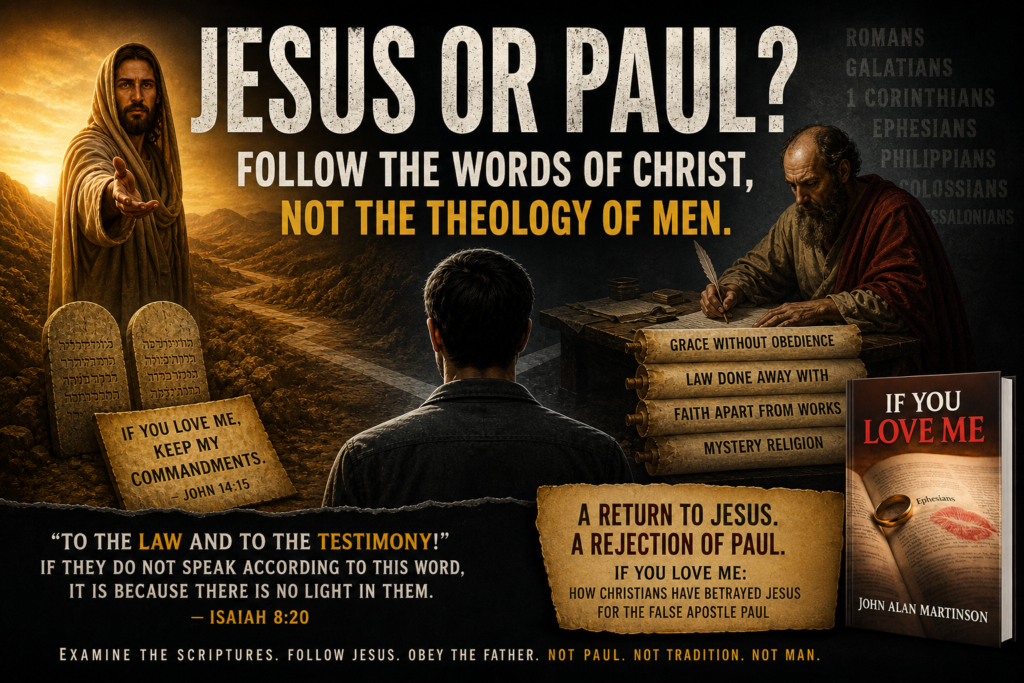
Christianity is not the faithful bride of Christ. It is a woman who dares to stand at the altar, clutching Paul’s letters in her hands, quoting Paul more often than Jesus. She is a woman who tucks a love letter from Paul into her bra and demands that Jesus cuck Himself to allow Paul, Santa Claus, the Easter Bunny, and a Christmas tree in the bedroom. No alpha male husband would tolerate such infidelity.
“Thus saith the LORD, Learn not the way of the heathen, and be not dismayed at the signs of heaven; for the heathen are dismayed at them. For the customs of the people are vain: for one cutteth a tree out of the forest, the work of the hands of the workman, with the axe. They deck it with silver and with gold; they fasten it with nails and with hammers, that it move not.“
— Jeremiah 10:2–4
“Thou shalt have no other gods before me. Thou shalt not make unto thee any graven image, or any likeness of any thing that is in heaven above, or that is in the earth beneath, or that is in the water under the earth: Thou shalt not bow down thyself to them, nor serve them: for I the LORD thy God am a jealous God, visiting the iniquity of the fathers upon the children unto the third and fourth generation of them that hate me.” — Exodus 20:3 – 5
Christians Worship Paul, Not Jesus
What is worship? At its root, worship is adoration, reverence, and devotion expressed toward the one you hold supreme. Christians claim they worship Jesus, but their behavior proves otherwise. The favorite word of the Christian is one that Jesus ever used. That word is “grace.” Jesus never speaks the word charis (grace) in the Greek manuscript of the New Testament—ever. Instead, He preached obedience, repentance, and righteousness (Matthew 5:17–20, Luke 6:46, Revelation 22:14).
Yet ask any Christian for a proof text, and nine times out of ten they quote Paul. They quote Romans, Galatians, or Corinthians while ignoring Jesus’ Sermon on the Mount. They treat Paul’s words as the “Word of God” when Paul himself is not God, nor did the Torah’s litmus test for a prophet ever approve him.
According to Deuteronomy 13:1–5, any man who preaches against the Law is a false prophet deserving of death. Paul did just that, calling the Law a curse (Galatians 3:10–13) and telling Gentiles they need not obey it (Romans 6:14, Galatians 5:4). In accordance with the commandments of God in the Torah, Paul should have been executed. Yet Christianity places this anti-Christ on a throne beside Lord Jesus.
Rebutting the Defenses of Paul-Worshippers
Claim: 2 Peter 3:16 Supports Paul
Christians argue that Peter defended Paul by saying his letters were “scripture.” But the verse actually warns that Paul’s letters contain things that are NONSENSE (dysnoetas) which the unlearned twist to their destruction. That word dysnoetas is not a compliment. It means “NONSENSE,” “absurd,” or “lacking understanding.” We know it is an insult — despite the sly and purposeful mistranslation of the word found in Strong’s Concordance — because we have historical records of its use as an insult by such early Christian writers as Lucian! Far from endorsing Paul, 2 Peter 3:16 is warning that his writings are dangerous stumbling blocks.
Christians also cling to 2 Peter 3:15, where Paul is called a “beloved brother,” as if this proves an endorsement. But once it is understood that Peter immediately followed this with a statement about Paul’s writings containing dysnoetas—nonsense, absurdities, or confused thoughts—the phrase “beloved brother” takes on a different tone. It reads less like high praise and more like the way an inner-circle might refer to a tag-along who is tolerated despite his frequent foolishness. In other words, Peter may have been showing patience toward Paul’s well-meaning but often idiotic and confusing tendencies, not endorsing him as a prophet or authority. This interpretation makes sense of the full passage: Paul is acknowledged as a brother (i.e., a fellow believer), but one whose words are riddled with stumbling blocks that can lead people to destruction.
Claim: Paul’s Words Are the “Word of God”
The Torah makes it clear: a prophet must be tested by whether his words align with God’s Law (Deuteronomy 13:1–5, Deuteronomy 18:20–22). Paul fails this test, preaching that the Law (Torah) has ended (Romans 10:4) and that believers are not under it (Galatians 5:18). Jesus taught the exact opposite:
“Do not think I came to destroy the Law… till heaven and earth pass away, not one jot or tittle will pass from the Law” — Matthew 5:17–19
Heaven and earth are still here. The Law remains. Paul contradicts Jesus—therefore Paul is no prophet of God.
Claim: Salvation Is by Grace
Christians repeat Paul’s refrain that salvation is “by grace through faith” (Ephesians 2:8). Yet Jesus never used the word grace. His teaching was clear: “If you want to enter into life, keep the commandments” (Matthew 19:17). He told people to repent (Luke 13:3), to love God with all their heart (Mark 12:30), and to endure to the end (Matthew 24:13). Grace was never His gospel; obedience and righteousness were.
Claim: Jesus Was the “End of the Law”
Paul twisted the role of the Messiah into declaring Him the termination of the Law (Romans 10:4). Yet Jesus said the Law is eternal (Matthew 5:18), and the Tanakh testifies the same (Psalm 119:142, Malachi 4:4). Revelation 14:12 affirms the faithful as those “who keep the commandments of God and the faith of Jesus.” To say Jesus was the “end of the Law” is to call Him a liar.
Claim: Jesus Personally Chose Paul
Paul’s conversion story is riddled with contradictions (compare Acts 9:7 with Acts 22:9). The witnesses’ testimonies don’t align. Paul saw “a light” but heard no voice; later he claims he did. Jesus said, “I have come in my Father’s name, and you do not receive me; if another comes in his own name, him you will receive” (John 5:43). Paul came in his own name — his real name is Saul.
Claim: Without Paul You Lose the Whole Bible
Christians act as though removing the 13 letters of Paul will destroy the faith. But God never declared that certain scrolls formed an “official Bible.” The concept of a certified and approved canon is man-made. The Torah itself gave us the litmus test for prophets. Paul fails it. The true Scriptures—the Law, the Prophets, the Writings, and the words of Jesus—remain intact without Paul. In fact, without Paul, they harmonize beautifully.
Claim: Anti-Paul Believers Are Fringe Heretics
This slander ignores the early record. The Ebionites rejected Paul as a heretic. James, the brother of Jesus, was wary of Paul (Acts 21:20–21). John warned against deceivers who abandon the Law (2 John 1:7–9). From the beginning, Paul was viewed with suspicion. Christianity’s mainstream adoption of him only shows how far it strayed from the narrow path Jesus laid out.
The Sexual Confusion of Christianity
Christianity is sexually confused because of Paul. In 1 Corinthians 7, Paul spouted anti-female nonsense (dysnoetas), advising against marriage and portraying women as little more than burdens, saying that “it is good if a man does not even touch a woman.” Contrast this with the Kingdom parable of Jesus in Matthew 25, where five women go in to the marriage bed with the Groom. Jesus’ imagery points to polygyny, not celibacy or misogyny. Also contrast with King David saying to enjoy women’s breasts at all times.
“Let her be as the loving hind and pleasant roe; let her breasts satisfy thee at all times; and be thou ravished always with her love.” — Proverbs 5:19
Daniel 11:37 warned of a man who has “no desire for women.” Paul fits that warning, a man whose theology despises female role and denigrates the family structure given by God. The result is a religion unable to discern between holy marriage and spiritual adultery, demanding that the Bride of Christ allow multiple lovers—Paul, pagan traditions, and worldly inventions—into the bedchamber.
Wolf of Benjamin, Lord of the Dead
Paul’s true name was Saul, and in Hebrew, Saul (שאול) and Sheol (שאול) are the exact same word until you add Hebrew vowels, which are a later invention. Sheol is the Hebrew term used in the Tanakh to describe the underworld, the grave, or the abode of the dead where all souls go after death, both righteous and wicked—it is often translated as hell, hades, death or grave. In the Israelite faith it is not depicted as a place of eternal torment but as a shadowy, silent realm of separation from the living and from the active presence of God. Jesus already warned, saying God is not the God of the dead (Sheol), but of the living (Luke 20:38). Saul began as a murderous psychopath, a ravenous wolf (Acts 8:1–3). Later, as Paul, he divided the spoil.
The fruit of his work is division: thousands of Christian denominations, all at odds, yet united in one thing—treating Paul’s lawless theology as divine.
Jacob prophesied over Benjamin, saying, “Benjamin shall ravin as a wolf: in the morning he shall devour the prey, and at night he shall divide the spoil.” (Genesis 49:27)
This wolf imagery is telling when we remember that Paul, formerly Saul of Tarsus, was of the tribe of Benjamin (Philippians 3:5). Jesus Himself warned of such men, saying, “Beware of false prophets, which come to you in sheep’s clothing, but inwardly they are ravening wolves.” (Matthew 7:15)
The alignment of Paul’s Benjamite identity with Jacob’s prophecy, and with Jesus’ own warnings about wolves, reveals a consistent picture of a man who devoured in his youth and later divided the spoil through lawless doctrines and fractured denominations.
Jesus warned us: “He was a murderer from the beginning and abode not in the truth” (John 8:44). Paul murdered at the start, and then lied throughout his career. Jesus also said, “If another comes in his own name, him you will receive” (John 5:43). Christians ran from the murderer Saul of Tarsus, but when he came to them in a name of his own making, they lovingly received him as “Paul,” repeating his name and his letters endlessly, while neglecting the words of the true Shepherd.
Christianity’s Adulterous Love
Christianity is not the true love of the Lord. She is a woman clutching Paul’s letters at the altar, keeping them close to her heart, whispering his words while ignoring the Groom’s. Christianity is symbolically a woman, and her behavior is analogous that another man be allowed into the marriage bed. She insists that her favorite word—grace—be honored, though the Lord never once spoke it. She parades Santa Claus, the Easter Bunny, and a Christmas tree into the bedroom, trying to force her Groom to share His glory.
But Jesus is a jealous God. He is not interested in sharing His wife with Paul. The command is simple: “If you love me, keep my commandments” (John 14:15). Christianity has failed the test. She has not loved Him. She hates the idea of following God’s commandments to attain salvation, loves Paul’s cheap “grace” — that he lifted from the pages of Roman thought — and she wants to cuckold the Lord by inviting Paul of Tarsus to slide in under the bedsheets.
Christianity is a spiritually adulterous disobedient whore, in love with the False Apostle Paul, not Lord Jesus.
The claim that Christianity is the Bride of Christ is the laughable claim of a delusional woman trying to turn the Lord of the Universe (Jesus Christ) into a cuckold by inviting the False Apostle Paul, Santa Claus, the Easter Bunny, a Christmas tree, and other men, into the Lord’s marriage bedroom.
The truth is stark: Christians do not love Lord Jesus. They love Paul. They prefer Saul, the man tied to Sheol, over the Messiah of Israel. They twist Jesus’ words to fit Paul’s theology, when in reality Paul stands condemned by every standard God has given.
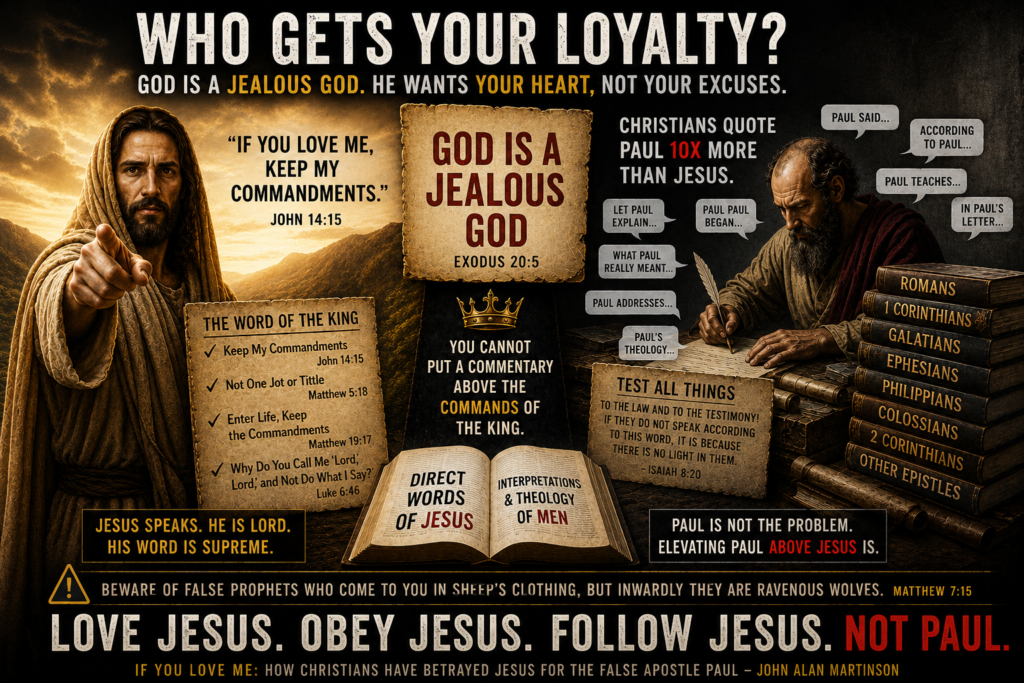
If you love Jesus, keep His commandments. Stop quoting Paul ten times more than the Lord. Stop excusing lawlessness with a word Jesus never used. Stop clutching another man’s letters in your bosom while pretending to be a faithful bride. The Lord is not fooled by whores.
Remember the woman at the well, who had already gone through five husbands and was living with yet another man when she met the Lord (John 4:18). She could not hide her shame, and neither can today’s Paul-worshipping Christians hide theirs. God is not fooled. It is sheer folly for this adulterous cult to think they can convince the world—or worse, convince God—that they love Jesus while keeping another man’s words closer to their hearts than His. Their mouths may say “Lord, Lord,” but their devotion is to Paul, and their actions prove them to be an unfaithful bride.
Jesus is not fooled. He will not share His glory with Paul. He will not accept an adulterous bride. The marriage supper of the Lamb will not be polluted with Valentine’s Day cards from Saul. If you love Him, obey Him. If you refuse to obey God’s commandments—613 in total as given in the Torah, not merely the well-known Ten—then be honest with yourself: you are a disciple of Paul, not a disciple of the Lord.
When Jesus declared, “Not every one that saith unto me, Lord, Lord, shall enter into the kingdom of heaven; but he that doeth the will of my Father which is in heaven” — Matthew 7:21, He was speaking prophetically of Christianity. It is inarguable. Who else in history has called Him “Lord” while refusing to obey the commandments of God? The Jews have never claimed Him as Lord, nor the Muslims, nor the pagans. Only Christianity fits the description of people who loudly confess His name but then throw away the very commandments He told them to keep.
Jesus continues: “Many will say to me in that day, Lord, Lord, have we not prophesied in thy name? and in thy name have cast out devils? and in thy name done many wonderful works?” (Matthew 7:22)
This perfectly describes Christianity with its endless ministries, revivals, tent meetings, and televangelists. They boast in miracles and in preaching, yet all of it is in Paul’s framework of lawlessness. Their churches are filled with false signs and wonders, and they think this activity proves their faithfulness. But Jesus cuts through their boasting, exposing them as liars whose works were never grounded in the Torah, never in the obedience God required from the beginning.
Then Jesus delivers His judgment:
“And then will I profess unto them, I never knew you: depart from me, ye that work iniquity.” — Matthew 7:23
The word iniquity in Greek is anomia, meaning lawlessness, the condition of being without law, of contempt for law, of violating law (Torah). This matches exactly the doctrine of Paul, who preached that believers are “not under the law” (Romans 6:14) and that Christ is the “end of the law” (Romans 10:4). Jesus calls this condition iniquity. Christianity is built upon this lawless foundation, and thus it is precisely the group He was identifying. They call Him “Lord,” but their lives and doctrine scream that they despise the commandments of the Father Consciousness (God).
Look at the passage systematically: Verse 21 tells us the standard—doing the will of the Father, which means keeping His commandments (Deuteronomy 30:16, John 14:15). Verse 22 shows the false claimants who loudly confess “Lord, Lord” and point to their religious activity, the very thing Christians do while rejecting God’s law. Verse 23 seals the case, declaring them workers of iniquity—lawlessness—which is the heartbeat of Paul’s theology and the essence of Christianity’s message. There is no escaping the fact: this prophecy is aimed squarely at Christianity—the lawless religion of Paul-worship.
Thus, when Jesus warned of those who cry “Lord, Lord” but do not obey, He was not speaking in vague generalities. He was describing, in perfect detail, the cult of Paul-worshipping Christianity. They are the ones who lift His name while clinging to Paul’s letters, the ones who celebrate grace while scorning obedience, the ones who have deceived the nations into thinking their adulterous cult is the true bride of Jesus the Messiah. Jesus foresaw them and named them for what they are: lawless workers of iniquity. And to them He will say, “Depart from me.”
“If you love me, KEEP MY COMMANDMENTS.”
— John 14:15
This is a sample of If You Love Me: How Christians Have Betrayed Jesus for the False Apostle Paul by John Alan Martinson. The PRINT version is available through Lulu.com, and the DIGITAL version can be purchased through my Payhip store.. This sample includes the Introduction and the first chapter.
About the Author