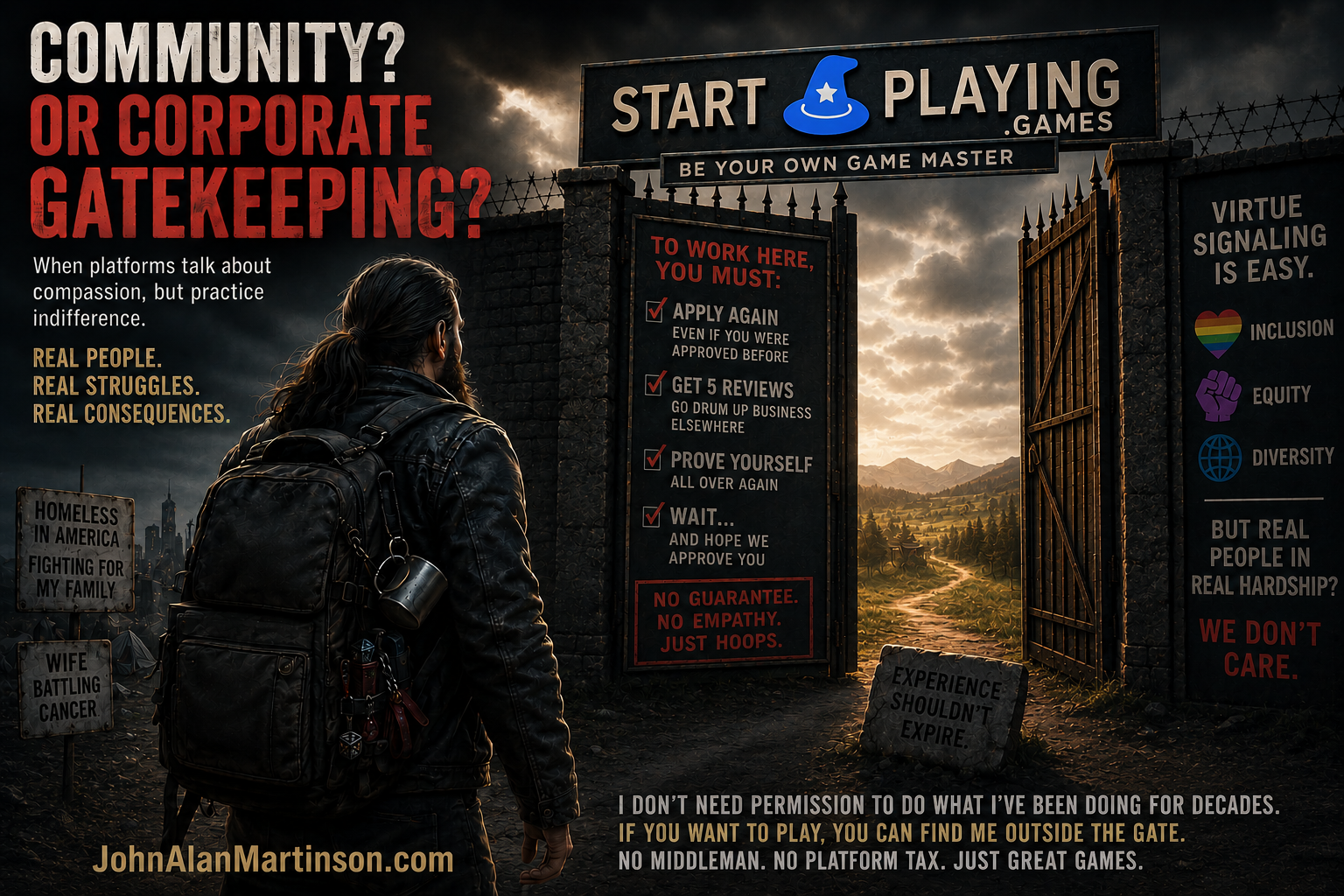
There is something deeply insulting about being told you are qualified to do a job, only to be told later that you are no longer qualified because you stepped away for a while. That is the absurd position I found myself in with StartPlaying. I had already been approved as a Game Master on their platform. I had already gone through their process, already been vetted, already been accepted. But after temporarily deactivating my account and returning just a few months later, I was informed that I had to apply all over again, as though my prior approval had somehow evaporated into the digital ether. Apparently, on modern internet platforms, experience has an expiration date.
And let’s be honest about what this is: bureaucracy for bureaucracy’s sake.
Imagine leaving a job for a short period, coming back, and your employer saying, “We know you worked here before, but we need you to prove yourself again.” That would be absurd in almost any profession. Nobody asks a plumber to re-prove he knows how to install pipes because he took six months off. Nobody asks a musician to audition again because they took a break from gigs. Yet somehow in the world of platform capitalism, this kind of nonsense is normalized. The digital gatekeepers create hoops, then congratulate themselves for having standards.
Then there’s the review requirement. Five reviews. Not five games run on their platform — five reviews, period. And if you don’t have them? Well, go find players elsewhere, bring them in, have them make accounts, and leave reviews. Think about that for a moment. That is not quality assurance. That is unpaid marketing labor disguised as vetting. It’s the corporate equivalent of saying, “Before we let you work here, please recruit customers for us.” That’s not professionalism; that’s outsourcing growth onto the worker. It’s a hustle wrapped in a policy and sold as fairness.
What makes this worse is the constant branding these companies engage in about “community.” Community is the favorite word of tech companies because it sounds warm, human, and compassionate. But when real human hardship enters the equation, the mask slips and you see the machinery underneath. My family is struggling with homelessness right now. My wife is battling cancer. We are fighting for stability, for food quality, for supplements, for medical decisions, for survival itself. And while none of that entitles me to special treatment, it does expose something ugly about systems like this: they are utterly indifferent to context.
The machine does not care.
The policy does not care.
The platform does not care.
It just asks for another form, another review, another hoop to jump through or obstacle to climb over.
And that’s the thing that infuriates me most about modern corporate culture: the selective performance of empathy. Companies love to drape themselves in the language of compassion, inclusivity, and support. They are eager to signal virtue when it costs them nothing. But when actual human hardship intersects with policy, suddenly compassion becomes conditional, procedural, and delayed. It reminds me of a comedian’s joke about airline customer service: “We’re very sorry for your suffering. Please remain on hold until your suffering is complete.” That’s what this feels like.
Sympathy as branding at StartPlaying.games but indifference is policy.
The truth is, I don’t need a platform to validate me as a Game Master. I’ve been running tabletop roleplaying games (TTRPGs) since the 1990s. I’ve been a Shadowrun Game Master since my teens. I created Gloria Nocturna. I am a professional voice actor. I’ve produced audiobooks. I understand storytelling, immersion, character work, dramatic pacing, and worldbuilding on a level most hobbyists never will. My skill set did not disappear because I clicked “deactivate.” My ability to create unforgettable sessions did not vanish because a platform changed its onboarding process.
And this is the dangerous thing creators need to understand: when you build your livelihood on platforms, you do not own your access to your audience. The platform owns that access. They own the gate. They own the algorithm. They own the visibility. You are always one policy update away from irrelevance. One new requirement away from delay. One bureaucratic adjustment away from lost income. It is digital feudalism dressed up like opportunity.
So here’s my conclusion: if you want to play at my table, play at my table directly. Pay me directly. Through Cash App. Through PayPal. In person. However you want. No corporate middleman. No platform tax. No artificial gatekeeping. No pretending that my decades of experience need to be “verified” by a handful of reviews collected like merit badges. I know what I bring to the table, and frankly, I don’t need a website to tell me whether I’m qualified to run a damn game.
Because in the end, platforms like StartPlaying want us to believe they are the gateway to opportunity. They’re not. They’re just toll booths on roads that existed long before they showed up. And like all toll booths, their business depends on convincing travelers that there’s no other way forward.
There is.
And sometimes the best thing you can do when faced with an unnecessary gate is walk around it.
About the Author