
This is the first chapter of the book They Are Trying to Kidnap Karol: Evidence of Corruption in Child Protective Services and the Fight to Bring Our Daughter Home by John Alan Martinson and Berenice Mariana Martinson. Sharing this post this friends and family, or purchasing a copy of this book will help bring our daughter home.

Chapter 1 — The Children Are Not Safe
The Courtroom Is Not What the Movies Promise
Most people have never had to stand before a judge while fearing that they might lose their child. Their understanding of the legal system comes largely from television and film, where the courtroom is portrayed as the ultimate forum for truth. In those stories, every witness is heard, every piece of evidence is carefully examined, every attorney is passionately committed to the client’s cause, and justice is achieved through reasoned deliberation. The courtroom is presented as a place where facts triumph over emotion and where the innocent have every opportunity to defend themselves.
That was not my experience.
When my family entered the legal system, I expected that I would have the opportunity to present photographs, medical records, timelines, witness statements, and other evidence demonstrating that the accusations against my family were false. I expected that my attorney would be interested in reviewing that evidence and presenting it before the court. I expected that the judge would want to understand the complete story before making life-changing decisions affecting my wife, my daughter, and me.
Instead, I found a process that felt rushed. Time was limited. Conversations were cut short. Evidence that I believed was important received little or no attention. Decisions appeared to be driven primarily by accusations rather than by a thorough examination of the facts that I had spent months documenting. Whether this was the result of overloaded court calendars, overworked attorneys, systemic problems, or something else entirely, the result was the same: I left believing that my family had not truly been heard.
This book exists because I intend to present the evidence that I believe should have been examined from the very beginning. Unlike a courtroom hearing with strict time limits, these pages allow me to present the complete timeline, the supporting documents, the photographs, the medical records, and the context surrounding the events that forever changed our lives. My goal is not merely to tell a story, but to present a detailed record that readers can examine for themselves.
Yes, CPS Sometimes Saves Children
Before I criticize Child Protective Services, I want to acknowledge something that is both important and deeply personal. Child Protective Services can save children. I know this because it once saved me.
When I was a child, my father was abusive. He abused me, and he sexually abused my older brother, who he had adopted as his son. Eventually, the abuse reached the point where Child Protective Services intervened and removed us from the home. Those events shaped the course of my childhood and remain among the most significant experiences of my life.
My mother loved us, but she also had to confront difficult truths about her own circumstances. She entered counseling to better understand why she had remained with an abusive husband and why she had tolerated behavior that endangered her children. She divorced my father, complied with the requirements placed before her, and fought to regain custody of us. Eventually, she succeeded, and our family began rebuilding our lives.
Because of those experiences, I have never believed that Child Protective Services should be abolished outright. There are children living in homes where they are beaten, sexually abused, starved, or otherwise subjected to unimaginable cruelty. There are parents who truly present a danger to their own children. In those situations, government intervention can be necessary and even lifesaving.
Recognizing that truth, however, does not require us to ignore the system’s failures. An institution capable of rescuing children from genuine abuse is equally capable of making devastating mistakes. The authority to remove a child from his or her parents is among the greatest powers any government possesses. That authority must therefore be exercised with extraordinary care, because when it is exercised improperly, the consequences can be catastrophic for innocent families.
This book is not an argument against protecting abused children. It is an argument that protecting children also requires protecting innocent families from false accusations, careless investigations, and decisions made without fully considering the available evidence. Those two goals are not in conflict. In fact, they depend upon one another. A child protection system that removes children only when the evidence truly justifies it is stronger, more trustworthy, and more effective than one that acts recklessly or carelessly.
The chapters that follow will explain why I came to believe that my own family became the victims of such a failure. Before telling that story, however, it is important to understand that my criticism comes from someone who has personally experienced both sides of the system: first as a child who benefited from intervention, and later as a father who believes his family was deeply harmed by it.
When Protection Becomes Family Destruction
No reasonable person believes that children should remain in homes where they are being beaten, sexually abused, tortured, or starved. The true purpose of child protection is to intervene when a child faces genuine danger. The difficult question is not whether children should be protected, but how the government determines when intervention is justified and how it balances the safety of the child with the constitutional rights of the family.
The United States Supreme Court has long recognized that parents possess a fundamental liberty interest in the care, custody, and control of their children. That principle has been reaffirmed repeatedly by the courts because removing a child from his or her parents is one of the most serious actions a government can take. It is not comparable to issuing a traffic citation or imposing a fine. It is the forced separation of a family, and the emotional consequences can last a lifetime.
The problem is that every child-protection system is operated by human beings. Human beings make mistakes. Witnesses misunderstand events. Anonymous callers lie. Personal biases influence judgment. Reports are written imperfectly. Information is omitted. Deadlines are rushed. Every one of those failures has the potential to change the course of a family’s life.
According to the National Academies of Sciences in New Directions in Child Abuse and Neglect (2014), child welfare agencies are responsible for carrying out multiple difficult responsibilities simultaneously: investigating allegations of abuse, protecting children from imminent danger, preserving families whenever safely possible, and respecting the legal rights of parents. Those objectives are not always easy to balance, particularly when investigators must make decisions under significant time pressure.
Unfortunately, once an allegation enters the system, momentum often develops very quickly. An anonymous report becomes an investigation. The investigation becomes interviews. Those interviews become written reports. Those reports become recommendations. Before long, a judge may be reading a stack of documents prepared by government employees while the parents have had little opportunity to gather evidence of their own. Whether that process reaches the correct conclusion depends almost entirely upon the quality and accuracy of the information collected during those first critical days.
The danger is obvious. If the original allegation is false, incomplete, exaggerated, or misunderstood, every decision that follows may be influenced by that same faulty foundation.
This concern is not merely theoretical. In 2007, the United States Court of Appeals for the Ninth Circuit, in Rogers v. County of San Joaquin, held that government officials violated a family’s constitutional rights when children were removed without judicial authorization and without the emergency circumstances required by law. The court emphasized that separating parents and children without due process is an extraordinary act that cannot be justified merely because an investigation is underway.
Cases such as Rogers do not prove that every removal is improper. They do demonstrate something important: courts themselves have recognized that child-protection agencies can overstep constitutional limits.
That reality should concern everyone, regardless of political beliefs. A government agency entrusted with protecting children must be held to the highest possible standard because its authority is so extraordinary. When it acts correctly, it may save a child’s life. When it acts incorrectly, it may inflict profound trauma upon innocent children and parents alike.
This book exists because I believe my family experienced the latter.
Poverty Is Not Neglect
One of the most persistent misunderstandings within child welfare is the tendency to confuse poverty with neglect.
The distinction matters enormously.
A family may have very little money while still providing love, supervision, education, food, medical care, emotional support, and security for their children. Likewise, a wealthy family living in a large house may still abuse or neglect its children behind closed doors. Income alone has never been a reliable measure of parental fitness.
This principle has become increasingly recognized by researchers, child welfare scholars, and even organizations that work closely with the child protection system. The federal Child Welfare Information Gateway, a service of the U.S. Department of Health and Human Services, has published materials specifically encouraging professionals to distinguish poverty from neglect and to recognize that families often need economic support rather than family separation.
Similarly, Casey Family Programs, one of the nation’s most influential child welfare organizations, explained in its February 2025 research brief Economic Supports Research that helping families obtain adequate financial support can prevent unnecessary family separation, reduce the likelihood of foster care placement, and improve outcomes for children. Rather than viewing financial hardship as evidence of parental unfitness, the organization argues that strengthening families economically often protects children more effectively than removing them from their homes.
Researchers have been making this distinction for years. In the report Distinguishing Poverty Experienced by Families from Child Neglect, published by the Center for the Support of Families and other child welfare experts, the authors warn that confusing poverty with neglect contributes to unnecessary child welfare involvement, unnecessary removals, and even the termination of parental rights. They argue that when poverty itself is treated as neglect, families are effectively punished for lacking financial resources rather than for harming their children.
The same point appears in legal scholarship. In the 2024 article Distinguishing Family Poverty from Child Neglect, published in the Iowa Law Review, Professor Josh Gupta-Kagan explains that there is broad agreement that Child Protective Services should not separate families solely because they are poor. The debate is not over whether poverty alone justifies removal—it does not—but over how often poverty is mistakenly treated as neglect in practice.
This distinction is especially important in understanding my family’s circumstances.
We were not wandering aimlessly through the United States with nowhere to go.
Our vehicle broke down, and our home is in Mexico.
My wife is a Mexican citizen, and although my daughter is “an American born abroad,” since I never completed the “born abroad” paperwork, my daughter is only a Mexican citizen at the time of this writing. We were traveling back to our home after our vehicle broke down. We were not attempting to raise our daughter permanently in a tent somewhere in California. We were trying to return home using the only means available to us after losing our transportation. We hiked, took short bus rides and train rides, received rides from friends, and carefully accepted offers for rides from a few strangers.
Throughout history, families have endured periods of hardship while traveling from one home to another. American pioneers crossed the continent in covered wagons. Prospectors slept outdoors while seeking work. Soldiers’ families lived in temporary camps. Migrant workers traveled seasonally in search of employment. None of those facts, standing alone, established that parents were incapable of loving or protecting their children.
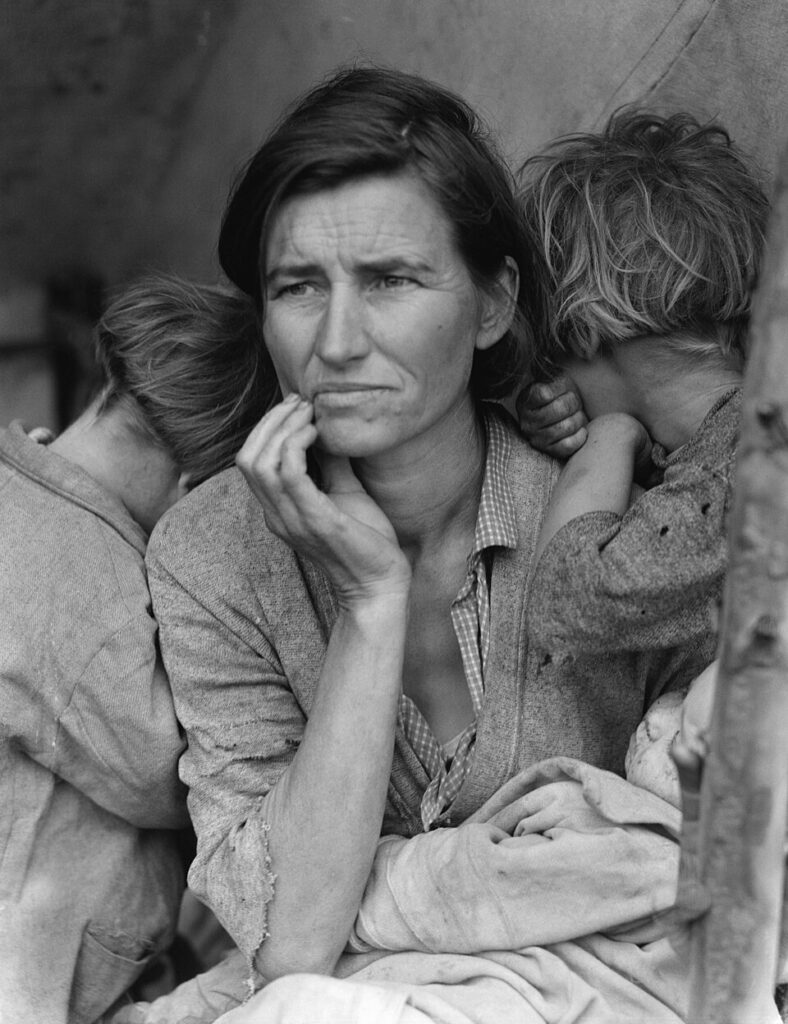
One of the most enduring images of the Great Depression is Dorothea Lange’s 1936 photograph Migrant Mother. The photograph depicts Florence Owens Thompson surrounded by her children after crop failures and economic hardship had left the family living in desperate poverty. The image became one of the defining symbols of the Depression, not because it portrayed neglect, but because it portrayed resilience in the face of extraordinary hardship.
Poverty has always existed. Travel has always existed. Temporary hardship has always existed.
None of those realities automatically transform loving parents into neglectful ones.
That distinction is fundamental to understanding everything that follows in this book.
Children Are Often Taken Before Parents Are Truly Heard
One of the greatest powers exercised by any government is the authority to separate parents from their children. The United States Supreme Court has repeatedly recognized that parents possess a fundamental liberty interest in the care, custody, and control of their children. In the 2000 case Troxel v. Granville, the Supreme Court reaffirmed that the right of parents to direct the upbringing of their children is one of the oldest and most fundamental liberty interests recognized by American law. That principle is important because it reminds us that the relationship between parent and child is not a privilege granted by the government. It is a fundamental right that may be limited only under extraordinary circumstances.
The difficult question is not whether children should be removed from truly dangerous situations. They absolutely should. The question is whether the process used to determine that danger is always fair, accurate, and thorough. Once a report is made to Child Protective Services, events can move remarkably quickly. Interviews are conducted. Reports are written. Recommendations are prepared. Emergency hearings may occur before parents have gathered records, contacted witnesses, or obtained meaningful legal representation. By the time many parents begin defending themselves, the machinery of government has already been set in motion.
This concern has been recognized by courts as well as legal scholars. In Rogers v. County of San Joaquin, decided by the United States Court of Appeals for the Ninth Circuit in 2007, the court concluded that government officials had violated a family’s constitutional rights after children were removed without the emergency circumstances required by law. The court emphasized that separating children from their parents without adequate legal justification is an extraordinary exercise of governmental power and that constitutional protections continue to apply even during child abuse investigations. That decision serves as a reminder that courts themselves have acknowledged that child-protection agencies are capable of making serious mistakes.
The Children’s Bureau, a division of the U.S. Department of Health and Human Services, has likewise emphasized through its Child and Family Services Reviews that one of the primary goals of the child welfare system is that children should be “safely maintained in their homes whenever possible and appropriate.” The federal government does not describe family separation as the preferred outcome. Rather, removal is intended to be the last resort when the child’s safety cannot be ensured through less intrusive means. The same federal review process evaluates whether states make reasonable efforts to preserve families whenever it can be done safely.
Even organizations that strongly support child protection have argued that unnecessary removals should be avoided. Casey Family Programs, one of the nation’s leading child welfare foundations, explains that effective prevention services and family support frequently allow children to remain safely with their parents, reducing the need for foster care altogether. Casey Family Programs notes that most children entering foster care are classified under neglect rather than physical or sexual abuse, a distinction that deserves careful examination because neglect can involve circumstances ranging from severe parental misconduct to conditions heavily influenced by poverty, housing instability, or inadequate access to community resources.
Every parent accused of neglect or abuse deserves a fair opportunity to present evidence before life-changing decisions are made whenever the law allows. Medical records matter. Photographs matter. Witnesses matter. Timelines matter. Context matters. False accusations are not corrected simply because they are false. They are corrected only when someone is willing to examine the evidence carefully enough to discover the truth.
That principle lies at the heart of this book.
I believe that my family’s evidence deserved far more consideration than it received. Whether the reader ultimately agrees with me or not, my hope is that the evidence presented throughout these pages will receive the careful attention that I believe every family deserves before a child is separated from his or her parents.
Is Foster Care Really Safer?
Many people assume that once a child enters foster care, he or she is automatically safer than before. It is an understandable assumption. Foster care exists to protect children who cannot safely remain at home. Thousands of foster parents sacrifice their own time, energy, and financial resources to provide loving homes for children they have never met, and many of those children benefit enormously from that care. Those foster parents deserve respect and gratitude.
The existence of many outstanding foster families, however, does not mean the foster care system is without serious problems. The system is composed of human beings operating under enormous pressure, often with limited resources and overwhelming caseloads. Like any large institution, it succeeds in many cases and fails in others.
The federal government has repeatedly documented those failures. The U.S. Department of Health and Human Services Office of Inspector General reported in 2022 that, in five states it examined, there was no documented evidence that many children who returned to foster care after going missing had received the required screening for possible sex trafficking. The Inspector General warned that these failures increased the risk that vulnerable children could remain unidentified as trafficking victims and recommended stronger oversight and compliance with federal requirements. That report was not issued by critics of the system. It was issued by the federal government itself.
Other failures have received national attention through the courts. In 2023, the Associated Press reported that a federal judge fined the State of Texas $100,000 per day after finding that state officials had repeatedly failed to properly investigate allegations of abuse, neglect, and exploitation occurring within its foster care system. The ruling followed years of litigation and described continuing deficiencies in protecting children who were already in state custody.
Research has also questioned the assumption that removal alone necessarily improves a child’s long-term well-being. A review published in the medical journal Pediatrics observed that hundreds of thousands of children enter foster care each year, most commonly because of neglect, and emphasized that the experience of removal itself can be traumatic. The authors argued that the child welfare system should invest more heavily in strengthening families whenever children can remain safely at home, rather than assuming foster placement is always the superior outcome.
Scholars continue to debate the question. The National Coalition for Child Protection Reform has summarized multiple studies concluding that many children left safely with their own families experienced better long-term outcomes than comparable children who entered foster care. While other researchers disagree with some of the Coalition’s conclusions, the very existence of this debate demonstrates that the question is far more complex than the public often assumes.
None of these facts prove that foster care is inherently harmful. They do demonstrate something important: removing a child from his or her parents should never be viewed as a simple solution. Foster care can save lives. It can also expose children to new forms of trauma, instability, multiple placements, interrupted education, and, in some tragic cases, additional abuse. Because both realities exist, the decision to remove a child should be made only after careful consideration of all available evidence, with constant recognition that every unnecessary separation carries consequences for both the child and the family.
The Foster-Care-to-Trafficking Pipeline
One of the most disturbing subjects in any honest discussion of child protection is the relationship between foster care, missing children, and sex trafficking. This does not mean that every foster home is dangerous, nor does it mean that every child in foster care is trafficked. It means something more specific and harder to ignore: children who are already separated from their families, moved through placements, placed in group homes, or allowed to go missing from state care are among the children most vulnerable to exploitation. Child trafficking is not merely something that happens in foreign countries or in dark alleys far away from respectable institutions. It happens in the United States, and the government itself has acknowledged that children involved with the child welfare system face heightened risks.
The Child Welfare Information Gateway, which is a service of the Children’s Bureau under the U.S. Department of Health and Human Services, states in its bulletin Human Trafficking and Child Welfare: A Guide for Child Welfare Agencies that “children and youth involved with the child welfare system are at heightened risk of experiencing human trafficking.” That sentence alone should disturb every parent in America. It means that the very system presented to the public as a rescue system also contains children whom federal authorities recognize as especially vulnerable to exploitation. The same federal bulletin explains that child welfare agencies must be at the forefront of responding to and preventing trafficking because they are dealing with a population that includes children with histories of abuse, neglect, instability, and exploitation. In other words, the risk is not speculative. It is acknowledged in official government materials.
The U.S. Department of Health and Human Services Office of Inspector General reached similarly troubling conclusions in a 2022 report titled In Five States, There Was No Evidence That Many Children in Foster Care Had a Screening for Sex Trafficking When They Returned After Going Missing. In that report, the Inspector General reviewed case files for children who had gone missing from foster care and later returned. Federal law and state policy required those children to be screened to determine whether they had been victims of sex trafficking. Yet the Inspector General found that in 65 percent of the children reviewed, 268 out of 413, there was no evidence in the case files that the required screening had been performed after the child returned to foster care. The report also found that male children were even less likely to have evidence of screening than female children, with 72 percent of male case files lacking evidence of screening compared with 59 percent of female case files. Those numbers are not rumors. They come from the federal government’s own oversight agency.
Another HHS Office of Inspector General report, State Agencies Can Improve Their Reporting of Children Missing From Foster Care to Law Enforcement for Entry Into the National Crime Information Center Database, examined whether state agencies properly reported missing foster children to law enforcement. The report found that, among a sample of 100 missing-children episodes, 8 were not reported to law enforcement in a timely manner for entry into the National Crime Information Center database, and 6 were never reported to law enforcement for entry into that database. Based on its sample, the Inspector General estimated that during the audit period, state agencies did not report 5,659 missing-children episodes to law enforcement in a timely manner. A child missing from foster care is already in danger. A child missing from foster care who is not promptly and properly reported is placed in even greater danger by bureaucratic failure.
The National Center for Missing and Exploited Children, commonly known as NCMEC, exists precisely because missing children are vulnerable and time matters. On its official “Our Impact” page, NCMEC states that since 1984 it has assisted with the recovery of more than 480,000 cases of missing children. NCMEC also reports that it supported 32,167 missing-child cases in 2025. These numbers reveal the scale of the crisis. They also show why every missing child should be treated with urgency, especially when that child is already under state supervision.
Casey Family Programs, one of the largest and most influential child welfare foundations in the United States, has also addressed this problem. In its publication How Can the Child Welfare System Protect Young People From Commercial Sexual Exploitation?, Casey Family Programs notes that studies show between 70 percent and 90 percent of youth who are victims of sex trafficking are survivors of child sexual abuse. The same publication describes risk factors including emotional or physical abuse, exposure to domestic violence, problems at school, and prior exploitation. These are precisely the kinds of vulnerabilities often present among children who enter the child welfare system. The point is not that foster care creates every trafficking victim. The point is that children who have already been wounded by abuse, instability, poverty, family separation, or institutional failure are exactly the children traffickers look for.
This is why the public should be skeptical whenever the state acts as if removing a child from his or her parents automatically means the child is safer. Sometimes removal saves a child’s life. Sometimes it is necessary. But removal is not magic. It does not erase danger. It may move a child from one danger into another. If the foster care system cannot reliably prevent children from going missing, cannot reliably ensure timely reporting when they do go missing, and cannot reliably document required trafficking screenings when they return, then no honest person should pretend that state custody is automatically safe custody.
A society that truly cares about children should be enraged by this. It should not be controversial to say that a child taken into government custody should receive the highest level of protection. The state claims the authority to remove children from their parents because it claims to be able to protect them. If the state then loses track of those children, fails to report them properly, fails to screen them for trafficking after they return, or places them in environments where further abuse can occur, then the state has not merely failed administratively. It has failed morally.
The “Professional Kidnapper” Incident
Sometimes a single image reveals more about an institution than a thousand official statements. In Arizona, child welfare investigators wore bright pink shirts to work that identified them as “professional kidnappers.” According to the 2020 article “Arizona Child Welfare Investigators Fired for ‘Professional Kidnapper’ T-Shirts,” published by The Imprint, several Arizona county workers who investigated allegations of abuse and neglect were fired after wearing the shirts. The article reported that the back of the shirts asked, “Do you know where your children are?” According to the same reporting, these were not random civilians mocking the system from the outside. They were workers inside the child welfare system, employed in the very field where families can lose their children through government action.
The New York Post also reported on the incident in a July 22, 2020 article titled “Arizona Child Welfare Workers Fired for ‘Professional Kidnapper’ Shirts,” stating that multiple employees of the Arizona Department of Child Safety lost their jobs after wearing shirts that read “Professional kidnapper.” The fact that workers were reportedly fired does not erase the significance of what happened. It confirms that the shirts were considered serious enough to warrant disciplinary action. It also raises a deeper question: what kind of workplace culture makes such a shirt seem funny, clever, or acceptable in the first place? …and if every child welfare worker in the United States had been sent that shirt, how many more would have gleefully worn it?
The phrase “professional kidnapper” is not a harmless joke when worn by people whose job involves investigating families and participating in a process that can lead to the removal of children from their parents. Parents who have lost children to the system often describe the experience as a kidnapping, even when the state insists that it is lawful removal. A child may not understand legal terminology. A child does not necessarily know the difference between a warrant, a dependency petition, an emergency removal, or a court order. A child knows only that strangers came, authority figures intervened, and he or she was taken away from home. For child welfare workers to wear a shirt using that language is not merely tasteless. It is cruel.
The most generous interpretation is that the workers had poor judgment and failed to understand how their joke would appear to grieving families. But even that generous interpretation is damning. Anyone working in child welfare should understand the seriousness of family separation. Anyone whose work may result in a child being removed from a mother or father should carry that authority with humility, not swagger. The job should produce sobriety, not mockery.
The incident matters because it exposes the emotional reality many parents already feel. The official language of the system is filled with terms such as “safety,” “best interests,” “placement,” “services,” and “case plan.” Those words sound clean, bureaucratic, and professional. But for the parents and children experiencing the process, the reality can feel violent and humiliating. A child is taken. A parent is treated as guilty before being heard. The family is told to comply. The system speaks in paperwork while the family experiences trauma.
No one should pretend that a T-shirt proves every child welfare worker is corrupt. It does not. Many workers enter the field because they genuinely want to protect children. Some are overworked, underpaid, and placed in impossible situations by the bureaucracy above them. But the Arizona incident still matters because it reveals that at least some workers could joke about the very fear that haunts parents across the country. It shows that in at least one office, the power to take children from families was treated casually enough to become a slogan.
That should horrify the public. If police officers wore shirts joking that they were “professional home invaders,” people would understand the problem immediately. If prison guards wore shirts joking that they were “professional kidnappers,” the public would recognize the cruelty. When child welfare investigators wear such shirts, the offense is even more intimate because children are involved. The power being joked about is the power to separate a child from his or her family.
For parents who have been falsely accused, that phrase is not a joke. It is the nightmare itself.
When Powerful People Exploit Children
For many Americans, the idea that wealthy, influential, or politically connected individuals could participate in the sexual exploitation of children once sounded like the plot of a crime novel. That perception changed dramatically over the past several decades as a series of criminal investigations exposed abuse committed by people who possessed extraordinary wealth, influence, or public prominence. Whatever one’s political views may be, these cases demonstrate an uncomfortable truth: child exploitation is not confined to impoverished neighborhoods or isolated offenders. It can exist wherever vulnerable children and predatory adults intersect.
Perhaps no modern criminal case has had a greater impact on public confidence than that of Jeffrey Epstein. According to the United States Department of Justice, Epstein was charged in federal court in New York in 2019 with sex trafficking and conspiracy to engage in sex trafficking involving underage girls. Federal prosecutors alleged that he recruited and abused numerous minor victims over many years. Although Epstein died before standing trial on those federal charges, the evidence collected during the investigation, together with earlier criminal proceedings in Florida, transformed public understanding of how influential offenders can evade accountability for years.
The prosecution of Ghislaine Maxwell continued after Epstein’s death. In December 2021, a federal jury found Maxwell guilty on multiple counts related to recruiting and grooming underage girls for Epstein’s sexual abuse. In June 2022, she was sentenced in federal court to twenty years in prison. According to the Department of Justice, the evidence presented at trial showed that Maxwell played a significant role in identifying, grooming, and facilitating the abuse of minor victims. Her conviction demonstrated that the criminal conduct surrounding Epstein was not merely the work of one individual.
The significance of these prosecutions extends far beyond the defendants themselves. They revealed that abuse can continue for years when powerful individuals possess money, influence, respected social circles, and the ability to intimidate or manipulate victims. They also demonstrated that institutions, whether public or private, are not immune from failures of oversight. Journalists, prosecutors, law enforcement officers, and victims themselves have all raised difficult questions about opportunities that may have been missed to stop the abuse much earlier.
The National Center for Missing & Exploited Children has long emphasized that child sexual exploitation takes many forms and frequently involves manipulation rather than obvious physical force. Traffickers often gain a child’s trust through gifts, promises, emotional attention, financial assistance, or false claims of love before exploiting that child. Understanding these methods is important because many people imagine child trafficking as dramatic kidnappings by strangers, when in reality it often involves grooming, deception, and coercion carried out over time.
The lesson from these documented criminal cases is not that every institution is corrupt or that every public official is complicit. Rather, it is that no institution should be considered beyond scrutiny simply because it carries authority or prestige. Healthy skepticism, careful investigation, and accountability are essential whenever children are involved. The protection of children depends not upon blind trust but upon the willingness of citizens, journalists, investigators, and courts to examine evidence wherever it leads.
Public Distrust, Documentaries, and Allegations
Documented criminal cases involving child exploitation have had another consequence beyond the courtroom: they have profoundly affected public trust. As high-profile prosecutions exposed genuine abuse committed by influential individuals, many members of the public began asking broader questions about whether similar crimes had escaped detection elsewhere. Those questions gave rise to documentaries, books, podcasts, investigative projects, independent researchers, and numerous competing theories attempting to explain how abuse can remain hidden for so long.
Some of these works focus primarily on verified criminal cases and institutional failures. Others advance allegations or broader theories that remain disputed or unproven. Readers should recognize the difference. A documentary, a podcast, an interview, or an internet discussion may raise important questions, but it does not by itself establish that every claim it contains is true. Responsible inquiry requires distinguishing documented evidence from unresolved allegations.
One example is the documentary PedoGate, which argues that organized networks of child exploitation have existed within powerful institutions and that these subjects have not received sufficient public attention. Supporters view the film as an effort to encourage further investigation. Critics dispute many of its conclusions and challenge aspects of its evidence. Regardless of where one stands, productions such as this illustrate the degree to which public confidence has been shaken by documented abuse scandals that were once dismissed as unimaginable.
Similarly, public figures have, at various times, made allegations concerning child exploitation among wealthy or influential individuals. Those statements have often generated significant public debate, particularly when the speakers later died or when investigations produced incomplete answers. In some instances, supporters have questioned official accounts of those deaths or argued that important leads were overlooked. Others reject those conclusions and maintain that the available evidence does not support them. These disagreements continue to be discussed in books, documentaries, online forums, and independent media.
The existence of competing narratives makes careful evaluation of evidence more important, not less. Readers should ask basic questions whenever they encounter extraordinary claims. What evidence has been produced? What evidence has been independently verified? What remains uncertain? Which claims have been confirmed through court proceedings or official investigations, and which remain matters of public speculation? Those questions are essential regardless of whether a claim supports or contradicts one’s existing beliefs.
My purpose in discussing these subjects is not to ask the reader to accept every allegation that has ever been made concerning child exploitation. Rather, it is to explain why many parents have become skeptical of institutions that ask for unquestioning trust. The documented criminal convictions of powerful offenders, together with acknowledged failures in various institutions charged with protecting children, have understandably caused many people to scrutinize official narratives more closely than they once did. Whether one ultimately agrees with every theory or rejects most of them, the underlying concern remains the same: children deserve vigilant protection, honest investigations, and institutions that are willing to examine evidence without fear or favoritism.
Stories from Other Families
As I began researching Child Protective Services and dependency courts, I discovered that my family’s experience was not unique. I found thousands of parents describing investigations, emergency removals, lengthy court proceedings, and difficult reunification processes. Their stories varied widely. Some believed Child Protective Services had saved their children from genuine abuse. Others believed that they had been wrongly accused or that poverty, misunderstandings, or procedural errors had led to unnecessary family separation.
The existence of these accounts does not prove that every complaint is valid. Every case has its own facts, and some parents undoubtedly lose custody because their children truly require protection. Nevertheless, the sheer number of families describing similar frustrations deserves attention. It is one reason that child welfare reform has become the subject of continuing discussion among lawmakers, attorneys, judges, researchers, foster parents, former foster youth, and parent advocacy organizations.
The federal Children’s Bureau has acknowledged that child welfare agencies face enormous challenges in balancing child safety with family preservation. The Child Welfare Information Gateway, a service of the U.S. Department of Health and Human Services, explains that one of the central goals of modern child welfare policy is to strengthen families and safely maintain children in their homes whenever possible rather than relying unnecessarily on foster care. This reflects a recognition that family separation itself can be traumatic and that preserving families, when it can be done safely, is generally in the best interests of children.
Researchers have also documented concerns about inconsistency within the child welfare system. In its reports and policy papers, Casey Family Programs has repeatedly argued that many families benefit more from housing assistance, financial support, substance-abuse treatment, mental health services, or parenting assistance than from removing children from their homes. The organization has emphasized that prevention and family preservation should be priorities whenever child safety can be maintained.
The American Bar Association has likewise published extensive material discussing the importance of due process in child welfare proceedings. Attorneys representing parents, children, and the government all play essential roles in ensuring that courts receive complete and accurate information before making decisions that profoundly affect families.
Among the families whose experiences influenced my thinking was that of my friend Daniel Date. According to Dan’s account, after he removed a roommate from his home and changed the locks, the former roommate returned and attempted to enter the residence. Law enforcement became involved and not wanting to go to prison for breaking and entering, the former roommate quickly concocted the lie that he “thought that Dan’s child was in danger” and therefore was trying to force his way into the home. During the incident, Dan states that he was asked to bring his child to the window to demonstrate that the child was safe. Dan responded, “I’ll bring my son to the window!” He further states that his words were misunderstood or misreported when an officer of the law said, “He said he’s going to throw the child out of the window!” According to Dan, the misunderstanding escalated dramatically, his child was removed, and he was forced into a lengthy legal battle to regain custody. I was not present during these events, and I present this account as Dan described it to me, not as an independent finding of fact. It is included because his experience deeply affected the way I came to view the power of false reports, misunderstandings, and rapid government intervention.
Whether one agrees with every family’s interpretation of its own case is ultimately beside the point. A child welfare system worthy of public confidence must welcome scrutiny, acknowledge mistakes when they occur, and continually seek to improve. When parents, former foster youth, attorneys, judges, and researchers all identify recurring concerns, those concerns deserve thoughtful examination rather than dismissal.
The Two Lies Told About My Family
Every dependency case begins somewhere. In my family’s case, I believe it began with two false reports.
According to the information provided to me during the proceedings, one report alleged that I intended to sell my wife and daughter for narcotics on the black market. I categorically deny that allegation. It is completely false.
Another report claimed that my daughter was in danger as we were walking along the train tracks in the middle of California, headed toward our home in Mexico.
I categorically deny the allegation of child endangerment as well.
These two accusations became the foundation upon which the government began examining my family. Because both accusations are false, I also insist that every subsequent decision should have been evaluated with great care rather than accepted at face value.
At the time, my wife and daughter were Mexican citizens, and we were traveling back to our home in Mexico after our vehicle became inoperable in the United States. We were not abandoning our daughter. We were not trafficking our daughter. We were not attempting to disappear with our daughter. We were trying to return home.
Throughout this book I will present the evidence that led me to conclude that these accusations were unfounded. That evidence includes photographs, videos, medical records, travel records, timelines, and other documents that I believe provide important context for understanding our circumstances. Some evidence, such as video files, are provided at JohnAlanMartinson.com or where this book is sold in digital format.
I recognize that allegations alone do not establish the truth, whether those allegations are made by a government agency or by a parent defending himself. That is precisely why evidence matters. Readers should not accept my conclusions simply because I state them. They should examine the evidence presented throughout this book and decide for themselves whether the accusations accurately reflected my family’s circumstances.
My purpose is not to ask for blind agreement. My purpose is to place before the reader the same evidence that I believe should have received careful consideration from the beginning.
Why This Book Exists
This book exists because I believe that my family’s story deserves to be examined carefully, thoroughly, and honestly.
Court hearings are necessarily limited by time. Judges manage crowded dockets. Attorneys represent many clients. Social workers manage large caseloads. Those realities do not necessarily reflect bad intentions, but they do mean that important facts can sometimes receive less attention than they deserve.
A book has no such limitation.
Within these pages I can present a complete chronology rather than a brief summary. I can include photographs that capture what our daily lives actually looked like. I can present medical records, correspondence, public records, timelines, witness accounts, and other documents that would be difficult to communicate during a brief hearing. Rather than relying upon isolated statements or fragmented recollections, readers will have the opportunity to evaluate the evidence in its broader context.
I do not ask the reader to believe me simply because I am the author. I ask only that the evidence be considered fairly. Whenever I describe events that I personally witnessed, I will identify them as my own experiences. Whenever I rely upon government reports, court decisions, news reporting, or academic research, I will identify those sources within the text so that readers can evaluate them independently.
The purpose of this book is not to attack every social worker, every foster parent, every attorney, or every judge. Many people working within the child welfare system entered those professions because they sincerely wanted to protect children. My purpose is narrower and more specific: to document what happened to my family as accurately as I can, to compare that experience with publicly available evidence about the child welfare system, and to encourage thoughtful discussion about how children can be protected while also respecting the rights of innocent families.
If this book encourages readers to ask difficult questions, to examine evidence carefully, and to insist that both child safety and due process remain central to the administration of justice, then it will have accomplished its purpose.
Sharing this post this friends and family, or purchasing a copy of this book will help bring our daughter home.
About the Author