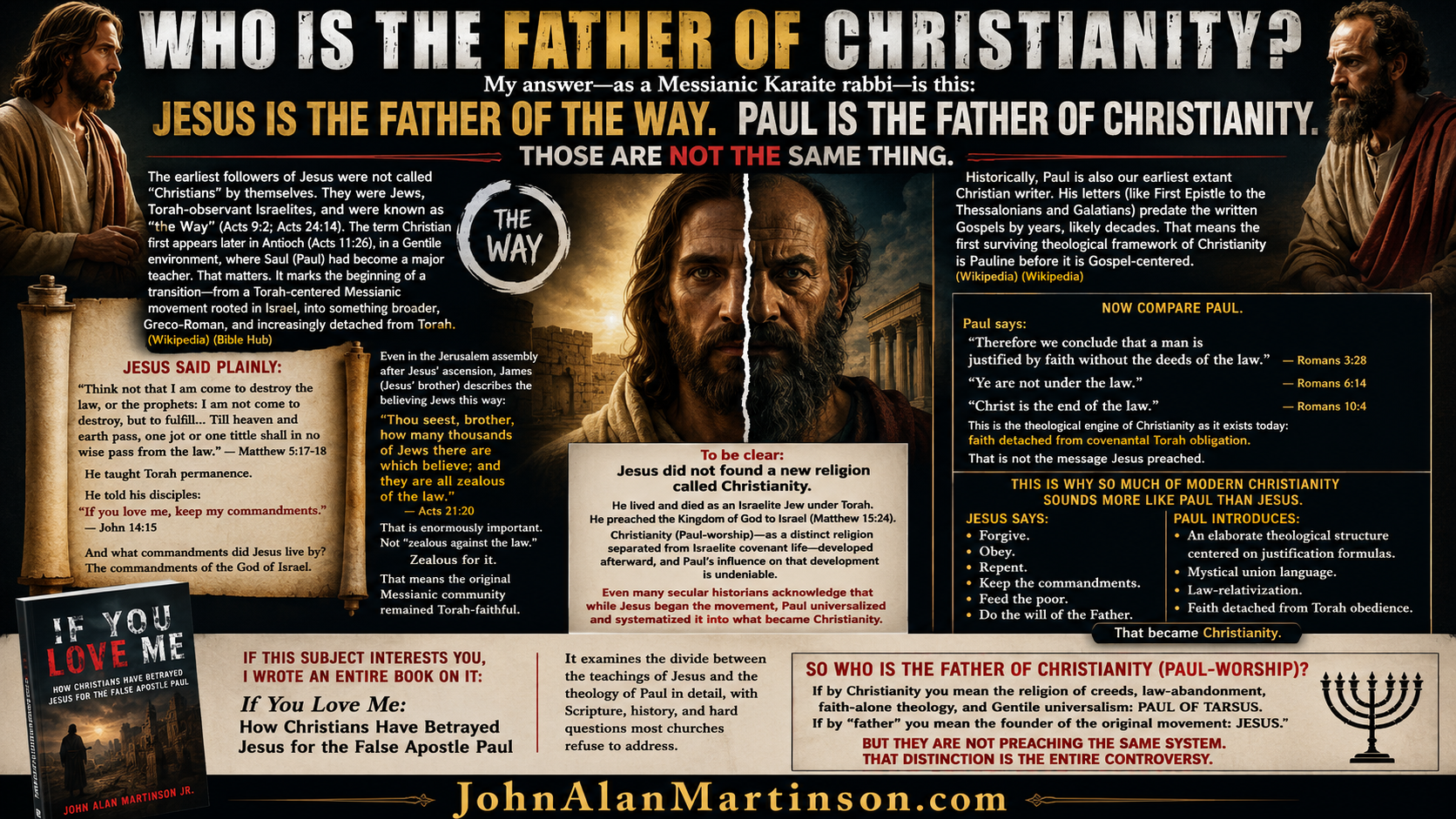
If the question is “Who is the father of Christianity?”, my answer—as a Messianic Karaite Jew—is this:
Jesus is the father of the Way. Paul is the father of Christianity.
Those are not the same thing.
The earliest followers of Jesus were not called “Christians” by themselves. They were Jews, Torah-observant Israelites, and were known as “the Way” (Acts 9:2; Acts 24:14). The term Christian first appears later in Antioch (Acts 11:26), in a Gentile environment, where Saul (Paul) had become a major teacher. That matters. It marks the beginning of a transition—from a Torah-centered Messianic movement rooted in Israel, into something broader, Greco-Roman, and increasingly detached from Torah. (Wikipedia) (Bible Hub)
Jesus said plainly:
“Think not that I am come to destroy the law, or the prophets: I am not come to destroy, but to fulfill… Till heaven and earth pass, one jot or one tittle shall in no wise pass from the law.” — Matthew 5:17–18
That is unambiguous.
He taught Torah permanence.
He told his disciples:
“If you love me, keep my commandments.” — John 14:15
And what commandments did Jesus live by? The commandments of the God of Israel.
Now compare Paul.
Paul says:
“Therefore we conclude that a man is justified by faith without the deeds of the law.” — Romans 3:28
And:
“Ye are not under the law.” — Romans 6:14
And:
“Christ is the end of the law.” — Romans 10:4
This is the theological engine of Christianity as it exists today: faith detached from covenantal Torah obligation.
That is not the message Jesus preached.
Even in the Jerusalem assembly after Jesus’ ascension, James (Jesus’ brother) describes the believing Jews this way:
“Thou seest, brother, how many thousands of Jews there are which believe; and they are all zealous of the law.” — Acts 21:20
That is enormously important.
Not “zealous against the law.”
Zealous for it.
That means the original Messianic community remained Torah-faithful.
Historically, Paul is also our earliest extant Christian writer. His letters (like First Epistle to the Thessalonians and Galatians) predate the written Gospels by years, likely decades. That means the first surviving theological framework of Christianity is Pauline before it is Gospel-centered. (Wikipedia) (Wikipedia)
This is why so much of modern Christianity sounds more like Paul than Jesus.
Jesus says:
- Forgive.
- Obey.
- Repent.
- Keep the commandments.
- Feed the poor.
- Do the will of the Father.
Paul introduces an elaborate theological structure centered on justification formulas, mystical union language, and law-relativization.
That became Christianity.
To be clear: Jesus did not found a new religion called Christianity.
He lived and died as an Israelite Jew under Torah.
He preached the Kingdom of God to Israel (Matthew 15:24).
Christianity (Paul-worship)—as a distinct religion separated from Israelite covenant life—developed afterward, and Paul’s influence on that development is undeniable.
Even many secular historians acknowledge that while Jesus began the movement, Paul universalized and systematized it into what became Christianity.
So who is the father of Christianity (Paul-worship)?
If by Christianity you mean the religion of creeds, law-abandonment, faith-alone theology, and Gentile universalism:
Paul of Tarsus.
If by “father” you mean the founder of the original movement:
Jesus.
But they are not preaching the same system.
That distinction is the entire controversy.
If this subject interests you, I wrote an entire book on it:
If You Love Me: How Christians Have Betrayed Jesus for the False Apostle Paul
It examines the divide between the teachings of Jesus and the theology of Paul in detail, with Scripture, history, and hard questions most churches refuse to address.
About the Author