🕯️INTRODUCTION
What is Gloria Nocturna?
Gloria Nocturna is an 18th-century dark fantasy tabletop role-playing game in which players take on the roles of men and women belonging to a religious military order. Their mission is to wage holy war against the forces of death, wickedness, and chaos in a world where haunted forests, pagan corruption, and alien darkness press in from every side. The Game Master (GM) serves as the chief storyteller—using the outcomes of twelve-sided dice rolls to decide how events unfold—while the other players embody the soldiers, prophets, assassins, priests, and other specialists who carry out the order’s work.
Any TTRPG ruleset can be used to play Gloria Nocturna, however, this book uses Jack’s Cinematic d12 (JCd12) to resolve all actions.
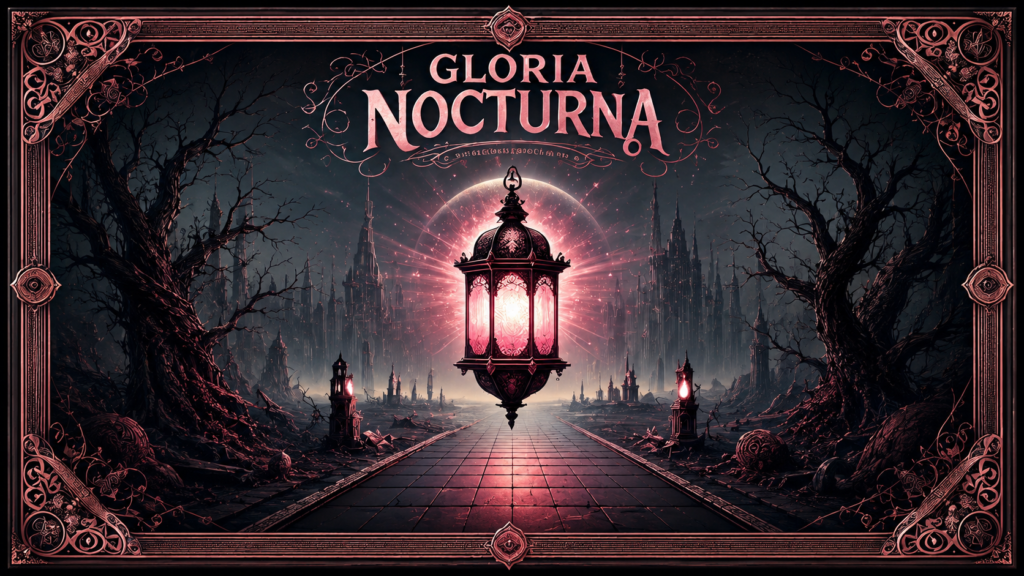
The setting is a brooding gothic world without oceans, only sprawling forests, lakes and rivers. The Kingdom of Eldoria and its rivals struggle for dominance while vampires, goblins, hags, trolls, and stranger horrors spread their influence. The Gloom—an unnatural darkness—seeps into every corner of the land, birthing monsters, empowering sorcerers, and drawing humanity toward despair. Villages vanish overnight, ancient ruins bleed corruption into the earth, and no traveler can be certain what awaits beyond the treeline. Within this world, the Black Order stands as a bulwark, taking contracts as town watch, mercenaries, investigators, or bodyguards, depending on what each mission demands.
Because Gloria Nocturna is built around playing members of a holy order, the game naturally brushes against the kinds of controversies that always follow religion. The ancient Israelite world, from which the fictional faith draws inspiration, was full of difficult and often unsettling ideas—circumcision, animal sacrifice, extreme tests of loyalty, harsh punishments, the conquest of enemies, the practice of polygyny, rewarding women as spoils of war, and genocide are among them. These are part of the texture of the setting, though not always emphasized in play. Any controversies from ancient Israelite religion—such as dietary laws or animal sacrifice—may appear in a Gloria Nocturna adventure at the discretion of the Game Master and players. The group must decide for themselves how deeply they wish to engage with religious controversies in their campaigns, and how prominently such themes will shape their stories. The faith of the Black Order is not a replica of real-world belief, but a fictionalized version of ancient Judaism shaped for a world of gothic horror.
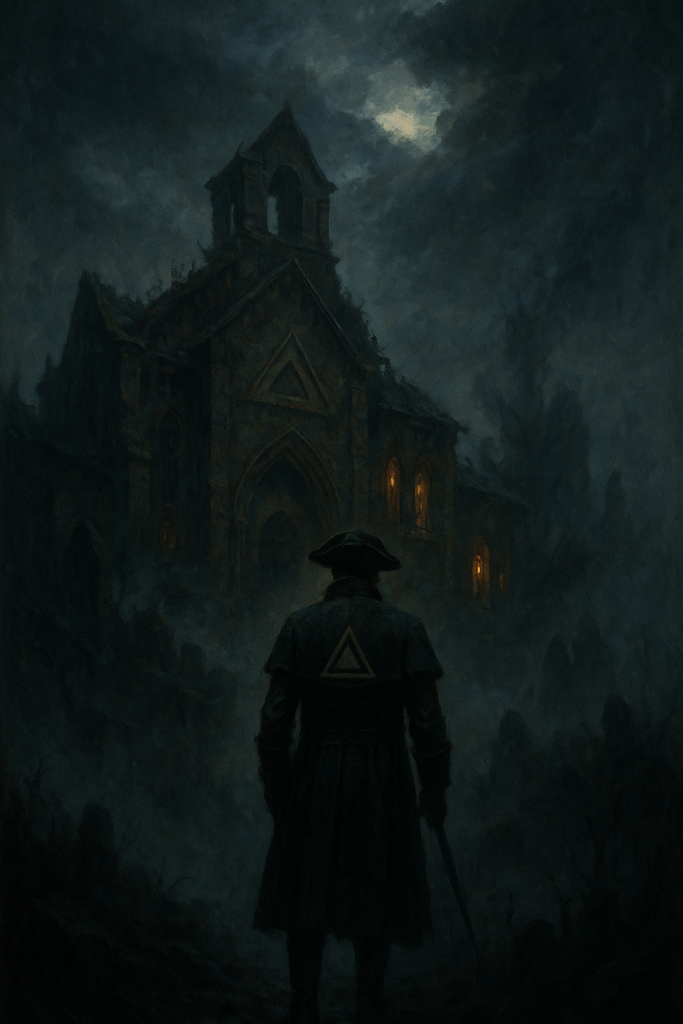
It is important to note that Gloria Nocturna is not intended to serve as a Bible study session, a sermon, or an invitation to debate religion. It is, first and foremost, a game of gothic horror and dark adventure. Religion here provides a framework for role-playing holy warriors in a dangerous and morally complex world, not a platform for theological argument.
Likewise, the Kingdom of Eldoria is loosely inspired by the United States. This connection is made intentionally clear in some respects while remaining entirely fictional and fantastical in others. For instance, Eldoria’s colors are red, white, and blue, yet its capital city is Luminara not Washington. Many world details are purposefully left undefined to signal that large-scale politics, geography, and history are secondary to the players’ immediate experiences. Game Masters may invent such elements as needed. The design philosophy mirrors stories like The Princess Bride—where broad context fades into the background, allowing the focus to remain on the personal journeys and adventures of a few memorable characters.
At its heart, Gloria Nocturna is about choice, consequence, and survival in a land where candlelight barely pushes back the shadows. Whether new to role-playing or a seasoned veteran, players are invited to step into this dark fantasy realm where every mission feels like an 18th-century tale of intrigue and terror—where every story leaves its mark, and the Gloom is always watching.
What Is a TTRPG?
A Tabletop Role-Playing Game—often shortened to TTRPG—is part storytelling, part strategy, and part shared imagination. It is not a video game, not a board game, and not a scripted performance, though it borrows something from each. A TTRPG is a conversation shaped by rules, dice, and imagination—a story built together by everyone at the table.
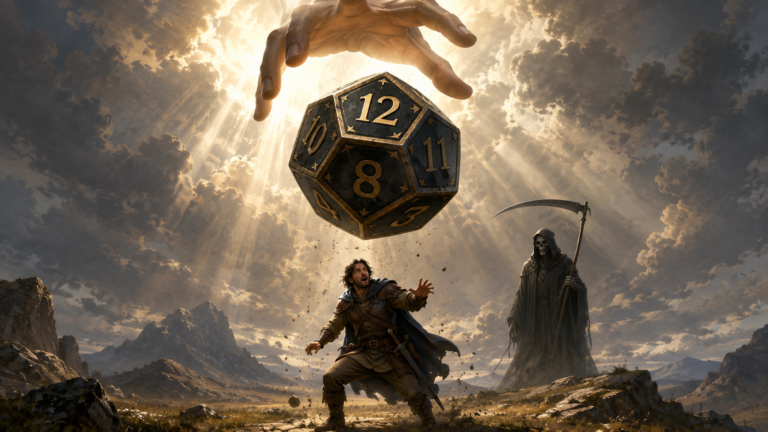
At its simplest, one person serves as the Game Master (or GM), describing the world, playing the roles of its inhabitants, and presenting challenges. The other players each control a single character—a hero, soldier, scholar, or wanderer—who lives in that world. The GM describes what’s happening: a crumbling monastery cloaked in fog, a merchant begging for help, the howl of something unseen in the trees. The players respond by declaring what their characters do: perhaps they investigate, pray, hide, or draw their weapons. When the outcome of an action is uncertain, dice are rolled to decide success or failure.
The results are interpreted through story, not spreadsheets. If you leap across a rooftop and roll well, you might land safely and impress onlookers. Roll poorly, and you may crash through the tiles, discover something hidden below, or injure yourself. The dice provide uncertainty; the players and GM provide meaning.
Unlike most games, there is no single “winner.” The goal is to experience a living story. Sometimes the group succeeds through courage and cleverness; sometimes they fail spectacularly—but even failure can make the story richer. Every session feels like writing a chapter of a novel together, with the dice deciding the twists.
There are many ways to play, ranging from pure imagination to full tabletop immersion:
- Theater of the Mind: Nothing is needed but your voices and imagination. The GM describes the scene, players respond in character, and everything unfolds in conversation. This is the purest and oldest form of role-playing—perfect for storytelling and drama.
- Sketch and Tokens: Many groups like a simple hand-drawn map on paper or a whiteboard, with coins, tokens, or miniatures representing characters and monsters. It keeps positioning clear while preserving imagination.
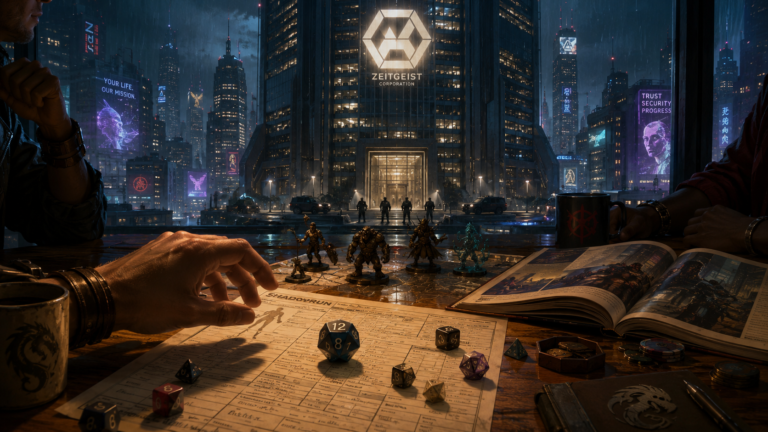
- Full Table Experience: Some tables embrace the spectacle—detailed maps, painted miniatures, terrain pieces, candles, soundtracks, even projected visuals. These tools don’t change the rules; they just make the world feel tangible. The more physical detail, the more cinematic the experience.
No matter the setup, the magic of a TTRPG lies in collaboration. Players describe their actions and choices; the GM reacts and weaves the consequences. Everyone builds the world together through imagination and emotion, guided by a simple set of rules. When played well, it feels less like a game and more like shared storytelling—part play, part dream, and part exploration of what courage, fear, and hope look like in the face of darkness. That is the heart of Gloria Nocturna: not rolling dice to win, but stepping into the candlelit world and asking, what would I do if this were real?
What You Need to Play?
At its heart, Gloria Nocturna is intentionally minimalist. To begin, each participant needs a 1d12 (twelve-sided die) and a Character Bible for recording details about their character, and an imagination ready to bring this gothic world to life. Character Bibles—printed or digital—are essential for tracking not only skills and Attribute Ratings, but also elements like vows, traumas, and moral convictions. The Game Master guides the session. Their role is to describe the setting, embody non-player characters, and manage tension.
A group of three to six players plus one GM is ideal, though larger or smaller groups are possible. Each player controls a protagonist in the story, shaping events through decisions and risks that echo across the campaign.
Though not required, props and tools add to the immersion. A whiteboard or chalkboard can track the time of day, objectives, or lingering effects. Index cards or scraps of parchment can be handed out as in-world letters, contracts, or cryptic clues. Players may want a sketchpad or blank notebook for maps, plans, or notes, while tokens, miniatures, or even coins can mark positions during tactical encounters.
Game Masters are encouraged to prepare handouts—such as mission orders from the Black Order, wanted posters of heretics, or copies of battlefield maps. These props enrich the world and give players something tangible to hold. In truth, creativity doesn’t need to be expensive. Even simple items—a candle on the table, a scrawled note, a token moved across paper—can pull everyone deeper into the setting.
Ultimately, the most important tools are not physical at all. What drives Gloria Nocturna is imagination, courage, and a willingness to enter a world where candlelight falters, shadows breathe, and the fate of nations can rest on a whispered word or a single blade stroke. With these, Gloria Nocturna becomes more than rules—it becomes an experience.
Additional Books Required
One of the most distinctive design choices behind Gloria Nocturna is that this book intentionally does not contain the game’s equipment lists or spell descriptions. Rather than forcing everyone at the table to share a single massive rulebook, the core rules have been divided into separate volumes that can be used simultaneously.
This approach keeps the game moving. While one player is looking up combat rules, conditions, or available actions in Gloria Nocturna, another player can browse weapons, armor, tools, mounts, and trade goods in Mercatus et Commercium Sylvae, while a spellcaster searches for a spell in Codex Arcanum. The Game Master likewise has immediate access to the book they need without waiting for another player to finish using it. The result is less downtime, fewer interruptions, and a smoother experience for everyone at the table. The Codex Arcanum serves as the universal spellbook for compatible games: Gloria Nocturna, No Quarter, and other game worlds, the adaptation of Shadowrun to Jack’s Cinematic d12 (JCd12). Players who enjoy multiple JCd12 games can learn a single spell format and reference system that carries across all three settings.
There are seven core books:
- Gloria Nocturna — The Player’s Handbook containing the core rules.
- Mercatus et Commercium Sylvae — Equipment, trade, commerce, services, and the economy.
- Codex Arcanum — The complete spellbook for Gloria Nocturna, No Quarter, and other game worlds.
- Codex Monstrorum Arcanum — The Monster Manual for Game Masters.
- Sylva — The world book covering the history, geography, cultures, factions, religions, and lore of the setting for Game Masters, but an optional book for players.
- Outpost Ravenholm — The Game Master’s Guide and introductory campaign setting featuring missions for characters Level 0 – 1.
- Codex Fraternitatis — The membership manual of the Black Order and an expansion to the Player’s Handbook, a must have for Game Masters and players who want an accurate portrayal of the valiant religious military order.
Players who do not create spellcasters generally need only Gloria Nocturna and Mercatus et Commercium Sylvae, though all players are encouraged to read Codex Fraternitatis to better understand the beliefs, traditions, duties, and expectations of members of the Black Order.
With these seven books, Game Masters have everything needed to create original adventures of their own. Those who prefer published content can instead run official adventure books, which carry characters from approximately Level 2 through Level 5 before leading into advanced campaigns and end-game adventures.
What Gameplay Should Feel Like?
Playing Gloria Nocturna should feel like stepping into a painting of the late 18th century—a world of oil lanterns and creeping fog, faith and fear, civilization and wilderness. The goal is not to drown in arithmetic or wade through endless tables, but to breathe life into a gothic world filled with danger, mystery, and emotion. Gloria Nocturna favors story over statistics—decisions, not decimals. The rules exist to serve the moment, not to slow it down, and players are encouraged to act boldly rather than pause to calculate every fraction of advantage.
The Game Master serves as narrator and world-builder, describing not just what happens, but how it feels. A tavern should smell of smoke and rain; a temple should echo with dripping water and fading hymns. Players, in turn, respond not only with actions but with tone and detail: the soldier who kicks open a door in anger, the priest who crosses himself before entering a crypt, the scholar who hesitates before reading a forbidden name aloud.
The world of Gloria Nocturna exists in a constant tension between 🌿Tranquility and the 🪱Gloom.
- 🌿Tranquility is not merely comfort or calm—it is the natural harmony that arises when humanity lives according to divine order. It manifests when people act uprightly, pursue justice, and honor the architect of creation. In such places, goodness has a measurable presence, and even the air seems lighter. Just as righteous deeds—or mitzvot—are said to influence the world for the better, so too does virtue shape the environment . When Tranquility is strong, the land itself reflects it: gardens flourish, the stars shine clearly, and wondrous beings of light—creatures reminiscent of an Edenic age long forgotten—may appear. The higher the Tranquility, the closer the world feels to what it was meant to be: peaceful and beautiful.
- 🪱️The Gloom (Arafel) is alien darkness, not mere shadow; it is a living corruption, an otherworldly blight that seeps into the world wherever righteousness weakens. It feeds upon despair, deceit, and cruelty, swelling in strength as faith and conscience decay. When men and women turn against what is good, their wickedness becomes nourishment for the Gloom, thickening its hold on both land and soul. Entire villages may grow dim and joyless under its influence, their people moving like sleepwalkers through a fog of moral decay. Yet the Gloom is not a passive force—it hungers. It whispers to the weary and tempts the proud, promising power, comfort, or revenge. Its influence seeps into thoughts, urging compromise and corruption one small choice at a time. The more one gives in, the more the Gloom gathers around them, until it becomes hard to tell where the person ends and the darkness begins. In scenes touched by the Gloom, the air itself feels heavier. Lanterns dim without reason. The wind carries voices that should not exist. Shadows stretch too far and cling too long. Horror is not born of mere gore or cheap spectacle, but of quiet realization—the dread that the world is unraveling because humanity itself has invited an unnatural darkness in.
Game Masters are encouraged to make every session feel like it belongs to that age. Immerse yourself in the history and imagery of the 1700s—read about colonial life, candle-making, muskets, and powdered wigs. Watch films set in the 18th century, and especially explore the Townsends YouTube channel, which recreates everyday life of the era with remarkable authenticity. Their videos—on food, clothing, travel, and craftsmanship—can help you picture the texture of Eldoria’s world: the creak of wagon wheels, the smell of tallow candles, the weight of wool cloaks in the rain.
For visual and emotional inspiration, look to works that capture both the elegance and raw emotion of that period. The music video for “Everywhere” by Fleetwood Mac, sung by Christine McVie, is a beautiful example of 18th-century imagery reimagined through modern eyes. Its pastoral settings, flowing garments, and luminous warmth evoke a sense of romantic idealism—a glimpse of what the world might look like when Tranquility is strong. It shows that the beauty of the age can still be felt in our time, if one knows how to look for it.
Likewise, the film The Patriot (starring Mel Gibson and Heath Ledger) provides valuable reference for atmosphere, costume, and the emotional stakes of 18th-century life. The movie’s portrayal of muddy battlefields, candlelit homes, and the moral cost of war mirrors the contrasts central to Gloria Nocturna—honor and horror, order and chaos, faith and vengeance. Watching it can help Game Masters visualize the grounded realism and human emotion that should pulse through every scene of their campaigns.
Combat, when it comes, should feel desperate and cinematic rather than mechanical. Duels in muddy streets, black powder smoke filling the air—these are the moments when fear and courage meet. The rules exist to guide the story, not to interrupt it. Each roll of the dice should heighten tension, not slow it down.
And horror—true horror—is about tone, not volume. Let the unnatural feel inevitable but unseen. Use restraint. A single bloodstain on a wall can say more than a field of corpses. The longer the players go without seeing the creature, the more real it becomes in their minds.
Every session is a dance between light and dark, faith and despair, beauty and decay. The Game Master and players shape the world together through description, imagination, and emotional truth. Whether you play with only your voices and a few dice, or with detailed maps, oil lamps, and miniatures arranged across the table, the purpose is the same: to create a story that feels real enough to touch.
If you allow yourself to lean into the history, the music, and the emotion—the scent of gunpowder, the creak of old floorboards, the shimmer of lamplight on steel—you’ll find yourself transported. That is what Gloria Nocturna feels like: not just a game, but a haunting dream that began in the year 1776.
Read Ephraim Hale’s letter to his mother after leaving Outpost Ravenholm.
Learn about Attributes next.
Purchase a digital copy of Gloria Nocturna: Player’s Handbook or keep reading for free.