Unlike non-player characters , player characters are composed of 💪12 Attributes, 🌈5 Attribute PRISMs, and 🛠24 Skills. Players first determine their character’s 💪Attribute Ratings during Character Creation and then determine the value of each 🌈Attribute PRISM based upon the average ratings of various combinations of attributes within each 🌈Attribute PRISM. 💪Attributes were created with the idea that the number of attributes should be robust enough to provide a nuanced picture of what the character is like at a glance, in combat and in social interactions.
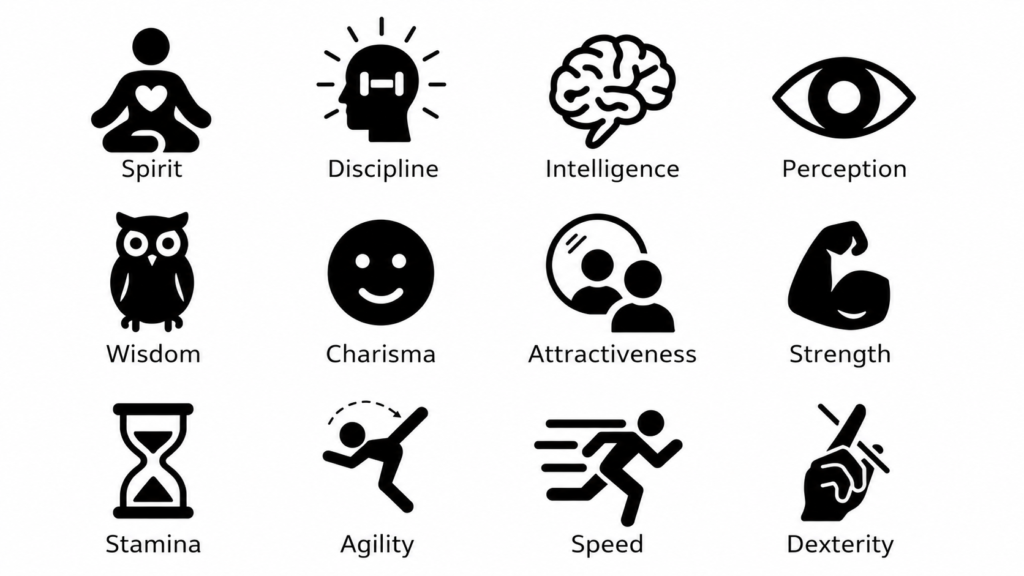
12 Attributes
A brief explanation of each Attribute is as follows:
` 🌬Spirit – metaphysical condition of the soul, connection to the spiritual aspect of the world
Discipline – mental fortitude, resistance to manipulation and mental attacks, ability to withstand the effects of injury, acting as armor against mental trauma
Intelligence – mental aptitude, problem solving
Perception – attention to detail, awareness of surroundings and ability to gather information through the senses
Wisdom – common sense, application of real-world knowledge and experience, ability to discern the truth
Charisma – charm, personal magnetism
Attractiveness – physical attractiveness
Strength – feats of strength, unarmed combat damage
Stamina – ability to sustain physical activity
Agility – acrobatic maneuvers, jumping, leaping dodging
Speed – movement speed
Dexterity – fine motor skills, delicate and precise movement of hands and fingers
💪Attribute Ratings
Attribute Ratings range from -3 to +8, with 0 representing the human average. Ratings of +1 and +2 indicate notable talent or training, while +3 and +4 mark the level of professional excellence or elite conditioning. A rating of +4 reflects the peak of human achievement—the world’s strongest soldiers, most disciplined monks, or most brilliant thinkers. +3 or +4 are exceedingly rare, reserved for the truly extraordinary or the divinely blessed. A negative rating indicates weakness, and there is no rating below -3 to indicate that the person simply doesn’t have the skill at all. Characters begin play with Attribute Ratings based on their generation method and any modifiers from Human Type, Gender. Over time, characters may raise these values, but only through investing Experience Points. When attempting an action that calls upon raw talent or physical capacity, the Game Master may request an Attribute Test rather than a Skill Test.
💪ATTRIBUTE TEST
Roll: 1d12 + Attribute Rating
Goal: meet or exceed a Realism Target Number usually between 7 and 12
Note: Attribute Tests represent untrained effort—no skill bonuses or external advantages apply.
💪Attribute Defense Test
Not every challenge is an attempt to accomplish something. Sometimes the character is not trying to act upon the world—they are trying to resist the world acting upon them. In such situations, the Game Master may call for an 💪Attribute Defense Test.
An 💪Attribute Defense Test represents a character’s ability to withstand, endure, resist, avoid, or overcome an unwanted effect. This may include resisting fear, enduring pain, avoiding disease, shrugging off fatigue, maintaining concentration, resisting supernatural influence, enduring harsh environmental conditions, avoiding being knocked prone, resisting torture, surviving poison, or maintaining self-control under extreme pressure. Unlike an Attribute Test, which represents active effort, an 💪Attribute Defense Test represents a defensive response. The character is reacting to a threat rather than initiating an action.
💪ATTRIBUTE DEFENSE TEST
Roll 1d12 + Attribute Rating + Trained Attribute Bonus.
The goal is to meet or exceed the Defense Target Number assigned by the Game Master.
The Defense Target Number is typically determined by the severity of the threat. Minor effects may require a Target Number of 7, while powerful supernatural effects, deadly toxins, or overwhelming circumstances may require Target Numbers of 10, 12, or higher.
A character only adds a Trained Attribute Bonus (TAB) when that character has training in the Attribute being tested. For example, the Infantry Class has a TAB in Strength, Stamina, Discipline, and Perception. If an Infantry character has Strength +1 and must make a Strength Defense Test, he rolls 1d12 +1 for Strength and +1 for his TAB.
Different threats call upon different Attributes. The most appropriate Attribute is always determined by the Game Master based upon the nature of the danger. A Spirit Defense Test may be used to resist possession, curses, spiritual corruption, or soul-draining effects. A Discipline Defense Test may be used to resist intimidation, mental manipulation, pain, or loss of concentration. An Intelligence Defense Test may be used to resist confusion, deceptive information, or faulty reasoning. A Perception Defense Test may be used to notice hidden dangers, detect ambushes, or identify subtle environmental threats.
A Wisdom Defense Test may be used to resist temptation, discern truth from deception, or avoid reckless decisions under pressure. A Charisma Defense Test may be used to maintain confidence, resist humiliation, or preserve composure before a crowd. An Attractiveness Defense Test is rarely used, but may apply when physical appearance directly influences a social or supernatural effect.
A Strength Defense Test may be used to resist being pushed, dragged, restrained, or physically overpowered. A Stamina Defense Test may be used to resist poison, disease, exhaustion, extreme temperatures, or bodily collapse. An Agility Defense Test may be used to avoid falling, keep balance, or react to sudden hazards. A Speed Defense Test may be used to escape collapsing structures, outrun environmental dangers, or avoid being overtaken by a threat. A Dexterity Defense Test may be used to avoid dropping an item, keep steady hands, or maintain precise control while under pressure.
💪Attribute Defense Tests are intended to be simple, fast, and intuitive. Whenever a character must resist an unwanted effect and no Skill is directly applicable, the Game Master should select the most appropriate Attribute and call for an 💪Attribute Defense Test.
🌬️Spirit SPI – Attribute
🌬️Spirit (Ruach) represents the spiritual aspect of a person’s Nephesh (Soul)—the total living soul composed of both the physical vessel and the unseen essence that gives it life. Every human is a Nephesh, a complete being of body and spirit. The body acts in the physical world, while the spirit exists simultaneously upon the unseen, astral plane. Spirit measures the purity, resilience, and divine vitality of that inner self. It governs how a character endures despair, corruption, and supernatural influence, and how they channel sacred power or resist the 🪱Gloom’s 🍎Temptations. Spirit is the thread that connects mortal existence to higher realities.
Most significantly, 🌬Spirit determines whether or not a character can use magic and what schools of magic they can learn from. Those with low Spirit ratings lack the capacity to safely channel or contain mystical forces, while those with strong, refined spirits can call upon miracles, incantations, or divine manifestations without their Nephesh (Soul) fracturing under the strain.
A person’s spirit manifests on the astral plane as a childlike creature that perfectly embodies their essence. The condition of this innocent form mirrors the state of the soul—it may appear radiant and whole, or frail and trembling, depending on the person’s faith, discipline, and purity. The manifestation of the 🌬Spirit (Ruach) as a visible entity—either in the astral or physical planes—is referred to as the 🦖Animus.
🎬Example — 🌬Spirit (💪Attribute Defense Test)
As the cursed tomb door creaks open, a blast of ancient necromantic energy erupts outward, threatening to overwhelm the minds of those who step too close. The Game Master calls for a Spirit 💪Attribute Defense Test as the characters are struck by a wave of malevolent force meant to bind their souls in place. One of the characters, Oscar, is a weathered scavenger with no formal magical training, standing directly in the path of the surge. As an atheist, he lacks spells or ritual understanding; his 🌬️Spirit Rating alone determines whether his inner self is strong enough to resist the enchantment. Oscar has 🌬️Spirit Rating 0. The Game Master sets the Target Number (TN) at 12, representing the power of the ancient curse. Oscar’s player rolls 1d12 and comes up with an 11— he adds 0 for his 🌬️Spirit attribute, so the total is 11. Oscar narrowly fails. The energy seizes his mind like a vice; he drops to his knees, eyes glazed and lips trembling, momentarily bound by the restless dead that linger in the tomb.
An Evil Soul
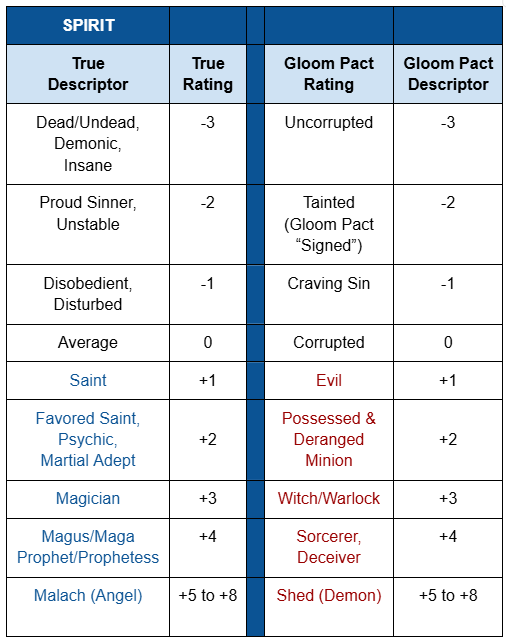
An evil entity, by its very nature, possesses a true 🌬Spirit rating only between -3 to -1, for the inner childlike essence has already been corrupted or worse. When such a being displays greater power—appearing to have a 🌬Spirit Rating of 0 or even higher—it is not the genuine vitality of its soul but rather a hollow shell “filled in” or distorted by the 🪱Gloom (Arafel) or some other dark supernatural force. The undead are the starkest example: their true 🌬Spirit is always -3, for they have no living essence at all, and are not in fact complete “souls” any longer—keeping in mind that a Nephesh (Soul) must consist both a body and a spirit. Yet they may simultaneously function with a 🌬Spirit Rating, such as -3 for a zombie—a husk animated by the 🪱Gloom—or even +4 for a vampire lord, whose terrifying aura comes not from their own spirit but from the malign power sustaining them. In such cases, what appears strong is only an unnatural projection; the authentic Nephesh is fully possessed by something else, or has been destroyed in the Second Death.
To exist in the physical world requires having both a functioning body and a spirit. If the body is no longer usable as a vehicle, the spirit still exists in the afterlife—which is the astral plane or other spiritual dimension. However, if the spirit is destroyed the person is both physically dead—which is called the first death—and they have been destroyed in the Second Death.
You Are the Nephesh “Monster”
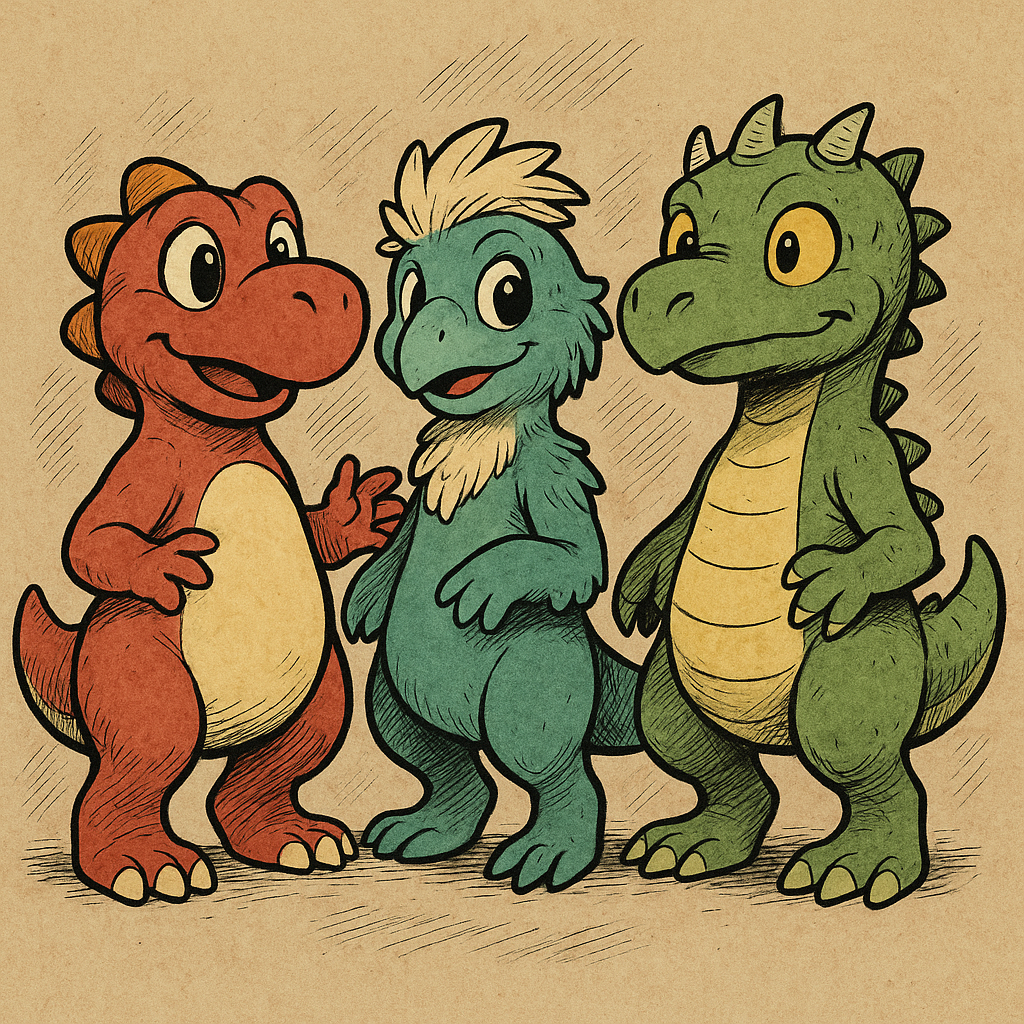
Every person is a Nephesh (Soul) and you are both a material and spiritual entity. This is not just a theological footnote—it’s part of the operating system of every player character. In Hebrew, nephesh (נֶפֶשׁ) is the life-self: the living person, the breath in the throat, the appetite, the “me.” The Tanakh consistently uses it this way: humans are a living Nephesh and animals are called nephesh chayah (“living beings”). Rabbis often stress that Nephesh means a living creature, not simply a ghost trapped in a body. Your Spirit isn’t a separate passenger—it’s the animating force (spirit), and the vehicle (body), and without either you would not be a Nephesh (Soul). You do not have a Soul (Nephesh), you are a Soul—which is a body animated by a spirit.
On the astral plane, the spiritual aspect of the Nephesh (Soul) appears as a creature with childlike proportions and disarming charm. The astral or spirit portion of a Nephesh (Soul) is referred to as “🌬Ruach (Spirit)” or “animating spirit”—but make no mistake, it is you—it is not something that you have, it is something that you are. When the 🌬Spirit is visible it is called the 🦖Animus. The 🦖Animus of every intelligent humanoid entity roughly has the same proportions or overall shape, but—much like the uniqueness of human bodies—each 🦖Animus is unique in its particulars. A person’s 🌬Ruach (Spirit) / 🦖Animus stands upright, usually between 3.5 – 4.5 feet tall, on two sturdy legs, often balanced by a thick, rounded tail that gives it a playful but steady posture. Its torso is plump at the waist, with a tapered upper torso, and small, almost comical arms that rarely look threatening—more suited for gestures of curiosity or affection.
The head is disproportionately large and childlike, with a wide snout or beak-like mouth and oversized eyes that dominate its expression, making it appear innocent or menacing depending on the Nephesh’s (Soul’s) condition.
The overall silhouette of the 🦖Animus resembles that of a cartoonish raptor or small theropod dinosaur, but softened—less a predator and more a strange, endearing companion shaped like a child’s dream of a monster. A person’s astral or spirit “monster” waddles, bounds, and glides with an eager energy, an inner-child given form. This is the healthy state: a joyful, curious Spirit that mirrors a conscience at peace. The Spirit in the astral plane is almost always a blend of the characteristics we see in red-blooded creatures—mammals, reptiles, birds, and fish. Some may be more reptilian in appearance, while others more mammalian or fishlike, some may have little wings, while others aquatic fins. Some 🌬Ruachs (Spirits) / 🦖Animus have round cheeks, big eyes, a soft snout, and a playful, saddle-like ridge along the spine, while others might have downy tufts along the arms, a smooth-scaled tail, nubs of horns that are rounded rather than threatening, and perhaps a crest of feathers that bristle when startled.
But the spiritual aspect of the Nephesh (Soul) changes as a person changes. Spiritual and mental wounds leave marks; doing evil—or even witnessing too much evil—etches scars. The more one indulges cruelty, deceit, or destruction, the more the 🦖Animus hardens. The soft teeth sharpen and lengthen; the round horns sharpen into points; the eyes shine with a predatory glow; the skin plates over with armored scales; the playful grin turns into a sneer. What began as a cuddly, childlike companion becomes a jaded street survivor or a battlefield orphan—still the same being, but forced to grow teeth to keep from being eaten. This visual evolution is not a costume; it’s the moral biography of the person written in anatomy.

The paradox is that a person usually cannot see the spiritual aspect of their Nephesh (Soul) because they are their 🦖Animus / 🌬Ruach (Spirit). Asking someone to interact with it is like telling them to bite their own teeth or shake hands with their reflection. Nevertheless, brief crossovers occur. In moments of heightened feeling—awe, terror, compassion, or rage—an onlooker might glimpse a ghostly after-image near a person: an angelic silhouette leaning protectively behind the righteous, or a dark specter looming over the violent. Those impressions fade in a heartbeat, like heat-haze over stone. In rare cases a person may catch their own 🌬Ruach (Spirit) / 🦖Animus out of the corner of their eye as a realistic animal—a fox, a hound, a raven, or something else natural that their mind is shocked to see. That “totem animal” is an echo, a gentle illusion that inspired the old shamanic language of animal guardians. It is not a separate spirit; it is the person’s own 🦖Animus / 🌬Ruach (Spirit), briefly translating itself for the waking world.
While some accused Jesus of “having a demon,” others have suggested that what the onlookers actually glimpsed was His 🦖Animus. In John 8:48, His opponents said, “Say we not well that thou art a Samaritan, and hast a devil?” The charge came in the context of Jesus’ sharp rebukes against hypocrisy and His bold claims of unity with the Father—statements that unsettled the religious establishment. While critics may insist that He truly had some demonic ally, some learned sages speculate that certain bystanders briefly saw His 🦖Animus upon the astral plane. To those unprepared for the sight, even a holy Nephesh—bright, powerful, and radiant beyond human measure—might have appeared alien or frightening, leading them to mistake it for a dark spirit. In this reading, their accusation was not proof of Jesus being assisted by demons, but of their inability to discern what they had seen: the true spirit-Nephesh of the Son of man, aflame with divine authority.
On the astral plane, trained practitioners—priests, wizards, rabbis, prophets, and certain magi (magicians)—can alter their perspective. They learn to step back just enough to witness their 🦖Animus without dividing from it. In that liminal state, the 🦖Animus acts as both steed and partner. The practitioner may “ride” it, sprinting across dream-sand or banking through star-wind, or may direct it like a limb: not a command so much as an intention the Nephesh eagerly fulfills. It’s still one being making one choice; the skill is simply seeing the choice happen.
This has direct consequences for how magic appears. Many spells are Nephesh-actions wearing physical disguises. When a sorcerer “hurls” a fireball, the waking world may show flames pouring from their hands; on the astral, the 🌬Ruach (Spirit) / 🦖Animus leans forward and belches a bright comet from its mouth with childish delight. When a thaumaturge levitates, witnesses see a body rise; the astral shows the 🦖Animus lifting the physical-Nephesh like a parent hoisting a child to see over a crowd. When a healer mends a wound, you might glimpse hands closing skin; the astral shows the 🦖Animus licking the injury like a devoted house pet, warmth and love knitting the flesh from within.

Not all workings are 🦖Animus-driven—sometimes God, angels, lesser spirits, or demons intervene—but the spirit portion of a Nephesh (Soul) is the first ambassador at every gate between worlds.
Because the 🌬Ruach (Spirit) / 🦖Animus is the person, its corruption or healing is not cosmetic. In the Tanakh, “the life of the flesh is in the blood,” and moral action is repeatedly framed as a path to life or to death. Choices carve channels in a person. Cruelty teaches the Nephesh (Soul) to bare its teeth. Habitual falsehood narrows its eyes and thins the voice to a hiss.
Conversely, mercy, truth-telling, and justice re-soften features that hardship had hardened. Traumatized but righteous souls may show a curious blend: armored plates over tender places, not to menace but to shield. You can meet a scarred, weary 🦖Animus that is still gentle—a veteran’s compassion wrapped in mail. Evil is not the same as woundedness; the game world recognizes both, and the 🦖Animus shows the difference.
This visibility gives a dramatic language for the 🌬Spirit Attribute. A high 🌬Spirit Rating represents a 🦖Animus that remains bright, responsive, and childlike in the best way—quick to delight, quick to object, fast to embrace the good. Such a character resists spiritual pollution, recovers from psychic shocks, and channels wonder with less friction. A low 🌬Spirit rating marks the 🦖Animus dulled or twisted by vice, despair, or cynicism. It still works—it can be powerful in a terrible way—but it is brittle, suspicious, and hungry. In play, this affects how magic feels, how supernatural forces react, how easily a character can be lured by corrupt entities, and how much “astral noise” they broadcast to seers.
Not every change is permanent. ↩Repentance (Teshuvah), restitution, fasting, prayer, songs that lift the heart, shared meals, acts of kindness, keeping sacred rhythms—these are balms. Within the fiction, time spent repairing wrongs and tending the poor makes the Nephesh’s eyes brighter. A hard horn may round again; a jagged tooth may blunt. The creature never quite returns to the untouched innocence of youth—that would erase the story—but it can grow into a noble adulthood: strong without cruelty, alert without paranoia, fierce without malice. The rulebook can give GMs guidance for narrating those transformations so players feel the moral weight of choices without losing agency or hope.
Spirit also governs “astral legibility.” Seers, prophets, and some vile creatures read what others broadcast: the warm hum of trust, the chill of deceit, the ozone crackle of rage. Characters with cultivated 🌬Ruach (Spirit) can veil themselves—quiet their wake on the astral like a boat cutting a clean line across still water. Characters with frayed Spirit trail foam: impulses spatter out as sparks and scents that draw unwanted attention. This is not a punishment mechanic; it’s a cinematic tool for foreshadowing, omen, and consequence. It also gives the party a reason to help one another heal: an ally’s calm Spirit makes the whole group harder to track.
Real world clergy understand this. A rabbi counseling a penitent might speak not of abstract guilt but of a tired creature in need of rest: “Your Nephesh hasn’t slept in days; let it breathe.” Biblical language supports the reality—the Nephesh (Soul) hungers, thirsts, longs, rests, rejoices. It’s the person doing those things. Gloria Nocturna leans into that concreteness. When a character’s Spirit is wounded by atrocity witnessed, note the change and let the table describe how their 🌬Ruach (Spirit) / 🦖Animus looks the next time someone glimpses it: feathers dulled, tail dragging, a protective croon replacing the usual chirp. When the same character spends a week feeding strangers, learning justice, and making peace, give them a scene where the Spirit laughs again—an audible trilling that rattles the lanterns in a holy place.
For play clarity, remember two guardrails. First, the 🌬Ruach (Spirit) / 🦖Animus is not a separate NPC to bargain with. It is the player-character expressed in astral grammar. Second, visibility is situational and brief unless a scene explicitly shifts to astral perspective.
This preserves mystery and prevents the table from treating the 🌬Ruach (Spirit) / 🦖Animus like a familiar, while still giving everyone a shared visual vocabulary for the Spirit Attribute: round horns and bright eyes for innocence; protective plates for endurance; sharpened teeth and a predatory gleam for corruption.
Finally, this metaphysic explains why certain supernatural effects “fit” some characters better than others. A bright 🌬Ruach (Spirit) / 🦖Animus sings in tune with healing, blessing, revelation, and protection. It can still generate terror—think of a lioness defending her cubs—but it does so with clean, purposeful lines. A twisted Spirit channels hexes, compulsions, and defilement with ease. It can also heal, in a technical sense—but the touch is cold, transactional, and often leaves a film of debt on the target’s aura. Game Masters can use these tones to describe identical spell effects in dramatically different ways, giving the Spirit Attribute continuous presence without new mechanics every time.

Role-Playing 🌬Spirit / 🦖Animus
The 🦖Animus is the inner being that is also you—it is the childlike “monster” that is the true spirit of every intelligent creature. Most people never grasp its nature, and even those with higher 🌬Spirit ratings only slowly awaken to its reality. The 🌬Spirit Rating not only reflects a person’s spiritual condition but also determines how they perceive, interact with, and ultimately command their 🦖Animus.
Spirit -3 to -1 – Dead, Evil or Delusional
At these levels, the entity is either dead and animated by the 🪱Gloom (Arafel)—and therefore “undead”—or they are outright evil, or they are afflicted with some form of insanity. Therefore, a negative Spirit rating does not necessarily mean that the person has accepted a 🥚Gloom Pact, rather, quite often it simply means they are victims of a world haunted and corrupted by the 🪱Gloom (Arafel).
Spirit 0 – Average
Most ordinary people fall here. They may have passing exposure to occult or religious teachings about spirit animals or guardian angels, but they have no personal confirmation. If they see something astral or supernatural, they shrug it off or blend it with tales of ghosts, angels, or even UFO sightings. While open to the idea of the Nephesh being both body and spirit, they remain unable to experience or control the 🦖Animus directly. To them, it is little more than myth, half-believed and half-dismissed.
Spirit +1 – Saint / Minion
These individuals occasionally glimpse their 🦖Animus in fleeting moments—out of the corner of the eye, in dreams, or during extreme emotional states. But they cannot make sense of it. They may mistake it for a haunting or a personal vision, and though they might secretly wonder if something deeper exists, they cannot call upon it consciously. They may talk about “spirits” or “protective forces,” but their experiences remain disconnected and unreliable. They can cast an extremely limited number of Level 0 spells (cantrips) under special conditions.
Spirit +2 – Priest Bloodline, Psychic, Martial Adept / Possessed & Deranged Minion
At this level, a person touches the astral only faintly. Their powers are inward: disciplined focus, flashes of telepathy, or sharpening the body through will. Here the astral current flows a little stronger. They begin the game only capable of casting Level 0 spells (cantrips), imitating the feats of stage magicians, fortune tellers, or martial artists of inordinate skill or strength but using real magic to do it. Anything a skeptic could explain away as sleight of hand, misdirection, or mere coincidence may in fact be their 🦖Animus at work. Their gifts are still mostly inward—heightened foresight, prophetic dreams, unnerving intuition—but they begin to show outward signs: illusions, parlor-trick miracles, martial prowess that borders on the supernatural. These are the illusionists, adepts, fortune readers, and battle-hardened veterans who always seem one step ahead, surviving where others would fall. They may typically learn spells from three or more Schools of Magic depending upon their character class—and learn more powerful spells after character creation.
Spirit +3 – Magician / Witch/Warlock
Here true magic begins. The Spirit no longer hides behind tricks or instinct—it acts openly, casting spells and shaping miracles beyond explanation. A character with 🌬Spirit +3 can summon their 🦖Animus in the astral, ride it, or fight with it, drawing strength from their soul’s full presence. They know what their Nephesh truly is: a unified being that consists of both body and spirit—and they can wield the spiritual aspect of their Nephesh (Soul) deliberately. Glimpses of their power in the world are harder to dismiss as coincidence or illusion. In astral space, their form and force are undeniable.
Spirit +4 – Magus/Maga , Prophet/Prophetess / Deceiver
At this level, the 🌬Spirit has such force that it occasionally manifests in the real world as the 🦖Animus, unbidden. Enemies sometimes catch terrifying glimpses of the monster—interpreting it as a demon, animal, or supernatural phenomenon. Friends may see it as a guardian, angelic being, or simply a terrifying mystery. These appearances are unpredictable, but they always leave a lasting impression. In the astral plane, their 🌬Ruach (Spirit) / 🦖Animus is utterly under their control, a loyal and mighty extension of their will.
Spirit +5 to +8 – Angel / Demon
Here, the veil between soul and flesh is nearly gone. An entity with a 🌬Spirit rating of 5+ typically spends most of its existence on the astral plane but it can willfully appear in the physical world for short periods of time. This entity consciously chooses whether or not to use a physical body, like a man choosing to ride in a carriage instead of walking. To allies, when this entity manifests it is an awe-inspiring miracle; to enemies, it is a nightmare given form. Whether appearing as a radiant childlike monster of light or a dreadful specter of horror, the 🦖Animus is unmistakably real to all who witness it. On the astral plane, their control is absolute, and they may even reshape the battlefield of spirit itself by the force of their 🌬Spirit.
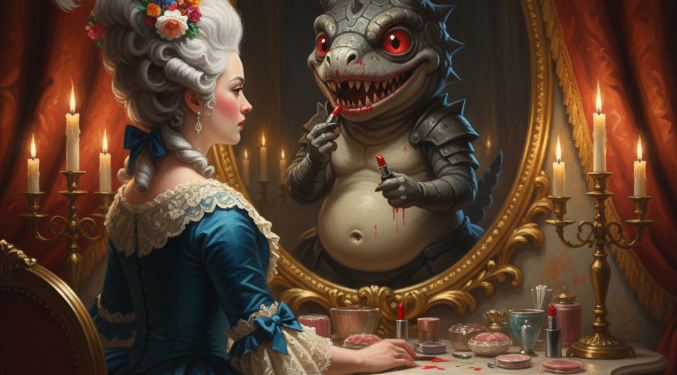
🎬Example — Servants of Evil
In Ravenholm, Erika Weiss was widely admired—graceful, persuasive, and trusted by magistrates, merchants, and guild leaders alike. She brokered contracts, settled disputes, and moved easily through candlelit parlors with polished manners and practiced charm. To all appearances, she was impeccable. In truth, her true 🌬️Spirit rating was -2 (Evil). Beneath the elegance and civility, her soul was hollowed and cold, sustained not by conscience but by calculation. Dark forces stirred within her, unseen by those who lacked the sight to perceive her Nephesh as it truly was. Through ☢Gloom Power +4, that void was filled with borrowed strength. The power was real—but it was not hers. It moved through her like a parasite, animating a body whose restraint and empathy were long gone. Her Nephesh revealed the truth: a twisted, predatory thing wearing beauty as camouflage. The refined woman the city admired was only a mask. What lay beneath was ruthless, remorseless, and waiting.
🪱️Gloom Threshold
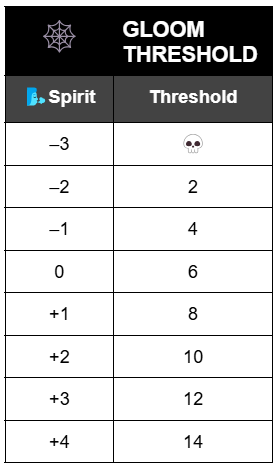
🥚Gloom Pact represents accumulated moral compromise, not instant corruption. It is a parasitic pressure that forms only after a character has begun to hollow themselves out through sustained, intentional choices. The 🪱Arafel does not reward accidents. It responds to patterns. 🌬️Spirit must be damaged before it can be replaced. Each point of 🥚Gloom Pact accumulates until it finally crosses the character’s 🕸Gloom Threshold, and then the Gloom may offer magical powers to the target. The first +1 of ☢Gloom Power will decrease the character’s 🌬️Spirit rating by -1 if they accept the sinister gift (typically offered after 8 – 12 game sessions). If a character eventually accepts +2, +3 or +4 ☢Gloom Power they must lower their 🌬️Spirit rating to 🌬️Spirit -2. The 🪱Gloom only offers ☢Gloom Power to characters who have at least +1 Intelligence and Spiritual Practices +1. Characters that the 🪱Gloom believes to be especially useful may be offered ☢Gloom Power +2, at which point they may cast spells within ⚖Domains tainted by the🪱Gloom without penality, and at ☢Gloom Power +3 they may learn spells from any school of magic—except no character with ☢Gloom Power can cast spells from 🕯Holy Magic, ❤🩹Healing Magic or ❤Love Magic. These powers are received by completing secret 🍎Temptation Missions offered to the player by the Game Master. Such missions always involving committing an evil act that benefits the 🪱️Gloom.
In the 📕Character Bible, 🌬️Spirit is written in paired form as 🌬️Spirit Rating / ☢Gloom Power Rating. The left number represents the character’s real spiritual condition — their actual integrity, resilience, and moral capacity. The right number reflects what remains after corruption, exhaustion, or later, false strength has been applied. These two values are never equal once corruption has begun, and they should never be treated as interchangeable. 🥚Gloom Pact does not grant power but is a measure of usefulness to the 🪱Gloom. It first drags the character downward. As a character commits deliberate harm, betrayal, exploitation, or repeated rationalized cruelty, their 🌬️Spirit is eroded step by step. This erosion travels the full length of the scale. Characters do not “dip” and rebound casually. They descend. Each point lost represents not a momentary lapse, but a narrowing of conscience — fewer internal objections, fewer brakes, fewer reasons not to act. During this phase, characters often feel little mechanical change but eventually, the 🪱Gloom will only offer 🍎Temptation without ☢Gloom Power on offer. 🪱Gloom Threshold can be understood as the incubation period of an alien parasite, as well a person’s tolerance for committing evil acts before the supernatural forces of evil have germinated long enough in their body to begin to use their body as a magical conduit. After 🥚Gloom Pact Points cross the 🪱Gloom Threshold the character may be offered ☢Gloom Power by the🪱️Gloom — a false capability that can fuel magical intent and force reality to conform to the will of the 🪱️Gloom. This distinction matters. A character cannot gain ☢Gloom Power without first being ruined. Power is not the reward for doing evil. It is what fills the space that is left when restraint is gone, and the person has hollowed themselves out.
🥚Gloom Pact points are gained through sustained, intentional acts that serve corruption. These include cruelty without remorse, betrayal for advantage, exploitation of the helpless, profane bargains, feeding on fear, or prolonged exposure to abysmal domains without resistance. The GM assigns 🥚Gloom Pact Points only when intent and repetition are clear. Single moments rarely matter. Persistence does. A character who kills once in panic is not the same as one who kills for convenience, and neither is the same as one who plans to do it again and again because it works.
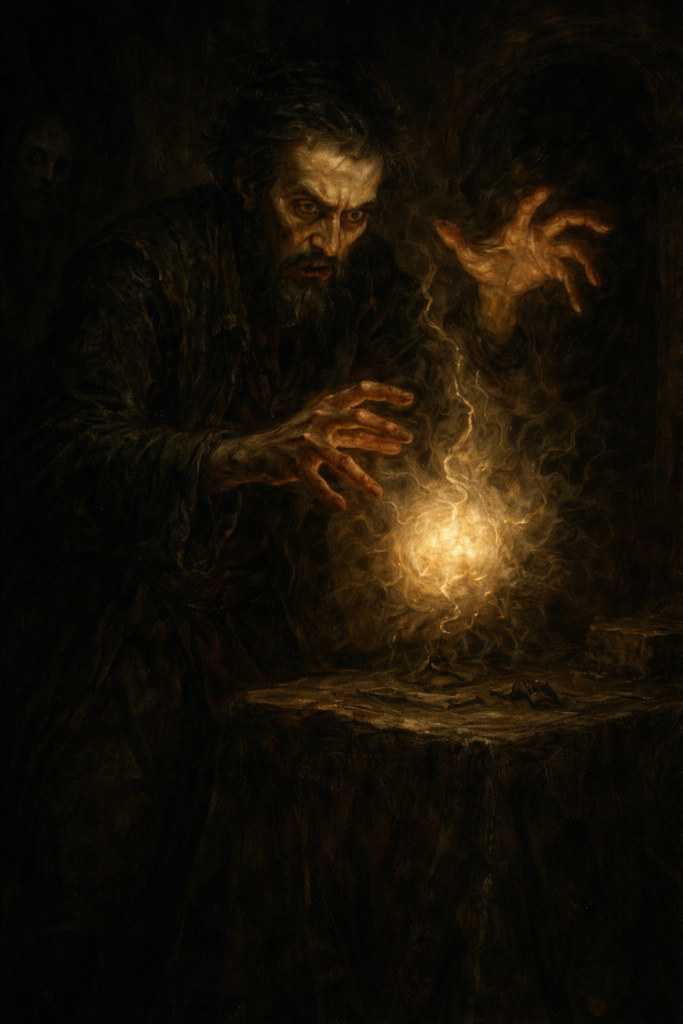
🥚Gloom Pact is not silent while it accumulates. Every 4 points of 🥚Gloom Pact exerts pressure even before ☢Gloom Power is offered or accepted. Characters accumulate 🥚Gloom Pact Penalties that force +1 Disadvantage to resist secret 🍎Temptation missions offered to the player by the Game Master (typically once per game session) that encourage the character to commit evil acts. In exchange for doing evil the character also suffers +1 Disadvantage to cast spells from the schools of 🕯Holy Magic, ❤🩹Healing Magic or ❤Love Magic until they can’t do it at all upon accepting ☢Gloom Power. Nightmares, intrusive thoughts, moral narrowing, social unease, or environmental reactions may occur. These are narrative signals meant to warn the player of the inevitable choice he must make if he continues to commit heinous wickedness that could ruin everyone’s fun, or that could realistically put a bounty on the character’s head. An evil character will be forced to redeem himself and transform into a new powerful character—a favored saint, or a heroic half-vampire or werewolf—or become an NPC (e.g., zombie, full vampire, evil genius sorcerer, abominable monstrosity, etc.) that the players will likely hunt down and destroy. The system is designed to create interesting story telling, where sometimes a party member betrays the group and marches on to the beat of his own destruction, or he redeems himself.
🥚Gloom Pact can decay, but only through resistance. Restitution, targeted ↩Repentance (Teshuvah), refusal of temptation, separation from corrupt influences, or deliberate moral cost can reduce 🥚Gloom Pact Points. Reducing 🥚Gloom Pact pulls the adjusted number back down toward the left. If the 🥚Gloom Pact falls below the threshold, ☢Gloom Power shuts off immediately. Nothing is banked. Nothing is saved. The mask collapses.
☢Gloom Power never heals 🌬️Spirit. If the pact is disrupted by redemption, the character can never raise their 🌬️Spirit rating beyond 0 (Normal)—unless they choose the path of the Humbled Redeemed (see the chapter “🪱️The Gloom”), in which case they will automatically have 🌬️Spirit +1. But no one who has ever accepted ☢Gloom Power, and then decided to turn back and stop doing evil, can ever use magic again—apart from prayer, as they can never raise their 🌬️Spirit beyond +1 in their lifetime. Characters who have relied on false strength may find themselves suddenly weaker than they remember being. Entities whose true 🌬️Spirit has been completely ruined may not survive this collapse. This is not punishment. It is exposure.
This system exists to support long-form story arcs as characters can typically only gain 🥚Gloom Pact +1 per 3 – 4 hour game session. Corruption is meant to feel delayed, private, and rational — until it isn’t. Redemption is possible, but never clean. Power is available, but never free. And at no point does the game force exposure. A character can rot quietly for a very long time. But when the consequences arrive, they arrive because the character earned them, not because the rules jumped the gun.
🪱️ The Gloom Ledger
🪱️The Gloom Ledger is a page in the 📕Character Bible used to track long-term moral corruption and false power, separate from the Medical Record that tracks 🩸Physical Wounds and 🧠Mental Trauma. 🪱️Gloom is tracked in the ledger independently, because it operates on a slower, more insidious timeline. The ledger tracks four values:
- 🌬️Spirit Rating
- ☢Gloom Power (false strength granted by corruption)
- 🥚Gloom Pact (accumulated moral corruption)
- 🪱️Gloom Threshold (how much Pact can be tolerated before consequences escalate)
A character that has any amount of ☢Gloom Power due to doing an excessive number of evil deeds will have their ratings presented in a split format—and the combined value is what the character will use to perform magic. The left number is who the character actually is. The right number is the Gloom’s energy making up for their loss of Spirit.
🌬️ Spirit / ☢Gloom Power
EXAMPLE GLOOM LEDGER STATS
• 🌬️-3 / ☢️+4 / 🥚17 / 🪱️10 (vampire lord): no living soul, but immense borrowed presence; sunlight, sanctified ground, and true compassion cut straight through the right number.
• 🌬️-2 / ☢️+3 / 🥚17 / 🪱️12 (warlock-general): ruined soul carried by 5 Gloom Pact Points above their threshold of 12; can cast freely, command lesser spirits, and radiate dread; also highly visible to seers.
• 🌬️-1 / ☢️0 / 🥚8 / 🪱️8 (hardened sinner without a pact): no adjustment; dangerous by will and skill, not by sorcery.
• 🌬️+2 / ☢️0 / 🥚0 / 🪱️8 (saintly veteran): healthy soul with no pact; excellent at resisting corruption, capable of magic if taught lawful rites.
When the presence of the Gloom matters, the Game Master may allow a Spiritual read (1d12 + Spirituality PRISM + Spiritual Practices) opposed by the target’s 1d12 + Spirituality PRISM + Spiritual Practices dice result. On strong successes they sense “something else is empowering this one.” Time, obedience to God, acts of restitution, and cleansing rites can peel away 🥚Gloom Pact Points -1. Some artifacts consume pact energy as a “toll.” Keep in mind that the more negative the left number is, the more dead, evil or delusional the character is.
🎬Example — Understanding Gloom Ledger Stats
Jonas began as a petty thief with 🌬️0 / ☢️0 / 🥚4 / 🪱️6—a soul dimmed by dishonesty but not yet defiled. Over months of cruelty and compromise, he grew colder, selling out friends and robbing graves. Each sin fed his Gloom Pact, his sheet rising to 🌬️0 / ☢️0 / 🥚6 / 🪱️6, then later it surged to 🌬️-2 / ☢️+2 / 🥚8 / 🪱️6 after committing a violent armed robbery that ended in the death of multiple innocent people. At first, the only signs were whispers in his dreams and an unnatural chill in his shadow. But when his adjusted Spirit reached 🌬️-2 / ☢️+2, the change became undeniable. Cornered by guards in a torchlit alley, he lashed out instinctively—and bolts of lightning burst from his hands, killing his pursuers. Jonas had never studied magic; the Gloom had begun casting through him. Terrified yet exhilarated, he soon realized that every cruel act deepened the bond, each betrayal raising the number on the right—proof that his soul no longer ruled his body. The Gloom did.
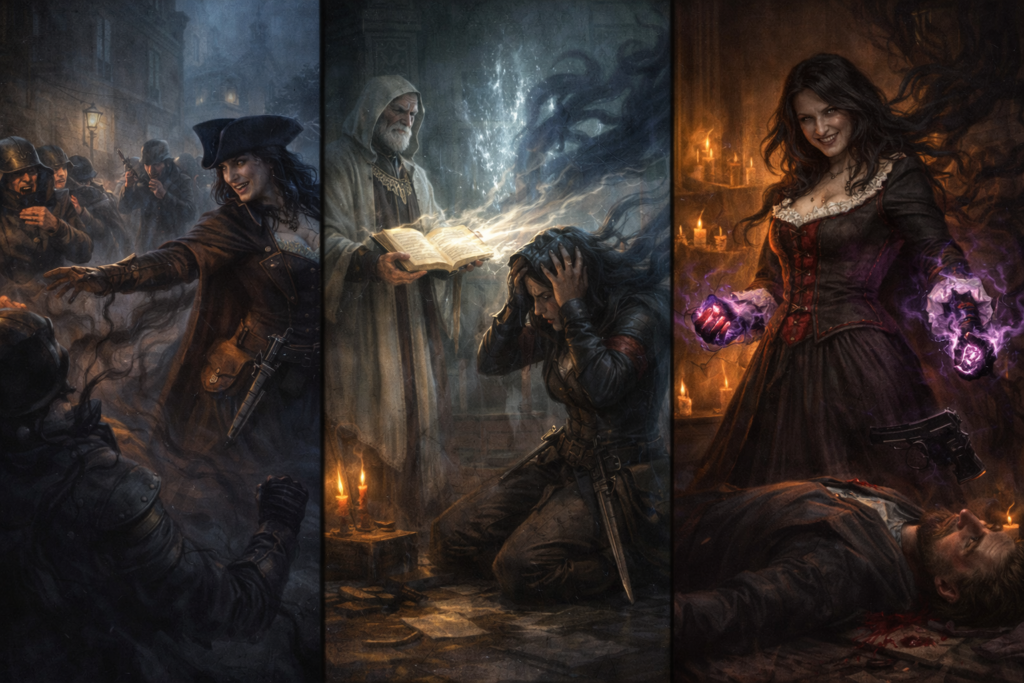
🎬Example — Evil Powers & Temptations
Mara had already told the Game Master she wanted to fall. Not loudly, not theatrically—just a quiet agreement, made out of character, that her story would bend toward the 🪱️Gloom. The offers began subtly. Once per session, always private, always framed as a small choice with a clear benefit to her character to the 🪱️Gloom. “Look the other way while a debtor is dragged into the alley.” “Plant false evidence to justify a hanging.” “Leave a wounded witness to die so the job stays clean.” Each secret 🍎Temptation was optional unless she failed a roll to resist.
By the time the Gloom offered her real power, it felt earned. Her 🌬️Spirit had already learned how to make room. Mara the Cutthroat had 🌬️Spirit -2 / ☢Gloom Power +3 after 12 game sessions. Though she could cast spells, her magic wasn’t truly hers—the Gloom moved through her like a puppeteer through a glove. When she attempted an evil spell against the city watch, the Game Master called for a dice roll to see if she could pull off the spell (1d12 + Spirituality PRISM + Spiritual Practices Skill) against TN 11 (Highly Improbable). Mara rolls high and succeeds, scattering the patrol as dread grips their hearts. Later that night, a Scroll Master confronts her with a Cleansing Psalm, a rite that specifically targets Gloom energy. The GM rules that the ritual weakens the pact, reducing Mara’s ☢Gloom Power by -3 points for the remainder of the scene. Her 🥚Gloom Ledger now temporarily reads 🌬️Spirit -2 / ☢Gloom Power 0. Later, when a rival sorcerer challenges her to a duel, she finds herself powerless—her adjusted 🌬️Spirit Rating has fallen below the threshold needed to cast even cantrips. Desperate and cornered, she accepts a 🍎Temptation from the shadows inviting her to commit an act of cruelty to renew her strength. After another murder, the Gloom surges back with 🥚Gloom Pact +3, restoring her line to 🌬️Spirit -2 / ☢Gloom Power +3.
Magic floods through her again—along with a compulsion to betray her only friend before dawn.
Discipline DIS
Discipline is the measure of a person’s inner strength—their ability to endure, to focus, and to remain composed when others would break. It governs how well a character resists mental intrusion, maintains concentration in chaos, and pushes through exhaustion, injury, or fear. When your Hit Points drop significantly, Discipline determines whether you stay in the fight or falter. A disciplined character can fight through pain, focus through panic, and suppress the urge to flee when death seems certain. Discipline is used whenever a character must resist temptation, psychic assault, or emotional collapse. It steadies the mind under pressure and anchors the will against both physical agony and supernatural dread. When a priest faces demonic whispers, when a soldier fights through blood loss, or when a mage struggles to maintain focus under fire, they rely on their Discipline.
🎬Example — Using Discipline
In a burning temple, Sister Miriam kneels amid falling embers, whispering a prayer as black smoke swirls around her. A dark spirit claws into her mind, whispering lies meant to break her will. The Game Master calls for a Discipline Test — a roll that tests her mental endurance and focus. Like other Attribute Tests, she rolls a d12, adds her Discipline Rating, and compares the total to a Target Number (TN) set by the Game Master. The more intense the fear or pain, the higher the Target Number. In this case, resisting the spirit’s psychic assault is TN 10 (Very Unlikely). Miriam rolls a 9 and adds her Discipline Rating of +2, for a total of 11 — success. Though her lungs burn and her body shakes, Miriam steadies her breathing and remembers her vows. The whispers lose their grip, retreating back into the shadows. She rises through the smoke with calm defiance, her faith unbroken.
Intelligence INT
Intelligence is used to solve puzzles, gather information, or analyze complex data. Providing life-saving first-aid, deciphering a complex riddle inscribed on an ancient scroll, analyzing a map of a labyrinthine dungeon to determine the best route, conducting research on the history of a cursed artifact to uncover its weaknesses, and developing a strategy to overcome a powerful enemy using limited resources, all require intelligence.
🎬Example — Using Intelligence
In the flickering lamplight of a collapsed observatory, the adventuring party discovers a series of massive, rotating brass rings—each etched with unfamiliar constellations. A mechanism hums faintly within the gears, and a sealed hatch lies beneath the structure. The rings appear misaligned, but there are no markings or clues to guide them. The Game Master calls for an Intelligence Test to see if anyone can discern the correct alignment purely through reasoning and pattern recognition. There’s no formula, no reference—just logic, memory, and intuition. The Target Number is 10 (Very Unlikely), reflecting the complexity of the mechanism. Seren Vale, the group’s navigator, steps forward. She rolls a d12 and adds her +3 Intelligence modifier. She rolls a 10, for a total of 13—a success. The Game Master narrates: Seren studies the rotating rings, counting their movements and noting how certain constellations briefly form recognizable shapes when the rings overlap. After a tense silence, she halts the central wheel at just the right moment. The brass rings lock into perfect alignment, and a hidden gear engages with a deep metallic click. The hatch below grinds open, releasing a gust of stale air from the depths.
Perception PER
Perception is used to detect and notice details within the surrounding environment—those things most people overlook until it’s too late. It governs awareness, attentiveness, and the ability to read subtle cues in the world. A character with sharp Perception can sense danger before it strikes, notice small inconsistencies, and interpret faint traces that reveal hidden truths. It allows adventurers to recognize the smell of damp powder before a musket misfires, catch a glimpse of movement behind a curtain, or sense that a smile hides deceit. Perception doesn’t represent training or specialized skill—it reflects clarity of thought, focus, and instinct. In play, it can reveal hidden traps, secret doors, disguised foes, or subtle clues that lead to greater discoveries.
🎬Example — Using Perception
While investigating a series of ritualistic murders in a fog-covered coastal town, Watchman Aiden Sparrow slowly walks the perimeter of a grisly crime scene in a crumbling temple. As his team photographs blood patterns and gathers samples, Aiden pauses. Something feels off. The GM calls for a Perception Test with a Target Number of 8 (Questionable) to notice a nearly imperceptible sigil carved into the stone floor—one that’s only visible from a specific angle when the flickering candlelight hits it just right. Aiden has Perception +1 and rolls 1d12. She rolls 7 but her +1 Perception gives her a total of 8. The GM describes how, crouching low, Aiden tilts his head and squints through the candlelight. A strange glint on the floor draws him closer—and there it is. A hidden rune etched in blood and sealed beneath a thin smear of dust. He instantly recognizes its shape: a summoning mark from an obscure occult tradition. His sharp eye shifts the investigation in a chilling new direction.
Wisdom WIS
Wisdom is used to solve practical problems, make sound judgments, and navigate moral or social complexity. It represents discernment—the ability to read a room, see the heart of a matter, and make decisions that endure beyond the moment. Wise characters think before acting and recognize patterns others miss, weighing motives, risks, and likely consequences before committing to a course. Examples include negotiating a delicate business deal, assessing the trustworthiness of a potential ally, or devising a long-term strategy to achieve a political or financial goal. Wisdom also aids in counseling others, mediating disputes, and predicting how small actions might ripple outward to shape future events. It is the attribute of seasoned leaders, mentors, and survivors who have learned that cleverness alone is not enough to endure.
🎬Example — Using Wisdom
In the gray dawn following a brutal goblin incursion, the smoking fields outside the village of Eldersburg lie strewn with broken carts and the dead. Survivors gather in what remains of the old churchyard—farmers, militiamen, and displaced families arguing over the last barrels of grain. Reverend Gideon Rusk, once a diplomat before the war, now serves as both preacher and mediator among the frightened townsfolk. Two men stand at the center of the crowd—Captain Harlan, commander of the local watch, and Foreman Trask, who controls the surviving stores. Each accuses the other of deceit and greed. The air is thick with desperation. The Game Master calls for a Wisdom Test with a Target Number of 7 (Reasonable) to see if Rusk can steady the crowd and prevent bloodshed. Rusk has Wisdom +2 and rolls 1d12. He rolls a 6, for a total of 8, beating the TN. The Game Master narrates: Rusk steps between the men, voice low but firm, reminding them that the goblins took enough without human hands finishing the ruin they began. He proposes that each household receive its share under the watch’s guard, overseen by the church bell at noon. The murmuring subsides. Though suspicion lingers in every eye, the mob disperses slowly. The tension has not vanished—but for now, reason holds the line.
Charisma CHA
Charisma is used to negotiate with others, build alliances, and influence opinions through confidence, eloquence, and presence. It reflects the ability to lead, persuade, and inspire, whether through steady reasoning or heartfelt passion. Charismatic characters know when to speak, when to listen, and how to read a room before making their move. Examples include convincing an NPC to share critical information through persuasive dialogue, charming one’s way past a guard to gain entry, or rallying public support for a cause. It might also involve calming a tense crowd, earning a leader’s trust, or holding authority in a heated debate. In short, Charisma measures a person’s power to shape outcomes through words, demeanor, and conviction.
🎬Example — Using Charisma
In the courtyard of Redfield Barracks, the smell of rain and powder still lingers from last night’s skirmish with highway raiders. Dozens of soldiers stand in ragged lines, shouting accusations of cowardice and theft, while officers struggle to regain control. Lieutenant Samuel Reed, a weary yet commanding figure with mud-stained boots and a torn blue coat, climbs onto a wagon to address them. The men are quiet, though anger still simmers in their faces and hands. The Game Master calls for a Charisma Test at TN 10 (Very Unlikely)—quelling near-mutiny in the wake of fear and loss is almost impossible. Samuel has Charisma +3 and rolls 1d12. He rolls an 8, bringing his total to 11—a success. The Game Master narrates: Lieutenant Reed speaks plainly, reminding them that their quarrels will undo what victory remains. He points to the torn banners overhead, saying, “You’ve bled together for this flag—don’t let greed finish what the enemy began.” The men exchange glances; some lower their weapons, others nod stiffly. No one cheers, but the shouting fades into silence. The storm in their hearts has not passed, but it has paused—and for tonight, that is enough.
Attractiveness ATT
Attractiveness is used to influence social interactions through appearance, charm, and body language. It reflects not only physical beauty but also the confidence, elegance, and poise that make others attentive or disarmed. A striking presence can open doors that logic cannot, altering how people perceive trustworthiness, authority, or desire. Those with high Attractiveness often find others eager to please them, overlook faults, or grant small favors without realizing why. Examples include convincing an NPC to reveal sensitive information through flirtation, using one’s looks to distract a guard while an ally slips by, or softening the attitude of a hostile witness with an inviting smile. Attractiveness can sway a merchant’s price, ease tension at a formal dinner, or turn suspicion into fascination. In play, it governs situations where social influence depends as much on allure and confidence as on words or status.
🎬Example — Using Attractiveness
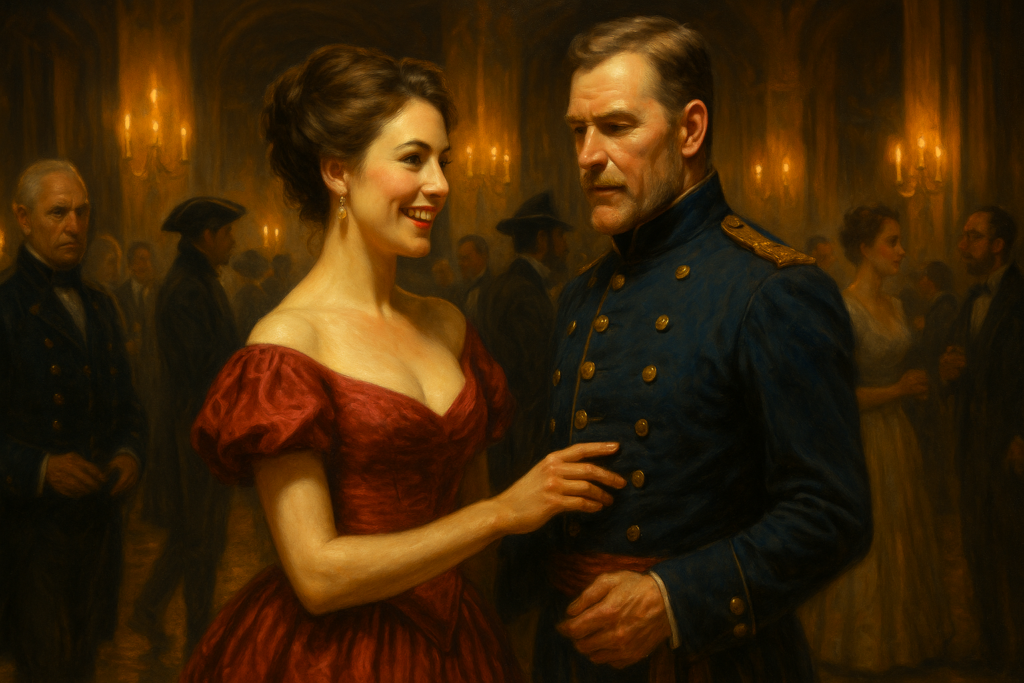
In the candlelit ballroom of Governor Hale’s estate, Clara Dawson, a well-known socialite with a smile that could quiet a room, arrives at a charity dinner teeming with officers, merchants, and spies. Her goal: keep the attention of Captain Nathan Briggs, the head of the governor’s household guard, long enough for her partner to slip into the study and retrieve a set of sealed military orders. The Game Master sets the Target Number (TN) at 7 (Reasonable)—a challenge suited to one-on-one persuasion under scrutiny. Clara has Attractiveness +2. She rolls 1d12, gets a 5, adds her +2, and totals 7—a success. The GM narrates: Clara glides across the floor, gown whispering against polished marble. Her conversation with Captain Briggs flows easily—laughter timed perfectly, a brief touch at his sleeve, a glance that lingers just long enough. The captain’s stern demeanor softens; he forgets the ledger he meant to check, the guards he meant to inspect. Behind him, a shadow slips through the study door unseen. When the band changes tune, Clara thanks him for the dance, leaving the captain flushed, bewildered, and utterly unaware that state secrets now rest in a thief’s pocket.
Strength STR
Strength measures raw physical power, endurance, and the ability to exert force under pressure. It determines how effectively a character can lift, push, break, or restrain objects and opponents. More than muscle alone, Strength represents determination in the body—the capacity to keep straining when others falter. It affects melee combat, climbing, grappling, and carrying capacity, as well as the sheer force behind labor or desperation. Strong characters can smash through barriers, drag injured comrades to safety, or haul critical supplies through hostile terrain. Whether bending iron, forcing open a sealed door, or wrestling a foe to the ground, Strength embodies the will to act through the body when words and tools fail.
🎬Example — Using Strength
In the ruins of Fort Briar Hollow, the eastern wall has collapsed after a night of cannon fire. Smoke and dust fill the air as Sergeant Nathan Briggs and his surviving men dig through the wreckage for trapped soldiers. A final, terrible creak announces that the remaining archway is about to collapse entirely—beneath it, two wounded privates cry out for help. The Game Master calls for a Strength Test at TN 12 (Virtually Impossible); holding the arch even for a few seconds would demand heroic effort. Briggs rolls his d12 and adds his +4 Strength modifier. He rolls an 8, for a total of 12—just enough. The Game Master narrates: Briggs drops his musket, braces his shoulders under the massive stone beam, and heaves upward as splinters rain down. His arms tremble, boots grinding into the mud, but the arch rises just enough for the wounded men to crawl free. The moment they’re clear, he collapses, coughing in the dust. When he lifts his head, his comrades are alive, and the fallen fort still echoes with the sound of his defiance.
Stamina STA
Stamina measures a character’s endurance, resilience, and ability to sustain physical effort over time. It determines how long one can fight, run, climb, row, or labor before exhaustion sets in. More than muscle, Stamina represents the will to persist when the body protests, the steady rhythm of breath and heartbeat that carries a person through hardship. It’s the measure of the inner fire that keeps soldiers marching after nightfall and sailors hauling lines through storm and sleet. A high Stamina score reflects determination forged in experience—how far a character can go before breaking, not how much pain they can take.
🎬Example — Using Stamina
After a full day of marching through heavy rain, Lieutenant Thomas Reed and his scouts find themselves far from their regiment, lost among the flooded lowlands. Night has fallen, and their lanterns burn low. A bridge ahead has collapsed, leaving only a rope strung across the raging river. One by one, the men falter, too exhausted to climb the slick line or fight the current. Reed knows that if he doesn’t cross and tie off a new lead, the rest will perish before morning. The Game Master calls for a Stamina Test, TN 9 (Difficult)—a grueling challenge even for a seasoned officer. Reed rolls his d12 and adds his +3 Stamina modifier. He rolls an 8, for a total of 11—a success. The Game Master narrates: Reed grips the rope and wades into the black water, muscles straining as the current claws at him. His coat drags heavy with mud, his breath comes in gasps, but he keeps moving—hand over hand, yard by yard. His arms tremble, his boots slip, yet his will does not falter. When he reaches the far bank, he drives his bayonet into the earth, ties off the rope, and signals the others across. By dawn, the men stumble into camp half-dead with fatigue—but alive because one man refused to stop.
Agility AGI
Agility measures balance, reflexes, and the elegance of motion—the body’s ability to adapt when precision decides survival. It governs leaps, dodges, dives, rolls, and quick changes of direction. Characters with high Agility move a heartbeat ahead of danger: sidestepping falling beams, slipping a blade’s reach, or twisting mid-fall to land sure-footed. It isn’t mere speed but harmony between thought and movement, the knack for recovering footing on treacherous ground and threading through tight spaces under pressure. Examples: dodging a pistol shot at close range, leaping from a crumbling balcony, weaving through a collapsing tavern, or keeping balance on a storm-tossed deck.
🎬Example — Using Agility
The rooftops of Port Ardyn glisten in the night rain, their tiles slick as glass. Lio Quenn, a nimble thief with a taste for danger, sprints across the uneven ridgelines with guards in hot pursuit. Below, lanterns flicker through the fog; above, lightning forks across the sky. As he reaches a gap between two gables, he realizes it’s wider than expected—fifteen feet at least. A missed step means a plunge to the cobblestones far below. The Game Master calls for an Agility Test, TN 10 (Very Unlikely)—the sort of jump no untrained man could survive. Lio rolls 1d12 and adds his +3 Agility modifier. The die shows a 9, bringing his total to 12—a success. The GM narrates: Lio’s boots strike the edge of the roof, splashing water outward. For an instant, his body hangs weightless over the void, wind tearing at his cloak. Then, with a twist and kick, he clears the chasm and lands hard on the opposite ledge, tiles cracking beneath his feet. He stumbles, catches himself against a chimney, and grins through the downpour. Behind him, his pursuers halt, staring at the impossible distance. One guard curses under his breath and lowers his musket. Lio vanishes into the storm, his laughter swallowed by thunder.
Speed SPD
Speed reflects how quickly a character crosses space—stride, acceleration, and decisive bursts. In pursuit or retreat, moments matter. A fast character closes distance before foes react, dives for cover between volleys, and reaches allies or objectives in time. Speed is motion married to will: the drive to keep running when lungs burn and the field turns murderous. Examples include: outrunning an enemy across a burning bridge, sprinting through falling masonry to reach safety, lunging for cover between musket shots, or racing a rival to seize a relic before the sea takes it.
🎬Example — Using Speed
The courtyard of Fort Dunmarrow is chaos—smoke, shouting, and the deafening crack of cannon fire. Captain Samuel Carter wipes ash from his eyes and spots the gatehouse through the haze. The enemy has breached the wall, and if the gates aren’t barred before the next wave arrives, the entire regiment will be slaughtered. Splinters rain from the timbered arch as another cannonball strikes nearby. The Game Master calls for a Speed Test, TN 9 (Unlikely)—a race through fire and ruin. Carter rolls 1d12 and adds his +2 Speed modifier. He rolls a 10, giving him a total of 12—a success. The GM narrates: Carter breaks into a full sprint, his boots splashing through puddles of blood and rainwater. He leaps over a fallen cannon, ducks beneath a collapsing beam, and drives himself forward until his lungs burn. Behind him, the cries of wounded men echo across the courtyard, but he does not slow. He reaches the gatehouse just as the structure begins to crumble. With a roar, he shoves the heavy bar into place and throws his weight against the door as enemy soldiers crash into it from the other side. Dust and stone rain from above, but the gate holds. For a long moment, only the pounding of his heart and the muffled rage of the enemy fill the silence. Carter exhales, steadies himself, and mutters, “Not today.”
Dexterity DEX
Dexterity governs fine motor control, steadiness, and precision. It reflects a steady hand and calm focus—essential for any task demanding delicate or exact movement. A character with high Dexterity can load a musket in the dark, perform surgery under fire, or disarm a trap while their allies hold their breath. It measures not only coordination but discipline—the ability to slow the world down and act with absolute control when panic would make others falter. A skilled hand guided by a clear mind can accomplish miracles where brute strength or speed would only make things worse. Examples: picking a complex lock under pressure, disarming a trap with trembling hands, threading a needle by lamplight on a rolling ship, repairing a musket’s firing mechanism mid-battle, or firing at a distant target in heavy wind.
🎬Example — Using Dexterity
In the infirmary at Stonebrook, Doctor Elias Ward kneels beside a wounded officer whose shoulder is impaled by a shattered bayonet. The blade is lodged dangerously close to an artery, the floor around him slick with blood. The Game Master calls for a Dexterity Test at TN 10 (Very Unlikely)—a single slip could end the man’s life. Ward rolls 1d12 and adds his +4 Dexterity. He rolls an 8, for a total of 12—a success. The GM narrates: Ward’s breath steadies as chaos roars outside the tent. His hands, stained and trembling moments ago, now move with eerie calm. With surgical precision, he twists the steel free, binds the wound, and clamps the artery shut before another drop can fall. The soldier jerks once, then exhales—a ragged but living breath. Outside, cannon fire shakes the earth, but Ward allows himself the faintest smile. “He’ll live,” he murmurs, “though I’ve no idea how many more I can save tonight.”
Learn about Attribute PRISMs next.