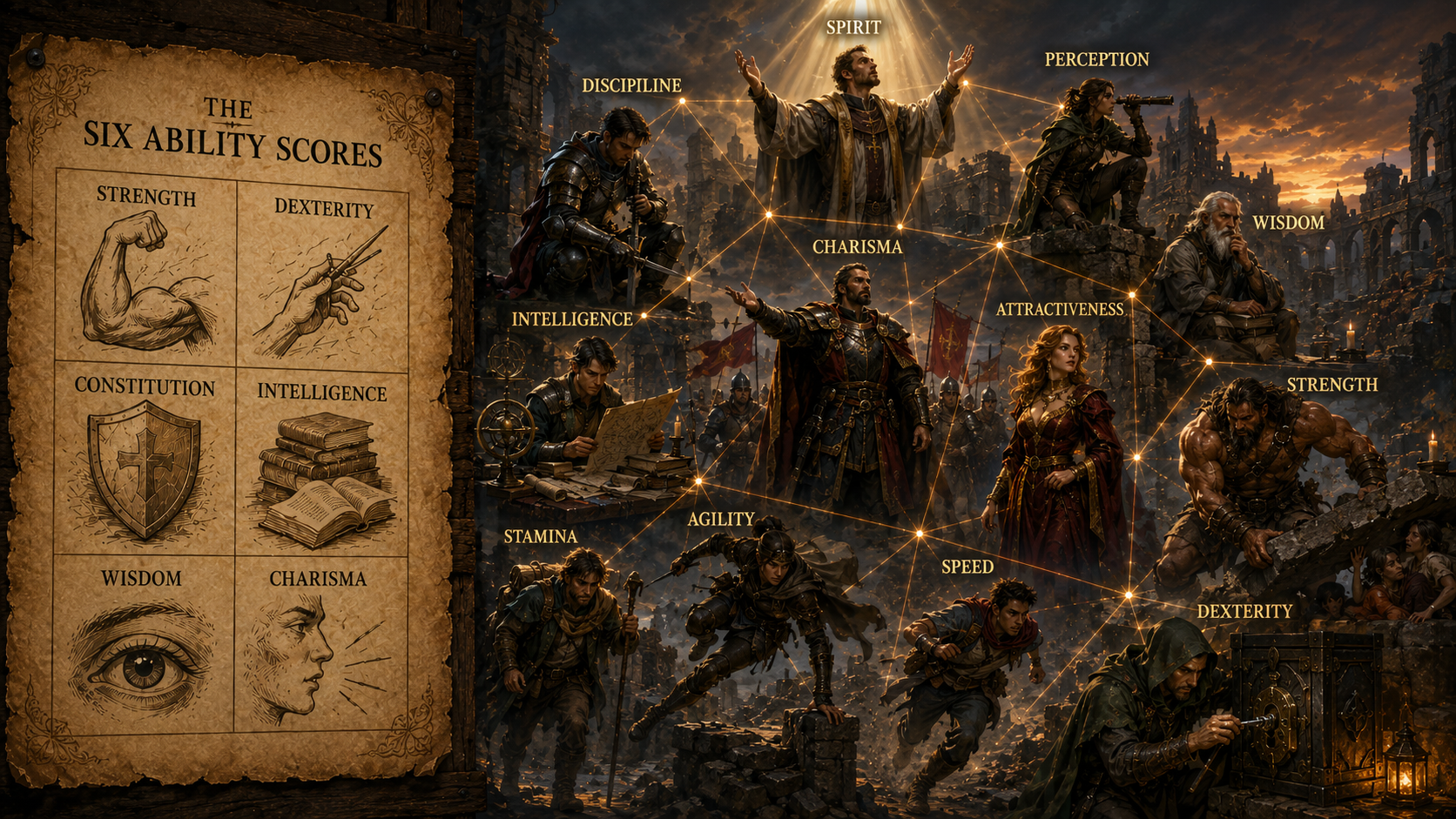
Strength, Dexterity, Constitution, Intelligence, Wisdom, and Charisma may be the most recognizable statistics in tabletop role-playing games (TTRPGs). Even people who have never played Dungeons & Dragons often understand the basic idea. Strength measures physical power. Intelligence measures how smart someone is. Charisma measures social presence. The six ability scores are easy to remember, easy to print on a character sheet, and deeply embedded in the language of modern TTRPG design.
They are also too broad to describe a person with much precision.
That does not mean the six-score model is foolish or badly designed. It has survived for decades because it solves a genuine problem: a role-playing game needs to reduce the complexity of a human being into a manageable set of numbers. No tabletop system can assign a separate statistic to every physical, mental, emotional, social, and spiritual capacity a person possesses. At some point, the designer must combine related qualities.
The question is not whether abilities should be combined. The question is how much can be combined before the categories stop describing coherent human capacities.
My conclusion while designing Jack’s Cinematic d12 (JCd12) was that D&D’s six ability scores cross that line too often. They are memorable, but several of them function less like individual qualities and more like crowded containers holding numerous abilities that do not always belong together.
That is why JCd12 uses twelve 💪Attributes: Spirit, Discipline, Intelligence, Perception, Wisdom, Charisma, Attractiveness, Strength, Stamina, Agility, Speed, and Dexterity.
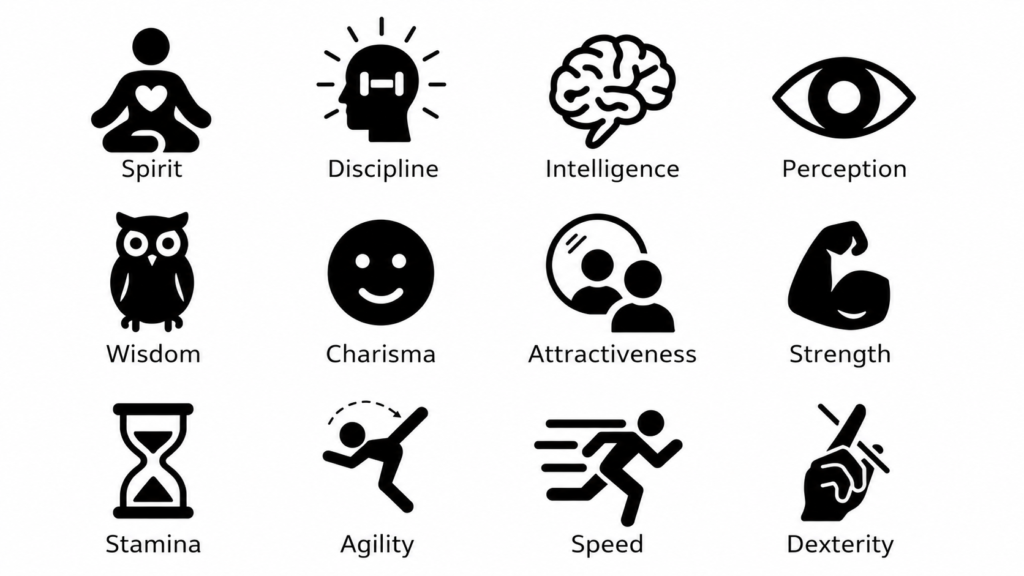
The solution was not to collapse the Attributes back together, but to abandon the one-attribute-per-skill model altogether. That led to the creation of the 🌈Attribute PRISM system. Rather than asking which single Attribute governs an action, PRISMs recognize that most skills draw upon several Attributes in different proportions. An accomplished swordsman relies on more than Strength. A physician depends on more than Intelligence. A diplomat requires more than Charisma. PRISMs were created because reducing complex human activities to one governing ability score is an oversimplification, regardless of whether a game has six Attributes, twelve Attributes, or twenty.
The Problem with Dexterity
Dexterity is probably the clearest example of an ability score doing too much work.
In D&D, Dexterity may influence reaction speed, initiative, bodily agility, balance, stealth, aim, delicate hand movements, lockpicking, acrobatics, reflexive defense, and the use of certain weapons. A character with high Dexterity may therefore be quick, graceful, accurate, quiet, flexible, and good with his hands, even though those qualities are not identical.
Consider several fictional characters. A large gunslinger may possess excellent aim and a fast draw while being relatively inflexible and poor at acrobatics. A gymnast may have extraordinary balance and bodily control without being especially skilled at picking locks. A watchmaker may perform precise hand movements while having slow reactions. A professional thief may move quietly but possess only average combat reflexes. A dancer may be graceful without being an expert marksman.
Under a single Dexterity score, these characters tend to collapse toward the same mechanical profile.
Many tabletop role-playing games recognize this problem in different ways. GURPS distinguishes broad physical attributes from individual skills, allowing Guns, Acrobatics, Stealth, Lockpicking, and other activities to develop separately. Call of Cthulhu uses Dexterity but relies heavily upon percentile skills such as Firearms, Locksmith, Sleight of Hand, and Stealth. Cyberpunk RED separates Dexterity from Reflexes, which allows bodily coordination and combat reaction to differ. World of Darkness games traditionally divide physical abilities into Strength, Dexterity, and Stamina, then further distinguish activities through skills.
These systems do not all solve the problem in the same way, but they illustrate the same underlying truth: aim, reflexes, agility, speed, and fine motor control are related without being identical.
JCd12 divides the overloaded Dexterity category into Agility, Speed, and Dexterity, while Perception can also affect activities that depend upon noticing and tracking a target.
- Agility concerns bodily coordination, balance, and controlled movement.
- Speed concerns rapid movement and quick physical response.
- Dexterity concerns precise manipulation and fine motor control.
A person can therefore be fast without being graceful, graceful without having delicate hands, or mechanically precise without being an acrobat. This produces characters who feel more like distinct people rather than variations of the same ability-score package.
Constitution Is Not One Thing
Constitution presents a similar problem.
D&D uses Constitution to represent health, endurance, resistance to poison, resistance to disease, the ability to withstand physical hardship, and a large portion of a character’s general durability through Hit Points. Yet the ability to run for hours is not identical to the ability to resist illness. Pain tolerance is not identical to cardiovascular endurance. A physically large person may withstand blunt trauma well while tiring quickly. A thin endurance athlete may possess exceptional stamina without being able to absorb tremendous physical punishment.
Many TTRPG systems separate at least some of these functions. Shadowrun uses Body to represent physical resilience while other qualities and skills influence athletic performance. Savage Worlds uses Vigor as a broad resistance statistic but derives Toughness from it and still separates movement-related traits through Agility and skills. The Basic Roleplaying family of games commonly uses Constitution for health while relying upon separate characteristics and skills for other physical capacities.
JCd12 uses Stamina to represent endurance, sustained physical effort, and the capacity to continue functioning under strain. Strength represents force and muscular power. Discipline may become relevant when a character must continue despite pain, fatigue, fear, or hardship. Depending upon the situation, Spirit may matter when survival becomes an act of inner resolve rather than merely physical endurance.
The goal is not to create a medical simulation. JCd12 does not need separate scores for lung capacity, immune response, bone density, pain threshold, circulation, and metabolic efficiency. That level of detail would make the game harder to play without necessarily making it more meaningful. The purpose is simply to stop treating every form of physical resilience as the same trait.
Charisma Should Not Determine Everything Social
Charisma may be the most conceptually confused ability score in D&D.
It commonly represents eloquence, confidence, leadership, intimidation, force of personality, attractiveness, personal magnetism, and sometimes supernatural identity. Depending upon the class and edition, Charisma may also power spellcasting, determine social influence, strengthen a character’s connection to an otherworldly force, and help resist certain magical effects.
This creates strange results. An attractive person is not necessarily persuasive. A persuasive person is not necessarily honest. A commanding military leader may be physically unattractive. A beautiful person may be shy, hesitant, or socially awkward. A confident speaker may possess little personal warmth. A frightening criminal may intimidate others without being charming. A respected priest may inspire people through conviction rather than charm or beauty.
Some tabletop role-playing games separate these qualities more explicitly. GURPS treats Appearance, Charisma, Voice, Reputation, Status, and social skills as distinct traits. Vampire: The Masquerade distinguishes Charisma, Manipulation, and Appearance, allowing a character to be genuinely likable, psychologically manipulative, or physically attractive without automatically possessing all three. Cyberpunk RED separates Cool from Personal Grooming and Wardrobe & Style, while Shadowrun relies heavily on individual social skills rather than expecting one attribute to define every social interaction.
JCd12 follows a similar philosophy by separating Charisma and Attractiveness. Charisma represents leadership, confidence, presence, and the ability to influence other people. Attractiveness represents physical appearance. While the two often complement one another, they are not the same thing. A scarred war hero may possess tremendous Charisma with little conventional attractiveness, while a beautiful noble may command attention without inspiring respect. Separating the two allows both strengths and weaknesses to exist independently instead of forcing them into the same mechanical box.
Twelve Attributes Is Not the Complete Solution
Expanding from six ability scores to twelve Attributes solved one problem, but it immediately revealed another.
At first, I approached JCd12 the same way many other tabletop role-playing games do: every skill should have a governing Attribute. It seemed obvious. If D&D assigns Strength to Athletics and Dexterity to Stealth, then perhaps JCd12 would simply assign one of its twelve Attributes to each skill instead.
The idea didn’t survive very long.
As I worked through the skill list, I kept running into the same question: Why should this skill depend upon only one Attribute?
Consider Unarmed Combat. A strong boxer certainly hits harder than a weak one, but strength alone does not make someone a good fighter. Speed determines whether the punch lands before the opponent reacts. Agility affects footwork and balance. Perception allows a fighter to recognize openings and anticipate attacks. Discipline helps maintain composure instead of panicking or becoming reckless. Stamina determines how effectively someone continues fighting after several exhausting rounds.
Which one of those Attributes should govern Unarmed Combat?
The answer is none of them.
Or more accurately, all of them.
The same observation appeared everywhere I looked. Swordsmanship is not simply Strength. Marksmanship is not simply Dexterity. Leadership is not simply Charisma. Tracking is not simply Perception. Lockpicking is not simply Dexterity. Medicine is not simply Intelligence. Almost every meaningful activity in life depends upon several different human capacities working together.
That realization became one of the most important turning points in the design of Jack’s Cinematic d12.
Why 🌈Attribute PRISMs Exist
PRISMs exist because the traditional relationship between one ability score and one skill is an oversimplification of how people actually perform complex tasks.
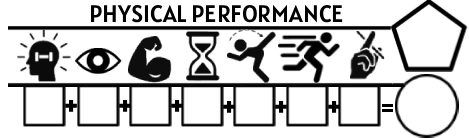
Human beings do not solve problems using isolated abilities. A firefighter entering a burning building relies on physical strength, endurance, perception, discipline, quick reactions, judgment, and courage. A surgeon depends upon intelligence, fine motor control, discipline, perception, stamina, and emotional composure. A battlefield commander needs intelligence, wisdom, charisma, perception, and discipline. None of these professions can be accurately reduced to a single governing statistic.
PRISMs acknowledge that reality by allowing different combinations of Attributes to contribute to different actions. Instead of asking, “Which Attribute governs this skill?” JCd12 asks a different question: What human qualities genuinely contribute to success in this situation?
That is a far more interesting design question, and I believe it produces more believable characters as well.
Every Design Is a Tradeoff
None of this means Dungeons & Dragons is a poorly designed game. Quite the opposite. The six ability scores have endured for more than fifty years because they accomplish exactly what they were designed to accomplish. They are simple, memorable, fast to teach, and immediately recognizable. There is tremendous value in that level of elegance, and every TTRPG designer should appreciate why they have become so influential.
JCd12 simply pursues a different design philosophy.
I wanted characters who felt less like collections of broad statistics and more like actual people. I wanted a quick gunslinger who wasn’t automatically graceful, a charismatic leader who wasn’t automatically handsome, a disciplined veteran who wasn’t necessarily wise, and an endurance athlete who wasn’t automatically the strongest person in the room. Most importantly, I wanted the mechanics to recognize that meaningful actions almost never depend upon a single human quality.
That approach introduces its own challenges. More Attributes mean more opportunities for designers to disagree about where the boundaries lie. There will always be edge cases where reasonable people could argue that an action should emphasize one Attribute more than another. No system can model human capability perfectly, and JCd12 is no exception.
Even so, I believe this approach is worth pursuing because it begins with a different assumption. Rather than forcing human behavior into six oversized categories, it starts by asking what qualities actually matter, then builds the mechanics around that answer. The result is a system that I believe portrays people more accurately while giving players far greater freedom to create characters who feel genuinely different from one another.
Ultimately, my disagreement with D&D isn’t simply that it has too few ability scores. It’s that human beings are far too complex for any meaningful skill to be governed by only one of them.
That realization is what led to the creation of the PRISM system, and it remains one of the foundational design principles of Jack’s Cinematic d12.
Learn more about 💪Attributes in Jack’s Cinematic d12, or learn about 🌈Attribute PRISMs.
About the Author