Why Tabletop Role-Playing Games May Be One of Entertainment’s Most Undervalued Investments
What Is a Tabletop Role-Playing Game?
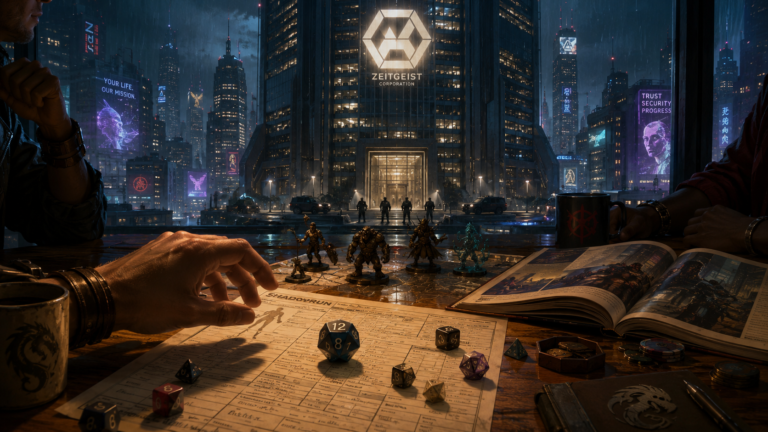
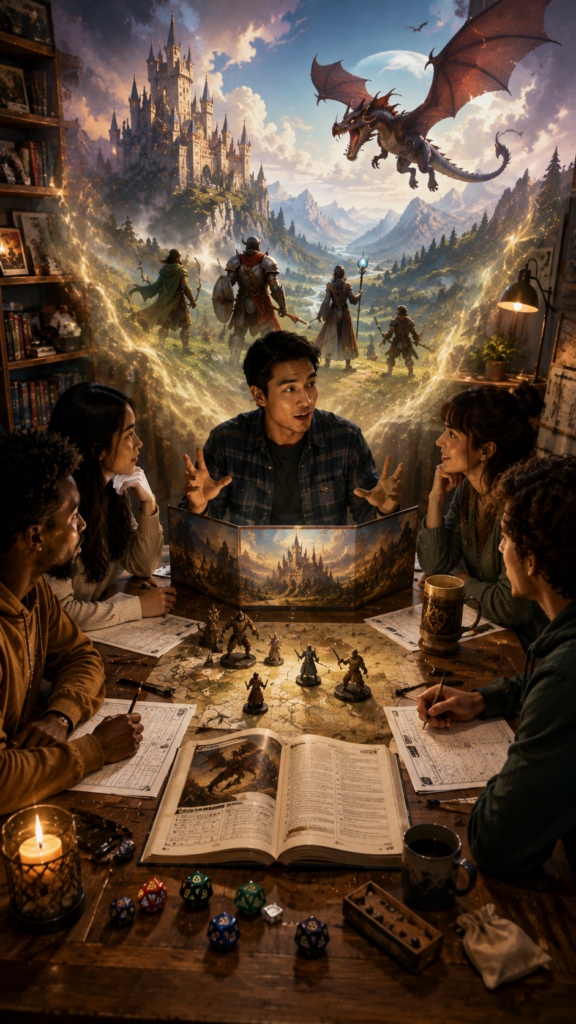
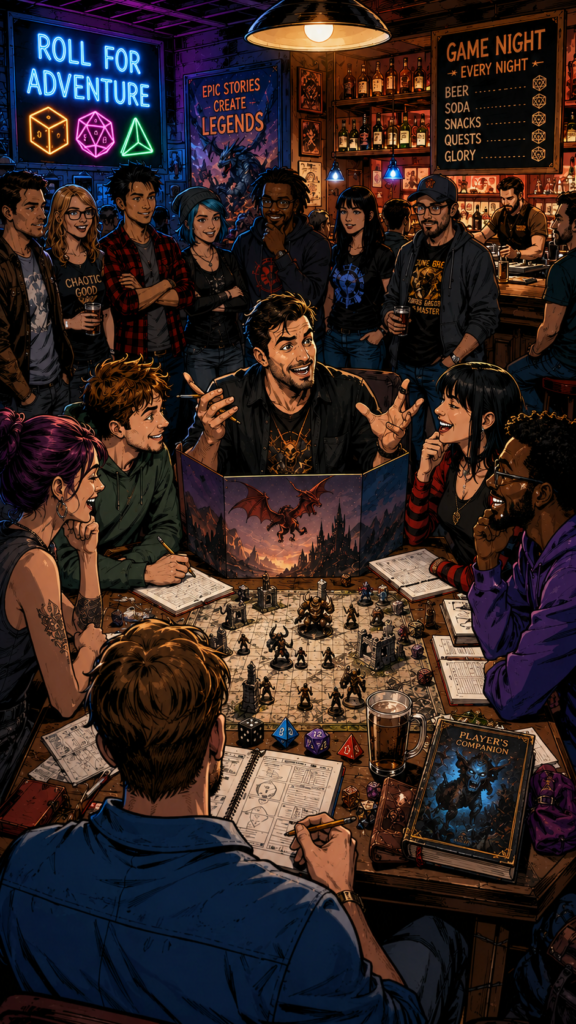
Six people sit around a table. There may be maps spread across it, miniature figures representing people and monsters, character sheets covered in notes, pencils, rulebooks, drinks, snacks, and a collection of strangely shaped dice. One person describes a place that does not exist. Perhaps there is an inn 🏡at the edge of a 🌲🌲🌲forest 🌲🌲🌲, with rain beating against the windows and a nervous stranger sitting alone in the corner. He has been watching the door for the last hour. Somewhere outside, horses are approaching. 🐴🐴🐴 The other people at the table begin deciding what they are going to do.
- One player says his character will approach the stranger.
- Another player says her character will watch the windows.
- Another player says his character will question the innkeeper.
- Another player character quietly slips out through the kitchen to find out who is coming down the road.
Nobody has a script, including the person who created the situation. That person is usually called the Game Master or Dungeon Master, depending upon the game being played.
The Game Master portrays the world and the people within it, presents situations and conflicts, interprets the rules, and responds to the decisions of the players. He may know exactly who the nervous stranger is and why those riders are approaching, but he does not necessarily know what the players are going to do about either of them. When the outcome of an action is uncertain, rules and often dice determine whether something succeeds, fails, or produces some unexpected consequence. The result is a peculiar form of entertainment in which nobody at the table—including the person running the game—completely knows the story in advance.
That is the basic idea behind a tabletop role-playing game, or TTRPG. The explanation sounds simple enough, but it describes something considerably stranger and more powerful than a conventional board game.
If I am playing Monopoly, I can buy Boardwalk, mortgage a property, negotiate a trade, roll the dice, and move around the board. The game provides a defined collection of actions and rules for resolving them. What I cannot normally do is:
- announce that I climb the hotel on Boardwalk,
- break through an upstairs window,
- search the owner’s office,
- discover his financial records,
- and blackmail him into selling me the property.
Monopoly has no idea what to do with that statement. A tabletop role-playing game does, because another human being can consider what I am attempting and decide how the fictional world responds.
The same distinction exists between a TTRPG and a videogame. Modern videogames 🎮 can offer enormous worlds and astonishing freedom, but software still has to recognize the player’s actions. If the developers did not create a method for convincing a 🏰 castle guard 💂 that you are a building inspector investigating violations of the local fire code, you probably cannot solve the encounter that way. At a tabletop game, you can try. The Game Master then works that into the story, opening up unforeseen possibilities in the direction the story can go.
- What does the guard know about building inspectors?
- Does the castle even have fire regulations?
- Is your character persuasive enough to make this ridiculous story believable?
- Does the guard summon his superior?
- Does somebody ask to see your credentials?
The encounter can suddenly become something neither the game designer nor the Game Master ever specifically planned.
This ability to do actions that are only limited by the human imagination is one of the defining characteristics of tabletop role-playing. A TTRPG combines elements of a game, collaborative storytelling, improvisational theater, probability, simulation, conversation, and social performance without being identical to any one of them. The rules provide structure and consequences, but the participants continually generate possibilities that no rulebook could completely anticipate. 🎲Dice or other resolution mechanics add uncertainty, meaning that even the people creating the story cannot simply dictate its outcome.
A Novelist decides whether his protagonist makes the desperate jump across the chasm. A Screenwriter knows whether the gun fires because the scene has already been written. At the gaming table, the Game Master may desperately want the character to survive, the player certainly wants the character to survive, and everyone else may be cheering when the die is rolled. If the result is terrible, everyone has to deal with what just happened.
This creates an unusual relationship between the creator and consumer. A novelist creates a story and sells that story to readers. A filmmaker creates a movie and audiences watch substantially the same movie. A Tabletop Game Designer creates something different: a system capable of helping other people generate stories of their own.
Two groups can buy exactly the same rulebook and have radically different experiences with it. One party hunts the dragon. Another negotiates with it. Another never discovers it. Another makes a disastrous series of decisions and accidentally burns down the village before reaching the dragon’s mountain. The designer has created the rules, possibilities, setting, creatures, equipment, conflicts, and perhaps a published adventure, but the players complete the creative process themselves. In that sense, the customer is simultaneously a consumer and a participant in production.
That distinction will become important when we begin talking about the business possibilities surrounding TTRPGs, because it means that a role-playing game should not be understood merely as another kind of book. The book is the foundation for an activity. A successful game can support thousands or millions of individual experiences that never existed in the original text. Those experiences can generate demand for additional books, adventures, miniatures, dice, maps, artwork, software, furniture, conventions, professional Game Masters, live performances, novels, videogames, and other products that may not even exist yet. The economic footprint of tabletop role-playing therefore extends considerably farther than the retail price printed on the back of a rulebook.
It is also worth remembering just how young this form of entertainment actually is.
Modern commercial tabletop role-playing is conventionally traced to the publication of Dungeons & Dragons in 1974 by Gary Gygax and Dave Arneson. D&D emerged from the tabletop wargaming culture in which both men were involved, with particularly important experimentation occurring in Arneson’s Blackmoor campaign as the focus shifted away from commanding military units and toward individual players controlling individual characters who explored an imaginary world. Gygax and Arneson subsequently developed and published Dungeons & Dragons, creating the commercial foundation of the hobby that followed.
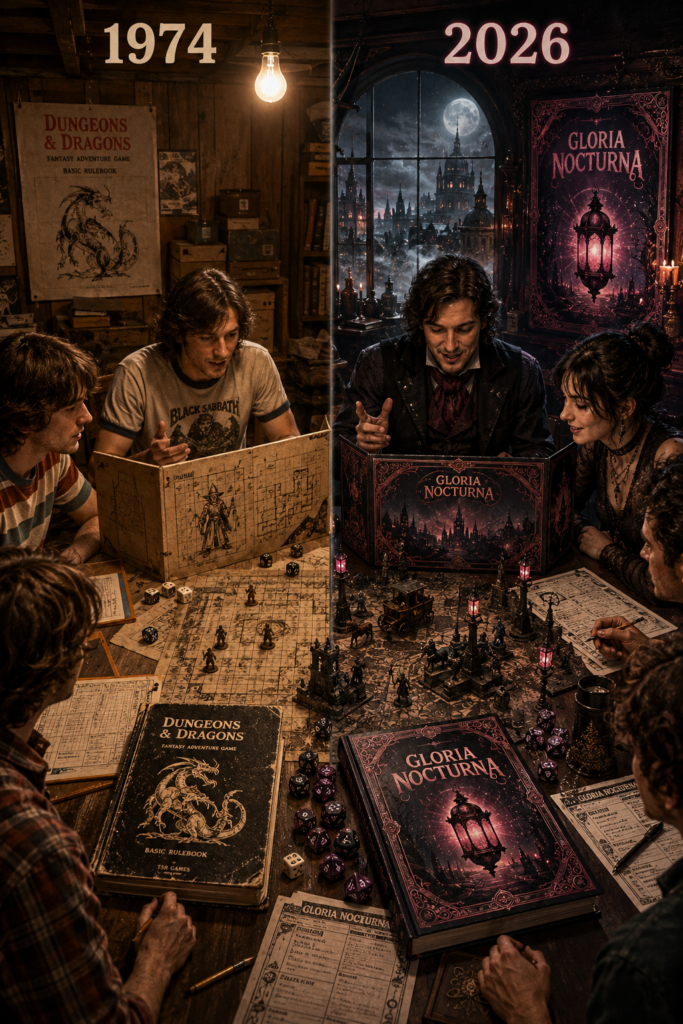
In 2024, D&D celebrated its fiftieth anniversary, meaning that the entire commercial TTRPG tradition remains younger than many of the people currently playing it.
The significance of 1974 becomes clearer when we consider everything that did not yet exist. There was no World Wide Web, no YouTube, no Twitch, no Kickstarter or BackerKit, no consumer 3D-printing industry, no modern print-on-demand publishing accessible to an independent author with a laptop, no online marketplace capable of instantly delivering an independent game to customers around the world, and certainly no generative artificial intelligence capable of producing or manipulating text, images, audio, and increasingly sophisticated video. Personal computers 🖥 had not even become ordinary household possessions. The fundamental activity of tabletop role-playing was invented in one technological world and has survived long enough to enter an almost unimaginably different one.
This matters because mature entertainment industries accumulate business models over very long periods of time. Music did not begin with the modern recording contract, the stadium tour, Spotify, or the nightclub DJ. Film did not begin with multiplex theaters, streaming subscriptions, global merchandising, billion-dollar franchises, or computer-generated visual effects. Professional sports did not begin with enormous television contracts, licensed videogames, fantasy leagues, branded clothing, collectible merchandise, and stadiums bearing corporate names. People discovered those opportunities gradually as technology, culture, capital, and audiences changed. There is no compelling reason to assume that tabletop role-playing somehow discovered every commercially important form it will ever take during its first half-century.
This is particularly important because the popular stereotype of tabletop role-playing remains remarkably small. Mention TTRPGs to someone unfamiliar with them and he may picture several socially awkward teenagers sitting in a basement pretending to be elves and wizards. The stereotype has weakened as Dungeons & Dragons and other games have entered mainstream popular culture, but the underlying assumption remains: this is a hobby, perhaps an amusing one, but surely not something a serious adult should regard as a major professional or financial opportunity.
I encounter versions of that attitude myself. One of the more memorable dismissals I have received on TikTok was essentially, “My teenage son makes games. Get a real job.” It is the kind of remark that sounds devastating only until one applies the same reasoning to almost anything else. Teenagers make games, but teenagers also write computer programs, make films, form bands, draw comic books, cook meals, write novels, play sports, repair cars, and start businesses. The fact that an activity can be attempted by an amateur tells us nothing about its professional ceiling. Millions of people cook dinner without becoming chefs, millions take photographs without becoming professional photographers, and countless teenagers play guitars in their bedrooms without anyone concluding that the music industry therefore does not exist.
Nor does the defense of game design require insulting conventional employment. I have done conventional work. There is dignity in driving a truck, working construction, serving food, repairing machinery, caring for patients, or doing any of the countless jobs upon which society depends. The relevant question is not whether game design is somehow more respectable than ordinary employment. The question is whether creating games, fictional worlds, entertainment experiences, and intellectual property can constitute serious economic activity. That is a factual question, and it can be investigated rather than settled by somebody scoffing in a TikTok comment section.
The question becomes even more interesting when we stop assuming that “the TTRPG business” means nothing more than selling rulebooks. A successful tabletop property can create a fictional world. A fictional world can support additional games, novels, artwork, miniatures, merchandise, videogames, performances, and eventually film or television adaptations. A skilled Game Master can potentially become an entertainer rather than merely the person at the table who volunteered to read the adventure beforehand. A game store, bar, nightclub, hotel, historic property, or resort can potentially sell experiences built around play. A miniature designer can sell physical representations of fictional characters. A carpenter can build gaming tables. An interior designer can create dedicated gaming rooms. A programmer can build software for players and Game Masters. A 3D artist can sell printable terrain and miniatures. As artificial intelligence develops, the record of what happened around the table may itself become raw material for new forms of audiovisual entertainment.
None of those possibilities means that every tabletop game is a good investment, any more than the existence of Hollywood means that every screenplay is valuable or the existence of the music industry means every garage band deserves a recording contract. Most creative projects will never become major commercial properties. Some will fail because the product is poor, some because the marketing is poor, some because the creator runs out of money, some because the market is crowded, and some because good ideas sometimes arrive at the wrong time. Serious enthusiasm for an industry requires acknowledging failure as readily as success.
What I reject is the opposite assumption: that tabletop role-playing should be dismissed as economically trivial because its central activity consists of people sitting around a table imagining things together. The evidence already contradicts that assumption, and the most interesting opportunities may be the ones that have barely begun to develop. We are looking at a form of participatory entertainment that is only a little more than fifty years old, that naturally generates intellectual property and social experiences, and that now exists inside a technological environment its creators could scarcely have imagined in 1974.
Before deciding whether betting on tabletop role-playing is foolish, then, we should look at what people are already willing to spend on it. Once we do that, the stereotype of a few teenagers rolling dice in a basement begins to collide with something much harder to dismiss: real companies, real customers, independent creators, million-dollar crowdfunding campaigns, valuable intellectual property, and an entertainment economy that has already grown considerably larger than the table where it began.
From Basement Hobby to Serious Business
Once tabletop role-playing is understood as a form of entertainment rather than merely a peculiar kind of book, the next question is unavoidable: is there actually serious money in it? For most of the hobby’s history, an outsider could reasonably have assumed that the answer was relatively limited. There were successful publishers, specialty hobby stores, conventions, and a few enormously recognizable properties, but there was also a much larger population of players who wrote adventures, created house rules, drew maps, and invented imaginary worlds without expecting to earn significant money from any of it. If someone wanted to become a professional game designer, the conventional path resembled other forms of publishing: convince an established publisher that the work deserved investment, or acquire enough capital to print and distribute it independently. That history helped create the persistent impression that tabletop gaming might be a legitimate business for a few established companies but was hardly a sensible field in which an independent creator could pursue serious financial ambitions.
Crowdfunding has done considerable damage to that assumption. It has not made game design easy, and it certainly has not made every independent designer successful, but it has allowed us to observe something that was previously much harder to measure: how much money customers are willing to commit directly to tabletop creators before a new product even reaches conventional retail. The results range from modest campaigns capable of financing a professional print run to campaigns raising several million dollars. Crowdfunding therefore gives us unusually concrete evidence. We do not have to speculate about whether people might someday spend serious money on independently created tabletop role-playing games. They already are.
One of the most timely examples is Professor Dungeon Master, the creator of Deathbringer and the person behind the Dungeon Craft YouTube channel. His 2026 Deathbringer TTRPG campaign ended on BackerKit with $1,326,922 pledged by 7,737 backers against an original $50,000 goal. The campaign describes Deathbringer as a dark-fantasy RPG centered on grim survival, brutal violence, fast rules, and lethal consequences, compatible with Shadowdark and other old-school role-playing games. Professor Dungeon Master did not enter this campaign as an anonymous first-time designer hoping strangers would accidentally discover his book. He had spent years developing a recognizable public identity as a Game Master and commentator on tabletop gaming, and the campaign itself describes Deathbringer as the culmination of his experience and design philosophy.
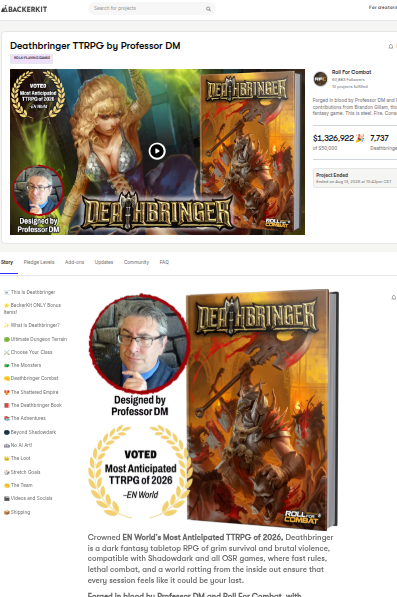
That distinction matters because Professor Dungeon Master’s success illustrates two different opportunities at once. The first is obvious: an independently created tabletop game can attract more than a million dollars in customer commitments. The second is more interesting for the larger argument of this essay: the Game Master himself can become part of the commercial value surrounding the game. His reputation, audience, accumulated experience, and recognizable philosophy of play helped create a group of people interested in what he would design. In an entertainment economy increasingly organized around personalities and direct relationships between creators and audiences, the person behind the game can become more than an invisible name in the credits.
MCDM Productions provides an even larger example. Its original campaign for what became Draw Steel ended in January 2024 with $4,600,520 pledged by 30,177 backers against an $800,000 goal. BackerKit describes it as MCDM’s first original game, a heroic-fantasy RPG built around two major books, one aimed primarily at players and another at the person running the game. This was not merely a publisher asking customers to preorder another supplement for somebody else’s rules. It was a company asking an existing audience to finance the creation of its own role-playing system and associated world, and more than thirty thousand people committed money to that proposition.
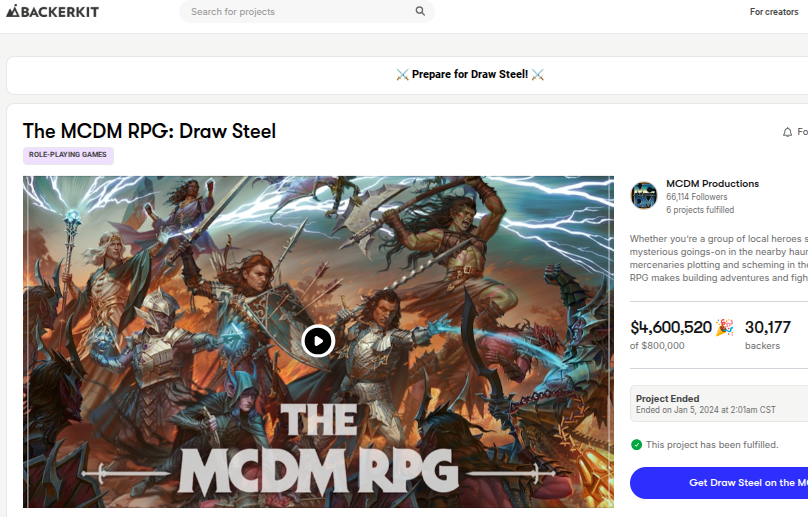
The subsequent history of Draw Steel is even more important than the original number because it provides evidence of repeat demand. MCDM returned with Draw Steel: Crack the Sun, a campaign supporting the continuing game line, and that project ended in January 2026 with $2,617,323 from 9,590 backers against a $1,250,000 goal. A creator can occasionally achieve a spectacular one-time launch because of curiosity, novelty, or an existing audience. Convincing thousands of customers to return for later products is more valuable evidence that the game has begun developing an enduring customer base.
The physical-product behavior surrounding Draw Steel is equally revealing. In 2024, MCDM crowdfunded a specialized set of Draw Steel dice. The campaign openly acknowledged that players did not need those particular dice to play the game; ordinary dice would work. Nevertheless, 2,755 people pledged $317,178 against a $25,000 goal for branded dice and related collectible options. This is important because it demonstrates something that people outside hobby markets frequently misunderstand. Customers do not purchase only what is mechanically necessary. They also buy objects because those objects make an activity more beautiful, convenient, collectible, immersive, or personally meaningful.
The original Draw Steel campaign showed the same pattern on a larger scale. The digital two-book package cost $65 and attracted 7,163 backers. The $135 tier containing both hardcover books and their PDFs attracted 15,663 backers, while 3,618 backers selected a $250 limited-edition hardcover package. MCDM also offered a $500 Ajax Edition containing the limited-edition books together with a resin miniature, cloth map, collectible coin, dice, and a Director’s Screen. These customers were not merely purchasing access to rules. They were buying physical participation in a hobby and a fictional world.
This behavior is hardly unique to tabletop role-playing. A football fan does not need an official jersey to watch football. A music fan does not require a concert shirt to hear an album. A motorcyclist can ride without branded clothing, and a golfer can theoretically play without filling a garage with specialized accessories. Hobby markets become economically powerful because enthusiasts frequently spend money on objects that deepen their connection to the activity. TTRPGs have the same property. Once someone becomes emotionally invested in a game, the commercial question is no longer merely whether he will purchase the core rulebook. It becomes what else he wants to own, display, collect, paint, read, wear, or use while participating in the world.
Million-dollar campaigns demonstrate the upper end of current independent tabletop crowdfunding, but they are not the only evidence that matters. Tales from Elsewhere: Clockworld, for example, is an action-horror, post-apocalyptic weird-west tabletop RPG whose Kickstarter campaign raised $48,316 from 940 backers against a $30,000 goal. That is obviously not four-and-a-half-million-dollar Draw Steel money, but dismissing it for that reason would misunderstand what a healthy creative industry looks like. Most viable businesses are not billion-dollar corporations, and most commercially successful books are not international blockbusters. An independent creator who can repeatedly turn a specialized audience into tens of thousands of dollars in product demand is participating in genuine commerce even if nobody writes a Forbes profile about him.
The smaller example may actually be more relevant to the ordinary aspiring designer. There is an understandable temptation to look at a million-dollar crowdfunding campaign and treat it like a lottery winner: impressive, but too unusual to mean anything about ordinary prospects. A $48,000 campaign demonstrates something different. It shows that a creator does not necessarily need tens of thousands of customers for a project to become economically meaningful. Five hundred committed customers can matter. A thousand can matter substantially. A creator who builds a back catalog, releases products repeatedly, develops direct customer relationships, and gradually increases the size of his audience can construct a business without ever becoming the dominant company in the field.
This is one reason niche tabletop role-playing can be commercially interesting. The creator does not necessarily need to appeal to everyone who plays Dungeons & Dragons. He can create something deliberately darker, stranger, historically specific, mechanically unconventional, romantically focused, politically complicated, religiously challenging, or otherwise outside the tastes of the largest possible audience. Entertainment markets subdivide continuously. The existence of one enormously successful fantasy game does not eliminate the market for other fantasy games any more than the existence of Marvel eliminates horror films or the popularity of Taylor Swift eliminates heavy metal. Different consumers want different experiences, and independent creators are often capable of pursuing an audience too specialized for a large corporation to consider worth serving.
There is an important qualification to all of these crowdfunding numbers, because promotional writing often abuses them. Money pledged is not profit. A campaign that raises $1.3 million does not necessarily put $1.3 million into the creator’s pocket. Artwork, writing, editing, graphic design, printing, manufacturing, platform fees, taxes, shipping, fulfillment, replacement inventory, customer service, and employees can consume substantial portions of campaign revenue. Physical fulfillment in particular can destroy margins when costs are estimated badly. Anyone who treats crowdfunding gross receipts as personal income is not making a serious business argument.
That qualification does not diminish what the figures actually prove. Crowdfunding provides unusually visible evidence of customer demand. More than thirty thousand people committed $4.6 million to the original Draw Steel campaign. Nearly eight thousand committed more than $1.3 million to Deathbringer. Thousands have paid premium prices for hardcover books, limited editions, dice, miniatures, maps, screens, and other physical objects associated with games they want to play. Those figures do not tell us precisely how wealthy the creators became. They tell us something more relevant at this stage of the argument: customers voluntarily decided that these tabletop products were worth substantial amounts of money.
Crowdfunding also changes the relationship between creator, capital, and customer. Under a traditional manufacturing model, a small publisher might have to finance artwork, printing, inventory, and distribution before discovering whether enough people wanted the finished product. Crowdfunding can partially reverse that sequence. The designer presents the concept and enough of the work to persuade potential customers, establishes a funding threshold, and asks the market whether the product should exist. If customers are not interested, that failure can become visible before the creator finances an enormous print run. If customers are interested, their commitments provide evidence of demand and can supply some of the capital required to manufacture what they have already demonstrated a desire to buy.
A crowdfunding backer is not ordinarily an equity investor and should not be confused with one. Supporting a game on BackerKit or Kickstarter generally means purchasing or supporting a promised product rather than acquiring ownership of the company. From the creator’s perspective, however, crowdfunding can still combine two extraordinarily useful functions: market validation and production financing. Thousands of potential customers can effectively answer the question, “Do enough people want this for us to manufacture it?” before the company assumes all of the financial risk on its own.
That possibility is especially important to independent creators because it allows ambition to be tested incrementally. A designer does not necessarily need to mortgage his future on one enormous print run merely to discover whether anyone cares. He can develop the game, build an audience, demonstrate the concept, sell digitally, use crowdfunding when appropriate, observe which products attract customers, and expand when the evidence justifies expansion. Serious entrepreneurship does not require pretending risk does not exist. It requires structuring risk intelligently.
The market evidence therefore leaves us with a conclusion considerably more precise than “there is money in TTRPGs.” Some tabletop products fail. Some barely recover their costs. Some generate useful side income. Some support small companies. Some campaigns attract tens of thousands of dollars, and a small number attract millions. What the current market has decisively demonstrated is that independently created tabletop role-playing games can produce meaningful commercial demand at several different scales.
That is where the insult “get a real job” begins to lose its force. If thousands of customers voluntarily exchange money for a creator’s game, the creator is engaged in commerce. If producing that game pays artists, editors, printers, manufacturers, fulfillment companies, software providers, and other workers along the way, an economic chain has formed around it. Whether one particular creator ultimately earns $10,000, $100,000, $1 million, or loses money is a question of costs, demand, execution, and business judgment. It is no longer reasonable to pretend that game design itself is inherently unserious.
Even these crowdfunding figures, however, capture only the money flowing directly toward particular game projects. They do not count the customer who backs the game and then buys a new set of dice, the Game Master who purchases a 3D printer to manufacture scenery, the player who orders custom miniatures, the group that commissions a purpose-built gaming table, the convention attendee who purchases a plane ticket and hotel room, or the friends who spend money on food and drinks every week because their campaign gives them a reason to gather.
To understand how much larger the economic opportunity can become, we have to stop looking only at the rulebook and begin following the money outward from the table.
The Economy Around the Table
The crowdfunding numbers demonstrate that there is real money in tabletop role-playing games themselves, but they still understate the economic importance of the hobby because they count only the money flowing directly toward a particular campaign. A person who spends $60 on a rulebook may eventually spend several times that amount on the activity surrounding the rulebook. A group of six players may own dozens of sets of dice, hundreds of miniatures, terrain pieces, paints, storage cases, maps, notebooks, digital tools, specialized furniture, and shelves filled with books. They may travel to conventions, stay in hotels, eat in restaurants, commission artwork of their characters, buy clothing connected to the games they love, and eventually devote an entire room of a house to gaming. The game book is not necessarily the end product in this economy. In many cases, it is the object that introduces the customer to everything else.
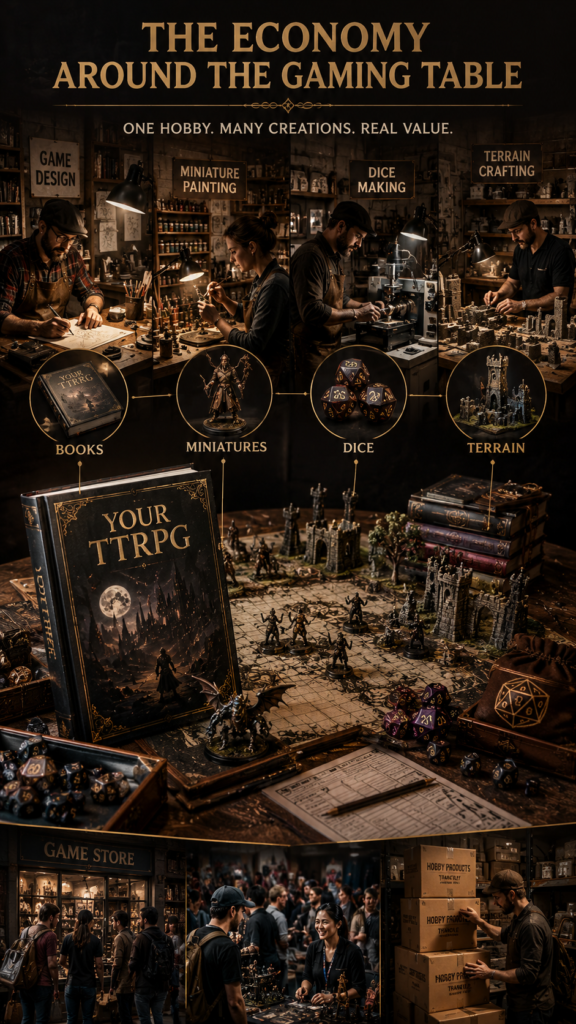
This distinction becomes obvious when we look at miniatures. A role-playing game can be played without them. People played for decades using graph paper, tokens, coins, bottle caps, or nothing but spoken descriptions, and many still prefer what is commonly called theater of the mind. Yet miniatures have become one of the most recognizable physical products associated with tabletop gaming because they give players something tangible to represent an imaginary character. Once that desire exists, an entirely separate industry can grow around it: sculptors design figures, manufacturers produce them, painters sell their services, companies manufacture paints and brushes, terrain designers create environments for the figures to occupy, and storage companies sell ways to transport the resulting collections. The customer who began by purchasing an imaginary world in a book can end up building pieces of that world physically.
Technology has expanded this economy further. Desktop 3D printing allows hobbyists to manufacture miniatures, monsters, buildings, dungeon walls, furniture, tokens, and other gaming accessories at home. Prusa, one of the major manufacturers in consumer 3D printing, has explicitly promoted tabletop gaming as an application for its machines, demonstrating printable RPG miniatures, terrain, dice towers, dungeon tiles, organizers, and other accessories. The significance goes beyond one printer manufacturer. A new chain of commercial activity becomes possible when digital sculptors can sell printable model files directly to customers, customers can manufacture those designs themselves, and other businesses can sell the printers, resin or filament, replacement parts, software, paints, tools, and finishing supplies required to turn digital designs into physical gaming collections.
This is one reason the boundary between a game company and a miniature company can become increasingly porous. Imagine that a game introduces one genuinely memorable monster. Initially, that monster is text and artwork in a bestiary. If players love it, however, there is now a reason to create a miniature. The miniature can be sold conventionally, offered as a premium collector’s piece, or distributed as a licensed file for home printing. If the creature becomes visually recognizable enough, it may eventually appear on clothing, posters, cards, screens, convention displays, or other merchandise. One strong piece of intellectual property can migrate across several different product categories without requiring the designer to invent a new fictional concept every time.
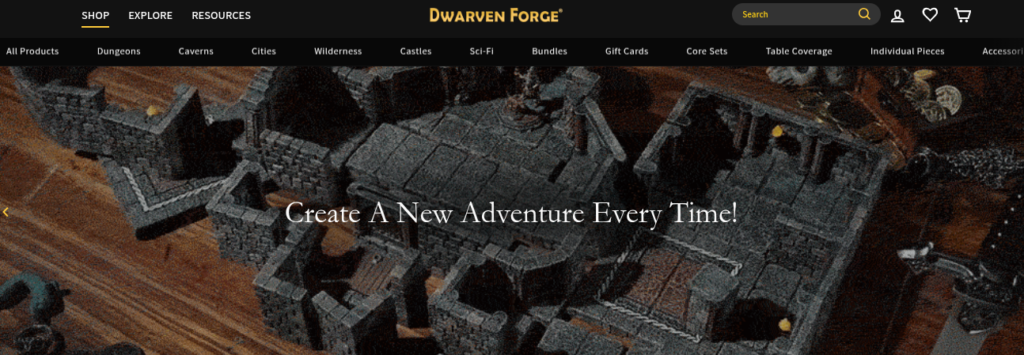
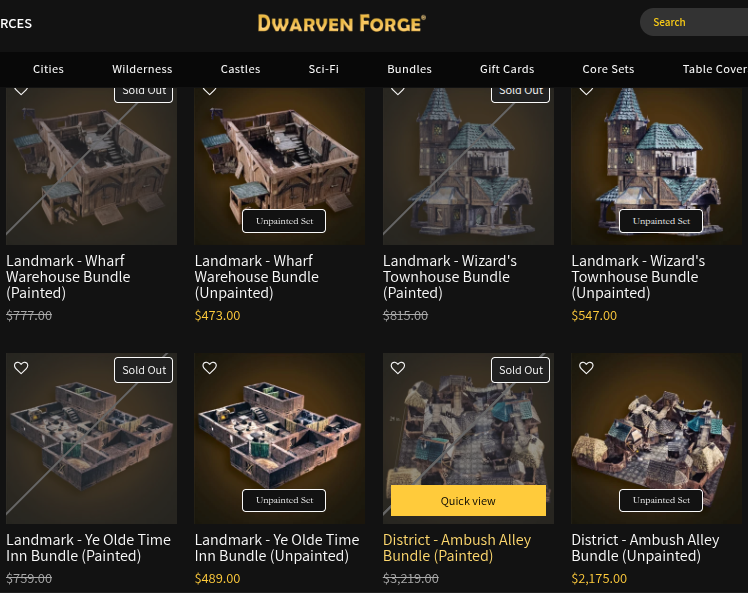
Terrain demonstrates the same principle on an even larger scale. Dwarven Forge, for example, has built a business around premium modular terrain for tabletop games, and the scale of demand is not hypothetical. Kickstarter’s own 2023 review of its Games category listed Dwarven Forge’s Cities Untold: Lowtown among the ten highest-funded games projects of that year, at $3,507,440. That is more than three and a half million dollars pledged not for a new role-playing rule system, but for physical terrain used to make tabletop gaming more visually and physically immersive. Once again, gross crowdfunding revenue should not be confused with profit, but it demonstrates the point that matters here: substantial customer demand exists for the physical environment surrounding tabletop play.
Dice may be an even simpler example. Most role-playing players do not need large collections of dice. A modest set can serve for years. Yet dice have become collectible objects because color, material, typography, weight, theme, craftsmanship, and association with particular games or characters can give them value beyond their mathematical function. We already saw in the previous section that MCDM raised $317,178 from 2,755 backers for specialized Draw Steel dice even while acknowledging that ordinary dice could be used to play the game. The rational economic explanation is not that thousands of people failed to understand what dice do. They wanted objects associated with an activity they cared about. The same principle explains why people buy football jerseys when ordinary shirts cover the human torso perfectly well.
Gaming furniture takes this logic into a much higher price category. A pool player immediately recognizes a pool table. Nobody looks at one and asks why someone would waste so much floor space on a piece of furniture that is useful primarily for a game. Pool tables became culturally established objects for homes, bars, clubs, recreation rooms, and dedicated entertainment spaces. I believe purpose-built tabletop role-playing tables will become increasingly recognizable in the same way. A proper gaming table can incorporate recessed playing surfaces, cup holders, storage, lighting, electrical connections, screens, dice trays, removable dining surfaces, and other features intended specifically for long gaming sessions. Once a household decides that tabletop gaming is one of its primary forms of recreation, dedicating furniture and space to it becomes no stranger than installing a home theater, billiard table, workshop, bar, or elaborate television system.
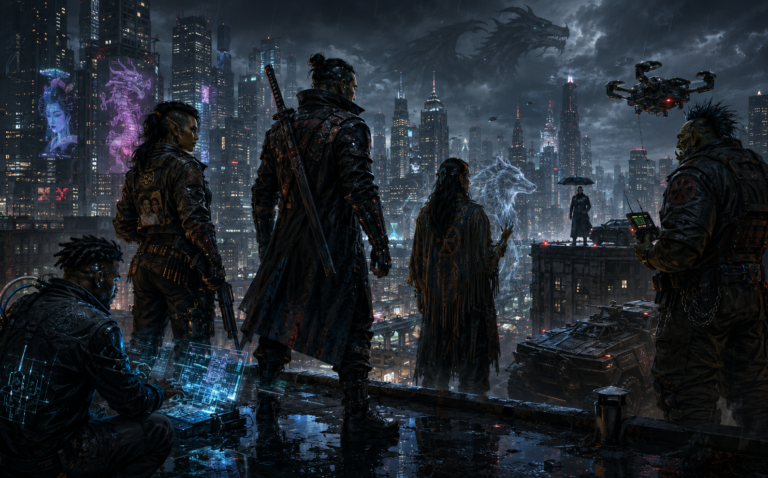
The commercial opportunity does not stop with the table itself. If people are willing to spend substantial money creating home theaters, sports rooms, music studios, workshops, bars, and gaming rooms, there is no reason that tabletop role-playing cannot develop its own recognizable forms of interior design. A dedicated Shadowrun room could look like a dimly illuminated cyberpunk hideout, with industrial surfaces, neon signage, computer displays, urban maps, and shelves of miniatures. A medieval fantasy room could use timber, stone textures, shields, lantern-style lighting, maps, weapon replicas, and furniture intended to make the space feel like an adventurers’ guild hall. A room built around Gloria Nocturna could have an entirely different visual identity, drawing upon its late-eighteenth-century world and the Black Order. None of these things is required to play. That is precisely the point. Luxury markets are built largely around things people desire after their basic needs have already been satisfied.
Once gaming becomes spatial, it creates work for people who may never write a role-playing rule in their lives. Carpenters can build tables and shelving. Electricians can integrate lighting and displays. Interior designers can plan themed rooms. Prop makers can create physical artifacts. Artists can paint murals. Metalworkers can fabricate decorative pieces. Sound technicians can design audio systems. Furniture companies can build chairs intended for long sessions. A wealthy customer could spend more constructing an extraordinary game room than another customer spends on role-playing books in an entire lifetime. From the perspective of the larger economy, both expenditures originated with the same hobby.
The convention business provides much harder evidence that tabletop gaming already produces substantial economic activity beyond game publishing. Gen Con, the largest and longest-running tabletop gaming convention in North America, reported that its 2025 Indianapolis convention attracted a record nearly 72,000 attendees and more than 575 exhibiting companies. More important for the argument here, Gen Con reported an estimated economic impact exceeding $82 million for Indianapolis hotels, restaurants, and other local businesses during the four-day event. That money is not captured by looking at the retail sales of role-playing books. It flows through an entire city because tens of thousands of people want to gather around tabletop gaming.
That is the broader economic principle I am interested in. An entertainment activity can be valuable to businesses that do not own the entertainment itself. A city does not need to publish Dungeons & Dragons to benefit from tens of thousands of gamers arriving for a convention. A hotel does not need to design a role-playing system to sell rooms to those attendees. A restaurant does not need to know the difference between a d12 and a d20 to benefit when hundreds of hungry players leave the convention center. Airlines, rideshare drivers, parking facilities, bars, coffee shops, printers, event contractors, security companies, and countless other businesses can participate in an economy created because people wanted to play games together.
At the premium end, tabletop role-playing has already entered the vacation business. D&D in a Castle currently sells four-day luxury gaming retreats built around more than 24 hours of campaign play with professional Dungeon Masters, meals, activities, transportation to the venue, and lodging purchased separately. Its published 2026 information lists player registration at $3,400, before the required accommodation purchase. The company describes the experience as an immersive tabletop vacation in which guests eat, sleep, and game at castle properties while participating in professionally run campaigns. Another company, Tabletop RPG in a Castle, markets all-inclusive weekend campaigns at historic properties, combining professional Game Masters, catered food, accommodations, and immersive locations.
Think about what has happened economically in those examples. Something that can be played almost for free around a kitchen table has become the organizing reason for somebody to purchase a multi-day vacation. The customer is no longer simply buying rules. He is buying travel, accommodation, food, professional entertainment, atmosphere, location, and the opportunity to spend several uninterrupted days with people who share his interests. A castle that existed centuries before tabletop role-playing was invented can now generate revenue partly because modern gamers want to pretend to be adventurers inside it. That is exactly the kind of secondary economic activity that disappears when someone tries to measure the importance of TTRPGs by looking only at book sales.
Bars and restaurants represent another largely underdeveloped opportunity. Six people who gather every week to play a four-hour campaign are not merely six game players. To a properly structured establishment, they are six recurring customers who need somewhere to sit and may purchase dinner, appetizers, coffee, beer, soft drinks, or other refreshments while they remain there. If the campaign is entertaining enough to attract spectators, the commercial value of that table changes again. Now the game itself may function as programming that gives other customers a reason to remain in the establishment. The same principle has supported trivia nights, karaoke, live music, DJs, comedy, televised sports, and countless other forms of hospitality entertainment. The establishment does not necessarily make its money by charging the performer for occupying floor space; it can make money because entertainment brings human beings through the door and keeps them there.
I will return to that problem in the next section because I believe some gaming establishments have the economics almost completely backward when they treat the Game Master and players primarily as people from whom table rent should be extracted. My experience as a DJ taught me to look at the situation differently. Entertainment has value because it creates traffic, attention, atmosphere, repeat customers, and spending. A talented Game Master running an excellent public campaign may eventually be worth more to a bar or game store than the square footage occupied by his table. The better question is not always, “How much can we charge these six people to sit here?” It may be, “How much business can these six people generate because everybody else wants to see what they are doing?”
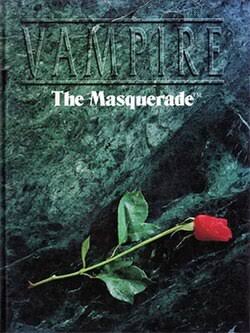
The nightclub model opens still more possibilities, particularly for live-action role-playing. A Vampire: The Masquerade event, for example, can overlap naturally with goth-club culture, costuming, music, dancing, theatrical performance, and nightlife. A venue could theoretically admit ordinary customers at one price while offering a different wristband or ticket to customers participating in the live-action game. Performers, Game Masters, DJs, bartenders, security staff, costume designers, makeup artists, photographers, and venue operators all become part of the same entertainment ecosystem. The game does not have to replace the nightclub; it can give the nightclub another reason for people to attend.
Clothing represents a similar opportunity because tabletop worlds produce identities, factions, symbols, orders, corporations, religions, military units, monsters, and slogans that players may want to display. The most valuable merchandise does not necessarily need to look like conventional gaming merchandise. A shirt with an enormous game logo announces that someone bought a shirt. A well-designed jacket, patch, ring, pendant, cap, or piece of fictional military clothing can allow a customer to wear something from the imaginary world without looking like a walking advertisement. When a fictional organization becomes sufficiently compelling that players want to identify with it physically, worldbuilding has crossed over into fashion.
This is where intellectual-property design and commercial design begin to overlap. A game designer deciding what a faction’s symbol looks like may think he is making a purely artistic decision. He may actually be designing a future patch, necklace, miniature emblem, flag, 👕 T-shirt, gaming-room decoration, convention banner, or collectible object. A memorable vehicle may become a model. A distinctive weapon may become a prop. A monster may become a miniature. A fictional book may become a real book. A military order may eventually have uniforms customers want to wear. Strong worldbuilding creates things that people can desire outside the paragraph in which those things were originally described.
None of this means that every game designer should immediately become a furniture manufacturer, clothing company, hotel operator, miniature sculptor, or convention promoter. Trying to operate twenty businesses simultaneously is an excellent way to fail at all of them. The important point is that a successful tabletop property can create economic opportunities for other businesses, while licensing, partnerships, commissions, referrals, events, and cross-promotion can allow the original creator to participate in some of that value without personally manufacturing every object. The tabletop industry is not simply a collection of competing book publishers. The industry of tabletop role-playing games is an ecosystem in which one successful creative property stimulates spending across many different industries.
This is also why I think the word investment is appropriate even when we are talking about somebody who has no intention of founding a major publishing company.
- A game store investing in a beautiful play space is making a bet that social gaming creates customer traffic.
- A bar hosting a professionally run campaign is making a bet that entertainment sells 🍺 refreshments.
- A sculptor producing miniatures is betting that people want physical representations of imaginary characters.
- A hotel hosting a gaming retreat is betting that customers will travel for an experience.
- A carpenter building premium gaming tables is betting that tabletop players will spend money improving the environments in which they play.
- A 3D-printing company showing customers how to manufacture terrain is participating in exactly the same surrounding economy.
The strongest evidence may therefore be found not in any single game company’s revenue but in the number of businesses capable of earning money because tabletop players exist. Gen Con’s reported $82 million-plus local economic impact in 2025 provides a particularly clear example: hotels and restaurants did not design the games that brought nearly 72,000 people to Indianapolis, but they participated economically in the gathering those games created. The same principle operates at smaller scales every Friday night when a gaming group orders food, buys another miniature, purchases resin for a printer, pays for a digital tool, or decides that the folding card table in the basement should finally be replaced by something worthy of the hobby.
The 📖 rulebook, then, is not the entire economy. Neither is the miniature, the dice set, the gaming table, the convention ticket, the hotel room, or the 🏰 castle vacation. The real economic object is the continuing desire to participate in the experience. Once people care enough about an imaginary world and the friends with whom they explore it, they begin spending money on ways to deepen, beautify, commemorate, and expand that experience. That is how a relatively inexpensive game can create a surprisingly large commercial ecosystem around itself.
And at the center of that ecosystem sits one human being whose economic importance has historically been badly underestimated: the person who actually makes the game come alive at the table. The next question is what happens when we stop treating the Game Master as the friend who reluctantly volunteered for extra homework and begin treating an exceptional Game Master as what he may increasingly become—a professional entertainer.
The Professional Game Master and the Business of Live Play
For most of the history of tabletop role-playing, the Game Master has occupied an economically peculiar position. He may…
- purchase more books than anyone else at the table,
- spend hours preparing adventures,
- learn hundreds of pages of rules,
- create maps and characters,
- improvise dialogue,
- portray dozens of personalities,
- adjudicate disputes,
- manage pacing,
- teach new players,
- and somehow keep five or six different people engaged for several hours at a time.
Then, after doing substantially more work than anyone else involved, he traditionally receives exactly the same financial compensation as the players: nothing.
Increasingly, Game Masters are understanding their value and demanding fair pay for being for taking on so much responsibility, and investment in an entertain game session. StartPlaying describes itself as the largest online marketplace connecting players with Game Masters and currently provides a searchable pool of more than 1,000 professional GMs. Its own 2026 guidance says that the average game on the platform costs approximately $15 to $20 per player per session, while its Game Master search says most sessions fall between $15 and $30. The Game Master chooses the price and schedule; StartPlaying handles booking and payments and currently takes a 15 percent platform fee. The company’s guidance also says that most sessions last roughly two to four hours.
Those numbers are not evidence that professional Game Masters are all earning comfortable full-time incomes. They demonstrate something more fundamental: a functioning market now exists in which strangers routinely pay other people specifically to Game Master for them. The old assumption that the GM is simply the unfortunate friend who got stuck doing the extra work is no longer sufficient to describe the profession. Some people are beginning to purchase Game Mastering in the same general way they purchase instruction, entertainment, guided experiences, or other skilled personal services.
StartPlaying itself says that Game Masters on its platform have collectively earned more than $3 million since the company launched in September 2020. The figure is published by the company rather than independently audited financial reporting, so it should be treated as the platform’s own claim, but even the existence of a marketplace large enough to advertise thousands of professional GMs tells us something important about where the culture is going. The question is no longer whether someone can charge money to run a role-playing game. The more interesting question is how far professional Game Mastering can develop as an entertainment profession.
I think the answer is much farther than the current market generally imagines.
A truly excellent Game Master possesses a combination of skills that are individually valuable in other professions. He needs the instincts of a storyteller, the timing of a performer, the organizational abilities of an event host, the social perception of someone managing a room, and enough improvisational ability to respond intelligently when the participants do something he never anticipated. Depending upon the style of game, he may also need voice acting, historical knowledge, tactical ability, music selection, visual presentation, technical proficiency, comedy, dramatic acting, miniature painting, terrain construction, or extensive knowledge of a fictional world. Most importantly, he needs the ability to understand the people sitting in front of him. A technically perfect Game Master who cannot read his players can produce a miserable evening. A great one knows when to let someone speak, when to interrupt, when to increase pressure, when to make the table laugh, when to frighten it, and when to get out of the way and allow the players to create the memorable moment themselves.
The Game Master is not merely operating the game. The Game Master is part of the entertainment.
That distinction is obvious in almost every other performance industry. People do not say that one DJ is interchangeable with another because they both own music. They do not say one comedian is interchangeable with another because both have microphones. A singer is not simply a delivery mechanism for songs. Personality, taste, technique, reputation, presentation, and the relationship between performer and audience create value. There is no reason Game Mastering should be exempt from the same principle. Matthew Mercer is not valuable merely because he knows the rules to Dungeons & Dragons. Professor Dungeon Master is not interesting merely because he possesses role-playing books. Their identities, philosophies, voices, experience, and ways of presenting games are part of what attracts audiences to them.
This is particularly obvious to me because I have worked as a DJ. When I was performing, the relationship between performer and venue was straightforward: if I could bring people through the door and keep them entertained, I had economic value to the establishment. I could charge whatever I wanted at the door, keep the majority of that money, and pay the people I had selected to help operate the event. The club benefited because people were inside the building. Those people bought 🍺 drinks, socialized, brought friends, returned for future events, and created the atmosphere that made the venue worth visiting in the first place. I would never have accepted a nightclub telling me that I first needed to pay the club for the privilege of entertaining the customers I was helping bring into it.
Yet I encountered essentially the opposite philosophy at a gaming establishment in San Francisco. I do not remember the establishment’s name well enough to identify it fairly, and I am not going to invent the precise rates from memory, but the basic model was unmistakable: players were expected to pay for access to the gaming space, with membership and hourly table charges built into the arrangement. What struck me immediately was how backward the incentive could become when applied to a talented Game Master. Instead of asking what a great GM might bring into the establishment, the model began by asking how much money could be extracted from the people occupying the chairs.
There are circumstances in which charging for private rooms or premium table space makes perfect sense. Real estate costs money. Employees cost money. Electricity, insurance, furniture, cleaning, and maintenance cost money. A group that wants to reserve an enclosed room exclusively for six hours may reasonably be expected to pay for that privilege. My objection is not to the existence of table fees under every conceivable circumstance. My objection is to treating the table itself as the primary economic asset while ignoring the entertainment taking place on top of it.
Imagine instead that a game store gives a talented Game Master an excellent table every Friday night. Six players participate. Perhaps the store makes very little directly from the chairs during the first few sessions. Then three people begin standing nearby because the campaign is entertaining. They laugh at the jokes, listen to the characters argue, and start wondering what is going to happen next week. One of them buys a miniature while watching. Another orders food or a drink. Somebody asks whether there is an opening in the campaign. The following week those spectators bring friends. Eventually customers begin coming to the store partly because they know something interesting happens there every Friday.
At that point, the Game Master has become like a regularly scheduled television program.
Bars have understood this principle for generations. A trivia host occupies space but can make Tuesday night worth attending. A DJ requires floor space and equipment but can fill a nightclub. A local band may consume an entire stage but can bring customers through the door. Karaoke requires equipment, a host, and an area that could theoretically have contained more tables, yet establishments run karaoke because people stay, drink, participate, and return. Televisions showing 🏈 sports occupy wall space because a room full of people watching a championship game spends money. The relevant economic calculation is not simply how many dollars can be extracted from each square foot every hour. It is whether the activity taking place there makes the establishment more valuable to the people inside it.
This becomes particularly interesting because the players themselves can eventually become performers. A great tabletop session does not consist solely of the Game Master talking while everyone else listens. The players develop characters, improvise dialogue, make unexpected decisions, argue, joke, betray one another, solve problems, and occasionally produce moments better than anything the Game Master planned. The GM creates the conditions under which those performances can happen. A particularly charismatic group can therefore become an ensemble in much the same way that an improvisational theater company develops chemistry among recurring performers.
Actual-play entertainment has already demonstrated that strangers will watch this process. That fact is so familiar within the TTRPG community now that its significance can be overlooked. Watching other people play a role-playing game once sounded almost absurd. Today, actual-play programs have built large audiences precisely because the combination of improvisation, character performance, uncertainty, humor, and continuing narrative can itself become entertainment. The existence of that audience suggests that the boundary between a private game and a public performance is not nearly as firm as people once assumed.
The theatrical industry has begun exploring the same territory. Dungeons & Dragons: The Twenty-Sided Tavern turned role-playing into an interactive stage production in which audience choices influence an adventure. The production’s official description calls it a combination of theater, gaming, and one-of-a-kind storytelling in which the experience can change from performance to performance. Its North American tour was designed around an audience of approximately 500 people, with professional scenic, costume, lighting, sound, projection, illustration, and show-control personnel contributing to the production. Ticket listings for its Off-Broadway run ranged from $59 to $144.
That matters because it shows what happens when the economic boundary around tabletop gaming expands. Suddenly the game is creating employment for lighting designers, costume designers, actors, sound technicians, projection designers, illustrators, theater employees, and venue staff. What began historically as several people describing imaginary adventures around a table has acquired enough cultural value to support professional theatrical production.
Live-action role-playing can push the concept even farther because the distinction between the imaginary environment and the entertainment venue begins to disappear. Vampire: The Masquerade has always been particularly suited to this because its fictional world is built around vampires hiding among ordinary human society. Nightclubs, underground parties, formal gatherings, and gothic social environments can therefore function simultaneously as real entertainment venues and fictional locations. Accounts of Vampire LARPs describe games conducted in nightclub-like and semi-public environments, while White Wolf’s officially produced 2016 End of the Line LARP placed approximately 70 participants inside a fictional illegal techno party.
The commercial possibilities are not difficult to imagine. A goth nightclub could operate normally while also hosting a live-action game. Ordinary customers pay normal admission. LARP participants pay a premium and receive a different wristband or another visible marker identifying them as players. Actors or game staff circulate through the venue. The DJ is still performing. The bartenders are still serving drinks. People who have no interest in role-playing can simply enjoy the club, while participants are simultaneously experiencing the room as a location inside an ongoing fictional world. The venue has not sacrificed its ordinary business in order to accommodate the game; the game has become an additional layer of entertainment taking place inside the business.
There is historical evidence that gothic nightlife and vampire-themed events can sustain this kind of overlap even outside formal role-playing. Portland’s Vampire’s Masquerade Ball began in 2002 as the anniversary celebration of an underground gothic nightclub with a crowd of roughly 100 people. After that club closed, the event continued independently, growing to 300 guests by 2005 and eventually moving through larger venues, including the Portland Art Museum. Its organizers combined DJs, live performances, vendors, formal costuming, and vampire aesthetics into an event that outgrew the nightclub where it originated. It is not itself evidence that every such event should become a Vampire LARP, but it demonstrates that the surrounding aesthetics, performance culture, nightlife, and audience already coexist naturally.
Professional Game Mastering could similarly develop at several economic levels rather than becoming one standardized occupation. At the entry level, someone might run a paid online game once per week for extra income. Another GM might operate several campaigns and make professional Game Mastering a substantial part of his income. A specialist could run premium private games for wealthy clients, corporate groups, tourists, bachelor parties, conventions, or resorts. Another could develop a public persona through recorded actual play. Another might tour. Another might combine Game Mastering with teaching, acting, voice work, writing, or game design. There is no reason the profession must eventually have one business model any more than “musician” means only one way of making money.
This is also why I do not believe professional Game Masters should compete primarily by becoming cheaper. If the average online session currently costs somewhere around $15 to $20 per player, that tells us something about the present marketplace, not the permanent economic value of the profession. A beginning musician playing a neighborhood bar and a globally famous performer selling arena tickets are both musicians, but nobody expects their compensation to be comparable. The same hierarchy can eventually emerge among Game Masters. Reputation, originality, production quality, reliability, charisma, mastery of particular games, and the ability to create experiences people cannot easily reproduce themselves can justify radically different prices.
A professional Game Master also has an advantage that many entertainers do not: the audience can become part of the performance. Six customers are not merely sitting silently in theater seats while one person entertains them. They are helping create the evening. This gives a great GM something closer to the relationship between a director, host, improvisational performer, and master of ceremonies. The product is not simply the story he prepared. The product is his ability to take six unpredictable human beings and make something memorable happen with them.
The best Game Masters will not merely run games. They will become people audiences specifically want to see run games.
Once that happens, the economics change again. A Game Master with a following can sell tickets, publish adventures, design games, appear at conventions, run premium campaigns, record actual-play programs, attract sponsors, sell merchandise, teach Game Mastering, and draw customers toward venues. His campaigns can introduce audiences to particular rule systems, settings, miniatures, dice, terrain, and other physical products. A professional Game Master who loves a particular game becomes, in effect, one of the strongest salespeople that game can have—not because he stands in front of a shelf telling people to buy it, but because people watch him make the game look exciting enough that they want to participate themselves.
That is the business model I find much more compelling than charging talented entertainers for the privilege of occupying a table. Give the entertainer the table. Make the environment excellent. Let people see what happens. Sell them refreshments, miniatures, dice, terrain, clothing, memberships, premium events, or whatever else makes sense for the establishment. If the GM cannot attract anyone and nobody cares about the game, then the experiment has failed and the table can be used for something else. But if people begin gathering around it, the establishment has discovered something far more valuable than an hourly furniture rental.
The natural objection is that this can work in a store or a nightclub only at relatively modest scale. Six players remain six players, and a few spectators standing nearby hardly constitute a revolution in entertainment. That objection is reasonable only if we assume that the physical scale of tabletop performance must always remain approximately the size of the table itself.
There is no reason to make that assumption.
Once people are willing to watch a Game Master and a group of players on a screen, once hundreds are willing to watch interactive role-playing on a theatrical stage, and once audiences form attachments to the personalities actually playing the game, the next question is not whether tabletop role-playing can become spectator entertainment. It already has.
The next question is how big the room can become.
From Six Players to a Stadium
The idea of filling a football stadium to watch people play a tabletop role-playing game sounds ridiculous until one notices that the supposedly ridiculous part has already begun to happen. In 2024, Critical Role drew more than 12,000 people to London’s Wembley Arena for a live role-playing performance. Dimension 20 subsequently took its actual-play show to Madison Square Garden in New York. Meanwhile, Dungeons & Dragons: The Twenty-Sided Tavern has demonstrated a different model by turning role-playing into interactive theater for audiences of approximately 500 people at a time. We are no longer asking whether people will leave their homes and purchase tickets to watch other people role-play. They already do. The question I find much more interesting is what happens if this form of entertainment continues growing.
There is an understandable objection to the entire idea of spectator tabletop gaming: why would anybody pay to watch somebody else play a game? The answer is that human beings have been paying to do essentially that for a very long time. Millions of people watch football without touching the football. They watch poker without holding the cards, videogame tournaments without touching the controller, chess matches without moving the pieces, and professional wrestling without climbing into the ring. The value comes from competition, personality, uncertainty, skill, narrative, identification with participants, and the communal experience of wondering what happens next. TTRPG actual play rearranges those ingredients into something unusual. It is not normally competitive in the manner of football, but it contains uncertainty that conventional scripted entertainment cannot completely reproduce. The Game Master can prepare an extraordinary situation, but the players may respond unexpectedly and the dice can destroy everyone’s plans.
That uncertainty becomes much more powerful in front of an audience. If a character has to make one extraordinarily difficult roll to save another character who has been part of a campaign for three years, thousands of spectators can understand what is at stake before the die ever leaves the player’s hand. For a few seconds, nobody knows what is about to happen. The audience sees the roll at essentially the same moment as the performers. There is no screenwriter backstage who already knows the answer. David Carpenter, one of the creators of The Twenty-Sided Tavern, has compared this feeling to watching the decisive moment of a sporting event: the uncertainty can create the same kind of collective tension and release when hundreds of people experience the result together.
This is where I think the comparison with professional sports becomes more useful than the comparison with ordinary theater. A movie audience knows that the film will be exactly the same at the 9:00 p.m. showing as it was at 6:00. A theatrical performance varies because human performers vary, but Hamlet does not ordinarily decide halfway through Act III that he would rather abandon Denmark and become a pirate. A tabletop campaign can go somewhere nobody expected because the people making it are simultaneously discovering it. That creates one of the oldest commodities in entertainment: the possibility that tonight something extraordinary might happen and you will be able to say that you were there when it did.
The Twenty-Sided Tavern has already experimented intelligently with extending that participation beyond the people physically playing characters. Audience members use their phones to vote on decisions affecting the performance, allowing hundreds of people to influence what happens onstage. The show’s creators deliberately approached the problem as a way of making the audience part of the game rather than merely surrounding a game with theater. The production describes itself as a combination of theater, gaming, and storytelling in which the adventure changes according to audience choices, and its technology allows the spectators to influence characters, puzzles, and outcomes. That is important because it suggests that scaling tabletop entertainment does not necessarily require turning players into actors while everyone else becomes passive. Technology can allow a large audience to participate without giving thousands of people permission to shout contradictory instructions at the Game Master.
But I think there is another direction worth exploring: preserve the traditional gaming table at the center of the experience and build an enormous production around it.
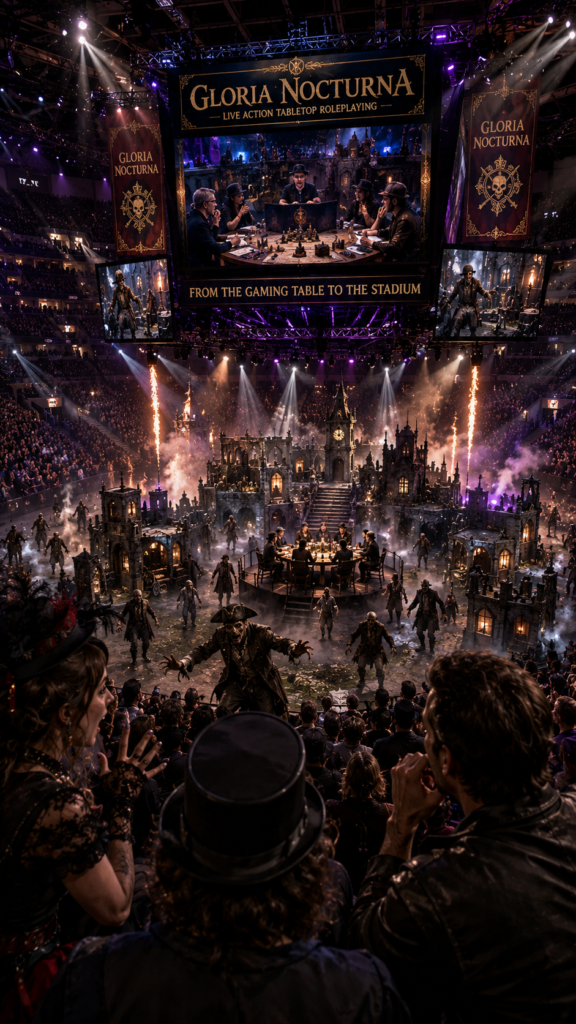
Imagine a football stadium with one exceptional Game Master and six or seven players seated at a beautiful gaming table near the center. They do not need to pretend that they are performing a conventional stage play. They are playing the game. Cameras capture their faces, dice, miniatures, maps, and physical performances and project them onto the enormous displays already used at major sporting events and concerts. The audience can follow the game exactly as millions of people already follow actual-play broadcasts from home. The difference is that the fictional world being described at the table can begin manifesting physically throughout the stadium.
The Game Master tells the players that their characters enter a circus tent. Music begins, the lights change, and actual aerialists or circus performers descend into the performance space. The characters arrive in a royal court, and costumed actors appear around the table as courtiers, guards, musicians, or servants. They enter a cemetery and, a few minutes later, the audience notices figures dressed as the dead walking through the stadium aisles. A battle begins and percussion, lighting, smoke, projection, practical effects, and carefully controlled pyrotechnics transform the atmosphere of the building. A sorcerer opens a portal and projection mapping or laser effects make the fictional event visible on a scale that would be impossible at somebody’s kitchen table.
The critical distinction is that these effects would serve the game rather than replace it. The spectacle would not be completely predetermined because the production team would need multiple possibilities prepared. If the players never enter the cemetery, the zombies never appear. If they negotiate with the dragon rather than fighting it, the battle effects remain unused. If they abandon the Game Master’s anticipated route entirely, the production has to improvise along with him. That would make the logistical challenge enormous, but the challenge is part of what makes the concept interesting. Modern stadium concerts already coordinate lighting, video, automation, sound, dancers, musicians, pyrotechnics, enormous moving stage elements, and thousands of individual cues. A stadium-scale role-playing production would apply comparable technical capabilities to an entertainment form in which some of those cues remain conditional until the players decide what they are doing.
The spectacle would be prepared. The story would not be predetermined.
That is something fundamentally different from simply putting Dungeons & Dragons costumes on a Broadway show. The central attraction remains the unpredictable game between human beings. Everything surrounding them magnifies the experience.
Once we imagine tabletop entertainment at that scale, an extraordinary number of professions become relevant. A production could employ actors, stunt performers, dancers, circus artists, musicians, composers, DJs, costume designers, makeup artists, miniature painters, sculptors, prop makers, scenic designers, lighting technicians, sound engineers, projection specialists, camera operators, editors, stage managers, security personnel, programmers, visual-effects artists, and dozens of other specialists. The Game Master and players would remain the nucleus, but a large live production could become an intersection of multiple human art forms.
This is particularly important in the context of artificial intelligence. Much of the present discussion about AI and entertainment concentrates understandably on what machines may eventually be able to produce more cheaply. I am equally interested in the reverse question: what kinds of human experiences become more valuable when machine-generated entertainment becomes abundant? If generating competent images, music, video, and prose becomes dramatically easier, scarcity does not disappear; it moves. Being physically present with thousands of other human beings while something unpredictable happens may become more valuable precisely because digital content becomes easier to manufacture.
We already understand this principle with music. A person can listen to nearly any song imaginable through a device in his pocket, yet people still spend hundreds or thousands of dollars traveling to concerts. The availability of recorded music did not eliminate the desire to stand in a room with the performer and thousands of other fans. If anything, recordings help create the audience that later wants the live experience. Actual-play video may function similarly for tabletop entertainment. Someone watches a Game Master online for years, develops affection for the players and characters, and eventually wants to experience that group in person.
The scale is already moving in that direction. More than 12,000 people attending a Critical Role performance at Wembley Arena is not a theoretical prediction about some distant future. It is evidence that an audience large enough to fill a substantial arena already exists for tabletop actual play. That does not prove that somebody can fill an 80,000-seat football stadium tomorrow. There is an enormous commercial difference between 12,000 tickets and 80,000 tickets, and pretending otherwise would weaken the argument. What it proves is that the ceiling has already moved dramatically beyond what most people would have imagined when role-playing games began in the 1970s.
I therefore do not claim that stadium TTRPGs are inevitable. I ask a different question: why should we assume that today’s livestream and arena show represent the final form of actual play?
The entertainment industry repeatedly makes the mistake of assuming that a new form has reached maturity simply because the present version seems familiar. Early cinema did not reveal IMAX theaters. Early radio did not reveal podcasting. The first videogames did not reveal professional esports arenas. The first DJs playing records for dancers did not reveal electronic-music festivals involving enormous stages, lasers, pyrotechnics, video walls, elaborate lighting, and crowds numbering in the tens of thousands. Entertainment formats accumulate technologies and traditions as audiences discover what they enjoy.
TTRPGs have an additional advantage because they are unusually compatible with other forms of entertainment. Music can become part of a game. Theater can become part of it. Dance can become part of it. Film can become part of it. Visual art, costume, architecture, puppetry, practical effects, animation, comedy, and improvisation can all be layered around role-playing without destroying the underlying activity. A fantasy game might incorporate medieval musicians and sword performers. A cyberpunk game might use electronic music, neon lighting, enormous video displays, and performers moving through the audience as corporate security or street gangs. Horror could use darkness, spatial sound, makeup effects, actors hidden among the crowd, and carefully controlled moments in which the audience is uncertain whether something occurring nearby is part of the production.
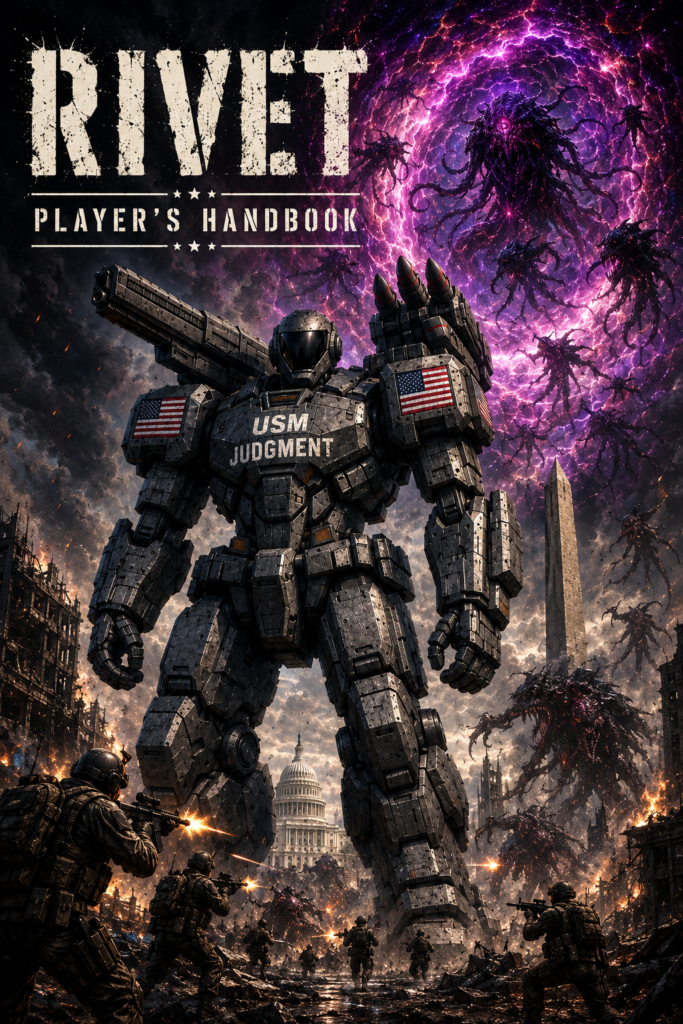
RIVET, my post-apocalyptic science-fiction nightmare setting, immediately suggests an entirely different production vocabulary: emergency broadcasts, distorted communications, industrial lighting, warning sirens, enormous creature imagery, military personnel moving through the venue, and the sense that something catastrophic is occurring outside the safe area occupied by the audience. Gloria Nocturna would demand something different again, with late-eighteenth-century influences, religious ritual, military ceremony, darkness, candlelight aesthetics, music, and the visual identity of the Black Order. The entertainment possibilities are not limited to generic medieval fantasy because tabletop role-playing itself is not limited to generic medieval fantasy.
There are also ways to involve the audience without allowing audience participation to destroy the integrity of the campaign. Spectators might vote on environmental complications, contribute resources to one side of a conflict, choose which previously prepared encounter appears, or influence secondary events without controlling the player characters themselves. Premium ticket holders might receive roles inside particular portions of the experience. A section of the stadium could become a fictional tavern, corporate enclave, royal court, military camp, or nightclub. Audience members could arrive in costume without being required to do so. The exact balance between watching and participating would differ between productions, just as some concerts encourage elaborate audience interaction while others place almost all attention on the stage.
The stadium itself could therefore become more than a large container for spectators. It could become part of the fictional geography.
That possibility becomes particularly interesting when compared with Renaissance fairs, haunted attractions, theme parks, professional wrestling, concerts, and immersive theater. Each has discovered different methods of allowing audiences to inhabit an entertainment environment rather than merely look at one. TTRPGs provide something those forms generally lack: a rule-governed, continuously evolving narrative whose central characters are making meaningful decisions in real time. Combining those properties does not guarantee commercial success, but it creates a form of entertainment sufficiently distinct that I think it deserves serious experimentation.
It also creates an economic ladder rather than requiring somebody to begin by renting a football stadium. A Game Master can start with six players. If people enjoy watching, he can run publicly in a game store. Then perhaps a bar. Then a small ticketed room. Then a theater holding a few hundred people. A particularly successful actual-play company might move into a 1,000-seat theater, then a 5,000-seat venue, then an arena. At each stage the market tells the creator whether enough people care to justify the next increase in scale. The Twenty-Sided Tavern demonstrates the roughly 500-person theatrical level, while Critical Role’s Wembley performance demonstrates that actual play can move into five-figure arena attendance. Nobody needs to gamble immediately on the final stage.
This is where the analogy to local music becomes personally important to me. When my friends and I were teenagers, before we were even old enough to drink, going to see local bands was something to do. They did not need to be Metallica. Part of the pleasure was discovering people from the local scene, seeing them perform in a small room, bringing friends, buying something, and perhaps watching a band gradually become better and attract a larger following. TTRPG performance can develop the same culture. A local Game Master does not need to be Matthew Mercer any more than a local guitarist needs to be Eddie Van Halen. He needs to be good enough that somebody says afterward, “You should come next Friday. This guy runs an incredible game.”
That kind of recommendation is how scenes form. Scenes create venues, performers, regular audiences, specialized businesses, conventions, merchandise, and eventually stars. The economic importance of professional Game Mastering may therefore depend less upon discovering one universally correct business model than upon creating an environment in which thousands of different Game Masters can develop their own audiences and styles.
If that happens, filling a stadium stops being the starting proposition and becomes the extreme end of a much larger entertainment ecosystem. Most musicians never play stadiums, but nobody uses that fact to argue that live music is not a business. Most comedians never sell out Madison Square Garden, but comedy clubs remain economically meaningful. Most athletes never play in the Super Bowl, but professional and semi-professional sports exist at many levels. Professional Game Mastering can develop the same hierarchy, from the person earning extra money running games on weekends to the exceptional performer capable of attracting thousands of paying spectators.
And if someone eventually becomes good enough, famous enough, and imaginative enough to put six players at the center of a football stadium while 60,000 people watch an imaginary world erupt around them, I do not think the correct reaction will be, “Why would anyone pay to watch people play a tabletop game?”
By then, the answer will be standing in the stadium.
The Independent Creator Has Never Had Tools Like These
The previous sections have moved steadily outward from the gaming table. A rulebook can support miniatures, terrain, specialized furniture, conventions, destination gaming, professional Game Masters, live theater, and perhaps eventually enormous spectator events. That expansion naturally makes tabletop role-playing sound increasingly expensive. A stadium production would require millions of dollars. A major miniature line requires manufacturing. A dedicated entertainment venue requires real estate. Even a professionally illustrated hardcover rulebook would once have required enough capital to make independent publishing prohibitively risky for many people. Yet one of the most important developments in the business of tabletop role-playing is happening at exactly the opposite end of the economic scale: it has become possible for one determined person with a computer to do things that once required a publishing company.
This does not mean that technology has eliminated the need for talent, judgment, persistence, or money. Professional artwork still costs money. Editing still matters. Graphic design matters. Marketing matters enormously. Printing physical books costs money, and creating a beautiful hardcover game remains a very different undertaking from uploading an amateur PDF to the internet. What has changed is the amount of infrastructure an independent creator must personally own before he can begin. He does not necessarily need a printing press, warehouse, conventional distributor, software development department, dedicated sales staff, or enormous first print run. Much of that infrastructure can now be rented inexpensively, accessed through software, purchased only when needed, or avoided altogether until customer demand justifies it.
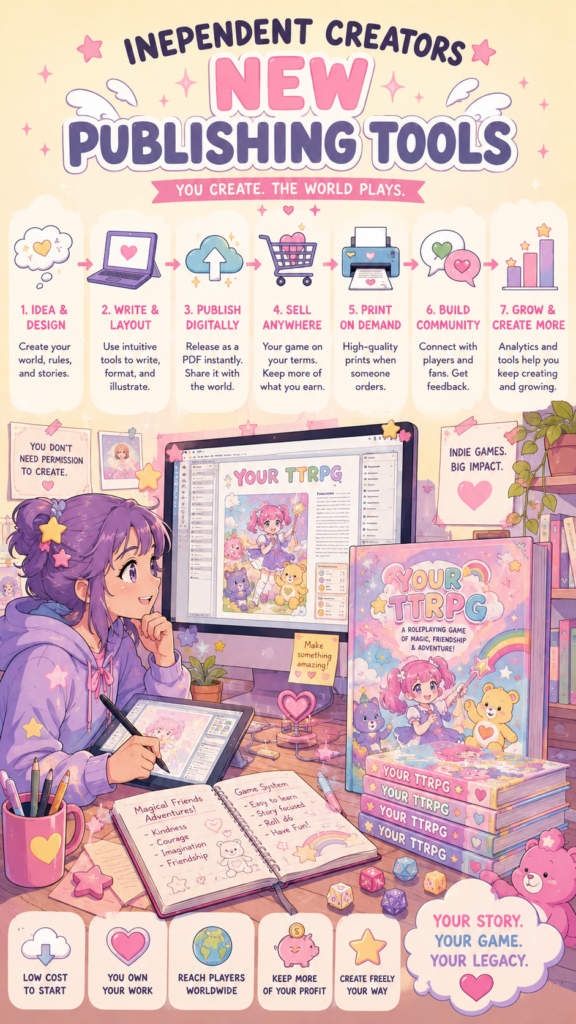
The cost of attempting professional publishing has fallen dramatically, even though the difficulty of creating something people actually want has not.
Consider the most basic problem: writing the book. A creator does not need an expensive proprietary publishing environment merely to produce a professional manuscript. LibreOffice is free and open-source software, and its Writer application is explicitly intended for everything from ordinary notes to full-length books. LibreOffice also permits commercial use without licensing fees. Google Docs provides another familiar route for drafting and collaboration, particularly when several writers or editors need to work on the same manuscript. Neither tool magically produces a good book, but that is precisely the point: the expensive part increasingly becomes the human work and quality of the ideas, rather than merely obtaining access to the machinery required to type, revise, store, and share them.
Worldbuilding presents a different problem. A substantial role-playing world may contain hundreds of characters, nations, religions, settlements, monsters, historical events, organizations, spells, technologies, maps, and relationships. A novelist may face the same problem when creating a large fictional universe, while a Game Master can accumulate years of campaign notes until finding one particular fact becomes an archaeological expedition. This is where a tool such as Obsidian becomes unusually useful. Obsidian stores information locally in plain-text Markdown files and allows notes to be linked together, which makes it particularly suited to interconnected bodies of information. Since February 2025, Obsidian has also been free for commercial as well as personal and nonprofit use; the company says no account is required for ordinary use and that the user’s data remains stored locally unless optional services such as Sync or Publish are used.
For a tabletop designer, the implications are obvious. A note about a fictional king can link to his kingdom, his children, the war in which he fought, the religious order that opposes him, the city in which he lives, and the adventure in which the players might encounter him. A monster can link to its habitat, related species, magical properties, miniature concept, and the campaign in which it first appeared. A novelist working in the same universe can use that interconnected information to maintain continuity. A Game Master can build a campaign encyclopedia. A fan who enjoys writing fiction set within a game world can organize the same kind of material. None of this requires Obsidian specifically, but tools like it make the construction of enormous fictional worlds increasingly manageable by individuals and very small teams.
Then there is the problem that historically separated writing a book from publishing a book. For much of publishing history, putting a physical book into commerce meant printing a substantial number of copies in advance. The economics favored larger print runs because the unit cost generally fell as the number of copies increased. That created a nasty problem for a small publisher: ordering more copies could make each book cheaper, but every unsold copy became money trapped in a box. Inventory had to be stored somewhere, transported somewhere, and eventually sold.
Print-on-demand changes that equation. Lulu states that its print-on-demand system has no minimum order requirement; a creator can order a single copy or hundreds or thousands, with books printed as they are ordered. Lulu also offers automated printing and fulfillment, more than 3,000 book-format combinations across its services, and a global print network. That does not necessarily make print-on-demand cheaper per copy than a large offset print run, nor does it eliminate the need to prepare professional files. What it eliminates is one of the most dangerous assumptions an independent publisher once had to make: I think people will buy 5,000 of these, so I must manufacture 5,000 before I find out.
For an independent tabletop designer, that is an extraordinary change. I can produce a book, order one copy, hold the physical object in my hands, discover that something looks terrible, correct the files, and order another copy. I can continue refining the product before committing myself to a large inventory. If demand later becomes substantial enough that another printing method offers better economics, I can make that decision based upon actual sales rather than fantasy.
The digital side can require even less capital. I use Payhip to sell my work directly. As of this writing, Payhip’s Free Forever plan costs $0 per month, provides the same core feature set as its paid plans, allows unlimited products and revenue, and charges a 5 percent Payhip transaction fee on sales. Its Plus plan is currently $29 per month with a 2 percent Payhip transaction fee, while the $99-per-month Pro plan removes Payhip’s transaction fee; payment processors such as PayPal or Stripe can still charge their own fees.
Think about what that means for someone attempting to enter publishing. The storefront itself does not necessarily require hundreds or thousands of dollars before the first customer arrives. A person can write a book using free software, create a digital product, establish a storefront without a monthly subscription, and begin discovering whether anybody wants what he has made. If sales remain tiny, the infrastructure remains inexpensive. If sales increase, the creator can upgrade the infrastructure as the business begins generating the money needed to pay for it.
This is a profound reversal of the old relationship between capital and experimentation. Instead of requiring substantial capital merely to determine whether an idea deserves to exist, modern publishing increasingly allows creators to make relatively inexpensive experiments and then invest more heavily in the experiments customers actually reward.
A serious independent creator should also have his own home on the internet. My own choice is Hostinger. Hostinger currently combines web hosting with site-building tools, domains on qualifying plans, email, SEO and marketing features, and AI-assisted website creation. Its website builder can be used for ordinary sites, blogs, portfolios, and ecommerce, while its current AI builder can generate a starting website from a written description and then allow the owner to modify it. Pricing changes and promotional introductory prices should never be mistaken for permanent costs, so I am less interested in advertising one temporary dollar figure than in the larger fact: a professional-looking independent web presence no longer necessarily requires hiring a programmer and web-design agency merely to get started.
That matters to me for reasons extending beyond convenience. I have had six TikTok accounts banned. I no longer do business with Amazon, despite having previously worked extensively in audiobooks. Experiences like those have strengthened a principle I have discussed elsewhere: do not build castles on land you do not own. Social-media platforms can be tremendously useful. Marketplaces can put products in front of enormous audiences. Video platforms can introduce a creator to people around the world. I would be foolish to deny their value. But an audience that exists entirely inside somebody else’s platform is an audience that exists subject to somebody else’s rules, algorithms, business decisions, moderation policies, and continued willingness to let you remain there.
A creator who depends completely upon one social network has not built a kingdom; he has rented space inside somebody else’s. The same problem exists when all sales depend upon one marketplace or all communication depends upon one account. An independent website does not solve every problem—web hosts themselves are companies, domains must be maintained, payment processors remain necessary, and traffic still has to come from somewhere—but it creates a central identity that can survive movement between platforms. Social media should lead people toward the creator’s work rather than become the only place where that work exists.
This principle becomes increasingly important for creators whose work is controversial, unusual, politically inconvenient, religiously challenging, artistically offensive to some people, or simply difficult for automated moderation systems to understand. If your entire business depends upon never upsetting the sensibilities of a platform you do not control, then the platform has acquired enormous influence over what you are willing to create. Independence is therefore not merely a technical matter. For some writers and artists, it is a creative one.
Artificial intelligence adds another set of tools to this independent publishing stack, and here I think both the utopian and apocalyptic versions of the conversation miss what is already happening. AI does not need to replace a novelist, artist, editor, programmer, or game designer completely in order to change the economics of independent creation. It merely needs to make some portions of their work faster or make capabilities available that an individual previously could not afford.
A game designer can use AI to help:
- deeply contemplate an idea,
- organize research,
- compare historical information,
- brainstorm alternatives,
- identify contradictions,
- create preliminary concepts,
- assist with translation,
- analyze rules,
- construct tables,
- test mathematical assumptions,
- or help edit enormous quantities of prose.
That does not mean the AI should be trusted blindly. Anyone who has worked seriously with current systems knows that they can misunderstand instructions, confidently state false information, lose track of established details, or produce something that sounds polished while being completely wrong. AI therefore makes human judgment more important, not less, because the ability to generate material quickly is worthless if the creator cannot distinguish useful material from garbage.
The correct question is not, “Can AI make my game for me?” The more valuable question is, “What can I now attempt because I have tools that make one person capable of doing more work?”
That distinction matters enormously for independent creators. A corporation can already hire researchers, editors, artists, translators, programmers, marketing specialists, and administrative staff. A solitary designer cannot. AI therefore has the potential to disproportionately increase the capabilities of individuals and very small teams, even when the final professional product still requires specialized human talent. A designer who previously spent three days organizing research may spend three hours. A novelist can examine continuity across hundreds of pages. A Game Master can organize campaign information. An author working in a second language can communicate with readers he could not previously reach. Saving ten hours does not sound revolutionary until the person doing the work has only forty or fifty productive hours available in the week.
The same principle applies to artwork and design, although the ethical and commercial questions become more complicated. AI-generated imagery can be valuable for private visualization, prototyping, mood boards, concept exploration, and early development even when a creator ultimately hires human artists for finished commercial illustrations. It allows someone with almost no budget to see whether a visual concept works before spending scarce money developing it professionally. As legal standards, licensing systems, and creative norms surrounding generated media continue evolving, creators will need to make intelligent decisions about where AI belongs in a commercial production pipeline rather than simply treating every possible use as equivalent.
This new tool environment also affects traditional human collaborators. If an independent designer can use AI and inexpensive software to perform the administrative and preliminary work himself, limited money can be concentrated where talented human specialists provide the most value. Instead of paying someone to organize a spreadsheet, perhaps the money goes to the illustrator who establishes the visual identity of the world. Instead of paying for hundreds of hours of basic transcription, perhaps the budget goes toward professional editing, a cover painting, miniature sculpting, or a beautiful physical edition. Technology can therefore complement human art when it reduces expenditure on work that neither the creator nor the customer particularly values as art.
Crowdfunding completes this emerging infrastructure by connecting creators directly with people willing to finance products they want. Kickstarter’s own taxonomy now recognizes tabletop role-playing games specifically: in May 2026, it added TTRPG as a dedicated discovery subcategory, alongside STL files and audiobooks. The combination is almost a miniature portrait of the modern independent creative economy. One creator can publish a game. Another can sell printable 3D models associated with gaming. Another can produce spoken-word entertainment. Customers can discover these projects directly and help determine which ones receive enough money to proceed.
None of this means that publishers, retailers, distributors, editors, artists, printers, or other traditional professionals are obsolete. Quite the opposite. As the number of people capable of publishing increases, quality becomes a more important competitive advantage because audiences are buried beneath more choices. The fact that anyone can release a PDF does not mean anyone can produce a rulebook worth reading. The fact that anyone can create a website does not mean anyone can build an audience. The fact that an AI can produce paragraphs does not mean those paragraphs contain wisdom. Lowering the barrier to entry increases opportunity, but it also increases competition.
That is why I am obsessed with refining my own tabletop products. I do not want the standard to be, “This is impressive for one guy.” I want the rulebook itself to stand beside professionally produced games and deserve to be taken seriously. Cheap tools should not become an excuse for cheap thinking. They should allow an independent creator to devote more of his limited resources to the things customers actually notice: better ideas, better writing, interesting and unique worlds, better rules, more useful books, stronger artwork, and more memorable experiences.
There is another consequence of these tools that may ultimately matter more than any individual publishing platform. They allow creators to build catalogs. A person does not have to stake his entire future on one book. He can write a game, then an adventure, then a bestiary, then another game, then a novel set in the same world. Digital products can remain available without occupying warehouse space. Print-on-demand books can continue being manufactured when ordered rather than requiring the creator to keep thousands of copies in his garage. An interconnected body of work can therefore accumulate over years.
That is how the economics of authorship begin to change. One book that sells ten copies in a particular month is not impressive. Fifty books that each sell ten copies are something else. One product can introduce a customer to another. A reader who discovers a novel may become interested in the game. A player who discovers the game may buy the world book. A Game Master may purchase adventures. A fan of one fictional world may try another game from the same designer because he has learned to trust the creator. The independent publisher begins accumulating assets rather than continually starting from zero.
The modern creator therefore possesses something previous generations of independent authors would have found astonishing: access to writing software, research tools, global communication, digital storefronts, print-on-demand manufacturing, inexpensive website hosting, crowdfunding, interconnected knowledge-management systems, and increasingly powerful artificial intelligence, much of it available either free or for amounts of money that an ordinary individual can realistically afford.
The opportunity should not be romanticized. Most people who upload books will not become wealthy. Most websites will not attract enormous audiences. Most crowdfunding campaigns will not raise millions. Technology has democratized the ability to attempt publishing much more thoroughly than it has democratized success. Success still has to be earned through quality, persistence, judgment, marketing, timing, and a willingness to improve when the market says no.
But the ability to attempt it matters. It means a person who has a compelling game in his head no longer has to wait for a corporation to decide whether he is permitted to become a game designer. He can write it. He can organize it. He can publish it digitally. He can print one physical copy. He can sell the next copy to a stranger on the other side of the world. He can build his own website, develop his own audience, and improve the product while he goes. If enough customers eventually care, he can expand.
And the tools are becoming more powerful while the cost of many forms of creation continues falling. That trajectory leads directly to what I believe may become one of the strangest and most important intersections between tabletop role-playing and artificial intelligence. A TTRPG already generates characters, dialogue, decisions, conflicts, locations, surprises, victories, failures, and complete narrative arcs every time people play it. At present, most of those stories disappear when the players leave the table, surviving only as memories, campaign notes, or recordings.
In the future, the game session itself may become the raw material for the movie.
The Game Session May Become the Movie
For most of the history of tabletop role-playing, something remarkable has happened every week and then largely disappeared. Five or six people spend several hours creating characters, conversations, battles, betrayals, discoveries, jokes, tragedies, and unexpected turns of events that have never existed before. When the session ends, most of that material survives only in the memories of the people who were there. Perhaps somebody keeps campaign notes. Perhaps the Game Master writes a summary. More recently, groups have recorded their sessions as podcasts or video. Actual-play companies have demonstrated that those recordings themselves can become entertainment. Yet even a recorded game captures only the people sitting around the table. The dragon remains imaginary. The burning city remains a description. The starship exists in everyone’s mind.
I believe artificial intelligence is going to change that, and when it does, tabletop role-playing may acquire an entirely new economic dimension. Imagine finishing a campaign and possessing not merely memories of what happened, but a recording sufficiently detailed for an artificial-intelligence system to reconstruct the adventure as audiovisual entertainment. The players leave the table, the session is processed, and eventually they can watch the adventure they just created. At first, these adaptations may resemble illustrated recaps, animated storyboards, motion comics, or limited animation. As the technology improves, they can become increasingly sophisticated animation and eventually something approaching a feature film in visual quality and narrative coherence. The ultimate destination is easy to describe even though the technology required to accomplish it convincingly does not yet exist: play the game first, then watch the movie that your game created.
That idea would have sounded like science fiction only a few years ago. Today, the individual technological pieces are beginning to appear, although nobody should confuse the pieces with the finished machine. Google’s Veo 3, introduced in 2025, can generate video together with dialogue, environmental sounds, and other audio, while Google’s Flow was specifically introduced as an AI filmmaking environment capable of creating cinematic clips and scenes with controls for characters, locations, camera movement, and visual style. Google has also demonstrated reference-based generation intended to improve consistency across characters, scenes, objects, and styles. Adobe has likewise developed generative video capabilities inside Firefly, including text-to-video, image-to-video, camera controls, and generated sound effects. These systems are not presently equivalent to pressing a button and receiving a coherent two-hour Hollywood movie. Long-form continuity, reliable character consistency, complex action, editing, performance quality, and directorial control remain substantial problems. But the direction of development is no longer difficult to see.
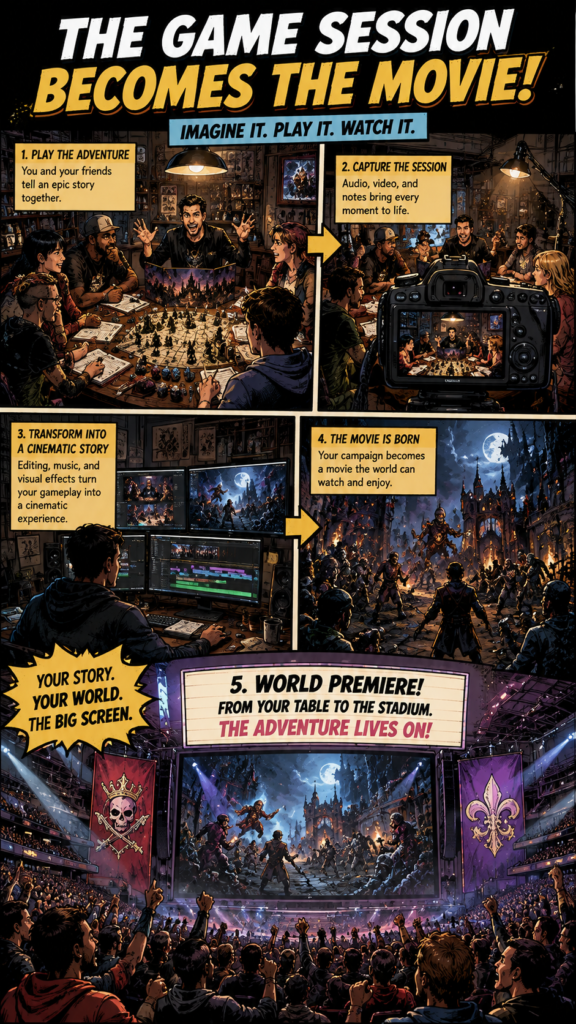
The distinction between what exists now and what I am predicting matters. I am not claiming that someone can currently record a four-hour tabletop session, upload it, wait an hour, and receive Mission: Impossible. That would be nonsense. I am arguing that the distance between those two things has become technologically conceivable. We already possess systems that can transform written instructions and images into moving audiovisual scenes. We already possess language models capable of analyzing transcripts and extracting characters, locations, dialogue, chronology, and plot events. We already possess increasingly sophisticated voice, music, image, and video-generation systems. The remaining problem is integrating these capabilities with enough memory, consistency, editorial intelligence, artistic control, computational efficiency, and legal clarity to transform hours of messy human play into a coherent piece of entertainment.
A tabletop session is unusually well suited to becoming raw material for such a system because it already contains many of the ingredients that a conventional film production has to create deliberately. The players have generated protagonists. The Game Master has generated supporting characters and antagonists. Dialogue has occurred. Decisions have been made. Locations have been described. Conflicts have been resolved. Characters may have died. Relationships may have changed. There is a chronology of events and, if the game was good, some kind of dramatic structure has emerged even when nobody consciously planned it beforehand. The AI would not necessarily be asked to invent the movie from nothing. It would be asked to adapt a recorded human creative event into another medium.
That distinction is extremely important to me. One of the least interesting futures for artificial intelligence would be an entertainment industry in which people sit alone and type “make me a movie about vampires” into a machine while human participation gradually disappears. Tabletop role-playing suggests almost the opposite possibility. Human beings gather physically or remotely. They talk to one another. They cooperate. They argue. They laugh. They make decisions. They role-play characters. The Game Master creates situations for them and responds to their ingenuity. Dice introduce genuine uncertainty. The human experience occurs first, and AI subsequently gives that experience another form.
The machine does not have to replace the game. The game can become the source material for the machine.
There is already an extraordinary precedent for the idea that a tabletop campaign can become screen entertainment, although the transformation currently requires a conventional professional production. Critical Role’s Vox Machina began as a private home game before becoming a streamed actual-play campaign in 2015. After the campaign concluded, Critical Role launched a 2019 crowdfunding effort to animate the characters and adventures. That project became The Legend of Vox Machina, an animated series based on the events and characters of the original campaign. Critical Role now describes the Kickstarter as having become the most successful Film & Video campaign in Kickstarter history, and the resulting partnership with Titmouse and Prime Video has produced four seasons of The Legend of Vox Machina. Critical Role has since expanded the same basic concept to another campaign through The Mighty Nein animated series.
That sequence deserves attention: home game, actual-play show, audience, crowdfunding campaign, professional animation. Something invented socially around a gaming table became intellectual property capable of supporting television animation. Critical Role accomplished that transformation with professional writers, animators, actors, producers, artists, and an enormous amount of conventional production work. AI potentially changes the cost and accessibility of the middle steps. It does not eliminate the value of skilled human filmmakers, but it may eventually allow much smaller creators—and perhaps ordinary gaming groups—to produce forms of adaptation that previously required studio-level resources.
The first commercially meaningful version does not need to be photorealistic. In fact, I suspect some of the earliest compelling products will deliberately avoid attempting to imitate a $200 million live-action movie. Imagine a four-hour game automatically condensed into a twenty-minute illustrated recap in which character portraits move subtly, mouths animate during important dialogue, maps transform into environments, sound effects accompany combat, and a narrator bridges scenes that would be tedious to reproduce in full. The result might resemble a sophisticated motion comic. Another system might produce stylized animation. Another could generate a five-minute “trailer” for the previous night’s session. A campaign could automatically produce an episodic series for the players after every game night.
Those intermediate forms matter because people sometimes evaluate emerging technologies only against the most difficult possible endpoint. If AI cannot yet create a flawless two-hour photorealistic movie with consistent actors, they conclude that the underlying idea has failed. That is like looking at an early videogame and dismissing the possibility of Red Dead Redemption because the machine can only display crude shapes. Technologies acquire economic value long before they reach their theoretical maximum. A $20 automatically generated animated campaign recap could be valuable to players even if nobody mistakes it for Pixar.
Eventually, however, the higher-end possibility becomes much more interesting. Imagine creating your player character and deciding how that person should appear in the resulting film. Perhaps the character resembles you. Perhaps you design someone completely fictional. Perhaps the game provides professionally created character models. A fantasy campaign might allow the same character to age visibly across years of adventures. A cyberpunk campaign could preserve particular clothing, cybernetic modifications, weapons, tattoos, and vehicles from session to session. The game system itself could maintain a visual record of the campaign so that when a sword is broken in Session 12, the movie generated from Session 13 knows that the character no longer carries it.
This suggests that future TTRPG design may include information that traditional rulebooks never needed. A character sheet might eventually contain not only Strength, skills, equipment, wounds, and personality notes, but structured information intended for audiovisual adaptation: appearance, voice, mannerisms, clothing, preferred cinematic presentation, important relationships, pronunciation guides, and continuity information. A Game Master’s campaign-management software could simultaneously become part of a production pipeline. Locations, characters, monsters, and props created for the game could have persistent visual identities that an AI system references whenever they appear.
That possibility is one reason I have been thinking about AI movie-making while designing Jack’s Cinematic d12 rather than treating it as an unrelated technological novelty. A game intended to produce cinematic play can be designed with an awareness that the record of that play may eventually become something else. Clear scenes matter. Dramatic decisions matter. Character motivation matters. Dialogue matters. Serious wounds matter. The rhythm between action and conversation matters. A system that constantly interrupts the fictional experience with cumbersome mechanical procedures may be perfectly enjoyable as a traditional game, but I am interested in rules that help people create sessions which already possess something resembling cinematic structure.
The same philosophy applies to professional Game Mastering. If game sessions increasingly become source material, a talented Game Master is not merely entertaining six people for four hours. He may be directing the first stage of a creative production. His descriptions establish environments. His portrayals establish supporting characters. His pacing influences the eventual edit. His ability to create meaningful choices determines whether the resulting narrative has dramatic weight. The players become performers without necessarily needing to think of themselves as actors, because their natural decisions and conversations provide the human behavior from which the adaptation is constructed.
There will also be obvious opportunities for professional actors and voice performers, but these require legal and ethical seriousness. I have previously imagined a future marketplace in which a player could pay an additional licensing fee to have a famous performer portray his character in the generated adaptation. Conceptually, the appeal is obvious. Someone might want the cinematic version of his character portrayed by an actor he admires rather than by a generic generated person. But such a system should exist through explicit licensing, consent, and compensation, not through simply instructing an AI to imitate an actor without permission. SAG-AFTRA’s current agreements already establish consent and disclosure requirements around digital replicas, and its 2025 commercial agreement requires specific consent and compensation when a performer’s digital replica is used to generate performances. Its 2026 TV/Theatrical agreement further strengthens restrictions concerning digital replicas and synthetic performers.
That actually points toward a legitimate new business rather than merely a restriction. Imagine an authorized marketplace in which performers voluntarily license carefully controlled digital versions of themselves for particular kinds of entertainment. The actor specifies what uses are permitted, receives compensation when the licensed performance is generated, and retains contractual protections against uses he has not authorized. A famous actor might command a substantial price. A working voice actor might offer a much less expensive license. Unknown performers could potentially build audiences by making their licensed performances available to game adaptations. The technology could therefore create paid work for performers rather than simply becoming a mechanism for stealing their faces and voices.
The same licensing logic could apply to music, visual styles, fictional properties, monsters, costumes, vehicles, and locations. A tabletop publisher might sell an official audiovisual asset package alongside a campaign book. Buy the adventure and the AI adaptation system receives authorized visual references for the principal characters, monsters, buildings, heraldry, weapons, and environments. Buy the premium version and perhaps it includes a professionally recorded musical score and licensed voice performances. Miniature companies could supply the same three-dimensional character designs used by the audiovisual system. The physical and digital versions of the fictional world begin reinforcing one another.
This creates another possible revenue stream for game publishers. Today, the publisher primarily sells the material needed to play. Tomorrow, it might also sell the material needed to render what was played. A monster book could contain not merely statistics and illustrations but licensed digital assets. An adventure could contain cinematic environments. A character pack could include visual models, voices, sound effects, and animation information. A campaign could accumulate a library of digital assets over years, just as players currently accumulate books and miniatures.
For the players, however, I think the emotional value may ultimately matter more than the technological novelty. People become deeply attached to long-running characters. They remember extraordinary rolls twenty years later. They tell stories about the night somebody accidentally killed the villain too early, the character who sacrificed himself to save everyone else, or the ridiculous plan that somehow worked. These memories are meaningful partly because the people at the table created them together. Imagine being able to revisit one of those moments not merely through memory but by watching a cinematic reconstruction built from the original voices and decisions of the people who were actually there.
A family could have an even stronger reason to value such recordings. Parents and children who play campaigns together would not merely accumulate photographs of family vacations; they could accumulate stories they created together. Friends separated later by geography could revisit campaigns from years earlier. A gaming group could possess a ten-season audiovisual history of its imaginary world. The resulting “movies” might be meaningless to everybody outside the group and priceless to the people inside it. Not every commercially valuable technology needs to produce content for a mass audience.
At the opposite extreme, particularly good campaigns could become public entertainment. Players might agree beforehand that a professional Game Master is running a campaign intended for eventual adaptation. The recorded sessions become the source. AI handles increasingly large portions of visualization and preliminary production while human editors, directors, artists, musicians, and effects specialists polish the material for commercial release. Instead of writing a screenplay and then trying to make the performances feel spontaneous, creators could begin with genuinely spontaneous human performances and adapt the strongest material afterward.
That reverses part of the conventional entertainment-production process. A movie normally begins with a written story and attempts to manufacture the illusion that events are happening naturally. A role-playing adaptation could begin with events that actually were unpredictable to the participants and then manufacture the visual world around them.
There are difficult questions attached to this future. Who owns the resulting story when the Game Master created the world but six players created major characters and decisions inside it? What happens when somebody leaves the group and no longer wants his voice or likeness used? How should revenue be divided when an actual-play campaign becomes commercially successful? How are copyrighted game settings handled? What constitutes an adaptation of licensed game material rather than merely a record of private play? How should performers’ digital likenesses be protected? These are not trivial questions, and businesses that solve them intelligently may become valuable precisely because ordinary players will not want to negotiate complicated intellectual-property agreements every Friday night.
None of those problems changes the underlying opportunity. In fact, the appearance of legal, technical, and licensing problems is often evidence that an entirely new market is trying to form. Somebody eventually builds the tools, contracts, marketplaces, standards, and services that make the complicated thing simple enough for ordinary customers to use.
What excites me about this possibility is not AI replacing human creativity. It is almost exactly the reverse. Tabletop role-playing is one of the most stubbornly human forms of entertainment ever devised. People have to listen to one another, understand one another, negotiate, cooperate, improvise, imagine, make decisions, and respond to surprises. The Game Master can use sophisticated technology, but the heart of the activity remains a group of people interacting in real time.
Artificial intelligence may eventually allow us to take that profoundly human event and give it a second life.
If that happens, the TTRPG rulebook becomes more than a book, the Game Master becomes more than a referee, the campaign becomes more than a private memory, and the gaming table becomes something remarkably close to a low-cost creative studio. Six friends might sit down on Saturday night believing they are merely playing a game and discover on Sunday that they also created the raw material for an animated episode, a cinematic recap, or eventually a feature-length film.
At that point, the economic value of a successful tabletop game becomes even harder to measure by counting rulebook sales alone. The game is no longer merely the product. It is a machine for generating characters, stories, performances, images, merchandise, and potentially entire bodies of intellectual property.
And that brings us to one of the strongest investment arguments for tabletop role-playing: sometimes the little game book is only the first door into a world that can continue making money for decades.
A Game Is Also Intellectual Property
If tabletop role-playing games were valuable only while people were sitting around a table playing them, the business case would already be substantial. Books, professional Game Mastering, miniatures, terrain, dice, conventions, hospitality, live entertainment, digital tools, and eventually AI-assisted adaptation create multiple ways for money to circulate around the activity. But the largest tabletop properties reveal another possibility. A successful TTRPG does not merely create a game. It can create intellectual property: characters, organizations, histories, visual identities, fictional technologies, monsters, terminology, locations, symbols, and entire worlds that can continue producing new creative works long after the original rulebook has been published.
The history of Dungeons & Dragons makes this obvious. The game began with a comparatively humble product published by Tactical Studies Rules in 1974. Jon Peterson’s historical research, drawing on TSR’s surviving financial records, places first-year sales at approximately $48,000 in 1974. By 1979, annual sales for TSR had reached roughly $2.3 million, and Peterson’s reconstruction places 1980 sales at approximately $8.7 million. (playingattheworld.blogspot.com) The significance of that trajectory is not simply that D&D sold more books. What began as a strange little tabletop game ultimately became the foundation for novels, videogames, miniatures, toys, merchandise, streaming entertainment, and film.
Hasbro reported that the Dungeons & Dragons brand produced more than $1 billion in total revenue during the decade preceding its 50th anniversary in 2024, while also emphasizing the expansion of the brand through digital games, entertainment, and licensing. (investor.hasbro.com) Baldur’s Gate 3, developed by Larian Studios under license from Wizards of the Coast, became one of the most celebrated videogames of its generation, winning Game of the Year at The Game Awards 2023. (thegameawards.com) Paramount’s Dungeons & Dragons: Honor Among Thieves brought the property back into major theatrical film production in 2023. The original 1974 game did not contain a business plan predicting any of these things. It created a form of play and a fantasy identity powerful enough that later businesses kept finding new things to do with it.
That history should change the way an investor looks at an apparently small tabletop property. A rulebook’s immediate sales matter, but they are not necessarily the upper boundary of its value. The more important question may be whether the game creates anything people want to return to.
A successful fictional world is an asset that can be visited more than once and sold in more than one form.
Shadowrun is one of the best examples because it demonstrates what can happen when the original concept is unusually distinctive. FASA released Shadowrun in 1989, combining cyberpunk technology, corporate dystopia, magic, elves, dwarfs, orks, trolls, dragons, Native American nations, street crime, and fantasy into a future setting that was immediately recognizable as something other than generic science fiction or generic fantasy. The tabletop game subsequently generated decades of sourcebooks and adventures, but the property escaped the rulebook almost immediately. The first Shadowrun novel, Robert N. Charrette’s Never Deal with a Dragon, appeared in 1990, beginning a fiction line that eventually grew into dozens of novels.
Shadowrun then moved into videogames. The franchise received adaptations for the Super Nintendo, Sega Genesis, and Sega CD during the 1990s; Microsoft later released Shadowrun for Xbox 360 and Windows in 2007; and Harebrained Schemes revived the setting through Shadowrun Returns, Shadowrun: Dragonfall, and Shadowrun: Hong Kong. Paradox Interactive acquired Harebrained Schemes in 2018 for a purchase price of $7.5 million plus a potential earnout tied to future performance, although that transaction involved the studio and its broader development capabilities rather than the Shadowrun intellectual property itself. (paradoxinteractive.com) That distinction matters because I do not want to manufacture a fictitious dollar valuation for Shadowrun. Publicly available information does not give us a reliable cumulative lifetime-revenue figure for the entire franchise across every tabletop book, novel, videogame, miniature, and license.
What we can say confidently is that a tabletop role-playing property created in 1989 has remained commercially exploitable for more than three decades across multiple media. Catalyst Game Labs continues publishing Shadowrun tabletop products today. (shadowrunsixthworld.com) The fiction line continues. The videogames remain recognizable enough to be sold in modern collections and on contemporary digital storefronts. Miniatures, dice, maps, accessories, merchandise, and other physical products continue to make the setting something customers can own rather than merely read about.
That is what I find commercially important about Shadowrun. I do not need to pretend that I know whether the property has generated $50 million, $100 million, or some other cumulative figure. Without reliable financial records, putting such a number into this essay would be irresponsible. The demonstrated fact is stronger than a guessed number anyway: an original tabletop setting survived multiple owners, editions, technologies, and generations of players while continuing to generate commercial products more than thirty-five years after its creation.
This is one reason I am developing Shadowrun JCd12. It is not my attempt to replace or appropriate the Shadowrun intellectual property. Shadowrun belongs to its respective rights holders, and my interest in adapting Jack’s Cinematic d12 to it is valuable precisely because Shadowrun provides a recognizable existing game environment against which the system can be tested. If JCd12 can demonstrate that it handles the particular challenges of Shadowrun—firearms, magic, cyberware, Matrix activity, vehicles, social interaction, and the cinematic rhythm of a shadowrun—it demonstrates something about the portability of the underlying system.
There is also a perfectly legitimate commercial ecosystem surrounding an established property that does not require pretending to own it. When people become excited about Shadowrun, they buy physical things. They want miniatures representing runners, corporate security, drones, vehicles, fantasy metatypes, and street gangs. They want dice. They want terrain suitable for neon streets and corporate facilities. They want gaming tables and rooms that make the setting feel right. A Game Master who makes Shadowrun exciting contributes to that surrounding demand. If somebody from Catalyst Game Labs ever reads this essay, I want that distinction to be clear: my value is not dependent upon discouraging people from buying Shadowrun products. A great Shadowrun campaign should make people want more Shadowrun around them.
HeroQuest illustrates the same principle from another direction. The original board game was released through Milton Bradley in cooperation with Games Workshop around 1989 and combined a board game with many of the physical and imaginative pleasures associated with tabletop role-playing: heroes, monsters, furniture, miniatures, quests, character advancement, and a Game Master-like player controlling the dungeon. Decades later, Hasbro revived HeroQuest through its HasLab crowdfunding platform. The 2020 campaign finished with approximately $3.72 million in backing, dramatically exceeding its $1 million threshold. (hasbropulse.com) The revived line has subsequently supported expansions and additional physical products.
I love HeroQuest, which is exactly why I want eventually to take aim at it. Competition does not require contempt. I can admire a game, recognize what it accomplished, remember why people loved it, and still believe I can make something better. That instinct is fundamental to healthy creative industries. Someone eats at a successful restaurant and thinks, I can make a better hamburger. Someone listens to a band and decides to start playing guitar. Someone sees a film and becomes a director. Someone plays a game and begins wondering what he would change.
Tabletop role-playing is particularly fertile ground for that kind of competition because the industry itself is so young. Dungeons & Dragons dates to 1974. Shadowrun dates to 1989. Entire entertainment forms that now seem culturally permanent are only a few decades old. Gary Gygax and Dave Arneson are jointly credited as the creators of the original Dungeons & Dragons, and historical scholarship makes it difficult to reduce their respective contributions to some neat percentage such as “Gygax deserves 70 percent.” Arneson’s Blackmoor experiments were crucial to the emergence of character-centered fantasy role-playing from wargaming, while Gygax played an enormous role in systematizing, writing, publishing, expanding, and commercializing what became Dungeons & Dragons. Trying to assign one man 60 percent and the other 40 percent would create an illusion of precision where the history does not support it.
What matters for my argument is how recently the synthesis happened. Human beings have played games for thousands of years. We have told stories for as long as language has existed. Theater is ancient. Gambling is ancient. Military simulation is centuries old. Yet the recognizable commercial tabletop role-playing game—persistent individual characters controlled by players inside an open-ended imaginary world adjudicated by a referee—is approximately half a century old.
That is incredibly young.
When an industry is young, conventions that look permanent may merely be habits inherited from the first successful companies. The familiar twenty-sided die does not represent the only possible foundation for a role-playing system. The conventional relationship between Game Master and player is not necessarily the only commercial relationship. The standard hardcover rulebook is not necessarily the final form of the product. The assumption that tabletop play ends when everybody goes home may be overturned by AI adaptation. The assumption that actual play belongs on YouTube may eventually look as limited as assuming music belongs only on the radio. Even the assumption that role-playing games primarily compete against one another may be wrong; they also compete with videogames, streaming television, nightlife, movies, social media, sports, and every other activity fighting for people’s leisure time.
This is where my own product line becomes more than a collection of unrelated books. I am not attempting to write one rulebook, hope it sells, and then wonder what to do next. I am attempting to build intellectual property deliberately.
Jack’s Cinematic d12 is the engine. The worlds are the vehicles built around it.
The system is intended from the beginning with professional Game Mastering and cinematic play in mind, and increasingly with the possibility that recorded sessions will someday become source material for AI-assisted films or other audiovisual adaptations. That affects the things I care about mechanically. I want action to feel consequential without spending half the evening performing arithmetic. I prefer serious wounds and mental trauma to enormous pools of abstract hit points. I want social scenes to matter. I want characters to feel competent while danger remains genuinely dangerous. I want the rules to support the fictional scene rather than continually drag everybody away from it.
Gloria Nocturna is the most developed demonstration of that philosophy, but it is also an intellectual-property experiment of its own. Rather than placing another fantasy game inside a vaguely medieval European world, Gloria Nocturna moves much closer to the historical imagination of Americans. Its world of Sylva draws heavily upon the late eighteenth century, while Eldoria deliberately contains recognizable echoes of the United States without simply being historical America. Firearms, monarchy, commerce, religion, wilderness, military life, strange creatures, magic, and the conflict between Tranquility and the Gloom create a setting that feels simultaneously familiar and alien.
I think that is a commercially intelligent position. Medieval fantasy is enormously popular, and I have no intention of pretending otherwise—I am creating my own medieval fantasy game too. But the success of one genre creates room for differentiation. An American player has seen countless variations of castles, taverns, knights, and quasi-European feudal kingdoms. The late eighteenth century gives Gloria Nocturna another visual and cultural vocabulary: tricorn-era clothing, early firearms, forts, frontier settlements, absolute monarchy, emerging commerce, sailing-era aesthetics even within a world whose geography differs radically from ours, and institutions that feel closer to the founding-era imagery Americans already recognize.
At the center of Gloria Nocturna is the Black Order, and this is where the world becomes more than historical pastiche. The characters are not generic adventurers wandering around looking for treasure. They belong to a religious and military tradition whose members are expected to confront the Gloom and live according to demanding convictions. That creates a type of moral gameplay I find much more interesting than simply labeling a character “good.” It is easy to choose good when goodness costs nothing. Temptation becomes dramatically meaningful when violating one’s convictions offers money, power, safety, revenge, romance, status, or some other thing the character desperately wants.
That theme connects directly to one of the darker questions behind Gloria Nocturna. Genesis 6:5–7 describes God seeing the greatness of human wickedness and grieving over what humanity had become, leading into the judgment of the Flood. It is an uncomfortable passage because it forces the reader to confront a frightening theological question: what could human beings become that would make God grieve that He had made them? Gloria Nocturna is partly my attempt to explore that question through fantasy. What does hardcore evil actually look like? What does resisting it require? What happens when the person fighting evil discovers that he is corruptible too?
That is why the game’s religious intensity is not decorative flavor. The Black Order is supposed to be all in. Its members are zealots in the original sense of people consumed by commitment. Yet the game also allows those commitments to be tested, compromised, misunderstood, or betrayed. The possibility of corruption gives conviction dramatic weight.
The product architecture reflects the same desire to build a world rather than merely release a rulebook. Gloria Nocturna is conceived as a seven-book core line. Gloria Nocturna itself is the Player’s Handbook. Codex Arcanum develops the magic system. Codex Monstrorum Arcanum is the bestiary. Sylva is the World Book. Outpost Ravenholm functions as the Dungeon Master’s guide and starting campaign region, teaching a Game Master how to run the game while giving players a place capable of taking beginning characters through their earliest levels. Mercatus et Commercium Sylvae is the equipment and commerce book—the book players can actually consult when their characters go shopping rather than forcing the Game Master to invent the economy every time somebody wants to buy a coat, weapon, horse, meal, or piece of equipment. Finally, Codex Fraternitatis serves as the Black Order’s membership manual and an expanded player resource for understanding the religious, military, and institutional life of the organization.
That seven-book structure is commercially useful, but I did not invent it merely to multiply products. Each book solves a different problem. A Game Master who needs a monster should not have to search through the economic history of Sylva. A player buying equipment should be able to consult something designed for that purpose. Someone deeply interested in magic can own an entire book devoted to it. Someone who wants to understand the Black Order as an institution has another. The line therefore allows the world to become deeper without requiring the Player’s Handbook to become a thousand-page encyclopedia.
It also creates exactly the catalog effect discussed in the previous section. One customer can discover one book and then discover six others. Those books can lead to adventures. Adventures can lead to novels. Monsters can lead to miniatures. The Black Order can lead to symbols, patches, jewelry, clothing, physical manuals, and collectibles. Locations can become maps and terrain. Characters can appear in fiction. Eventually, the same world could support animation, film, actual play, or videogames.
RIVET demonstrates how far the same underlying system can move in another direction. It is a post-apocalyptic science-fiction nightmare set around 2026, after occult experiments beginning in the 1970s gradually opened portals and allowed increasingly bizarre phenomena into the world. Eventually the situation catastrophically escalates. Portals appear in greater numbers and entities begin arriving from apparently different dimensions, planets, planes of existence, or realities. It is not a neat alien invasion in which one species arrives with a comprehensible military objective. Reality itself seems to have gone wrong.
A strange fungus capable of infiltrating and destroying inadequately protected electronics helps collapse the technological infrastructure upon which modern civilization depends. Survivors encounter supernatural entities, physical monsters, cryptid-like creatures, and things that do not behave according to ordinary expectations. Amid that catastrophe, remnants of human civilization preserve enough knowledge and alien-derived technology to construct enormous machines, including a roughly 500-foot-tall mobile mech containing hundreds of people. One of the central questions is not merely whether giant robots are cool. Of course giant robots are cool. The interesting design question is what living inside one would actually be like. How fast can something that enormous move? How are hundreds of occupants protected from acceleration, vibration, structural failure, attack, and ordinary human problems? How is food stored? Where do people sleep? How is waste handled? What happens when something breaks hundreds of feet above the ground?
That creates intellectual property of a completely different visual character from Gloria Nocturna while still allowing the underlying JCd12 philosophy to be tested. A Black Order soldier in an eighteenth-century-inspired nightmare and a survivor living inside an enormous post-apocalyptic machine should not feel like characters from the same setting merely because they share an underlying rules engine.
Then there is No Quarter, my answer to the kind of fantasy I expected when I first encountered fantasy role-playing. It is darker medieval fantasy influenced by sword-and-sorcery, the atmosphere of Heavy Metal, older fantasy illustration, Conan the Barbarian, the animated The Lord of the Rings, Willow, gamebooks such as Lone Wolf, and the bloodier, stranger fantasy imagery that made the genre fascinating to me in the first place. I do not want fantasy that feels sanitized into a brightly illuminated amusement park where magic is so commonplace that everybody seems to be throwing colored special effects at one another. I want steel to matter. Darkness should matter. Monsters should be frightening. Magic should feel wondrous and dangerous.
No Quarter gives me the opportunity to compete directly within the most familiar territory in tabletop gaming while still approaching it according to my own design philosophy. It uses Jack’s Cinematic d12 and can share underlying magical concepts with Gloria Nocturna while presenting a very different civilization, history, visual identity, and style of adventure. If Gloria Nocturna demonstrates that I can move fantasy toward the late eighteenth century, No Quarter demonstrates that I can return to medieval fantasy without simply imitating the dominant version of it.
These games are therefore both products and experiments. Gloria Nocturna asks what happens when JCd12 encounters religious orders, firearms, eighteenth-century-inspired society, horror, wilderness, commerce, temptation, and the Gloom. RIVET asks what happens when the same underlying design philosophy encounters post-apocalyptic survival, science fiction, enormous machines, ruined modern infrastructure, and completely unpredictable monsters. No Quarter asks whether JCd12 can deliver the darker medieval fantasy experience I want. Shadowrun JCd12 asks the particularly useful question of whether the engine can be adapted to a famous existing setting with decades of mechanical expectations already attached to it.
If those experiments succeed, then the valuable thing is not merely four games. It is evidence that an underlying design system can support radically different worlds.
That brings us back to intellectual property. A creator trying to build a lasting business should not think only in terms of the next product he can sell. He should ask what he is building that can still matter ten years later. A memorable monster is potentially more valuable than one encounter. A memorable character is potentially more valuable than one adventure. A compelling organization is potentially more valuable than one chapter. A game world that people fall in love with can generate books long after its original rules have been revised or replaced.
Shadowrun demonstrates that principle beautifully. I first encountered a game published decades ago, and the world still makes me want to run it, adapt it, build rooms around it, collect physical objects associated with it, and introduce other people to it. That is the kind of longevity a world designer should envy.
My ambition is not merely to sell somebody a PDF.
I want to create worlds that make people want the next book, the miniature, the novel, the campaign, the game room, the actual-play show, and eventually the film. I want other Game Masters to take Gloria Nocturna, RIVET, and No Quarter away from me and show me things about those worlds that I never imagined. That is one of the strangest properties of a TTRPG intellectual property: unlike a novel, the creator deliberately gives thousands of other people permission to create new stories inside it.
The customer does not merely consume the world.
He helps keep it alive.
And if the world is good enough, he may keep doing that for decades.
Betting on Yourself When Other People Think You Are Wasting Your Time
All of the business arguments in the preceding sections eventually collide with a much more personal question. It is one thing to demonstrate that tabletop role-playing games can raise millions through crowdfunding, support professional Game Masters, generate tourism and hospitality spending, create miniature and accessory markets, produce valuable intellectual property, and potentially intersect with artificial intelligence in entirely new forms of entertainment. It is another thing to look at one particular man writing games and ask whether he will succeed.
That is where the scoffing begins.
I have had people make comments to the effect of, “My teenage son makes games. Get a real job.” The insult depends upon confusing an activity with the level at which somebody performs it. Teenagers make music too. That does not mean there are no professional musicians. Teenagers make videos, write computer programs, play sports, draw pictures, work on cars, and cook food. None of those observations tells us anything useful about whether someone can build a career or business in music, software, athletics, art, automotive work, or restaurants. The relevant questions are whether there is a market, whether the person has something worth selling, whether he can reach customers, whether he can execute consistently, and whether he can survive long enough to become good at what he is trying to do.
The previous sections of this essay have already answered the first question. There is a market.
The remaining questions are about me.
I have made decisions in my life that would probably look irrational to someone who values security above almost everything else. At one point, while working as a semi-truck driver, I deliberately chose homelessness because I had reached a point where I seriously considered leaving conventional society behind. I considered going into the wilderness and had been invited to live on the Crow Reservation. Instead, my path eventually took me to Southern California, where for a period I lived in a storage unit while trying to establish myself recording audiobooks.
That did not produce instant success. It took more than a year and a half before I received my first royalty check of approximately $650. But the work accumulated. By the time I was living in Mexico, those audiobook royalties had grown into several thousand dollars per month. The experience eventually contributed to another kind of intellectual property: How to Live in a Storage Unit, or the Place You Don’t Belong. Later experiences with homelessness in Mexico, including the period following an armed robbery that I attribute to corrupt police officers in the mountains of Querétaro, contributed to The Homeless Survival Guide. I would not recommend homelessness as a clever entrepreneurial strategy. What those experiences taught me is something different: circumstances that look like the end of the story can become material for the next thing a writer builds.
I no longer do business with Amazon. That closed one chapter of my work rather than ending my ability to create. I have also had six TikTok accounts banned. That experience reinforced my conviction that a creator cannot safely make somebody else’s platform the foundation beneath everything he hopes to build. Social media can be useful for discovery, promotion, communication, and audience growth, but I do not want my future to depend upon whether a corporation decides tomorrow that I am still welcome on its property.
This is why “get a real job” does not strike me as particularly sophisticated advice. A conventional job can be honorable, useful, necessary, and financially intelligent. I have worked conventional jobs. I drove semi-trucks. There is nothing shameful about earning a paycheck from an employer, and entrepreneurship should not be romanticized into pretending that everybody ought to quit his job and start a business. But employment and ownership solve different problems. A job primarily sells some portion of my time and labor. Intellectual property can continue producing value after the original hour of work is over. A book written once can be sold repeatedly. A game system can support several games. A fictional world can support rulebooks, novels, miniatures, adventures, merchandise, actual play, and adaptations. That does not guarantee that any of those products will sell, but it explains why building them is fundamentally different from merely refusing to work.
I am not trying to avoid work. I am trying to build something I can own.
That distinction has become much more important to me because my ambitions are not abstract. I have a wife and family. My wife is battling cancer. Anyone who has lived close to serious illness understands that the cost is not limited to whatever appears on a hospital bill. There is transportation. There is food. There are things intended to make the person more comfortable. There is time spent at hospitals, time spent caring for someone, time family members cannot spend doing something else, and the constant desire to give someone you love the best life and care you can possibly provide.
I do not want to make my wife’s illness the centerpiece of an essay about tabletop gaming, and I certainly do not want her suffering reduced to a marketing device. But pretending that it has nothing to do with my ambition would be equally dishonest. When somebody you love is fighting for her life, money stops being an abstraction very quickly. I want the freedom to buy what my family needs without wondering which other necessity must be sacrificed. I want the freedom to devote my time to the people I love when they need me. I want better housing, better food, better transportation, greater security, and the ability to respond to an emergency without first calculating whether I can afford to respond to it.
Some people apparently find it offensive to say that serious illness can motivate someone to make money. I find the objection bizarre. Families establish fundraisers every day precisely because illness creates financial pressure. People work overtime because somebody they love needs something. They start businesses because they want their children to have opportunities they never had. They try to increase their income because poverty and crisis are a miserable combination.
Wanting money so that you can do more for the people you love is not exploiting them. It is one of the oldest motivations for work there is.
My objective is larger still. I want to change the future history of my family. I am not thinking only about whether I can sell enough books this month to cover a particular expense. I am thinking about whether the work I do now can create assets that still matter years from now and, if I am exceptionally successful, long after I am dead. That is why I think in terms of systems, worlds, catalogs, characters, trademarks, websites, novels, and intellectual property rather than one isolated product.
And yes, my ambition is to become a billionaire.
That statement will cause some people to laugh, which is precisely why it belongs here. If I said that I hoped someday to make an extra $500 per month selling role-playing books, nobody would accuse me of delusions of grandeur. Increase the number sufficiently and suddenly people become offended by the ambition itself. Yet billion-dollar fortunes have been created from software, shoes, cosmetics, restaurants, entertainment, toys, comic-book characters, videogames, and countless other things that once began as somebody’s idea. Becoming a billionaire is statistically extraordinary. I am not confusing an ambition with a forecast. But if the objective is to build intellectual property capable of becoming enormously valuable, thinking only in terms of modest supplemental income places an artificial ceiling over the enterprise before the market has even had the opportunity to decide what it can become.
There is a line attributed recently to Busta Rhymes that struck me because it expresses something entrepreneurs, artists, performers, and inventors repeatedly experience: sometimes you have to believe the “delusion,” because it is only delusional until it works. A 2026 podcast clip circulated that formulation under his name, although I have not found a sufficiently authoritative original Busta Rhymes interview to pretend that I can authenticate every word of the viral quotation. I nevertheless agree strongly with the idea behind it.
There is, however, a dangerous version of that philosophy. Believing in yourself does not make a bad product good. Confidence does not replace customer demand. Repeating that you are a genius does not turn bankruptcy into a business strategy. The world is filled with people who were absolutely convinced that customers would eventually recognize their brilliance and were absolutely wrong.
The useful kind of “delusion” is different. It is the willingness to act toward a result that does not yet exist while continuously subjecting the work to reality.
Believe beyond the evidence of your present circumstances. Then work relentlessly to create the evidence.
That means writing the next book. Fixing the bad rule. Replacing weak artwork. Testing the mechanic again. Studying competing games. Learning publishing. Learning marketing. Learning web design. Studying the history behind the setting. Listening when a customer identifies a real problem. Refusing to listen when a stranger merely enjoys insulting you. There is an enormous difference between criticism and contempt, and one of the skills an independent creator must develop is learning which one he has received.
Criticism can save a product. “This rule takes too long.” “I cannot understand this paragraph.” “This character class does not have enough to do.” “The price is too high for what I receive.” “The artwork communicates the wrong tone.” Those statements may hurt, but they contain information.
“My teenage son makes games; get a real job” contains almost none.
The revenge of success is admittedly motivating to me. I do want to outwork the people who scoff. There is something satisfying about imagining that the person who laughed at the project eventually encounters it somewhere he cannot ignore. I do not think that should become the primary reason to create anything; resentment is a terrible architect. But human motivation is rarely perfectly pure. Love motivates me. Curiosity motivates me. Religious conviction motivates me. Artistic obsession motivates me. Competition motivates me. Fear motivates me. Wanting security for my family motivates me. And yes, sometimes remembering the people who said I could not do it makes me want to work another hour.
Chris Stapleton’s “White Horse” has occasionally made me think about that tension from another direction. Stapleton actually wrote the song with Dan Wilson around 2012 or 2013 when they were trying to create something suitable for The Lone Ranger. It was not ultimately used in the film and sat for roughly a decade before being released. Stapleton has described its origin as an attempt to make a rock-driven, Western-themed song, so I would not claim that he wrote it as some autobiographical entrepreneurial manifesto. But the song’s narrator tells a woman, in essence, that if she is waiting for the idealized cowboy riding in to give her the storybook ending, she needs to hold on because he is not there yet. Critics have similarly interpreted the song as a man admitting that he is not yet ready to become the romantic ideal being asked of him.
That is not precisely my situation, but I understand the emotional idea: I am not there yet.
I cannot presently give my wife everything I want to give her. I cannot presently build the gaming room I can see in my imagination, much less the studio, company, publishing operation, live productions, or larger enterprises I imagine beyond it. Gloria Nocturna is not yet a globally recognized intellectual property. RIVET is not a television series. No Quarter is not competing with HeroQuest on store shelves. Jack’s Cinematic d12 has not yet proven itself across a large player base. Those are present facts.
They are not instructions about what the future is required to be.
That is why the game room matters to me more than it might appear. I can see a room designed specifically for the darker games I love: Shadowrun, Gloria Nocturna, RIVET, No Quarter. Not a folding table shoved beneath a fluorescent light, but an environment deliberately constructed for gaming. Proper lighting. Excellent sound. Shelves of painted miniatures. Terrain. Maps. Props. Comfortable seating. A purpose-built table. Cameras positioned for recording. Displays where useful. Different elements of the room capable of changing according to the campaign being played. The kind of place where somebody walks through the door and immediately understands that the game about to happen is being taken seriously.
That room is both a personal dream and a prototype of the larger argument in this essay. Someone has to manufacture the table. Someone manufactures the miniatures. Someone designs the lighting. Someone makes the dice. Someone prints the terrain. Someone manufactures the 3D printer and its materials. Someone sells the camera. Someone produces the microphone. Someone makes the shelving and furniture. Someone may eventually design entire rooms like this professionally. My desire to create a magnificent place to play games becomes revenue for people who never wrote a TTRPG rule in their lives.
If I become sufficiently successful, I want that room to become a studio. I want people to watch the games. I want my ability as a Game Master to help demonstrate what these worlds are supposed to feel like. More importantly, I want other Game Masters to take them and surprise me. One of the measures of whether I have actually created a living role-playing world will be whether somebody I have never met can run Gloria Nocturna differently from me and make me think, I never imagined that, but it belongs there.
There is another personal reason I want to succeed through independent creation. My life has repeatedly taught me how fragile dependence can be. Employers disappear. Accounts can be closed. Platforms can ban you. Companies change policies. Circumstances change countries. Immigration problems can turn ordinary life into bureaucracy and uncertainty. Illness can overturn every plan a family made. Money that seemed sufficient during normal circumstances suddenly becomes insufficient during an emergency.
Ownership does not make a person invulnerable to those things. But ownership gives him something he can carry forward.
I own the work I create. I can improve it. I can republish it. I can build another product on top of it. I can take lessons from a failure and incorporate them into the next game. Nobody can guarantee that the market will reward those efforts, but nobody needs to give me permission to attempt them either.
This is where my fascination with gematria also enters the story. I use the English ordinal cipher, the extremely simple system in which A equals 1, B equals 2, continuing through Z equals 26. Under that cipher, I found a correspondence that became personally meaningful to me: JOHNALANMARTINSON.COM and FROM BUM TO BILLIONAIRE both total 241. I do not present that as financial analysis or proof that the universe owes me a billion dollars. An investor should evaluate my business according to products, intellectual property, customers, execution, costs, and growth—not numerology. But as someone interested in divine mathematics and gematria, I find the correspondence symbolically powerful. It captures the trajectory I am trying to create: from experiences of homelessness and instability toward ownership, independence, and eventually extraordinary prosperity.
The arithmetic itself is straightforward: JOHNALANMARTINSONCOM totals 241 under A=1 through Z=26, and FROMBUMTOBILLIONAIRE also totals 241. The meaning I attach to that coincidence is personal. That distinction is important because faith and entrepreneurship can coexist without pretending they are the same kind of evidence.
My spiritual interests also influence what I write. Gloria Nocturna is not a religious tract disguised as a role-playing game, but neither is its moral universe accidental. I am interested in what it means to confront evil, what conviction costs when maintaining it becomes inconvenient, and why human beings repeatedly choose things they know are destructive. The Black Order gives me a fictional structure through which to explore those questions. The Gloom gives evil a fantastic manifestation, but the interesting part remains human temptation.
That is one reason Genesis 6 disturbs and fascinates me. The text describes human wickedness becoming so great that God grieves over humanity and brings judgment upon the world. Whatever theological interpretation one gives that passage, it raises an enormous storytelling question: How bad can human beings actually become? Gloria Nocturna allows me to explore the answer from inside a game. Instead of merely reading that good people should resist evil, players can be placed in situations where doing the wrong thing would be easier, safer, more profitable, or more pleasurable.
Those themes are not separate from my business ambitions. They are part of the intellectual property. A creator competes partly by making something that could not have been created by a corporate committee attempting to offend nobody. My experiences, convictions, obsessions, failures, theological questions, tastes in fantasy, frustration with institutions, love of darker entertainment, and ideas about Game Mastering all become ingredients competitors cannot duplicate merely by copying my mechanics.
That does not guarantee they will like what I make.
It gives them a reason to notice it.
There is therefore a strange relationship between the person telling me to “get a real job” and the work I am doing. The insult assumes that the safe path is automatically the intelligent one. Sometimes it is. Sometimes taking a stable job, saving money, and creating on evenings and weekends is exactly the intelligent strategy. But every independent business ultimately requires someone to decide that the possibility of owning something is worth accepting some degree of uncertainty.
I have already lived through uncertainty.
What I want now is to make it productive.
I want the years ahead to become the period in which the scattered experiences of my life—writing, audiobooks, homelessness, travel, religion, professional entertainment, Game Mastering, worldbuilding, publishing, technology, and everything else—begin converging into intellectual property that can support my family and eventually employ other people. I want the games to finance better books, the books to create larger audiences, the audiences to support professional games, the games to generate stories, the stories to support novels and adaptations, and the worlds to become valuable enough that other businesses want to participate in them.
Maybe I will fall dramatically short of becoming a billionaire. Any serious person has to admit that possibility. But there is an enormous range between “failed billionaire” and “failure.” Building a profitable independent publishing company would be success. Creating intellectual property that supports my family would be success. Becoming a respected professional Game Master would be success. Producing games people continue playing after I am gone would be success. And if the ceiling turns out to be vastly higher than that, I have no intention of apologizing because I aimed for it.
The important thing is that the ambition must continually produce work.
A dream that never becomes a manuscript is fantasy. A manuscript that never becomes a product is unfinished work. A product nobody wants is a business problem. A product customers love is the beginning of an asset. And an asset that continues producing new products, stories, customers, and opportunities can eventually become a company.
That is the bet I am making.
Not that success will descend from heaven because I believed hard enough, but that relentless creation, intelligent use of new technology, ownership of intellectual property, constant refinement, and the expanding economics of tabletop role-playing give me a field worth betting on.
And I intend to stay at the table long enough to find out how large that bet can become.
TTRPGs Are More Than Entertainment
The investment case for tabletop role-playing becomes considerably stronger when we stop asking only how much money can be extracted from the hobby and ask why people continue returning to it. Entertainment businesses ultimately depend upon human desire. A technically impressive product that satisfies no durable desire has little future. TTRPGs are interesting because the fundamental experience satisfies needs that extend beyond entertainment: companionship, imagination, creativity, problem-solving, identity, storytelling, learning, cooperation, and the simple human need to gather around something and spend meaningful time together.
That distinction may become increasingly important in an age dominated by artificial intelligence and digital entertainment. AI can make astonishing amounts of content available. It can generate pictures, prose, music, voices, and increasingly sophisticated video. It will almost certainly make personalized entertainment cheaper and more abundant. But abundance creates its own problem. If practically unlimited entertainment can be generated whenever someone wants it, another movie or another image becomes less scarce. What remains stubbornly scarce is human attention, human friendship, and experiences shared with other people.
A tabletop role-playing game begins with those scarce things.
The rules can be digital. The character sheet can be on a tablet. The maps can be projected. An AI assistant can help the Game Master organize information. Eventually the entire session may be transformed into an animated episode or movie, as I argued earlier. None of that changes the central event: several human beings decide to spend a portion of their lives together. They listen to one another and jointly maintain an imaginary reality for several hours. If one player says his character opens the door, everybody at the table agrees that the door has been opened even though no physical door exists. If another player decides to betray the group, the emotional consequences can be real even though the betrayal is fictional. This peculiar act of cooperative imagination is one of the defining characteristics of tabletop role-playing.
That makes TTRPGs fundamentally different from many forms of screen entertainment. A television series can be excellent, but the viewer normally cannot make a decision that changes Episode Six. A videogame allows decisions but within possibilities constructed in advance by programmers. A TTRPG can respond to almost anything the players can articulate because another human being—the Game Master—is interpreting the fictional world in real time. The rules provide structure without completely defining what can happen.
That freedom makes the game a remarkably powerful environment for learning how other people think. One player may approach a hostage situation by planning an assault. Another tries negotiation. Another searches for an escape route. Another asks why the hostage-taker did it in the first place. Another comes up with something so strange that nobody else at the table considered it. The group learns not merely whether the plan succeeds but how its members approach uncertainty.
A good role-playing table is a laboratory for human decision-making disguised as entertainment.
Researchers have begun examining some of these properties seriously. A 2024 systematic review in Simulation & Gaming examined research on tabletop role-playing games and psychological or psychosocial outcomes and concluded that the existing literature shows promising applications involving social interaction, identity, empathy, and psychological well-being, while also emphasizing that the evidence base remains comparatively small and that stronger controlled research is needed. That qualification matters. It would be easy for someone promoting TTRPGs to leap from “researchers are studying therapeutic applications” to “role-playing games are clinically proven therapy.” The evidence does not justify that claim.
What the research does justify is taking the phenomenon seriously enough to investigate it.
The nonprofit [Game to Grow](https://gametogrow.org/?utm_source=chatgpt.com) has developed one of the best-known examples of deliberately structured therapeutic tabletop role-playing. Its Therapeutically Applied Role-Playing Game approach uses trained facilitators and role-playing scenarios to work on social and emotional goals. Game to Grow also provides training for mental-health professionals, educators, and other practitioners interested in applied role-playing. This is not simply somebody declaring that his Saturday Dungeons & Dragons campaign cured his depression. It represents a developing professional effort to understand how the characteristics of role-playing—characters, choices, collaboration, consequences, and fictional distance—can be used intentionally.
The fictional distance may be especially useful. Directly asking someone, “What would you do if your friend betrayed you?” can feel personal or accusatory. Asking, “What does your paladin do when he discovers that the thief lied to him?” creates a layer of separation. The player is talking about the character, but the decision may still require him to think about loyalty, anger, punishment, forgiveness, trust, or justice. The game allows people to examine human situations without requiring every conversation to begin as an examination of themselves.
That does not make the Game Master a therapist. Professional boundaries matter, particularly when mental-health treatment is involved. It means that role-playing contains characteristics that trained professionals can potentially use therapeutically and that ordinary groups may experience socially without pretending that entertainment is medical treatment.
Education presents another enormous field. History is often taught as information that happened to somebody else. A date appears in a textbook. A war begins. A treaty is signed. A government falls. Students memorize the sequence long enough to pass an examination. Role-playing can approach historical learning from another direction by asking the student to make decisions inside a carefully constructed historical situation.
Imagine a game set during the American Revolution in which the students are not asked merely to memorize that armies require supplies. They have to feed one. They discover that ammunition must come from somewhere, roads become impassable, soldiers desert, civilians may not cooperate, money loses value, disease spreads through camps, and political authorities want military results without necessarily providing the resources required to produce them. Suddenly logistics stops being a vocabulary word. It becomes the reason their plan failed.
The same method can illuminate politics without requiring the game to dictate one approved political conclusion. Give students different interests. One represents merchants. Another farmers. Another soldiers. Another government officials. Another a foreign power. Put limited resources and conflicting objectives in front of them and let them negotiate. Afterward, compare their decisions with what historical people actually did. The objective is not to pretend the simulation perfectly reproduces history. It is to make the historical problem comprehensible enough that the real decision no longer looks like an arbitrary sentence in a textbook.
Language learning may be an even more natural application because TTRPGs are built almost entirely from communication. A person learning Spanish can complete worksheets containing artificial dialogues about buying groceries. Or he can play a character who actually needs to buy supplies in a Spanish-speaking fictional town. The vocabulary has a purpose because failing to understand the merchant affects something the player wants to accomplish.
A bilingual campaign can increase the second language gradually. At first, only greetings, titles, numbers, food, equipment, and common expressions appear in the target language. Later, simple conversations become bilingual. Eventually particular fictional cultures or characters can speak predominantly in the language being learned. The Game Master can adjust complexity according to the players’ abilities. Vocabulary becomes associated with people, places, objects, jokes, victories, and disasters rather than isolated flashcards.
This is one of the ideas I want to incorporate into the eventual professional presentation of Gloria Nocturna. A beautiful rulebook does not need every square inch devoted to mechanics. Sidebars can contain small pieces of real knowledge relevant to what the reader is encountering: historical information, geological facts, language, material culture, military history, religion, animals, plants, technologies, or other subjects. The fictional world can become a doorway into curiosity about the real one.
A player encountering a black-powder weapon might learn something about historical firearms. Someone traveling through a fictional forest can encounter a sidebar explaining a real ecological phenomenon. A fictional term can introduce a word from another language. A discussion of fortifications can explain why real forts were shaped in particular ways. None of these sidebars needs to become a lecture. A few interesting facts placed where curiosity naturally arises can teach almost accidentally.
That is how I think games teach best.
The objective is not to interrupt an adventure every fifteen minutes and announce that education is occurring. The information should make the world more interesting. A child who would resist being assigned a book about medieval armor might voluntarily spend an hour researching armor because he wants to know what his character should wear. A teenager who finds probability boring may suddenly care very much about probability when he wants to know whether rolling three dice gives him a better chance of surviving the dragon. A player who never cared about eighteenth-century history may become curious because his campaign made the period feel alive.
Games manufacture reasons to want knowledge.
There is also evidence that educators themselves see potential in tabletop role-playing. Academic literature has examined TTRPGs in education across language learning, history, social skills, collaborative learning, and other contexts, although—as with therapeutic applications—the quality and scale of evidence varies considerably. A 2024 study in Education Sciences, for example, examined tabletop role-playing in higher education and discussed its potential for collaborative learning, problem-solving, creativity, and student engagement while emphasizing the importance of deliberate instructional design. The interesting point is not that every classroom should suddenly become a dungeon. It is that an entertainment form once dismissed as escapism is increasingly being investigated as a framework for structured learning.
TTRPGs can also teach something considerably harder to quantify: perspective.
A person normally experiences life from one identity. Role-playing asks him temporarily to make decisions from another. A timid person can portray someone courageous. A physically powerful person can portray someone weak. A young player can portray an old character. Someone accustomed to giving orders can play a servant. A wealthy character may lose everything. A warrior may be forced into diplomacy. A deeply religious character may encounter a crisis of faith. A criminal may have to decide whether loyalty is worth more than money.
This does not automatically produce empathy. Someone can role-play another kind of person badly, stereotypically, or thoughtlessly. But the structure of the activity repeatedly asks a useful question: What would this person do, given what this person knows, believes, fears, and wants?
That is one of the fundamental questions behind understanding another human being.
The collaborative nature of the game adds another dimension. A traditional board game often identifies a winner. Sports divide participants into opposing teams. Many videogames revolve around defeating other players. TTRPGs can contain competition and sometimes player-versus-player conflict, but their default structure is usually cooperative. The group succeeds by combining abilities, information, judgment, and imagination.
A character who is terrible at combat may nevertheless be the only person capable of negotiating with a hostile official. Another may understand medicine. Another notices something everyone else missed. Another can navigate the wilderness. The system teaches through repeated experience that competence is distributed. The strongest person does not solve every problem. Neither does the smartest. Different circumstances make different people valuable.
This is one reason tabletop gaming can become particularly meaningful within families. A parent and child can participate in the same imaginary problem without their ordinary family roles completely determining the interaction. The child may solve the puzzle. The parent may make the terrible decision. The teenager may rescue everybody. Family members create shared jokes and stories that can remain part of family memory for decades.
I think this matters commercially because businesses built around durable human relationships behave differently from businesses built entirely around novelty. A customer may become bored with a particular videogame and never open it again. A gaming group can remain together through multiple campaigns, systems, and genres because the deeper reason for meeting is eventually the people themselves. The games continually give them new reasons to gather.
That creates recurring demand without requiring the company to manufacture addiction. A group finishes one campaign and wants another. They try another genre. Someone buys the next rulebook. Someone decides to Game Master. Somebody paints miniatures. They attend a convention together. Eventually their children learn to play. A hobby can become part of a family’s culture.
And this returns us to artificial intelligence.
One of the largest questions facing technologically advanced societies is what human beings do when less human labor is required to produce the necessities and conveniences of life. That transition will not happen evenly, and predictions that everyone will soon stop working are premature. AI may eliminate some jobs, transform others, and create entirely new kinds of work. Political and economic systems will determine how the benefits and disruptions are distributed. There is no guarantee that technological abundance automatically produces leisure for everyone.
But the long-term question remains.
John Adams expressed a famous version of it centuries before artificial intelligence. In a 1780 letter to Abigail Adams, he wrote that he had to study politics and war so that his sons could have liberty to study mathematics and philosophy, and that their children in turn could study painting, poetry, music, architecture, and other arts. The quotation is sometimes misattributed or paraphrased through modern popular culture, but the underlying idea comes from Adams himself.
That is the progression of civilization he was imagining: one generation struggles to create the conditions under which another generation can devote more of itself to knowledge and art.
Modern technology raises a similar possibility on a much larger scale. What happens if machines eventually perform significant portions of the repetitive work human beings currently do? What happens if AI and robotics make many goods and services dramatically cheaper? What happens when a person who once spent sixty hours per week surviving needs thirty, or twenty?
Senior citizens already confront a small version of this question when they retire. For decades, work provided schedule, identity, social interaction, responsibility, and purpose. Then suddenly there is time. Some people flourish. Others discover that they never developed an answer to the question, What do I actually want to do when nobody is paying me to do it?
Future generations may begin asking versions of that question much earlier.
If technology gives us more leisure, we will need better things to do with one another.
I cannot think of many entertainment forms better positioned for that world than tabletop role-playing.
It is social without requiring a nightclub. Creative without requiring everyone to be a professional artist. Intellectual without feeling like homework. Competitive when people want competition and cooperative when they do not. It can cost almost nothing or support extraordinary luxury. It can be played by children, adults, families, friends, retirees, soldiers, students, actors, writers, and people who have never thought of themselves as creative. It can last two hours or thirty years. It can teach history one evening and become ridiculous escapism the next.
Most importantly, the players are not merely consuming what someone else made.
They are making something together.
That quality becomes more valuable, not less, in a world of generated media. If AI eventually gives everyone the ability to request unlimited personalized television, movies, music, and videogames, the scarce commodity may no longer be content. The scarce commodity may be five people who genuinely want to spend Saturday night with you.
TTRPGs give those five people something extraordinary to do.
And that is why I believe the future of tabletop role-playing is tied to something much larger than the future of game publishing. The economic opportunity exists because the underlying human activity is valuable. Books, miniatures, professional Game Masters, castles, nightclubs, stadium events, AI movies, gaming rooms, and all the other businesses described in this essay are layers built around a much simpler foundation: people enjoy imagining things together.
A technology can become obsolete.
A platform can disappear.
A corporation can fail.
But human beings have been gathering to tell stories since before anybody wrote the first one down.
Tabletop role-playing found a way to turn that ancient instinct into a game. The next generation of designers and entrepreneurs will discover just how many other things can be built around it.
Why I Am Building Jack’s Cinematic d12
If the argument of this essay were merely that tabletop role-playing is an expanding commercial field, I could end it without discussing my own games any further. There is already enough evidence. Independent games can raise millions of dollars. Professional Game Masters already have paying customers. Actual-play shows sell tickets to major venues. TTRPG conventions generate substantial economic activity for host cities. Customers spend money on miniatures, terrain, dice, furniture, travel, and premium gaming experiences. AI is beginning to reduce barriers between amateur creativity and audiovisual production. Researchers and educators are exploring applications for role-playing beyond entertainment. The business opportunity does not depend upon whether anything I personally design succeeds.
But that is not why I am writing this essay.
I am writing it partly because I am making a bet of my own. I believe the next several decades of tabletop role-playing will be considerably larger, stranger, more professional, and more technologically integrated than the hobby we know today. I do not want merely to observe that transformation. I want to build games for it.
That is the purpose behind Jack’s Cinematic d12, or JCd12.
The name Cinematic is important. It does not mean that I want tabletop gaming to become an imitation of movies. One of the strengths of role-playing is precisely that it can do things a movie cannot. A player can interrupt the expected story, walk away from the obvious adventure, negotiate with the monster, betray his employer, fall in love with somebody the Game Master invented five minutes ago, or become fascinated with an apparently irrelevant detail until that detail changes the direction of the entire campaign. A conventional movie cannot provide that freedom because the audience receives the finished story. A TTRPG produces the story while people are experiencing it.
What I want from cinematic design is flow.
The rules should help people remain inside the fictional situation rather than repeatedly pulling them away from it. Mechanics are necessary because uncertainty needs structure. Characters need different capabilities. Danger needs consequences. The Game Master needs a framework for resolving what happens when somebody attempts something difficult. But there is a point at which mechanical detail stops supporting the fictional world and begins competing with it.
I have no desire to spend half an evening resolving several seconds of imaginary action.
That philosophy affects the basic architecture of JCd12. Characters are described through twelve attributes: Spirit, Discipline, Intelligence, Perception, Wisdom, Charisma, Attractiveness, Strength, Stamina, Agility, Speed, and Dexterity. I deliberately separate qualities that other games frequently collapse together because I want characters to feel like people rather than bundles of broad mechanical abstractions. Intelligence and Wisdom are not identical. Charisma and physical attractiveness are not identical. A person can be extraordinarily disciplined without being spiritually strong. Someone can be physically agile without possessing exceptional manual dexterity.
The purpose is not complexity for its own sake. The purpose is to create distinctions that become dramatically meaningful.
The wound system reflects the same philosophy. I do not particularly like enormous pools of hit points in games attempting to create serious cinematic danger. A person being shot, stabbed, crushed, or burned should not feel primarily like subtracting a number from a large reservoir until eventually the reservoir reaches zero. JCd12 uses serious wounds and wound levels because I want injuries to feel like events. The player should understand that something happened to the character, not merely that an invisible resource became smaller.
Mental trauma deserves similar treatment. Characters experience frightening, horrifying, humiliating, and psychologically devastating events. A system interested in consequences should be capable of acknowledging damage that does not leave a bullet hole.
This becomes especially important in darker games. Gloria Nocturna, RIVET, Shadowrun, and No Quarter can all place characters in situations where psychological pressure matters. A survivor watching something impossible crawl through a portal in RIVET should not necessarily respond exactly as someone encountering an ordinary criminal. A member of the Black Order in Gloria Nocturna can face temptation, spiritual corruption, guilt, terror, and moral failure. Shadowrun characters inhabit a world of violence, exploitation, cybernetic alteration, organized crime, and corporate power. The mechanics do not need to become amateur psychiatry, but they should recognize that human beings can be damaged in more than one way.
JCd12 is also built around a relatively compressed experience scale. I am not particularly interested in campaigns where a character begins as a fragile nobody and eventually becomes a demigod because he accumulated twenty levels. I prefer a smaller number of meaningful stages. A Level 0 character is someone at the beginning of the journey. By Level 3, the character should feel genuinely formidable. Five levels can describe an entire career if each one represents a significant change in capability and reputation.
That compressed scale serves cinematic storytelling particularly well because characters can become impressive without turning the world around them into mathematical absurdity. A highly experienced gunfighter should still understand that bullets are dangerous. A master swordsman can still die from a sword. Competence should change the odds, expand choices, and allow extraordinary accomplishments without making consequences meaningless.
Heroes become interesting because they can do extraordinary things, not because ordinary dangers have stopped mattering.
That principle is particularly important to professional Game Mastering. If a Game Master is performing for paying players—or eventually an audience—time becomes an economic resource. Nobody wants to purchase four hours of entertainment and spend ninety minutes watching someone search through rules. A system intended partly for professional play should help the GM maintain momentum.
That does not mean every rule must be simple. Depth and speed are not opposites. Chess has enormous strategic depth despite rules that can be explained relatively quickly. The challenge is deciding where complexity produces meaningful choices and where it merely produces procedure.
I want JCd12 to put complexity where players can use it.
Character creation can contain meaningful distinctions because those decisions continue influencing play for an entire campaign. Equipment can matter because selecting the right equipment is itself a strategic decision. Magic can contain substantial depth because learning and using supernatural power should be important. Wounds can have differentiated consequences because injuries affect what characters can do. But once somebody declares an action, I generally want the game to determine what happens without requiring an accounting department.
The Game Master benefits from the same philosophy. A professional GM should be looking at his players, listening to them, reading the mood of the table, portraying characters, maintaining pacing, and thinking about what happens next. Every unnecessary mechanical task consumes attention that could have been directed toward the human beings who are actually paying for the experience.
This is one place where my experience with entertainment affects my game design. A DJ cannot stop the dance floor every few minutes because he needs to consult an instruction manual. A comedian cannot continually break his rhythm to calculate whether the next joke is permitted. A professional performer learns the technical side of his craft well enough that technique becomes almost invisible during performance.
Game Mastering should aspire to the same standard.
That does not mean the Game Master should arbitrarily ignore rules whenever they become inconvenient. Consistency creates trust. Players need to understand what their characters can do and what consequences their choices may produce. The ideal is a system whose core procedures become intuitive enough that the GM can adjudicate confidently without constantly interrupting the fictional experience.
The cinematic philosophy extends beyond mechanics into the way campaigns themselves are structured. JCd12 emphasizes scenes because scenes provide a useful common language between tabletop storytelling and cinematic storytelling. A conversation with a police officer is a scene. Searching an abandoned building is a scene. A firefight is a scene. Escaping through traffic is a scene. The transition between scenes allows the game to move over unimportant stretches of time without pretending that every minute of the character’s life deserves equal attention.
That structure also makes the system unusually compatible with the AI adaptation future I described earlier. If a recorded game already contains identifiable scenes, characters, locations, actions, dialogue, and transitions, software has a more manageable structure from which to construct an adaptation. The Game Master does not need to direct the campaign like a film set, but the rules can encourage play that naturally produces material with cinematic organization.
This is where I think the word universal has to mean more than changing the names of weapons.
Many role-playing systems call themselves universal because theoretically the same dice mechanic can resolve an attack with a sword and an attack with a laser rifle. That is useful, but genres differ by more than equipment. Horror creates different expectations from heroic fantasy. Cyberpunk cares about different problems from eighteenth-century dark fantasy. Post-apocalyptic science fiction asks different questions from sword-and-sorcery. A genuinely adaptable system needs a stable mechanical foundation while allowing the surrounding rules to emphasize what makes each world distinctive.
That is why I am deliberately testing JCd12 against very different environments.
Gloria Nocturna is the flagship expression of the system. Its late-eighteenth-century-inspired setting immediately changes the assumptions of fantasy role-playing. Firearms coexist with swords. Commerce matters. Clothing matters. Religion matters. Military organization matters. Social hierarchy matters. Travel through Sylva matters. The Black Order gives characters an institutional identity rather than simply making them wandering adventurers who happen to meet in a tavern.
The seven-book core structure is part of the experiment. I want a player who enters a market to have a real commerce book available. I want magic substantial enough to deserve the Codex Arcanum. I want monsters treated seriously enough to deserve the Codex Monstrorum Arcanum. I want the world itself documented in Sylva. I want Outpost Ravenholm to do more than explain abstract principles of Game Mastering; it should give the GM a living place in which he can actually learn to run the game while beginning a campaign. I want Codex Fraternitatis to make membership in the Black Order feel like belonging to a real institution with traditions, training, responsibilities, and internal culture.
That approach costs me considerably more work than putting everything into one book.
I think the world will be better because of it.
It also creates a commercial structure in which each book can remain useful rather than existing merely because seven products generate more revenue than one. The equipment book should be the book people actually reach for when they go shopping. The bestiary should be the book the Game Master opens when he needs creatures. The Black Order manual should allow somebody who wants to portray a serious member of the organization to understand what that membership means. Good product segmentation should make the game easier to use.
RIVET tests JCd12 from almost the opposite direction. Instead of an eighteenth-century-inspired civilization struggling against supernatural darkness, RIVET begins with the wreckage of something resembling our own world. Occult experimentation beginning in the 1970s gradually destabilizes reality until, by 2026, the phenomenon becomes catastrophic. Portals open. Things come through them. Some appear supernatural. Others appear biological or extraterrestrial. Some may belong to completely different planes or dimensions. There is no reassuring taxonomy telling humanity that everything attacking it belongs to one comprehensible enemy.
That unpredictability is central to the horror.
Then modern civilization suffers another catastrophe through a fungus capable of destroying inadequately protected electronic systems. Suddenly humanity possesses all the theoretical knowledge of modern technological civilization without necessarily possessing the industrial infrastructure required to use it. The survivors know what computers are. They know what aircraft are. They know what satellites were. They may possess brilliant engineers and scientists. But knowing how a microprocessor works does not mean you can manufacture one in a ruined factory.
That creates exactly the kind of worldbuilding problem I enjoy: not merely “what would look cool?” but “what would actually have to happen for this to function?”
The enormous mobile mech at the heart of RIVET is a perfect example. It is roughly 500 feet tall and contains hundreds of people. Alien-derived technology provides capabilities that conventional engineering cannot completely explain away, but invoking alien technology should not become permission to stop thinking. People still need food. They need water. They need places to sleep. They generate waste. They need medical facilities. The machine experiences vibration and acceleration. Components break. Human beings need evacuation procedures. Ammunition occupies physical space. Repairs require tools and materials. If the machine walks across the remains of the United States searching for survivors and confronting creatures, every movement creates logistical problems.
The fantastic premise becomes more convincing when ordinary reality continues operating inside it.
No Quarter tests another part of the system. It is my return to the darker medieval fantasy that originally attracted me to the genre: sword-and-sorcery, old fantasy illustration, Heavy Metal, Conan, the animated Lord of the Rings, Willow, Lone Wolf, dangerous wilderness, steel, blood, monsters, and magic that feels like magic rather than convenient household technology.
I do not object to lighter fantasy existing. Plenty of people enjoy it. What I want is an alternative.
When someone opens No Quarter, I want the artwork and writing to communicate that the world is dangerous before he understands a single rule. I want a warrior to look like someone who could actually hurt you. I want monsters to inspire apprehension rather than exist merely as carefully balanced packages of experience points. I want romance, violence, horror, heroism, temptation, and ugliness to exist in the same world because those contrasts make fantasy feel adult without requiring it to become pornography or pointless nihilism.
Then there is Shadowrun JCd12, which serves a different strategic purpose because I did not create Shadowrun. I love the setting, particularly the FASA-era material through Third Edition, and I think it presents one of the most useful stress tests imaginable for a universal cinematic system. Shadowrun has firearms, armor, melee combat, magic, spirits, cyberware, hacking, vehicles, drones, social interaction, surveillance, corporations, crime, different metatypes, and an enormous fictional history. If I can demonstrate that JCd12 handles those elements elegantly, I have shown considerably more than I could by designing another world specifically around whatever my rules already do well.
The Matrix is particularly important. Shadowrun’s Matrix has historically been one of the game’s most imaginative concepts and one of its most notorious practical problems because the decker can effectively enter another game while everyone else waits. Vehicle combat can create a similar separation. A cinematic system should be capable of moving between the physical team, the decker, and the vehicle specialist without making any one player feel that the campaign has stopped for everybody else.
That problem illustrates the philosophy behind JCd12 better than almost anything else. I do not want to eliminate the Matrix because it is complicated.
I want to preserve what makes it exciting while eliminating unnecessary reasons everybody else stops having fun.
If Shadowrun JCd12 can accomplish that, then the adaptation itself becomes a demonstration. Someone who encounters JCd12 through Gloria Nocturna can see it functioning in a world I designed around it. Someone who encounters the Shadowrun adaptation can evaluate the system against a setting he already understands. If the same engine can make both experiences work without making them feel identical, universality has been demonstrated rather than advertised.
The product line therefore has a deliberate architecture. JCd12 is the underlying engine. Gloria Nocturna demonstrates the flagship original world and the seven-book model. RIVET pushes into post-apocalyptic science-fiction horror. No Quarter moves into darker traditional fantasy. Shadowrun JCd12 tests adaptation against established intellectual property. Novels can eventually explore the worlds without requiring readers to play the games. Actual-play campaigns can demonstrate them. Professional Game Mastering can turn the rules into live entertainment. AI adaptation may eventually transform those sessions into audiovisual stories.
The parts reinforce one another.
A person might discover Gloria Nocturna because he watched an actual-play episode. Another might discover it through a novel. Someone who enjoys the game might become interested in JCd12 and then try RIVET. A Shadowrun player might encounter JCd12 through the adaptation and then become curious about the original worlds. A miniature designed for one game becomes an advertisement for the setting whenever somebody puts it on a table. A professional Game Master running the game becomes a living demonstration of what it can do.
This is what I mean when I say I am building something rather than merely writing books.
The ambition also imposes a standard on me. If I am going to argue publicly that independent tabletop gaming represents a serious business opportunity, I cannot use independence as an excuse for mediocrity. “Good enough for an indie game” is not the target. I want the Player’s Handbook to be useful. I want the rules organized intelligently. I want the artwork eventually to communicate a coherent visual identity. I want the worldbuilding to survive scrutiny. I want economics to make sense. I want monsters to possess ecology rather than simply wait in rooms to be killed. I want fictional religions and institutions to feel like things people genuinely believe and belong to.
That is why refinement can become obsessive.
There is a danger there too. Perfectionism can become another form of procrastination. A creator can revise forever and never publish anything. At some point the work has to encounter customers. But the opposite error is just as destructive: releasing poorly considered material simply because modern technology makes publishing easy. The lower the barrier to publication becomes, the more important reputation becomes. If customers learn that my name means poorly edited rules, inconsistent worldbuilding, and unfinished ideas, inexpensive publishing technology has merely allowed me to damage my reputation faster.
I want the opposite association.
When someone eventually sees Jack’s Cinematic d12 on a cover, I want that name to communicate a philosophy: cinematic flow, serious consequences, meaningful characters, adaptable mechanics, strong Game Mastering, worlds designed to be inhabited rather than merely read, and rules conscious of where entertainment technology is going rather than only where it has been.
That is an ambitious standard.
It is supposed to be.
Because the larger argument of this essay is not that tabletop role-playing is a clever little side hustle. It is that we are looking at an unusually young entertainment form at the same moment that artificial intelligence, inexpensive publishing, crowdfunding, print-on-demand manufacturing, streaming, 3D printing, professional Game Mastering, immersive entertainment, and direct-to-customer commerce are all changing what a small creator can realistically attempt.
I cannot know which of my predictions will prove correct. Stadium-scale actual play may remain rare. AI-generated campaign films may develop differently from what I imagine. Professional Game Mastering may evolve toward business models nobody has invented yet. Some products I design will undoubtedly work better than others.
But I know what kind of position I want to occupy while those experiments are happening.
I do not want to spend the next twenty years watching other people discover what tabletop role-playing can become and wishing I had taken my own ideas more seriously.
I want to build for that future now.
The Future Belongs to People Who Still Want to Play Together
There is a temptation, whenever somebody makes a large prediction about an industry, to imagine that the prediction requires everything to happen exactly as described. It does not. Tabletop role-playing does not need stadium events to become common for professional Game Mastering to grow. AI does not need to produce flawless feature films from game recordings next year for game sessions to become increasingly valuable source material. Every game store does not need to become a nightclub, every castle does not need to become a gaming resort, and every independent designer does not need to raise a million dollars through crowdfunding.
Only some of these opportunities need to work spectacularly well.
That is one reason I believe the investment case for tabletop role-playing is stronger than it first appears. We are not discussing a single product category with one route to market. We are discussing an entertainment activity sitting at the intersection of publishing, live performance, hospitality, technology, collectibles, education, streaming, tourism, furniture, fashion, miniature manufacturing, 3D printing, intellectual property, artificial intelligence, fiction, and human social life. An investor does not have to believe in every branch of that tree to recognize that the tree has an unusual number of branches.
The evidence presented throughout this essay should also destroy the idea that making role-playing games is inherently equivalent to playing around instead of working. That argument should sound increasingly ridiculous after looking at the actual industry. Independent creators have raised extraordinary amounts of money. Critical Role turned a home campaign into a multimedia entertainment company and animated television properties. Dungeons & Dragons grew from the early tabletop industry into a global entertainment brand. Shadowrun has survived for more than three decades across tabletop games, fiction, videogames, miniatures, and merchandise. Professional Game Masters already charge for their services. People buy elaborate gaming tables, handcrafted dice, miniatures, terrain, costumes, books, software, convention tickets, and immersive experiences.
Professor Dungeon Master does not become less serious because teenagers also design games. A teenager can pick up a guitar. That does not invalidate the music business.
The question was never whether amateurs can participate.
The question is what professionals can build.
That distinction matters because tabletop role-playing has retained an unusual amount of its amateur culture even as the commercial possibilities surrounding it have expanded. I use amateur here in its best sense. People create characters because they love creating characters. Game Masters spend hundreds of unpaid hours constructing campaigns because they enjoy watching their friends experience them. People paint miniatures that will never be sold, write fictional histories nobody outside their group will read, construct terrain for one encounter, and spend an afternoon designing a tavern because six friends are going to visit it for forty minutes on Saturday.
That enormous reservoir of unpaid creativity should be extremely interesting to entrepreneurs.
Industries become powerful when customers do not merely consume products but use products to create more value for themselves. A guitar is valuable partly because the customer makes music with it. A camera is valuable because the customer creates photographs. A workshop full of tools is valuable because the owner builds things. A TTRPG rulebook is similar. The publisher provides an instrument. The customers generate thousands of hours of additional entertainment with it.
A fifty-dollar book can become a campaign that lasts three years.
That is an extraordinary value proposition, and it helps explain why tabletop games create secondary markets around themselves. The longer the campaign continues, the more likely players are to want accessories. They buy another book. The Game Master wants miniatures. Someone buys dice. Someone wants a better table. Another player starts painting terrain. Someone decides the campaign should be recorded and buys a microphone. The group travels to a convention. The Game Master begins using campaign-management software. A player wants a miniature matching his character and commissions or 3D-prints one.
The original product causes economic activity far beyond the original sale.
This is where I think game stores and TTRPG bars need to reconsider what business they believe they are in. If six people are sitting at a table for four hours, the table should not automatically be viewed as square footage that must produce rent by the hour. Sometimes that may be appropriate; premium private rooms and reservation systems can make sense. But charging the entertainment itself for the privilege of attracting customers is backwards when the Game Master is capable of creating an audience and increasing traffic.
I learned this instinctively from working as a DJ. If I was bringing entertainment into a nightclub, I did not expect the nightclub to tell me that I first needed to rent the dance floor from them. I expected my performance to have economic value. I could charge admission, control the door arrangement, compensate the people helping me, and create an event that benefited the establishment because people came through the door.
A great Game Master should eventually possess similar leverage.
Imagine a local game shop with an exceptional weekly campaign. Six players occupy the principal table. At first, three other people stand nearby listening. They return the next week. Then they bring friends. Eventually fifteen people are watching. Some buy drinks. Some buy food. Someone purchases dice because he has decided he wants to start playing. Someone buys miniatures after seeing the ones on the table. Another customer asks whether the Game Master runs private sessions. Another wants to join the next campaign.
What exactly was the Game Master consuming?
Or was he producing?
An empty table is furniture. A great Game Master can turn it into a stage.
The business model changes completely once that distinction is understood. The establishment can sell refreshments, products, memberships, premium seating, merchandise, event tickets, and eventually sponsorship opportunities. The Game Master can be paid. Players can receive benefits because their performances are part of the attraction. Audience members can initially watch for free in order to build the culture. Successful events can graduate into paid shows.
And if the audience becomes sufficiently large, leave the game store.
Rent a theater.
Then a larger theater.
Then a convention hall.
Then ask the question that sounds ridiculous until somebody actually does it: why not a stadium?
I am perfectly serious about that possibility. Not because I expect every campaign to fill a football stadium, but because nothing inherent in tabletop role-playing says the audience must stop at the number of people who can physically stand around the table. Actual play has already proved that thousands of people will watch other people role-play. Once that fact has been established, audience size becomes a production and entertainment problem rather than a conceptual impossibility.
And a stadium-sized TTRPG performance should not merely be six tiny people sitting at a table while 60,000 spectators watch them on screens.
Think bigger.
Treat the table like the ring at a major combat-sports event or the stage at a concert. Cameras capture the players and Game Master for giant displays. Music establishes atmosphere. Lighting changes with the scenes. Sound design surrounds the audience. Visual effects transform the venue. Actors can portray important moments. Practical effects can reinforce the imaginary world without replacing it.
The Game Master says the characters enter a circus, and performers emerge into the stadium.
The characters enter a cemetery, and costumed dead begin appearing among the audience.
A dragon arrives, and the entire lighting system changes while enormous projections or other effects make the audience feel its presence.
A science-fiction vessel is damaged, and warning lights ripple around the stadium while sound effects create the illusion that the entire building has become part of the ship.
A horror campaign can use darkness and carefully staged appearances among the crowd. Fantasy can use aerial performers, musicians, fire effects where safely permitted, projection, puppetry, costumes, and enormous physical scenery. A cyberpunk production can use lasers, screens, electronic music, dancers, advertisements, augmented-reality elements, and performers moving through the audience.
At that scale, tabletop role-playing begins employing people.
Actors.
Musicians.
Costume designers.
Lighting technicians.
Sound engineers.
Set builders.
Makeup artists.
Circus performers.
Camera operators.
Editors.
Security.
Ushers.
Food vendors.
Miniature manufacturers.
Merchandise designers.
Writers.
And, standing at the center of it, a Game Master and a group of players making decisions whose outcomes are not completely known when the audience buys its tickets.
That unpredictability could become part of the attraction. A concert generally has a set list. A theatrical performance follows a script. A movie is identical every time it is screened. A major role-playing performance can contain prepared production elements while still allowing dice and player decisions to determine which elements actually appear.
One night’s audience may see the heroes save the city.
Another audience may watch them fail.
That is live entertainment.
The same principle can operate at smaller scales. A Vampire: The Masquerade LARP does not require a stadium. Put it inside the right nightclub. Give ordinary patrons one experience and LARP participants another. Different wristbands can identify levels of participation. Actors or experienced players can portray important characters. The club’s normal lighting, music, bartending, security, dance floor, and architecture become part of the game environment. The role-playing event gives customers another reason to attend the nightclub; the nightclub gives the game something no basement can reproduce.
A castle, historical property, wilderness lodge, old hotel, ranch, or unusual resort can do something similar. A group might spend several hundred or several thousand dollars on an immersive weekend campaign in a location appropriate to the setting. Suddenly the TTRPG industry is generating business for hospitality and tourism. The resort does not need to publish a game. It needs to provide a place where the game becomes more memorable.
This is why I resist the narrow definition of a tabletop role-playing business as a company that sells rulebooks.
Rulebooks are the seed.
The larger economy grows around what people do with them.
The same applies at home. I want a gaming room designed around darker games such as Gloria Nocturna, RIVET, No Quarter, and Shadowrun. I want the physical environment to contribute to the experience: the right table, miniatures, terrain, lighting, sound, recording equipment, displays, storage, artwork, and atmosphere. I do not think that desire is unusual enough to remain a niche curiosity forever.
People already recognize a pool table immediately. Nobody needs to explain why it has that shape. A pool table is a piece of specialized furniture devoted to a particular social game. Foosball tables, poker tables, home bars, theater rooms, and videogame setups occupy similar categories.
I believe the dedicated TTRPG table will become increasingly recognizable in the same way.
Then someone needs to manufacture it.
Someone else makes affordable versions. Someone makes luxury versions. Someone builds modular terrain into them. Someone integrates screens. Someone specializes in traditional wooden tables that hide their technology. Someone designs chairs for long gaming sessions. Someone designs entire rooms. Another company sells lighting packages. Another produces modular wall scenery. Another provides audio equipment. A home-improvement contractor eventually advertises basement conversions specifically for tabletop gaming.
The economics spread outward.
This is also where 3D printing becomes enormously important. Tabletop role-playing has always had a relationship with miniatures, but additive manufacturing allows the physical representation of a campaign to become increasingly personalized. A player does not necessarily need to select the miniature that most closely resembles his character from twenty models hanging on a store wall. He can increasingly design or customize the character itself and have that specific figure manufactured.
Now connect that to the AI movie-making future.
The same digital character definition could eventually generate the portrait on the character sheet, the miniature on the gaming table, the token on a virtual tabletop, the character appearing in campaign artwork, and the performer appearing in the AI-generated adaptation of the session. A sword purchased during the campaign changes the miniature file and appears in the film. A character loses an eye and the persistent model changes. The campaign accumulates a visual history.
Physical and digital gaming stop being competitors and become different manifestations of the same fictional identity.
This is the kind of convergence that makes me believe we are still extraordinarily early.
The publishing side is changing just as dramatically. An independent creator today has access to tools that would have looked like the infrastructure of a small publishing company not very long ago. I can write and organize material using free or inexpensive software. LibreOffice provides a complete open-source office suite. Google Docs makes collaborative writing and editing accessible through a browser. Obsidian gives worldbuilders a powerful way to connect notes, characters, locations, timelines, factions, research, and campaign information through linked knowledge bases. [LibreOffice](https://www.libreoffice.org/?utm_source=chatgpt.com) [Google Docs](https://docs.google.com/?utm_source=chatgpt.com) [Obsidian](https://obsidian.md/?utm_source=chatgpt.com)
Artificial intelligence adds another layer. Used intelligently, AI can help an independent creator brainstorm, reorganize, research, critique, proofread, test explanations, analyze inconsistencies, generate development questions, and perform portions of the administrative labor that previously required additional employees. It can help a creator see holes in a rule system or organize enormous bodies of worldbuilding information.
That does not mean pressing a button and publishing whatever comes out.
If anything, AI makes judgment more important. A machine can produce an enormous quantity of plausible nonsense very quickly. The author remains responsible for knowing his own world, checking facts, rejecting bad ideas, maintaining consistency, and deciding what belongs in the finished product. The value of AI is leverage, not infallibility.
But leverage matters enormously to an independent publisher.
The same is true of distribution. I use [Payhip](https://payhip.com/?utm_source=chatgpt.com) to sell digital products directly and [Lulu](https://www.lulu.com/?utm_source=chatgpt.com) for print-on-demand publishing. Print-on-demand changes the economics of small publishing because a creator does not necessarily need to finance a warehouse full of books before discovering whether customers want them. Digital distribution can eliminate physical inventory entirely for some products.
I use [Hostinger](https://www.hostinger.com/?utm_source=chatgpt.com) for website hosting because I also believe creators need territory they control. That conviction has become stronger after losing multiple TikTok accounts. Social media remains useful, but I think building an entire business on somebody else’s platform is strategically dangerous.
I have described this elsewhere as building castles on land you do not own.
A creator spends years accumulating followers. Then the algorithm changes. Reach collapses. Policies change. An account is suspended. A platform disappears. A controversial opinion becomes unacceptable. A company changes ownership. Suddenly the creator discovers that what he thought was an audience was actually permission to communicate with someone else’s users.
A website does not solve every problem. Search engines and payment processors still matter. Hosting companies still have terms of service. Complete technological independence is largely an illusion. But owning a domain, maintaining customer relationships where legally and ethically appropriate, controlling a catalog, and distributing products through multiple channels creates more resilience than possessing nothing except a social-media following.
That is especially important for creators who intend to challenge prevailing ideas. Gloria Nocturna is not designed by committee to make every reader comfortable. It deals with religion, zealotry, temptation, wickedness, violence, corruption, moral conviction, and the difficulty of remaining good when evil offers something desirable. I do not expect everyone to agree with everything I write.
I want enough independence to write it anyway.
That entrepreneurial possibility extends far beyond me. Someone reading this essay may never design a TTRPG system. Perhaps she writes adventures. Perhaps he makes miniatures. Someone else paints them professionally. Another person writes novels set in game worlds. Someone produces music for campaigns. Someone specializes in historical research for designers. Someone creates terrain. Someone builds gaming tables. Someone becomes a professional Game Master. Someone runs immersive weekends at a rural property. Someone opens a nightclub with recurring LARP events. Someone develops software for transforming recorded sessions into illustrated recaps. Someone designs clothing inspired by fictional organizations. Someone creates a company that converts garages and basements into extraordinary gaming spaces.
Someone else will invent something I have not thought of.
That is the point.
Young industries still contain obvious ideas nobody has executed properly and strange ideas nobody realizes are obvious yet.
This is also why I believe the arrival of artificial intelligence strengthens rather than destroys the long-term case for deeply social forms of entertainment. AI may reduce the economic value of some kinds of routine creative production. It may make certain forms of content nearly limitless. If anyone can generate ten thousand pictures, the existence of another picture becomes less remarkable. If personalized entertainment becomes instantaneous, merely having something to watch becomes less valuable.
But there is no prompt that generates twenty years of friendship.
There is no image model that substitutes for your daughter remembering the character she played with you when she was thirteen. There is no language model that can retroactively give you the Friday nights you chose not to spend with your friends. There is no video generator that can reproduce the exact experience of everybody at the table realizing simultaneously that the terrible plan somehow worked.
AI can help preserve those experiences.
It can embellish them.
It may eventually turn them into movies.
It cannot make the human experience of having lived them irrelevant.
That is why I think tabletop role-playing may become more culturally valuable as artificial entertainment becomes more abundant. People will increasingly need reasons to leave their individual screens and interact with one another. They will need activities where technology enhances human relationships rather than substitutes for them.
TTRPGs are unusually well designed for that world because they are simultaneously ancient and modern. Their fundamental ingredients—speech, storytelling, imagination, chance, performance, friendship—are ancient. The rules and publishing form are modern. Streaming added another layer. AI can add another. None of those technologies needs to destroy the thing underneath.
The table remains.
And that brings me back to the person who says, “My teenage son makes games. Get a real job.”
Good.
Encourage him.
He may be learning game design. He may be learning probability, writing, economics, illustration, programming, project management, history, publishing, leadership, or public speaking without realizing that those are the things he is learning. He may abandon game design in two years and carry those skills somewhere else. Or perhaps he will become very good at it.
Perhaps his father should ask to see the game.
I do not know whether Jack’s Cinematic d12 will become the system I believe it can become. I do not know how large Gloria Nocturna will become, whether RIVET will eventually support novels or screen adaptations, whether No Quarter will ever compete directly with the fantasy games that inspired me to make my own, or whether my ideas about professional Game Mastering will spread beyond my own work.
An investor should distrust anyone who claims certainty about outcomes that have not happened.
What I can demonstrate is why I believe the bet is rational.
The industry exists. Customers spend real money. Independent creators have demonstrated that small teams and individuals can generate substantial sales. Tabletop properties have demonstrated extraordinary longevity. Professional Game Mastering has begun turning a traditionally unpaid role into a service profession. Actual play has proved that role-playing can attract spectators. Crowdfunding allows audiences to finance products directly. Print-on-demand reduces inventory barriers. Digital publishing reduces distribution costs. 3D printing expands customization. AI is dramatically reducing the cost of certain kinds of creative and administrative work while opening entirely new possibilities for adaptation. And the fundamental activity underneath all of it satisfies human needs that technological progress is unlikely to eliminate.
That is not proof that my company will become worth a billion dollars.
It is proof that I have chosen a field in which enormous ambition is not inherently absurd.
My responsibility is to do the rest.
I have to write the books. I have to refine JCd12. I have to finish Gloria Nocturna’s core line. I have to develop RIVET and No Quarter. I have to demonstrate the system through play. I have to become the kind of Game Master people would actually pay to watch. I have to develop the intellectual property. I have to create novels. I have to build my own audience instead of assuming a social-media company owes me one. I have to recognize bad ideas quickly enough to kill them and good ideas early enough to invest in them. I have to keep learning.
Most importantly, I have to produce.
I have been homeless. I have lived in a storage unit. I have driven a semi-truck. I have recorded audiobooks. I have built income from intellectual property before. I have lost access to platforms and learned why independence matters. My family has faced immigration difficulties and circumstances I would never have voluntarily chosen. My wife is fighting cancer, and there are days when the future feels much more immediate than a ten-year business plan.
Those experiences have not made me want a smaller future.
They have made me more conscious of how much a future matters.
I want to change the future history of my family. I want my wife to see what I am building and understand that I am not playing around because the products happen to be called games. I want my children and the generations after them to inherit something more durable than memories of how hard things once were. I want intellectual property, businesses, books, worlds, and opportunities that continue after the particular emergency occupying us today has passed.
I also want the people who supported me when the outcome was uncertain to be there when the outcome is no longer uncertain.
That may be the part of ambition outsiders understand least. Success is not merely the pleasure of proving scoffers wrong. There is some satisfaction in that, and I will not pretend otherwise. But there is a much better image than silencing an insulting stranger on TikTok.
It is looking across the table at the people who stayed.
The wife who believed.
The family member who helped.
The player who joined the campaign when hardly anybody knew the game’s name.
The customer who bought an early book.
The artist who understood the world.
The Game Master who decided to run it.
The reader who told somebody else about it.
Those are the people I want to remember if this works.
And I intend to work as though it can.
I am not betting everything on the proposition that one particular rulebook will magically become a bestseller. I am betting on a much larger convergence: that human beings will continue needing one another; that interactive storytelling will become more important rather than less important; that intellectual property remains one of the great forms of economic leverage available to creators; that AI will allow individuals and small teams to attempt things once reserved for corporations; that professional Game Mastering can become legitimate entertainment work; that physical and digital gaming will increasingly reinforce one another; and that tabletop role-playing is still young enough for somebody sufficiently stubborn to help determine what comes next.
Somewhere right now, another person is probably sitting at a kitchen table designing a game nobody has heard of.
Maybe it will fail.
Maybe twenty people will play it.
Maybe twenty thousand will.
Maybe it becomes the foundation of a company.
Maybe someone will eventually make a television series from the campaign.
Maybe fifty years from now people will regard its characters as casually as we now regard fictional properties that once began in somebody’s notebook, garage, apartment, or basement.
We cannot know.
That uncertainty is not an argument against creating it.
It is the reason there is still an opportunity.
Tabletop role-playing is not the finished industry I am trying to enter. It is an unfinished industry I want to help build.
That is why I keep writing.
That is why I keep designing.
That is why I keep refining the rules when nobody is forcing me to do it. It is why I think about the game books, the novels, the miniatures, the professional Game Masters, the gaming rooms, the nightclubs, the castles, the stadiums, the movies, and technologies that do not yet exist in finished form.
It is why I am willing to look ridiculous before I look correct.
And if someday I am fortunate enough to sit inside the gaming room I currently imagine, surrounded by the books and worlds that paid for it, with my wife beside me and my family secure, I do not think I will look back and wish I had listened to the person who told me to get a real job.
I will be glad I put in the work and believed the “delusion.”
About the Author