
I discovered Shadowrun when I was in my early teens, and there was something about that world that immediately made sense to me. Not that I thought elves were going to suddenly appear, dragons were going to become corporate executives, or that someday I would walk down the street with a cyberdeck plugged into my brain. It was the attitude of the game that made sense. Shadowrun looked at the future and assumed that all of our marvelous technological progress was not necessarily going to make human beings better. We might have cybernetic limbs, artificial intelligence, astonishing medical technology, virtual worlds and machines that would have seemed like magic to our grandparents, and we might still be greedy, corrupt, prejudiced, violent, selfish assholes.
And then there were the corporations.
The megacorporations of Shadowrun were not simply businesses that had gotten really big. They had become powers. They possessed private armies and security forces, controlled enormous amounts of information, owned sprawling corporate facilities, influenced governments, and eventually acquired a degree of sovereignty themselves. In the Sixth World, the most powerful corporations are not merely companies operating within the political order. They are part of the political order.
That creates one of the great fantasies at the heart of Shadowrun: you can fight back.
You are not necessarily a police officer, soldier, government investigator, or heroic knight commissioned by some legitimate authority. You are a shadowrunner. Somebody hires you through a mysterious intermediary called Mr. Johnson, and perhaps tonight you are breaking into a corporate research facility. Maybe you are stealing evidence. Maybe you are extracting a scientist who wants out. Maybe you are destroying something that should never have been created. Maybe you are sabotaging one corporation because another corporation is paying you to do it. And, of course, maybe the corporation you are attacking is not actually the bad guy at all. Maybe you are.
That moral uncertainty is part of what makes Shadowrun interesting.
I did not read Shadowrun as a teenager and suddenly decide that every corporation was evil. I still do not believe that. A corporation is a group of human beings organized to accomplish something, and human beings can organize themselves to accomplish wonderful things as easily as terrible ones. Corporations build airplanes, manufacture medicine, publish books, develop games, move food across continents, employ millions of people and create technologies that genuinely improve human life.
What Shadowrun taught me was suspicion.
It taught me that wealth and power can corrupt people, although I have never accepted the cliché that “power corrupts, and absolute power corrupts absolutely.” If absolute power necessarily corrupted absolutely, then God would necessarily be the most corrupt being imaginable, which makes the maxim rather silly when treated as some universal law. Power does something more complicated. It gives character room to express itself. It gives a good person greater ability to do good and a wicked person greater ability to do wickedness. More importantly for this essay, power can remove consequences. Wealth can buy lawyers. Political influence can change regulations. Organizational complexity can hide responsibility. A corporation can become so enormous that an act no decent human being would proudly put his own name on becomes a “policy,” a “business decision,” a “cost-benefit analysis,” or simply the consequence of “the system.”
That possibility was already embedded in the world in which Shadowrun was created.
The first edition appeared in 1989, at the end of a decade saturated with arguments about deregulation, mergers, hostile takeovers, corporate raiders, leveraged buyouts and the growing power of finance. The Federal Reserve Bank of Chicago reported in January 1989 that leveraged buyouts had risen to more than 20 percent of U.S. merger-and-acquisition activity by dollar value, with the nearly $25 billion RJR Nabisco buyout alone exceeding the annual value of all leveraged buyouts in 1984 and 1985 combined. The decade also produced the savings-and-loan crisis, insider-trading scandals and arguments over whether deregulation and financial engineering were liberating American enterprise or creating new opportunities for greed and abuse.
And then there was Bhopal.
In December 1984, an enormous release of toxic methyl isocyanate gas from the Union Carbide pesticide plant in Bhopal, India, killed approximately 3,800 people according to the EPA’s immediate-death figure and injured tens of thousands more. The catastrophe was so consequential that it helped drive American concern about chemical hazards and contributed to the political environment that produced the Emergency Planning and Community Right-to-Know Act of 1986.
Imagine being a science-fiction writer or game designer in that world.
Corporate finance was exploding. Multinational corporations operated across national borders. Environmental catastrophe could kill thousands of people in a single night. Computers were becoming increasingly important. Governments were deregulating industries. The American airline industry, for example, experienced substantial consolidation following deregulation; by 1988 the five largest carriers handled 74 percent of U.S. travel, according to the Government Accountability Office.
Cyberpunk did not have to invent its anxieties out of nothing. It only had to look around and turn the volume up.
That point becomes especially important when looking back at Shadowrun, because Jordan Weisman has been remarkably clear about what he thought cyberpunk was doing. Years later, he described cyberpunk as fundamentally concerned with the “dehumanisation of humanity,” operating both at the individual level through technology and at the societal level through the erosion of governments and their replacement by megacorporations that owe nothing to the people beneath them. In another interview, he described society surrendering portions of its control to megacorporations as one of the frighteningly plausible elements of cyberpunk’s dystopian future.
That matters because it means the megacorporations were never merely there because they looked cool next to neon lights and cybernetic street samurai.
They were part of the warning.
Of course, Shadowrun exaggerated. That is what good speculative fiction does. The world of 2026 is not the Sixth World. Amazon does not possess extraterritorial sovereignty. PayPal does not have a corporate army. TikTok does not dispatch Red Samurai when somebody violates the Community Guidelines. Walmart cannot declare war on Target, although I admit that I would probably read the sourcebook if Catalyst published it.
But exaggeration can reveal something precisely because it removes subtlety.
Over the years, I have had enough encounters with corporations to understand why that teenage suspicion stayed with me. I spent seven years in Mexico dealing with PayPal periodically deciding that my own international transactions were suspicious. I have dealt with Amazon and ACX while trying to get access to money from my own audiobook work. I wrote an entire book, Chasing the Carrot, out of my experiences with the gig economy and Instacart. I have watched automated corporate systems place barriers between human beings and the human beings supposedly responsible for helping them. More recently, while my wife has been battling cancer and my family has desperately needed money and public awareness, I have dealt with TikTok removing and restricting material while I tried to talk about what my own family was going through. And during my recent journey across the United States and back into Mexico to reach my wife, I had another miserable encounter with Greyhound that left me asking a question I have asked about corporations over and over again:
Who the fuck designed this system, and who is responsible for it?
That question is more important than “Are corporations evil?”
Some corporations have committed acts that can be called criminal without exaggeration because courts and the corporations themselves have established it. Some corporate scandals that sound like paranoid cyberpunk plots are documented historical facts. Others are myths, exaggerations, disputed accusations, or complicated events that have been simplified until the popular version is no longer true. We are going to distinguish among them, because there is no reason to make shit up. Reality gives us plenty to work with.
And that distinction matters to me. I am interested in conspiracies, but the existence of real conspiracies does not make every conspiracy theory true. If Volkswagen engineers created software to cheat emissions testing, I want to know exactly what they did. If tobacco companies engaged in a decades-long scheme of deception, I want the court record. If a supposedly monstrous corporate story turns out to have been exaggerated, then throw the exaggerated version away. If I accuse a corporation of treating me or my family terribly, I will tell you what happened and why I judge its behavior the way I do.
Do the legwork.
That, incidentally, is another lesson Shadowrun taught me.
Before you walk into the corporate facility, find out who owns it. Find out who runs security. Find out what is being developed on the third floor. Find out who wants it stolen and why. Find out whether Mr. Johnson is telling the truth. Find out who benefits. Find out who gets hurt. Find out where the money goes.
Then decide whether you still want to take the job.
That same discipline ought to apply when examining corporations in the real world. It is easy to say that corporations are evil. It is much more interesting to ask why organizations composed largely of ordinary human beings can sometimes produce behavior that appears astonishingly callous. Is it simply greed? Is it the personalities of the people who rise to the top? Is it capitalism? Is it the shareholder system? Is it bureaucracy? Is it the ability to hide behind a corporate name? Is it the diffusion of responsibility across thousands of employees until everyone can truthfully say that somebody else made the decision?
Or is the corporation itself structured in a way that can separate human action from human conscience?
That is where I think Shadowrun becomes much more interesting than a game about elves with cybernetic arms shooting corporate security guards.
The first strange thing we have to understand about a corporation is that everybody works for it, everybody acts through it, somebody owns it, somebody runs it, and somebody profits from it.
And yet, when the corporation does something truly wicked, sometimes the damnedest thing happens:
Nobody seems to be responsible.
The Corporation That Nobody Is Responsible For
So who is responsible when a corporation does something wicked?
At first, the answer seems obvious. Human beings are responsible. A corporation does not crawl out of its corporate headquarters in the middle of the night and dump chemicals into a river. A corporation does not physically open a fraudulent bank account, falsify an emissions test, deny somebody access to his money, fire a whistleblower or decide that saving three cents per unit is worth exposing customers to some additional danger. Human beings do those things. Somebody designed the policy. Somebody approved the budget. Somebody wrote the software. Somebody signed the document. Somebody gave the order. Somebody obeyed it.
Yet the larger an organization becomes, the more strangely responsibility seems to disappear into it.
Consider what happens linguistically. If I walk into your house and steal $500 from your kitchen table, nobody says that an unfortunate asset-transfer event occurred as the result of systemic failures involving multiple stakeholders. They say Jack stole $500. There is a human being attached to the action. There is a face. There is a name. There is somebody to confront, somebody to forgive, somebody to sue, somebody to punish.
But suppose Wells Fargo employees secretly open unauthorized accounts in customers’ names because the company has created intense sales targets and financial incentives encouraging employees to sell more products. Now the sentence changes. “Wells Fargo opened unauthorized accounts.”
Who is Wells Fargo?

That question is not rhetorical nonsense. Legally, Wells Fargo really is an entity separate from the thousands of individual human beings who work for it. Corporations can own property, enter contracts, borrow money, sue and be sued, continue existing after founders die and executives retire, and possess legal rights and obligations independent of the particular people currently occupying their offices. Limited liability, meanwhile, generally protects investors from being personally responsible for every debt and obligation of the enterprise. These inventions have enormous practical advantages. Without some separation between the business entity and every person participating in it, building large enterprises and raising investment capital would become considerably more difficult.
So there are perfectly legitimate reasons for creating an artificial legal person.
The problem is that artificial persons do not have consciences.
When the Consumer Financial Protection Bureau acted against Wells Fargo in 2016, this was not a case of somebody on the internet claiming that a bank had done something shady. The CFPB determined that Wells Fargo employees had opened unauthorized deposit accounts, submitted credit-card applications without customers’ knowledge or consent, enrolled people in online banking they had not requested, and ordered and activated debit cards without authorization. According to Wells Fargo’s own analysis at the time, employees had opened more than two million deposit and credit-card accounts that might not have been authorized. The CFPB explicitly connected the behavior to sales targets and compensation incentives, and imposed what was then its largest-ever penalty: $100 million, in addition to other penalties and restitution.
Think about how bizarre that is if we translate it from corporate language into ordinary human behavior.
Imagine that a man working at a neighborhood bank secretly applies for a credit card in your name because his boss has told him he needs to sell eight financial products today. You discover it and ask him why the hell he did it. He answers that his supervisor pressured him. You confront the supervisor, who explains that regional management established aggressive performance expectations. Regional management says senior executives wanted growth. Senior executives point toward incentive structures, decentralized management, corporate culture, competitive pressures and failures of oversight.
At every stage, somebody can point upward, downward or sideways.
Eventually you arrive at a logo.
That is one of the strangest moral properties of a large corporation. A thousand individually understandable decisions can accumulate into an institutional action that almost nobody inside the institution experiences as entirely his own.
Psychologists have studied related phenomena for decades. Diffusion of responsibility occurs when the presence of other people reduces an individual’s sense that he personally must act. Displacement of responsibility allows someone to perceive himself as merely carrying out the instructions or expectations of an authority. Moral disengagement describes psychological processes through which people separate their conduct from the moral standards they would ordinarily apply to themselves. None of these mechanisms requires that the participants be monsters. That is precisely why they matter.
A corporate hierarchy can create a magnificent machine for distributing responsibility.
- The employee says, “I’m following policy.”
- The supervisor says, “I’m enforcing performance standards.”
- The executive says, “I’m responding to market conditions.”
- The board says, “We’re protecting shareholder interests.”
- The shareholder says, “I just own the stock.”
And the corporation itself says nothing, because a corporation cannot speak unless another human being speaks for it.
That does not mean corporations provide some magical legal shield behind which everybody can commit crimes with impunity. American law is considerably more sophisticated than that. The Department of Justice explicitly recognizes that a corporation may itself be held criminally liable for illegal acts committed by directors, officers, employees and agents when the applicable requirements are satisfied. More importantly, DOJ policy states that prosecuting a corporation is not a substitute for prosecuting criminally culpable individuals. Because corporations can act only through human beings, federal prosecutors are instructed to evaluate potentially responsible individuals separately and to pursue provable individual charges, particularly when senior corporate officers are implicated.
That is important because I do not want to create the false impression that incorporating a business is some kind of cheat code for criminal immunity.
It isn’t.
Courts can also sometimes disregard the separation between an entity and the people controlling it—a doctrine commonly called “piercing the corporate veil”—when the corporate form has been abused under the applicable legal standards. And corporate criminal liability itself exists precisely because the law recognizes the absurdity that would result if a company could enjoy the advantages created by thousands of employees while denying responsibility whenever one of those employees committed wrongdoing in its interest.
What interests me, however, is not merely legal liability. I am interested in moral responsibility.
Those are not the same thing.
A court has to answer specific questions according to statutes, precedents, evidentiary rules and burdens of proof. Moral judgment asks a larger question: Who allowed this to happen?
That is why corporate culture matters so much. The Department of Justice itself tells prosecutors examining corporate wrongdoing to consider the role and conduct of management, explaining that management bears responsibility for whether corporate culture discourages criminal conduct or tacitly encourages it. DOJ policy also makes an extremely important point: merely writing rules against misconduct does not automatically absolve a corporation when its agents violate those rules. A corporation cannot simply put “WE VALUE ETHICS” on the break-room wall while building an incentive system that rewards employees for behaving unethically.
That distinction should be obvious, yet corporate America gives us endless variations of the same bullshit.
Imagine that I own a restaurant. I tell my cooks, “Never serve spoiled meat.” I put it in the employee handbook. I make everybody watch a thirty-minute training video about food safety. I hang a poster in the kitchen saying:
CUSTOMER SAFETY IS OUR #1 PRIORITY
- Then I tell the restaurant manager that food costs must drop by twenty percent this quarter or he loses his bonus.
- The manager tells the kitchen supervisor that waste has to stop.
- The supervisor tells the cooks that too much meat is being thrown away.
- A cook smells a package of questionable beef, remembers that employees who discard too much food get yelled at, and serves it.
- Someone gets sick.
- Now everybody can truthfully point to my written policy and say, “But the company specifically prohibited serving spoiled meat.”
Bullshit.
If I created an organization in which the formal rule says one thing while every meaningful incentive pushes employees toward another, then the incentive structure tells us considerably more about what my organization actually values than the poster does.
This is where the Wells Fargo case becomes more interesting than the familiar story about thousands of crooked bank employees. If thousands of employees independently begin engaging in similar misconduct while pursuing the same organizational objective, eventually “a few bad apples” becomes an increasingly ridiculous explanation. At some point you have to examine the barrel.
And then you have to examine whoever built the barrel.
This is one place where my political instincts differ substantially from modern corporate governance. I dislike systems in which ultimate responsibility becomes difficult to identify. I would rather be able to point to a human being and say: You are in charge. Therefore you are responsible.
That does not mean a CEO should automatically go to prison because some cashier steals twenty dollars from a register three thousand miles away. Responsibility must correspond to knowledge, authority, negligence, reasonable control and the seriousness of the misconduct. No human being can personally supervise every action of tens of thousands of employees.
But authority ought to create responsibility rather than destroy it.
The more power a person possesses over an organization, the less persuasive “I didn’t know” should become when the organization develops systematic patterns of abuse. If you receive the salary, prestige, stock compensation and authority that come with being the supreme executive of an enormous corporation, then I do not think you should simultaneously be permitted to pretend that the corporation’s behavior belongs to some mysterious entity floating above everybody’s heads.
If you are the captain, the condition of the ship is your concern.
This is why I find the usual conversation about corporate wrongdoing unsatisfying when it ends with a fine. Suppose a corporation commits wrongdoing that earns it a $500 million penalty. Where does that money actually come from? Not from some magical vault belonging to the abstract corporate spirit. It comes from the corporation’s resources. Ultimately the costs may be borne in various proportions by shareholders, employees, customers, insurers, creditors and future investment. Depending upon the circumstances, some of the human beings paying the economic price may have had absolutely nothing to do with the original wrongdoing.
- A corporation cannot sit in prison.
- It cannot lie awake at three in the morning ashamed of what it did.
- It cannot look its children in the eyes.
- It cannot repent.
Only people can do those things.
That is one reason I am attracted to much clearer chains of responsibility. I want to know who had authority, who possessed the relevant information, who created the incentives, who ignored the warnings, who profited, who gave the orders and who could have stopped what happened. The answer will sometimes be one person. More often it will be several. Sometimes the wrongdoing genuinely will be the act of a rogue employee acting against everything the organization tried to accomplish.
But sometimes the system worked exactly as designed.
That possibility is considerably more frightening.
It is also quintessentially Shadowrun. The evil megacorporation does not require ten thousand cackling villains sitting around a conference table plotting how to ruin Seattle. Most Renraku employees can simply be people trying to pay their rent. The receptionist wants to finish her shift. The security guard wants his paycheck. The accountant wants a promotion. The scientist wants funding. The middle manager wants his quarterly targets. The executive wants the division to outperform projections.
Nobody has to wake up thinking, Today I shall serve evil.
Each person merely has to perform his small, compartmentalized function while refusing to ask what the entire machine is doing.
That brings us to an even darker possibility. Perhaps corporations sometimes behave terribly because bad organizational structures allow ordinary human beings to distribute responsibility until conscience becomes somebody else’s department. But perhaps that is only half of the problem.
Because certain people do not need to disengage their conscience in the first place.
Some human beings are unusually comfortable with manipulation, deceit, callousness, domination and risk. Some are remarkably skilled at appearing charming while possessing very little concern for the people harmed by their decisions. And there is a provocative body of psychological research asking whether precisely those characteristics can sometimes become advantages in climbing corporate hierarchies. So before blaming everything on “the system,” we need to ask the uncomfortable question on the other side of it:
What kinds of people does the system reward?
Does a Corporation Behave Like a Psychopath?
If we are going to ask what kinds of people a corporate system rewards, eventually we run into one of the most provocative claims in popular discussions about business: psychopaths thrive in corporate leadership.
There is enough truth behind that idea to take it seriously, and enough bullshit surrounding it that we need to be careful.
One of the people most responsible for popularizing the connection is British psychologist Kevin Dutton, author of The Wisdom of Psychopaths. Dutton produced a widely circulated ranking of professions supposedly containing the highest proportions of psychopaths. CEO occupied the number-one position, followed by professions including lawyers, media workers, salespeople, surgeons, journalists, police officers, clergy, chefs and civil servants. It is an irresistible list for anybody who already suspects that the executive suite is filled with Patrick Bateman impersonators.
It is also routinely repeated as though researchers performed some gigantic epidemiological survey of every occupation and conclusively proved that chief executives are more likely than anyone else to be psychopaths.
That is not what happened.
Dutton’s ranking should be treated as popular psychological commentary rather than definitive prevalence research. There is no scientifically established table demonstrating that CEOs are precisely the number-one occupation for psychopathy, lawyers are number two, television personalities number three and so forth. That distinction matters because if we are going to accuse corporations of behaving like psychopaths, we should probably begin by not behaving like bullshit artists ourselves.
There is, however, legitimate research examining psychopathic traits in corporate environments.
Before getting there, we need to straighten out another mess created by popular culture: psychopath and sociopath are not two tidy medical diagnoses where one means “born evil” and the other means “made evil.” Neither term currently exists as a standalone diagnosis in the Diagnostic and Statistical Manual of Mental Disorders. The formal diagnosis most closely associated with them is antisocial personality disorder, but psychopathy and antisocial personality disorder are not interchangeable concepts. Psychopathy generally refers to a constellation of interpersonal, emotional and behavioral characteristics that can include superficial charm, manipulativeness, deceitfulness, grandiosity, lack of remorse, shallow emotional responses, callousness and irresponsible or antisocial behavior. Researchers commonly assess those characteristics using instruments developed around the work of psychologist Robert Hare and others.
“Sociopath,” meanwhile, is used inconsistently. Historically and popularly it has sometimes emphasized antisocial characteristics thought to arise more from environment and socialization, whereas psychopath has sometimes been used for characteristics thought to have stronger temperamental or biological roots. That distinction can be useful conversationally, but presenting it as settled diagnostic science would be misleading.
And another misconception needs to die immediately: psychopathy does not mean psychosis.
A psychotic person may have difficulty accurately perceiving reality through hallucinations or delusions. A highly psychopathic person may understand reality perfectly well. He may understand exactly what you are feeling. He may simply not care.
That distinction is particularly relevant to corporations.
The Hollywood psychopath is usually a murderer. The corporate psychopath does not need an axe. He needs PowerPoint.
In 2010, psychologists Paul Babiak, Craig Neumann and Robert Hare published research examining psychopathy within a corporate sample. Their work is particularly interesting because some individuals displaying stronger psychopathic characteristics could nevertheless be perceived favorably in areas associated with communication, charisma, presentation and strategic thinking, even while psychopathy was also associated with poor management characteristics and problematic behavior. The research helped develop the concept of the corporate psychopath: somebody whose interpersonal skills can allow him to perform extremely well during the very processes organizations use to identify leadership potential.
That makes intuitive sense once you stop imagining psychopathy as synonymous with screaming insanity.
Imagine two people competing for an executive position. One is cautious about making promises he cannot keep. He admits when he does not know something. He worries about employees who might lose their jobs if a restructuring plan fails. He dislikes taking credit for other people’s accomplishments. He feels uncomfortable manipulating coworkers.
The other candidate is extraordinarily confident.
He tells the interview panel exactly what they want to hear. He reads people quickly. He takes credit without embarrassment. He lies without displaying nervousness. He makes enormous promises without worrying about whether they are realistic. He presents himself as decisive because consequences that would emotionally torment the first candidate do not bother him nearly as much.
Which one looks more like “executive material” during a forty-five-minute interview?
That does not mean confidence is psychopathy. Charisma is not psychopathy. Ambition is not psychopathy. Emotional composure is not psychopathy. Ruthlessness in a difficult situation does not automatically make somebody mentally disordered. We should be especially careful about diagnosing public executives we have never clinically examined.
But a selection system can reward the outward appearance of certain characteristics without being able to distinguish their underlying causes.
- Fearlessness can look like leadership.
- Grandiosity can look like vision.
- Manipulation can look like persuasion.
- Emotional detachment can look like professionalism.
- Callousness can look like the courage to make “difficult decisions.”
That last phrase deserves particular attention. Corporations love difficult decisions.
The executive who announces that 8,000 people are losing their jobs rarely says, “We discovered that eliminating these people’s livelihoods increases our quarterly numbers, and I am willing to make them suffer because investors matter more to me.” He talks about restructuring. Efficiency. Streamlining. Competitive positioning. Long-term shareholder value. Necessary adjustments.
Sometimes those decisions really are necessary. Companies can fail. Businesses sometimes employ more people than revenue can sustain. An executive who refuses every painful decision because he wants everybody to like him can destroy the company and ultimately cost everyone his job. Compassion without competence is not virtue.
The problem arises when emotional detachment becomes an end in itself—when the ability not to care about consequences becomes indistinguishable from leadership.
Another body of personality research gives us useful language here: the Dark Triad. It describes three overlapping but distinct personality tendencies—narcissism, Machiavellianism and psychopathy. Narcissism involves characteristics such as grandiosity, entitlement and a strong need for admiration. Psychopathy involves characteristics including callousness, impulsivity and diminished remorse or empathy. Machiavellianism emphasizes strategic manipulation, cynicism and willingness to use other people instrumentally.
For understanding corporate behavior, Machiavellianism may actually be more useful than the popular image of the psychopath.
The stereotypical serial killer is not especially useful to a corporation.
The person who can smile warmly, remember everybody’s names, understand office politics, cultivate allies, destroy rivals indirectly, conceal his intentions and make morally questionable decisions while preserving an immaculate professional reputation might be extremely useful.
That brings us to one of the more sensational statistics associated with this subject. An Australian study examining 261 professionals working in corporate supply-chain environments reported that roughly 21 percent displayed clinically significant levels of psychopathic traits under the researchers’ assessment approach. That number generated headlines because it sounded astonishingly close to estimates commonly associated with prison populations. But it absolutely does not mean that science has demonstrated that one in five CEOs—or even one in five corporate employees—is a psychopath. The sample was specific, the measurement approach matters enormously, and prevalence estimates change depending upon how psychopathy is defined and measured.
More broadly, a 2021 meta-analysis examining psychopathy prevalence across numerous samples estimated an overall prevalence of approximately 4.5 percent, but the estimate changed dramatically depending upon the assessment instrument. Studies using the Psychopathy Checklist-Revised—the influential Hare-associated instrument—produced substantially lower prevalence estimates than some self-report approaches.
So there is no responsible way to take a viral statistic and declare:
ONE IN FIVE CEOs ARE PSYCHOPATHS!
That would make a wonderful clickbait headline. It would also be bullshit.
What the research allows us to ask is considerably more interesting: could organizational environments disproportionately reward some characteristics associated with psychopathy, narcissism or Machiavellianism?
I think the answer is obviously worth investigating. But here is where the argument becomes much darker, because blaming psychopaths actually gives the rest of us an easy way out. If corporations do terrible things because psychopaths infiltrate them, then the solution seems straightforward: identify the psychopaths and keep them away from positions of authority. Problem solved.
What if the CEO is not a psychopath?
What if the board members are perfectly ordinary people who love their spouses, play with their children, donate money to charity, cry at funerals and would personally stop to help an injured stranger?
Now imagine those people sitting around a conference table. Their company manufactures a profitable product. New research suggests that a chemical involved in producing it may increase the risk of serious illness. Replacing the chemical would cost hundreds of millions of dollars. Disclosing the findings immediately could cause lawsuits, regulatory scrutiny and falling stock prices. The company’s attorneys explain what legally must be disclosed. Accountants calculate replacement costs. Actuaries estimate potential future liability. Public-relations specialists discuss reputational exposure. Executives calculate what competitors will do.
Nobody says, “I want people to get cancer.”
Nobody needs to.
All they have to do is transform the human question into an accounting question.
- How much will remediation cost?
- How much might litigation cost?
- How many cases are statistically expected?
- How strong is causation?
- What are the disclosure requirements?
- What is the expected regulatory penalty?
- What is the effect upon quarterly earnings?
At some point, the suffering of actual human beings becomes another column in a spreadsheet.
The spreadsheet performed the psychopathy for them.
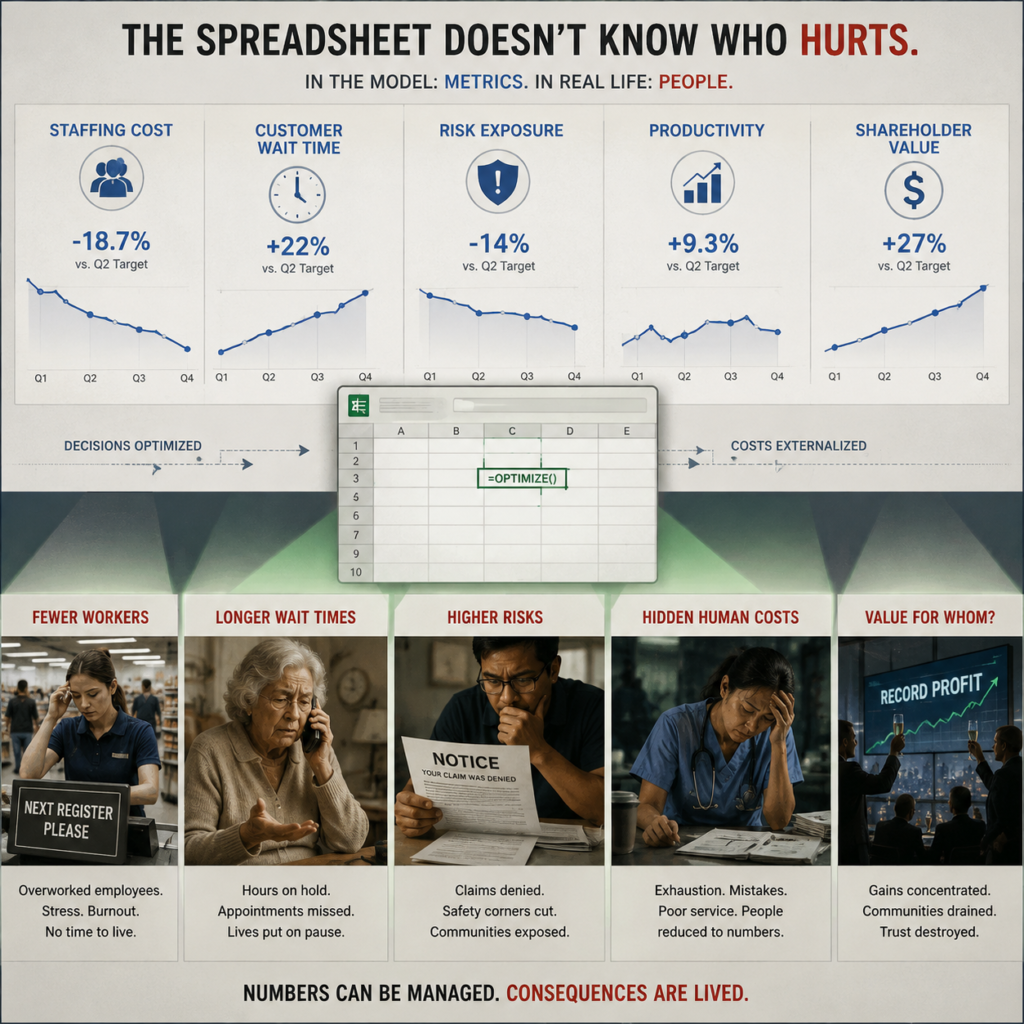
That is the possibility that bothers me far more than the idea that some executive somewhere might score highly on a psychopathy assessment. A psychopath is unusual. A system capable of producing psychopathic behavior from psychologically ordinary people is scalable.
This is where organizational structure, incentives and personality intersect. The corporation does not need to recruit villains. It merely needs to establish what success means. If success means increasing profit while respecting workers, customers, communities, law and moral obligations, then the organization can reward people who accomplish those things together. If success means maximizing a number and everything else is described as a constraint, then people who are unusually willing to sacrifice everything else may gradually outperform people who are not.
The system begins selecting for the behavior it rewards.
This is why I am suspicious whenever somebody excuses corporate conduct by saying that the executives had a “fiduciary responsibility” to shareholders, as though some supernatural force compelled them to make whatever morally disgusting decision produced the largest return. Corporate law is far more complicated than the popular slogan that corporations are legally required to maximize shareholder profit at every moment. But even if the law did require that, my response would simply be that the law was immoral and should be changed. “The system required me to do it” does not magically transform wickedness into righteousness.
Human beings created the system.
Human beings can change it.
This is also why Shadowrun‘s megacorporations work so well as villains. Aztechnology does not need every employee to be evil. Renraku does not need every security guard to be a sociopath. Saeder-Krupp does not require every accountant to possess the personality of a dragon merely because a dragon happens to sit at the top.
Most employees can be ordinary people. That makes the corporation more frightening, not less.
The security guard standing between the shadowrunners and the research laboratory may have absolutely no idea what is happening inside it. He may be working overtime because his daughter needs braces. The scientist may genuinely believe her research will help people. The middle manager may know something is wrong but fear losing his career. The executive may have been shown sanitized reports. The board may see aggregated numbers rather than individual victims.
Then Mr. Johnson hires shadowrunners to make the problem disappear.
- Nobody thinks they are the villain.
- Everybody has a reason.
- Everybody has a supervisor.
- Everybody has a mortgage.
- Everybody has plausible deniability.
And somewhere at the end of that chain, somebody gets hurt.
That is why the question “Are corporations run by psychopaths?” ultimately turns out to be less important than it initially sounds. Some undoubtedly contain people with unusually strong psychopathic characteristics. Certain corporate environments may reward traits associated with psychopathy, narcissism and Machiavellianism. That deserves serious attention.
But we should not allow that fascinating psychological question to distract us from the larger moral problem.
A corporation does not have to be run by psychopaths to behave psychopathically.
It only needs a structure in which compassion is expensive, responsibility is diffused, human suffering can be converted into numbers, and the people making the decisions rarely have to look into the eyes of the people who pay for them.
Most of us will never sit across a conference table from a diagnosed psychopath. Most of us will, however, spend an enormous portion of our lives dealing with corporations. And corporate amorality usually does not first introduce itself through poisoned rivers, criminal conspiracies or bodies on the pavement. Usually it begins with something considerably more mundane.
It depletes you of your most valuable resource: it wastes your fucking time.
When Customer Service Becomes Customer Management
“It wastes your fucking time.”
That sounds trivial after talking about poisoned rivers, corporate psychopaths and decisions that can potentially ruin thousands of lives. Nobody is going to make a documentary called The Man Who Spent Forty-Seven Minutes on Hold. There probably will not be a congressional investigation because somebody had to reset his password four times. No one is going to prison because a grocery store had eighteen checkout lanes but only three cashiers on duty. But…
Time is life.
That is not some inspirational slogan. It is literally true. Money can be lost and replaced. Property can be destroyed and rebuilt. If somebody wastes two hours of your life, those particular two hours are gone forever. You had a finite amount of time remaining before the interaction began, and you have two hours less when it ends.
Corporations understand this perfectly well when the time belongs to them.
Businesses spend enormous amounts of effort measuring labor hours, employee productivity, processing times, deliveries per hour, calls handled per shift and transactions per minute. A corporation may restructure an entire operation because it discovers that employees are spending an unnecessary thirty seconds performing some repetitive task. Multiply thirty seconds by ten thousand employees performing the task hundreds of times per year, and suddenly those tiny fragments of time become millions of dollars.
Fair enough.
Efficiency matters.
But then you walk into a grocery store and discover twenty checkout lanes, three human cashiers and a crowd of customers waiting to give the corporation money.
What message does that send?
The Bureau of Labor Statistics has described one of the fundamental economic effects of self-checkout rather plainly: tasks such as scanning and bagging purchases are transferred from cashiers to customers, allowing fewer cashiers to oversee multiple checkout stations and enabling retailers to capture efficiency gains.
Read that again without corporate vocabulary.
The customer is doing work that an employee used to be paid to do.
Now, I am not against self-checkout. Sometimes I prefer it. If I have three items and there is an open machine, I would rather scan them myself than stand behind somebody buying groceries for a family of twelve. Some customers appreciate privacy. Some appreciate speed. Some simply do not want to make small talk with a cashier. Technology that allows customers to perform a task themselves can genuinely improve their experience. The important question is not whether self-checkout is evil.
The important question is: Who receives the efficiency dividend?
Suppose technology makes it possible for a grocery store to operate its checkout area with five employees instead of fifteen. Why doesn’t the grocery store discount your purchase since they’ve admittedly suckered you into working for them for free so they can increase their profit margin? There are many possible ways to distribute that increased productivity. Prices could fall. The remaining employees could receive higher wages. The store could maintain more employees elsewhere so shelves stay stocked and customers receive better assistance. Customers could move through the store faster. Shareholders could receive greater profits.
Or some combination of all of those things could happen.
But there is another possibility, and it’s the one we see often: The corporation eliminates ten jobs, keeps prices essentially where the market allows them to remain, leaves customers standing in line, makes those customers scan and bag their own groceries, asks them to return their own shopping carts, and then proudly announces how much it values your time.
At some point I begin wondering what exactly the corporation thinks the word service means.
This phenomenon is not confined to grocery stores. Modern corporations have become extraordinarily talented at transferring administrative work onto the customer.
- Check yourself into your flight.
- Print your own boarding pass.
- Scan your own groceries.
- Bag them yourself.
- Download the app.
- Create an account.
- Verify your email.
- Verify your telephone number.
- Enter the code.
- No, the other code.
- Upload your identification.
- Take a photograph of yourself.
- Answer the security questions.
- Navigate the automated telephone system.
- Visit the Frequently Asked Questions page.
- Chat with the automated assistant.
- Troubleshoot the device yourself.
- Restart it.
- Reinstall the application.
- Try another browser.
- Clear the cache.
- Wait forty-eight hours.
- Call us if the problem persists.
Eventually, after performing enough unpaid administrative labor, you may earn the privilege of speaking to another human being.
This is sometimes called customer labor or consumer labor: work once performed primarily by employees being transferred onto consumers. Again, that transfer is not inherently wrong. Sometimes it represents genuine technological improvement. I do not want to return to an era when every banking transaction requires standing in line in front of a teller. But there is an enormous difference between giving me the option to serve myself and eliminating service while calling the result convenience.
The distinction becomes especially obvious when something goes wrong.
I experienced this repeatedly with PayPal while living in Mexico. I lived there for approximately seven years, and naturally I needed to use my money while I was there. Yet I repeatedly encountered problems with my PayPal card being restricted for international transactions. I could tell them that I was living in Mexico. I could explain that transactions in Mexico were therefore not inherently suspicious. I could get international use restored.
Then eventually I would discover that I had a problem again. And how do you sometimes discover that? Not while comfortably sitting at home with nothing better to do. You discover it after traveling to an ATM because you need money.
- Now the card does not work.
- Now you call.
- Now you navigate the telephone system.
- Now you wait.
- Now you explain that you are the same person who explained this before.
- Now somebody tells you that the security measures exist to protect you.
Protect me from what?
That is not a sarcastic question. If the corporation can tell me, “Sir, during the past twelve months our security system prevented three fraudulent attempts to withdraw $1,700 from your account,” then wonderful. Thank you. That is a measurable benefit. I would gladly tolerate some inconvenience in exchange for preventing somebody from stealing my money.
But if the only demonstrable outcome is that I could not access my money until I spent my time convincing the company to let me use it, then the company has demonstrated inconvenience, not protection.
Security is necessary. Fraud is real. Identity theft is real. Financial institutions cannot simply disable every safeguard whenever a customer finds one annoying. There will inevitably be false positives in any fraud-prevention system, and eliminating every false positive would probably require accepting an unacceptable number of fraudulent transactions.
Fine.
Then false positives are a cost of the security system. And somebody is paying that cost.
Usually the customer.
I encountered another absurd version of this when PayPal sent me a card whose chip eventually did not function properly. I needed a replacement. But replacing it while living in Mexico created another problem because the replacement could not simply be sent where I was actually living. I needed an American address and ultimately had to deal with forwarding arrangements to get the replacement card to Mexico.
Think about the inversion taking place.
The corporation’s defective or unusable piece of plastic becomes my logistical project.
That is the pattern I am interested in.
Corporations have become very good at identifying costs that can be pushed outside the corporation.
Economists have a useful term for a related phenomenon: externalities. A business may produce something profitable while some of the associated costs are borne by other people. Pollution is the classic example. A factory produces widgets and profit; people downstream receive contaminated water. The corporation’s accounting may accurately measure the widgets while failing to internalize the full social cost of producing them.
Customer time can function similarly on a much smaller scale.
If improving a company’s support system requires hiring another thousand employees, that expense appears directly on the company’s books.
If not hiring those employees causes five million customers to waste twenty minutes each navigating bad support systems, where does that expense appear?
Not on the company’s payroll.
The cost has been exported.
Those five million customers collectively lose more than 1.6 million hours of human life, but the corporation does not receive an invoice for them.
Imagine if we could send one.
“Dear PayPal: Your security system unnecessarily consumed three hours of my time this month. My hourly consulting rate is $75. Please remit $225 within thirty days. Failure to make timely payment will result in a $35 late fee.”
Corporations would suddenly discover astonishing improvements in customer service.
The absurdity of that imaginary invoice exposes an important imbalance. Corporations routinely monetize our delays. Miss a payment: late fee. Change a reservation: fee. Need special processing: fee. Need something faster: expedited-service fee. Sometimes, as we will discuss when I get to Greyhound, even moving a transaction from one channel to another can cost more money.
The corporation’s inconvenience has a price.
Your inconvenience is apparently complimentary.
This is one reason I increasingly dislike the phrase customer service when dealing with large bureaucratic systems. In too many cases the objective no longer seems to be serving the customer. It is managing the customer as efficiently as possible.
Get him through the workflow.
Authenticate him.
Categorize the problem.
Push him toward self-service.
Prevent unauthorized exceptions.
Close the ticket.
Minimize handling time.
The individual human being becomes another unit moving through an administrative machine.
And once again, almost nobody inside that machine needs to be malicious.
The programmer who created the authentication system may be trying to stop fraud. The call-center employee may genuinely want to help you. The supervisor may be required to follow procedures. The compliance department may be responding to regulations. The executive may be looking at aggregate customer-satisfaction scores and believing everything is functioning reasonably well.
That is precisely the problem we encountered in the previous section.
The corporation can produce an experience that nobody inside it personally intended.
And because the costs are dispersed across millions of customers, each individual inconvenience appears insignificant.
- Twenty minutes here.
- Forty-five minutes there.
- Another password reset.
- Another trip to the ATM.
- Another identity verification.
- Another afternoon waiting for a technician.
- Another hour on hold.
- Another customer who eventually gives up.
There is also something deeply dehumanizing about linking more and more of our lives to a single telephone. Lose your phone and suddenly you may discover that possessing your email address and password is not enough to access your email. Your bank wants to send a verification code to the phone you no longer possess. Your payment account wants the same thing. Another account wants authentication through an application installed on the missing device.
From the corporation’s perspective, multifactor authentication can significantly improve account security.
From the human perspective, somebody stole my fucking phone and now half my digital life thinks I am the suspicious person.
Again, the answer is not to abolish authentication. The answer is to design recovery systems around the reality that human beings lose phones, change telephone numbers, travel internationally, move between countries, forget passwords, become homeless, lose access to old addresses and sometimes experience circumstances that do not fit neatly into the corporation’s expected customer profile.
- A humane system anticipates human beings.
- A bureaucratic system anticipates compliant data.
There is a larger economic point underneath all of this. When people talk about exploitation, they usually think about money. That makes sense because money is measurable. If somebody takes $100 from you, everyone understands that you lost something.
Time is harder to see. But time is the original currency.
Every dollar you have ever earned represents some combination of your labor, someone else’s labor, ownership, risk, investment or inherited claims upon human activity. Human civilization constantly converts pieces of people’s finite lives into economic value.
A corporation that respects its customers should therefore respect their time.
Not sentimentally.
Economically.
If ten thousand customers are unnecessarily wasting an hour because of a stupid corporate procedure, the company should regard that as a serious failure even if the wasted hours do not appear anywhere on its balance sheet.
This is where my complaint about grocery-store lines comes from. If I walk into a massive supermarket and see fifteen closed checkout lanes while customers stand waiting in the three that are open, I see an organization making a decision about whose time matters.
Hiring another cashier costs the corporation money.
Making fifty customers wait costs the corporation considerably less.
So we wait.
That decision may be economically rational according to the corporation’s accounting.
It may even increase profit.
But profitability and morality are not synonyms.
That distinction is going to become increasingly important as we move through this essay, because the same logic that transfers small inconveniences onto customers can transfer enormous costs onto workers.
The customer brings his own labor to the checkout.
The gig worker brings his own labor, his own automobile, his own gasoline, his own insurance, his own telephone, his own maintenance costs and sometimes even his own financial risk.
The corporation provides the platform.
And somehow, after transferring more and more of the costs of doing business onto everybody else, the corporation still gets to call itself the employer—or, when convenient, insist that it isn’t one.
Chasing the Carrot: When the Worker Pays the Business’s Costs
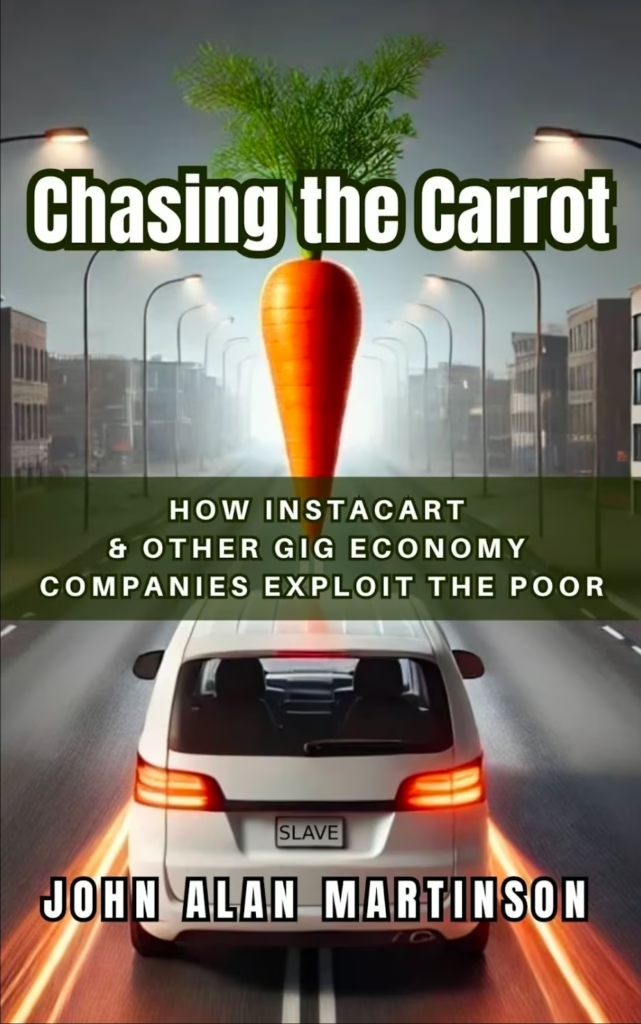
I already wrote an entire book about this particular species of corporate wickedness.
It is called Chasing the Carrot: How Instacart & Other Gig Economy Companies Exploit the Poor, and I did not write it after sitting in an air-conditioned office studying charts about the future of labor. I wrote it while living the thing. By then my wife and I had completed more than a thousand grocery deliveries, worked Instacart across numerous states, lived through Uber and Lyft before that, and learned exactly what “flexibility” can mean when the person receiving that flexibility is poor enough that he cannot afford to stop working.
That distinction is important, because one of the easiest defenses of the gig economy is also one of the stupidest: if the job is so bad, why are you doing it?
Because people have reasons.
I had worked as a professional truck driver, driving more than 120,000 miles in a year. My mother drove a taxi for approximately forty years. Transportation was not some mysterious business I wandered into without understanding fuel, routing, time, mileage or vehicle maintenance. Before Instacart, I had worked Uber and Lyft for more than seventy hours a week and still found ordinary housing so financially unrealistic that I lived in a storage unit in San Diego, where I later recorded audiobooks among the roaches, mice and spiders.
My first experience with working 11+ hours a day in the gig economy, resulted in deciding to live in a storage unit, instead of continuing to be a wage slave for Uber Lyft, and from that experience I wrote the book How to Live in a Storage Unit or Other Place You Don’t Belong.

Years later, after Amazon was celebrating that I couldn’t afford a lawyer to force them to pay me my royalties on over 100 audiobooks that I had mostly recorded while sweating in a storage unit. I eventually turned to DoorDash and Instacart. Apart from Amazon’s Audiobook Creation Exchange (ACX) enjoying watching me squirm as they illegally refused to pay me my royalties, and my family being homeless, I had one other overwhelming reason to take up Instacart as my job, and that had nothing to do with thinking grocery delivery was a magnificent career opportunity. After an attempted kidnapping involving my wife and daughter, I wanted work that allowed me to remain close to my family. A conventional job that placed me somewhere else for eight, ten or twelve hours at a time did not solve that problem. Gig work appeared to.
That is the population these companies are especially good at finding.
People who need something.
The parent who needs unusual hours. The person whose ordinary employment options have collapsed. The immigrant. The person living in his car. The person who needs money today rather than after a three-week hiring process. The person with family responsibilities that make conventional scheduling difficult. The person who cannot afford to wait for something better.
The sales pitch is ingenious because it tells that person he is not desperate.
- He is an entrepreneur.
- He is independent.
- He is his own boss.
Except the boss is still there. The boss is the app, and the corporation that designed it with the corporation’s profit margins in mind first and foremost.
That was the point of the carrot in Chasing the Carrot. The carrot was not simply low wages. It was the system of hope surrounding those wages. There is always the possibility that the next order will be the good one. The next batch will have the generous tip. The next neighborhood will be better. The next hour will finally become busy. The next promotion will make the day worthwhile.
The app can encourage this beautifully because it knows exactly how to speak the language of a slot machine without looking like one.
Heavy Pay.
Peak Pay.
Streak Bonus.
You’re almost there!
Great job!
Another order.
Another notification.
Another carrot.
In the book, I described the experience as psychological warfare because what irritated me was not merely that Instacart sometimes offered terrible orders. It was the polished way in which terrible economics could be surrounded by cheerful little words and rewards that made the worker feel as though he were progressing. A worker can spend an entire day moving, shopping, loading, unloading, driving and staring at gross earnings while the expenses quietly follow behind him like a predator.
My wife and I once calculated that after working Instacart together from approximately 9:00 in the morning until 7:00 at night, we had earned about $3.33 each after gasoline expenses.
And gasoline was not even the whole calculation.
That is the trick.
A gig company can tell you that a batch pays $18.42 because $18.42 is the number that appears on the screen. But the automobile does not care what appears on the screen. Tires still wear out. Oil still needs changing. Brake pads disappear. The transmission accumulates abuse. Insurance costs money. The telephone and data connection required to perform the job cost money. Batteries wear down. The vehicle depreciates because every mile you drive today is one less mile of useful service you possess tomorrow.
When I wrote Chasing the Carrot, I was doing Instacart in a fourteen-foot Ford E450 box truck because that was the vehicle my family had at the time. That is obviously a horrible vehicle for delivering groceries. I knew that. I had previously delivered in a Chrysler Town & Country and other vehicles that were much more sensible. But poor people generally do not begin each morning by opening the garage and selecting the optimally efficient vehicle from their private fleet. Sometimes you work with what you fucking have.
That matters because gig-economy mathematics is very different depending upon who enters the game.
A financially comfortable person with a paid-off hybrid, excellent credit, savings for repairs and the ability to reject every bad order may genuinely do fairly well.
A desperate person driving an old minivan with 180,000 miles on it experiences another economy entirely.
The platform does not have to discriminate between those people.
The mathematics does it automatically.
And the hidden cost of using a vehicle for work is not some eccentric theory of mine. The IRS currently allows a standard business-mileage rate of 76 cents per mile for business travel occurring from July 1 through December 31, 2026, after raising the rate in response to increased fuel costs. That rate is an approximation used for tax purposes, not proof that every person’s vehicle literally costs 76 cents per mile, but it exists precisely because operating a vehicle for business involves far more than whatever you just paid at the gasoline pump.
Gig companies understand costs perfectly well when those costs belong to the corporation. That is what makes the model so beautiful from the corporation’s point of view. Imagine Instacart purchasing tens of thousands of delivery vehicles. Now Instacart has to think about depreciation.
- Instacart needs tires.
- Instacart needs oil.
- Instacart needs repairs.
- Instacart needs fleet insurance.
- Instacart has vehicles sitting idle when there are not enough orders.
- Instacart needs employees to manage those vehicles.
- Instacart bears the risk when a transmission blows up.
Instead, with the Instacart gig economy wage slave app, the shopper arrives with a vehicle already attached.
- The shopper supplies the telephone.
- The shopper supplies the fuel.
- The shopper pays for the tires.
- The shopper loses the value when the odometer climbs.
- The shopper absorbs the downtime when the car breaks.
- The shopper sits in a parking lot waiting for something worth accepting.
- The platform owns the marketplace.
That is one of the reasons the gig economy fascinates me as a corporate structure. It represents one of capitalism’s favorite games played almost to perfection:
Find the cost and move it onto somebody else.
The Federal Trade Commission has recognized that there are serious enough problems in this sector to establish gig-worker enforcement priorities specifically involving deceptive earnings claims, opaque compensation, undisclosed costs, unfair contract terms and other practices capable of distorting workers’ understanding of what they are really earning. The FTC has also emphasized that gig workers should not be forced to accept poor wages or working conditions merely because companies classify them as independent contractors.
That does not mean every gig worker is being cheated.
It does mean the broader problem is real enough that federal regulators are not treating it as the whining of people who simply failed to hustle hard enough.
And Instacart itself has already supplied us with examples of why skepticism is warranted. In 2022, the District of Columbia reached a $2.54 million settlement with Instacart resolving allegations that the company misled consumers about service fees and tips and failed to pay required sales taxes. The D.C. Attorney General alleged that Instacart used a service fee in a way that led customers to believe money was going toward worker compensation when, according to the District, the company was using those funds for its own purposes; the resulting settlement funded payments to eligible workers as well.
DoorDash produced another variation of the same problem. The District of Columbia reached a $2.5 million settlement resolving allegations that its old pay model used customer tips to offset what the company otherwise would have paid Dashers. New York subsequently secured another $16.75 million settlement involving unpaid tips to delivery workers.
These aren’t theoretical arguments about Marx and Adam Smith.
They are arguments about who gets the fucking tip.
That is one reason tipping occupies so much space in Chasing the Carrot. I repeatedly encountered batches involving large grocery orders, significant shopping time and driving in which there was either no tip or such a poor tip that the economics became insulting. Instacart could label an order “Heavy Pay” while the total amount being offered still made the label feel like mockery. In multi-customer batches, the shopper could also lack enough transparency to know which customer was providing the meaningful tip and which customer was effectively being carried along by somebody else’s generosity.
And that brings us to something more uncomfortable than corporate greed: Customers participate in the economics too.
One of the deliberately provocative chapters of Chasing the Carrot is called “People Love Having Slaves.” I was not equating Instacart with historical American chattel slavery. The book explicitly distinguished what I called economic captivity from chattel slavery. My point was about the human appetite for receiving another person’s labor while paying as little as possible for it.
Remove the app for a moment.
- Ask your neighbor to drive to the grocery store.
- Ask him to walk through the aisles for an hour finding forty items.
- Ask him to communicate with you when things are unavailable.
- Ask him to stand in the checkout line.
- Ask him to load everything into his personal automobile.
- Ask him to pay the operating costs of that automobile.
- Ask him to drive ten miles to your home.
- Ask him to carry the groceries to your door.
Now give him three dollars! Watch his reaction as you pretend that three measly dollars is sufficient payment for his labor.
Most decent people would feel embarrassed to attempt to scam a friend out of his time and elbow grease.
Put a beautiful interface between those two human beings, however, and something changes.
The shopper is no longer Jack, your friend. He is the little vehicle icon moving across the map.
That is dehumanization through interface.
And the company benefits enormously from preserving that psychological distance. If the customer really understood that the worker might receive very little after expenses, perhaps the customer would tip differently. If the worker saw a brutally honest calculation of his actual operating costs rather than gross receipts, perhaps he would reject more orders.
That is why one of the things I argued for in Chasing the Carrot was greater transparency—not merely higher pay. Show the shopper dollars per mile. Show which customer tipped what in a multi-order batch. Let shoppers filter stores that repeatedly waste their time. Let them reject certain geographic areas or order types. Give shoppers better control over the batches they are willing to perform. Show a more realistic approximation of earnings after vehicle expenses. Let workers evaluate the transaction with the information a genuine independent businessman would want before accepting a contract.
Because that is the central contradiction.
If I am truly an independent contractor, then treat me like one.
- Let me know what the job actually pays.
- Let me understand who is paying me.
- Let me evaluate the expenses.
- Let me decide what stores I serve.
- Let me decide what distances make economic sense.
- Let me reject a bad contract without having my livelihood manipulated through an opaque system.
Do not call me independent when independence benefits you and manage me like an employee when control benefits you.
That is not entrepreneurship. That is risk without authority.
And this is why Chasing the Carrot: How Instacart and Other Gig Economy Companies Exploit the Poor belongs in an essay about what Shadowrun taught me about corporations. The gig economy is almost a beautifully mundane real-world cousin of the shadowrunner economy. The corporation wants the mission accomplished without maintaining everything required to accomplish it. The worker appears with his own equipment, assumes the physical risk and gets paid by the job.
There is one rather embarrassing difference.
A competent shadowrunner meets Mr. Johnson and negotiates.
- The Johnson says, “Fifty thousand nuyen.”
- The Face leans back and says, “Seventy-five.”
The gig worker’s Johnson is an app.
- The app flashes: $7.41. Heavy Pay.
- There is no opportunity to negotiate or communicate the terms of the contract with a human being. You have a button to accept the offer or reject it. Take it or leave it, slave.
And somewhere inside a corporate office, nobody even has to look you in the eye.
Greyhound: The Cyberpunk Dystopia Has Bad Wi-Fi
There are moments when a corporation stops being an abstract subject and becomes something you physically have to endure. Greyhound became that for me during one of the worst periods of my life. My wife was in Mexico battling stage 3 cervical cancer, and I needed to get back to her. Money was extremely tight. For a brief period I seriously considered taking a bicycle across the country, and I even bought one for fifty dollars and started trying to work out how such a journey might be possible. I probably could have eventually done it, but “eventually” was exactly the problem. My wife was sick. I needed to move quickly. So I did what countless Americans without a car or airplane money have done for generations: I turned to Greyhound.
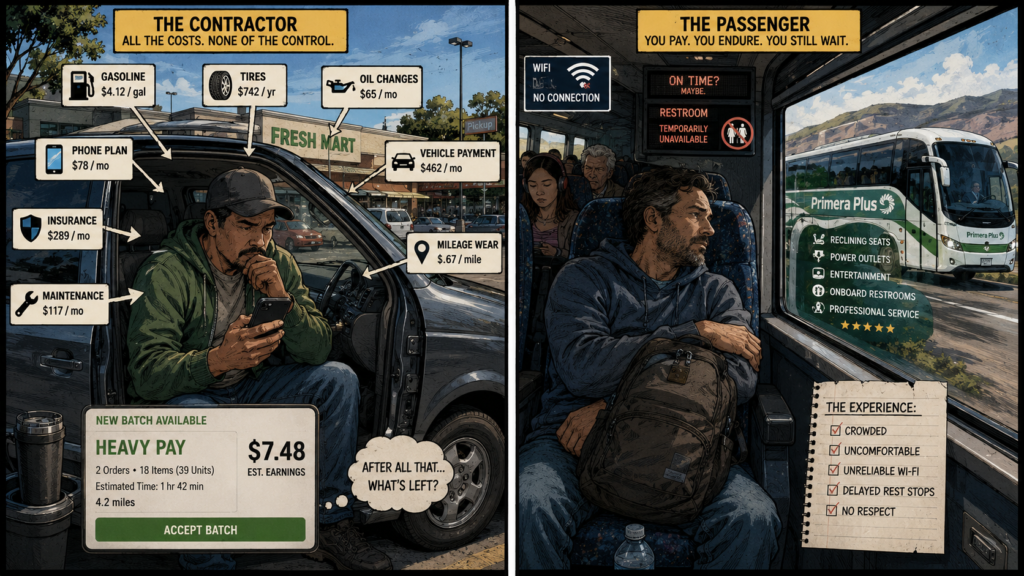
That experience reinforced something I have increasingly come to believe about corporations. You can learn a great deal about what a company thinks of its customers by examining the experience it considers acceptable for people who have few alternatives.
Even buying the ticket became ridiculous. Greyhound’s app would not accept my card. Its website would not accept my card. I looked into the error I was receiving and eventually called the company. Suddenly, over the telephone, the exact same card could apparently be accepted—but I was told that handling the purchase that way would cost me an additional fee. From my perspective, the maddening part was obvious: if my card was genuinely unsuitable for the transaction, why did it suddenly become suitable when a Greyhound employee entered it? If the problem was somewhere in Greyhound’s automated system rather than with my money, why should resolving Greyhound’s problem cost me more money? That is exactly the kind of corporate inversion I discussed earlier. A company’s system inconveniences the customer, and then the customer can end up paying for the privilege of escaping the inconvenience.
Greyhound certainly knows what long-distance travelers want. Its current advertising explicitly promises free Wi-Fi, power outlets, reclining seats, extra legroom and onboard restrooms. Greyhound’s own Wi-Fi page even explains that its complimentary internet uses cellular networks and may encounter dead zones, which is a perfectly reasonable limitation of mobile internet. I have no problem with a bus losing Wi-Fi while driving through the middle of nowhere. Technology has limitations. My complaint is about the accumulated experience. The Wi-Fi may be advertised but unreliable. The seats may technically recline but still leave a passenger feeling cramped after hours of travel. A restroom may technically exist, but that fact becomes rather meaningless when a driver decides passengers cannot use it because she dislikes the smell or the repeated opening and closing of the restroom door, as happened on one of my trips. Everybody on a long-distance bus has a bladder. “The bathroom smells” is not a workable long-term restroom policy.
I have had some good Greyhound drivers. I want that said plainly because this is not an attack on every individual who has ever worn a Greyhound uniform. Some have been courteous, professional and exactly what a long-distance driver should be. Others have left me wondering what standards the company uses when deciding who should be responsible for dozens of tired, vulnerable passengers trapped together for hours. A driver possesses an extraordinary amount of situational authority inside that bus. If she is professional, the trip feels organized and safe. If she is hostile, indifferent or arbitrary, there is not much the passengers can do about it until the next station. The company has placed one person in charge of a temporary little civilization rolling down the interstate, and corporate standards determine what kind of ruler that person is permitted to become.
My frustration with Greyhound became much sharper once I had traveled extensively in Mexico, because Mexico proved to me that long-distance bus travel does not have to feel this way. I am not comparing Greyhound to Mexican city buses, colectivos or inexpensive local transportation. I am comparing Greyhound with the Mexican companies performing the equivalent job: carrying passengers between cities for journeys lasting several hours or longer. Companies such as ETN Turistar and Primera Plus operate intercity coach services whose basic assumptions about the passenger experience can feel completely different.
This is not merely nostalgia or my imagination. ETN currently advertises reclining seats, individual entertainment screens, electrical connections, USB charging, Wi-Fi, air conditioning and onboard restrooms. Some of its route information specifically advertises independent restrooms, while Primera Plus advertises broad reclining seats, footrests, individual tables, entertainment screens and onboard bathrooms; its policies also discuss onboard and waiting-room Wi-Fi. The companies themselves are competing on comfort. That is important because comfort is being treated as part of the product rather than some unreasonable demand from passengers who should simply be grateful that the bus moves.
The difference can begin before you even board. Some of the major Mexican bus terminals feel much more like airports than what many Americans imagine when they hear “bus station.” You have substantial waiting areas, ticket counters, food, shops, organized boarding areas and large numbers of coaches moving between cities. Then you get onto some of the premium intercity buses and the difference becomes even more striking. The seats can recline far enough that sleeping for several hours is actually plausible rather than an endurance exercise. There is generous space between rows so the person in front of you can recline without seeming to enter your lap. Curtains and blinds reduce outside light. Electrical outlets keep devices alive. Individual entertainment systems may provide movies, music and games. On buses I have ridden, there have even been two audio connections at a seat arrangement so passengers can either enjoy entertainment separately or share it.
And then there are the bathrooms.
This probably sounds like an absurd subject to devote serious attention to until you spend twenty hours traveling by bus. A restroom becomes one of the most important pieces of engineering in the entire vehicle. On some Mexican coaches I have encountered a small vestibule separating the passenger cabin from the actual toilets. You open one door and enter a narrow intermediate space; the men’s restroom may be on one side and the women’s on the other. Then another door separates the toilet itself from that vestibule. It is a remarkably simple design decision with obvious advantages for odor, privacy and passenger comfort. There may be running water. The restroom itself feels more like something deliberately designed for human beings rather than a plastic emergency closet bolted into the back of a bus.
None of this is magical technology unavailable to the United States.
That is what makes the comparison interesting.
Mexico did not discover some lost alien science of comfortable seating. American engineers understand reclining chairs. Greyhound knows how electrical outlets work. Everybody knows that a double-door barrier helps contain restroom odor. The technology behind a decent waiting room, reliable climate control, curtains and courteous boarding procedures is not complicated. The question is why one transportation culture can make long-distance coach travel feel like legitimate mainstream intercity transportation while another can so often make it feel like the thing you endure because you could not afford something better.
That is the class dimension that bothers me most. When a customer has few alternatives, capitalism’s supposed discipline of consumer choice becomes much weaker. If an affluent traveler dislikes one airline, perhaps he chooses another. If air travel altogether becomes unpleasant, he may drive. If somebody cannot afford a car, cannot afford airfare, or simply has some other reason that long-distance bus travel is his realistic option, then the bus company knows something important about him: he needs the bus more than the bus needs to impress him.
That is exactly when corporate character matters.
A good corporation can look at that captive or semi-captive customer and think, “Because these people have fewer alternatives, we owe them a particularly good service.” A worse corporate culture can reach the opposite conclusion: “Because these people have fewer alternatives, how much discomfort can we get away with before they stop paying us?”
The second logic is tremendously profitable in the short term. It is also one of the reasons people come to hate corporations.
To be fair to Greyhound, the company is operating in an American transportation environment that is not entirely of its own making. The United States has spent generations structuring enormous portions of its infrastructure around automobiles and air travel. Intercity bus terminals have closed or been moved. Greyhound itself is now part of Flix, and modern intercity service increasingly uses curbside stops and shared facilities rather than the grand central terminals that once characterized American bus travel. Greyhound also really does advertise amenities that passengers value, and there are obviously routes, buses and employees where those amenities work as promised. My argument is not that every Greyhound bus is literally a torture chamber while every Mexican bus is a first-class hotel.
My argument is that I have repeatedly experienced enough of both systems to know what the difference feels like.
Traveling on a good Mexican intercity coach can make me excited about traveling. I can settle into a deep seat, lower the shade, charge my phone, watch something, sleep, use a thoughtfully designed restroom and arrive several hours later feeling that somebody actually considered what it is like to inhabit that vehicle as a human being. My Greyhound experiences have too often left me feeling like the corporation understands that its customers are frequently poor, stranded between transportation options or unable to demand much better, and has constructed the product accordingly.
That is not merely an aesthetic complaint. Service itself communicates social value. When a terminal is clean, the restroom works, the driver greets passengers professionally and the seat allows an exhausted person to sleep, the institution is saying, “You are worth accommodating.” When the experience is filthy, arbitrary, cramped or unreliable, another message can be received whether corporate management intends it or not.
You begin to feel processed rather than transported.
There is, of course, a much funnier explanation for all of this, and it sounds exactly like the beginning of a Shadowrun job. Perhaps Greyhound is secretly controlled by an automobile megacorporation. The board’s actual mission is not to make bus travel attractive but to ensure that every passenger staggering off after a fourteen-hour trip thinks, “Dear God, I need to buy a car.” The runners are hired to infiltrate corporate headquarters and steal the documents proving that the broken Wi-Fi, uncomfortable terminals and bathroom policies are all part of Project Buy-a-Ford.
That is a joke. I have found no evidence that Greyhound is secretly an automobile-industry psychological operation, and reality is usually less entertaining than that.
But the joke works because corporations really do create incentive structures whose outcomes can look conspiratorial even without a secret room full of villains. Nobody has to deliberately design a miserable passenger experience. Management can cut one cost here, eliminate one station there, understaff one location, defer one refurbishment, tolerate one bad employee and accept one unreliable amenity after another. Every individual decision may make sense when evaluated as a line item. The final product can still feel as though somebody deliberately designed it to make you miserable.
That takes us back to the central question of this essay. What should a corporation owe a customer beyond the bare contractual exchange? Greyhound can say that it sold me transportation from Point A to Point B and, assuming the bus ultimately delivered me there, completed the fundamental transaction. I think that conception of business is far too impoverished. A transportation company’s responsibility is not merely to move a warm body across geography. It is temporarily responsible for the comfort, safety, dignity and basic bodily needs of human beings who have entrusted themselves to it.
That should mean something.
And increasingly, corporations do not merely control transportation, banking or employment. Some of them control something even stranger: whether other human beings are allowed to hear you speak. That problem became very real to me while my wife was battling cancer, when TikTok’s algorithms and moderation systems repeatedly stood between my family’s story and the people I was trying to reach.
When Your Family Is the Customer the Algorithm Doesn’t Understand
There is something uniquely infuriating about being told that a system exists to protect people while you are the person being harmed by the system.
That has been one of my recurring experiences with TikTok while my wife has been battling stage 3 cervical cancer. My family has needed money, awareness, support and the simple ability to tell people what is happening to us. I have posted videos about my wife’s cancer, about the treatment choices we have made, about the financial strain on our family, about our daughter and the legal nightmare surrounding her removal from us, and about the desperation of trying to reach people who might actually care enough to help.
Then the platform intervenes.
A video gets removed. Another receives a Community Guidelines strike. An account becomes restricted. Reach seems to collapse. Sometimes the problem appears after simply mentioning cancer, alternative treatment, holistic treatment or something that triggers whatever combination of automated systems and human moderation TikTok uses to determine what is permissible.
Now, to be fair, TikTok has a real problem to solve: medical misinformation can kill people.
There are people online claiming that some herb cures every cancer, that chemotherapy is always a conspiracy, that a particular supplement will magically eliminate a tumor, or that people should ignore their doctors and treat serious disease with whatever product the influencer happens to be selling. A platform with hundreds of millions of users cannot responsibly pretend that health misinformation is harmless.
That part is obvious.
What is not obvious is why a corporation should be permitted to collapse the distinction between making a false medical claim and talking about your own family’s medical choices.
Those are not the same thing.
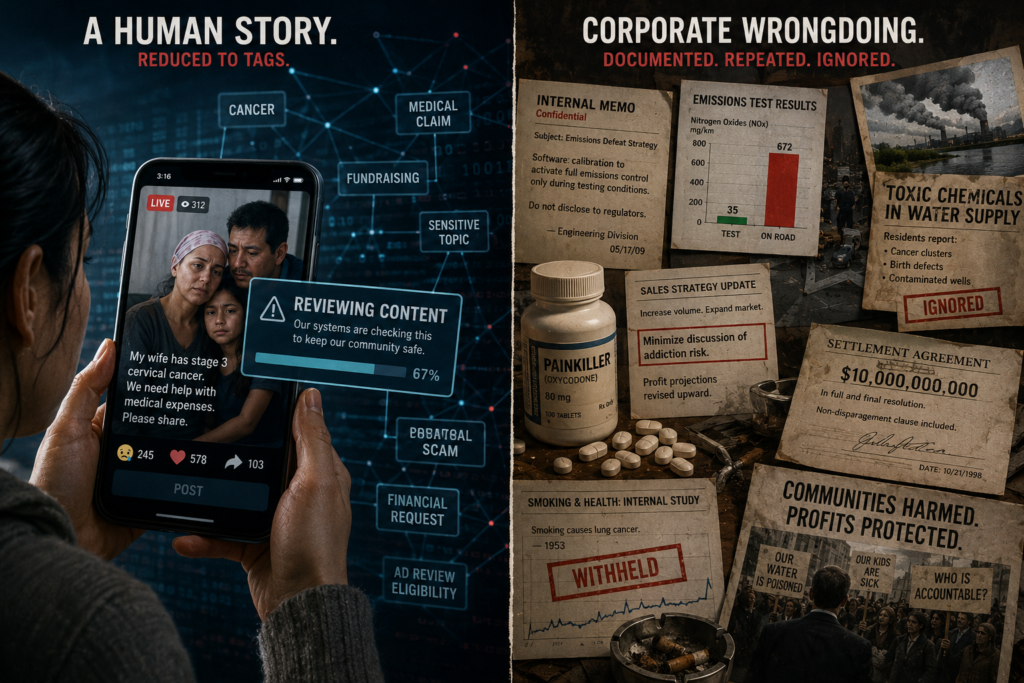
- There is a difference between saying, “This treatment cures cervical cancer,” and saying, “My wife has cervical cancer, and this is something we are trying.”
- There is a difference between pretending to be a doctor and describing your own life.
- There is a difference between advising millions of strangers to reject medical treatment and saying that your family is using a particular holistic or alternative approach alongside, instead of, or after other care.
Context matters. 🧑💼Humans understand context reasonably well. 🤖Algorithms are much less reliable at it.
And the scale of modern content moderation means algorithms have become unavoidable. TikTok itself has described automated moderation systems as central to its enforcement operation, with enormous portions of violating content identified and actioned before a human moderator ever looks at it. In its European Digital Services Act reporting, TikTok has said that the overwhelming majority of violating-content actions were initiated automatically. That is understandable from an engineering perspective. No corporation can employ enough people to personally watch every second of every video uploaded to a platform of that size.
But scale creates a mathematical problem.
Suppose an automated moderation system is astonishingly accurate.
- Not good.
- Not pretty good.
- Astonishingly accurate. 🤖
Suppose it correctly classifies 99 percent of everything it touches.
- If the system evaluates one hundred pieces of content, one mistake is trivial.
- If it evaluates one billion pieces of content, a one-percent error rate becomes ten million mistakes. 🤖
Even a system that looks spectacular on a corporate dashboard can become an industrial-scale producer of individual injustice.
That is what corporations can forget when they speak statistically.
The company sees percentages. 💰
The customer experiences the one fucking mistake. 🤖
European regulators have now accumulated enough data under the Digital Services Act to demonstrate that content-moderation mistakes are hardly hypothetical. In February 2026, the European Commission reported that users had appealed approximately 165 million moderation decisions made by very large online platforms and search engines through internal appeal systems, and that about 30 percent of those appealed decisions had ultimately been reversed. That amounts to nearly fifty million moderation decisions changed after users challenged them. The Commission further reported that, in the first half of 2025, 99 percent of moderation decisions by those platforms involved enforcement of the companies’ own terms and conditions rather than illegal content required to be removed under national or European law.
That distinction is enormously important.
When TikTok removes something because the government has lawfully ordered the removal of illegal content, one kind of authority is operating. When TikTok removes something because TikTok has decided it violates TikTok’s own rules, something else is happening.
- The corporation has written the law.
- The corporation has created the police.
- The corporation has created the court.
- The corporation has created the appeals process.
- The corporation controls the territory.
Of course TikTok is not literally a sovereign nation. Nobody should mistake a Terms of Service agreement for a constitution or a Community Guidelines strike for a prison sentence. Users can theoretically leave. Governments can regulate the company. Courts remain above it. But within the digital territory TikTok controls, the analogy becomes uncomfortable.
- TikTok decides what behavior is permitted.
- TikTok monitors the behavior.
- TikTok imposes penalties.
- TikTok decides whether to restore what was removed.
And the punishment does not even have to be outright deletion.
This is where the entire concept of reach becomes especially strange. For most of human history, censorship was easy to recognize. The king burns the book. The police shut down the newspaper. The government prohibits the speech. Modern platform control can be subtler.
- The video remains online.
- Nobody can prove that the corporation “censored” it in the traditional sense.
- The algorithm simply does not recommend it.
TikTok openly recognizes recommendation eligibility as a distinct part of its platform governance. Its support materials explain that accounts and content can become ineligible for recommendation and that users can appeal those decisions. The European Commission itself now uses language broad enough to include moderation affecting reach, suspension, deletion and what users commonly describe as “shadow banning.”
That produces an extraordinary kind of power: You are technically allowed to speak…but nobody hears you.
From the corporation’s perspective, perhaps this is simply risk management. A video mentioning alternative cancer treatment receives some internal risk score. The system decides that recommending it widely might create misinformation concerns. The video remains available to existing followers or anyone who directly seeks it.
From my perspective, however, I am trying to tell people that my wife is sick.
Those perspectives are not morally equivalent merely because the corporate system is technically sophisticated. This is the recurring problem of scale and abstraction. Somewhere inside TikTok there may be a perfectly reasonable employee who sincerely wants to prevent vulnerable cancer patients from being deceived by dangerous medical claims. I do not object to that person’s goal. I would probably agree with it.
But the system that person helps build may encounter my wife not as Berenice, a human being with cervical cancer whose family is frightened and struggling, but as a collection of signals.
The TikTok 🤖 algorithm makes the following assessment:
- Cancer.
- Alternative treatment.
- Holistic treatment.
- Fundraising.
- Medical claims.
- Possible misinformation.
- Possible recommendation risk.
That is how bureaucracy works.
Human beings become categories. And when the category is wrong, the human being pays.
This has become even more frightening because online platforms now control things much more consequential than entertainment. A TikTok account can be:
- a storefront;
- an audience;
- a political platform;
- a career;
- a fundraising mechanism;
- a support network;
- a news outlet;
- a diary;
- a lifeline.
A person can spend years building an audience and then discover that access to those people depends upon rules the corporation can rewrite, interpretation systems the user cannot inspect and appeals processes the user does not control. That is an extraordinary transfer of cultural power to private organizations.
Again, I am not saying corporations should be forced to publish literally everything anybody wants. A social platform has responsibilities toward users too. It should remove child exploitation. It should combat scams. It should address genuine medical fraud. It should remove certain forms of violent threats and criminal behavior. Moderation itself is not the problem.
The problem is the asymmetry.
The corporation can make a mistake involving you at almost no meaningful cost to itself.
You may experience that mistake as catastrophic.
Imagine that TikTok incorrectly removes one of my videos while my wife is sick. Suppose that video would otherwise have reached ten thousand additional people.
- Perhaps one of those people would have donated twenty dollars.
- Perhaps one would have connected us with a specialist doctor that we urgently need.
- Perhaps one would simply have offered encouragement at a moment when she needed it.
TikTok never sees the alternate timeline.
Neither do I.
That is why algorithmic decisions can be so difficult to evaluate. Their consequences include not only what happened, but what never got the chance to happen.
And this is where the language corporations use about mistakes can become almost insulting. The moderation system may have “performed within expected error thresholds.” The false-positive rate may be acceptably low. The automated enforcement model may have excellent precision.
Wonderful.
Your dashboard A.I. shows that you have a green light. But my human eyes see that the light is red: my video has been removed by TikTok, or my 6th account has been permanently banned.
That is the gulf between institutional measurement and human reality.
There is another strange cultural consequence of this machine-mediated communication: people begin changing their language for the machine. Terms such as unalive came common partly because creators feared moderation or reduced distribution associated with words such as killed or murdered. People intentionally misspell words, use euphemisms and alter captions because they are trying to communicate simultaneously with two audiences: the human being watching and the automated system judging whether the human being should be allowed to watch.
That is cyberpunk as hell.
The corporation does not merely regulate what you say. Eventually you begin regulating yourself according to what you imagine the machine might dislike.
There is an old political concept called the chilling effect: people refrain from lawful expression because they fear consequences. The platform version does not require a police officer or prosecutor. It can arise because creators know that a mistake by the algorithm may cost them reach, income or their account.
So they adapt.
- Don’t say this word.
- Spell that word differently.
- Avoid mentioning this treatment.
- Don’t talk too explicitly about the cancer.
- Don’t show that.
- Don’t phrase it this way.
The machine has entered the language, and the corporation has taken control of your behavior and now, therefore, it unarguably has some control over your mind.
And yet the most frustrating part for me is still personal rather than philosophical. My wife is not a content-moderation problem. My daughter is not a Community Guidelines issue. My family’s poverty is not an edge case in an automated classifier. They are human beings.
When someone you love has cancer, you become acutely aware that time is finite. You want information. You want support. You want options. You want money for food, transportation and medical care. You want people to know what is happening.
Then a corporation whose entire business model depends upon connecting human beings to one another tells you that its machinery has decided your story is something people should perhaps see less of. That is a remarkable amount of private power. It is also a perfect example of why I keep returning to Shadowrun. In the Sixth World, corporate power is obvious because it wears armor and carries rifles. Modern corporations often exercise power through interfaces, policies, recommendation systems, authentication systems and algorithms.
No Red Samurai appears at my door. A database simply changes the conditions of how it flags or categorizes certain content. Sometimes that is enough.
And at this point a reasonable reader could still say that I am talking about frustrating services: a payment processor makes it hard to get money, a gig platform makes work economically precarious, a bus company provides miserable service, a social platform makes questionable moderation decisions. These things may be infuriating, but calling them evil corporations still sounds melodramatic to people whose loved ones we’re pushed into poverty by royalty theft, or whose spouse isn’t battling cancer.
Fair enough.
So now we should stop talking about “inconveniencing” some “nobody” like myself.
We should talk about corporations that cheated regulators, concealed risks, contaminated environments, manipulated addictive products and engaged in conduct serious enough that courts and governments did not have to speculate about whether something wicked happened. Because if Shadowrun sometimes seems paranoid about corporations, the strangest discovery is how little paranoia we actually need.
Real Corporations That Started Looking Like Shadowrun
At this point, somebody could reasonably accuse me of stretching the word evil. PayPal inconvenienced me. Greyhound gave me miserable service. Instacart helped create a gig economy that I believe exploits poor and desperate workers. TikTok placed corporate moderation systems between my family’s story and the people I was trying to reach, all while my wife is battling a deadly disease. Those things matter to me, but none of them by themselves proves the larger proposition that corporations can become genuinely dangerous institutions.
So let us raise the stakes.
One reason I have little patience for the claim that distrust of corporations is inherently paranoid is that we do not need conspiracy theories to establish that corporations sometimes conspire. We have court records. We have guilty pleas. We have regulatory findings. We have internal documents. We have companies that have admitted criminal conduct. Some corporate scandals really do sound like missions somebody wrote for Shadowrun, except nobody had to roll initiative because the events actually happened.
The tobacco litigation is probably one of the strongest examples. In 1999, the United States government brought a civil racketeering case against major cigarette manufacturers and related organizations. Seven years later, federal judge Gladys Kessler issued an enormous opinion finding that the defendants had violated the Racketeer Influenced and Corrupt Organizations Act, or RICO. The court found a decades-long pattern of deception involving the health consequences of smoking, nicotine addiction, manipulation of cigarette design, secondhand smoke, marketing toward young people and other matters. This was not simply an activist holding a sign outside Philip Morris and accusing Big Tobacco of being evil. This was a federal racketeering case in which the government established its case in court.
That deserves some contemplation. RICO is the law most Americans associate with organized crime. Yet here it was being applied to respectable corporations selling a legal product through ordinary stores, advertising agencies and distribution networks. Nobody needed to meet in the back room of an Italian restaurant wearing a fedora. Corporate executives could operate through memoranda, research departments, marketing campaigns, trade organizations and lawyers. The appearance of legitimacy did not prevent the underlying behavior from becoming the subject of a successful racketeering action.
That is one reason the distinction between criminal organization and respectable corporation should never be based primarily on aesthetics.
Volkswagen gave us an even more cyberpunk example. Beginning in the 2000s, the company installed software in diesel vehicles that could recognize when the automobile was undergoing an emissions test. Under testing conditions, the vehicle’s emissions controls behaved differently so that the automobile appeared to comply with regulatory standards. Under normal driving conditions, the controls operated differently. This was not an internet allegation about mysterious automotive behavior. Volkswagen pleaded guilty in 2017 to three federal felony counts, including conspiracy to defraud the United States, wire fraud and Clean Air Act violations, obstruction of justice, and importing merchandise through false statements. The Justice Department described it as a decade-long scheme involving approximately 590,000 diesel vehicles sold in the United States, and Volkswagen agreed to a $2.8 billion criminal penalty.
Think about that as a Shadowrun mission.
Mr. Johnson slides a credstick across the table and tells you that a major automobile corporation has developed software that detects government inspections and changes the machine’s behavior during the test. Your team needs to break into a development facility, obtain the source code and deliver proof to somebody who can expose the company.
That plot almost sounds too obvious. A game master might worry that the corporation is behaving like a cartoon villain.
Reality did it anyway.
Purdue Pharma takes us somewhere darker because the product involved was medicine. In November 2020, Purdue pleaded guilty to three federal felony offenses: conspiracy to defraud the United States and violate the Food, Drug, and Cosmetic Act, plus two conspiracies involving the federal Anti-Kickback Statute. Among other admissions, Purdue acknowledged representing to the Drug Enforcement Administration that it maintained an effective program against opioid diversion while continuing to market opioids to more than one hundred healthcare providers whom the company had good reason to believe were diverting them. It also admitted providing misleading information to the DEA in connection with manufacturing quotas.
As of 2026, that criminal case has culminated in a $5.5 billion sentence in fines and penalties connected with Purdue’s guilty plea, although the bankruptcy structure means most of that nominal amount will not actually be collected. The broader Purdue and Sackler story has become one of the defining corporate scandals of modern America precisely because it forces the accountability question we have been asking throughout this essay: when a corporation admits serious criminal wrongdoing involving a product associated with enormous human suffering, what punishment can actually make the abstract corporate entity suffer?
Fine the corporation and ultimately money moves around.
A human being can go to prison.
The distinction matters.
Then there is DuPont and PFOA, the history dramatized in the 2019 film Dark Waters. In 2005, the Environmental Protection Agency reached what was then the largest civil administrative penalty settlement in the agency’s history under any federal environmental statute. DuPont agreed to pay $10.25 million to resolve alleged violations involving its failure to report information concerning PFOA risks as required under federal law, along with another $6.25 million in supplemental environmental projects. The EPA’s allegations involved information about human health and environmental contamination that the agency maintained DuPont had been legally obligated to report.
The film is useful because movies can restore the human scale that corporate cases tend to lose. Court documents become dates, counts, statutes, concentrations and settlement figures. A movie gives us somebody standing in a kitchen wondering whether the water coming out of the faucet is poisoning his family. Dark Waters dramatizes attorney Robert Bilott’s extraordinarily long fight over chemical contamination associated with DuPont, and while a dramatization should never substitute for the underlying record, the underlying record is disturbing enough without embellishment.
The same is true of Erin Brockovich, the 2000 film in which Julia Roberts portrayed the real Erin Brockovich. She was not an attorney, as people sometimes remember her; she was a legal clerk whose investigative work helped build the case involving Pacific Gas & Electric and hexavalent chromium contamination around Hinkley, California. The litigation eventually produced a $333 million settlement. Once again, the basic story sounds like the setup for a cyberpunk investigation: residents become sick, contamination is suspected, an enormous utility company possesses vastly greater resources than the individuals affected, and somebody begins assembling the evidence needed to make the institution answer for what happened.

Then there is Bhopal, which belongs in a category of horror almost by itself. In December 1984, methyl isocyanate escaped from the Union Carbide pesticide plant in Bhopal, India. Thousands of people died, and vastly more suffered injuries and long-term consequences. The disaster occurred only five years before the first edition of Shadowrun. Anyone constructing a late-1980s dystopia in which multinational corporations could inflict catastrophic harm did not need an especially vivid imagination. The world had already provided an example in which an industrial accident at a multinational corporate facility devastated an entire community.
Bhopal is also a useful warning against making every corporate disaster fit the same moral template. There is a difference between deliberately installing software designed to fool emissions tests and operating an industrial facility where catastrophic safety failures produce mass death. There is a difference between intentionally lying and negligently failing. There is a difference between an executive explicitly ordering wrongdoing and an organization creating conditions in which disaster becomes possible. If we flatten all of these cases into “corporation did evil thing,” we actually learn less about corporations rather than more.
The point is not that every disaster is a conspiracy.
The point is that corporations can produce many different kinds of wickedness.
Sometimes the wrongdoing is deliberate deception. Sometimes it is concealment. Sometimes it is regulatory evasion. Sometimes it is corruption. Sometimes it is negligence. Sometimes it is a willingness to continue profitable behavior while evidence of harm accumulates. Sometimes it is the failure of a vast organization to give safety the same institutional power that it gives production, expansion or profit.
And sometimes corporate power appears not through poisoned water or medicine but through a brutally unequal fight over ownership.
That brings us to Robert Kearns, the inventor whose battle with the automobile industry became the basis of the 2008 film Flash of Genius, starring Greg Kinnear. Kearns developed and patented an intermittent windshield-wiper system in the 1960s. His patent history is real; U.S. Patent No. 3,351,836 identifies Robert W. Kearns as inventor of a windshield-wiper system with intermittent operation. What followed was years of patent litigation against automobile manufacturers, including Ford and Chrysler, over their use of intermittent-wiper technology.

The Kearns story is important to this essay for a different reason. It demonstrates the enormous asymmetry between an individual and a corporation. Even when an individual possesses legal rights, enforcing those rights against a giant institution can consume years of his life. The corporation has lawyers because lawyers are part of its normal operating machinery. The individual has a life that gets reorganized around the fight.
A right that you cannot afford to enforce is a strange kind of right.
Planned obsolescence takes us into even more fascinating territory because this is where documented corporate coordination begins to sound exactly like the kind of thing dismissed as a conspiracy theory. In the 1920s, major international light-bulb manufacturers formed the Phoebus cartel and coordinated aspects of the worldwide lighting market, including standardization of bulb life. The famous story is that manufacturers deliberately reduced expected incandescent-bulb lifespans toward approximately 1,000 hours, with monitoring mechanisms used to enforce standards among cartel participants. The broader history is more complicated than the meme version—brightness, efficiency, filament design, manufacturing cost and bulb longevity involve genuine engineering tradeoffs—but the cartel itself was real. Major manufacturers really did coordinate rather than simply compete.
That is why the documentary The Light Bulb Conspiracy is so provocative. It asks a question that applies far beyond light bulbs: what incentive does a company have to sell you something that lasts forever?

There are legitimate answers. Products improve. Technology becomes obsolete because genuinely better technology arrives. Making something last fifty years may make it prohibitively expensive. Consumers themselves frequently choose lower initial prices over durability. Repairability can conflict with size, weight, waterproofing or other design objectives. It would therefore be ridiculous to assume that every broken appliance was secretly engineered to die the morning after its warranty expired.
But planned obsolescence does not have to be universal to be economically tempting.
If I sell you a perfect refrigerator that lasts sixty years, I may not see you again for sixty years.
If I sell you one that lasts eight, I may get several more opportunities.
That is an incentive worth examining rather than pretending it does not exist.
This is also where intellectual discipline matters. During the research for this essay, I wanted examples that could withstand scrutiny, not merely stories everybody has heard. Some famous corporate morality tales become considerably weaker when examined carefully. The Ford Pinto is a good example. The popular version says Ford calculated that paying settlements to burn victims would be cheaper than fixing dangerous fuel tanks and therefore deliberately chose to let people burn. The underlying history of the Pinto, its fuel-system design, the famous cost-benefit memorandum and the regulatory environment is substantially more complicated than that popular story suggests. So I am not going to use the simplified version as though it were established fact merely because it fits my argument perfectly.
I do not need it.
That is perhaps the most disturbing conclusion of this entire section.
I do not need exaggerated stories about evil corporations. I do not need to claim that every product failure is planned obsolescence, every industrial accident is deliberate, every pharmaceutical company is poisoning people intentionally or every executive is a psychopath. I do not need the Pinto story in its most sensational form. I do not need Facebook memes, anonymous whistleblowers or a guy on YouTube connecting photographs with red string.
- Volkswagen pleaded guilty.
- Purdue pleaded guilty.
- A federal court found major tobacco companies liable under RICO.
- The EPA imposed what was then its largest administrative environmental penalty in the DuPont PFOA matter.
- PG&E paid hundreds of millions of dollars to resolve the Hinkley litigation.
- The Phoebus cartel existed.
Reality is enough.
And this is where Shadowrun begins to look less like paranoid fantasy and more like a deliberately exaggerated mirror. A game master creating a morally satisfying anti-corporate run could take almost any of these historical patterns and transpose it into the Sixth World. A chemical corporation has contamination data it does not want regulators to see. A pharmaceutical division has discovered that its extraordinarily profitable product is producing consequences management would rather redefine than confront. An automotive megacorp has embedded illegal software in millions of vehicles. An inventor’s technology has been swallowed by a corporate giant with enough lawyers to make justice prohibitively expensive. A cartel of manufacturers has agreed that products lasting too long are bad for business.
The shadowrunners do not necessarily have to assassinate anybody. They might steal the internal study. Extract the scientist willing to testify. Copy the source code. Protect the whistleblower. Deliver documents to a journalist. Destroy a dangerous prototype. Expose the arrangement between corporations. Get the evidence into the hands of somebody powerful enough to use it.
Those are fictional missions. The patterns behind them are not.
And if tabletop gamers are tempted to think this kind of corporate behavior exists comfortably outside our little hobby, the industry eventually supplied an incident so absurdly appropriate that it sounds as though somebody at Wizards of the Coast decided to perform a live-action Shadowrun.
They sent the Pinkertons.
When Wizards Sent the Pinkertons
If somebody were writing a satire about modern tabletop gaming and wanted to invent the most Shadowrun thing a gaming corporation could possibly do, sending the Pinkertons to somebody’s house over unreleased Magic: The Gathering cards would probably be rejected as too obvious.
Wizards of the Coast actually did it.
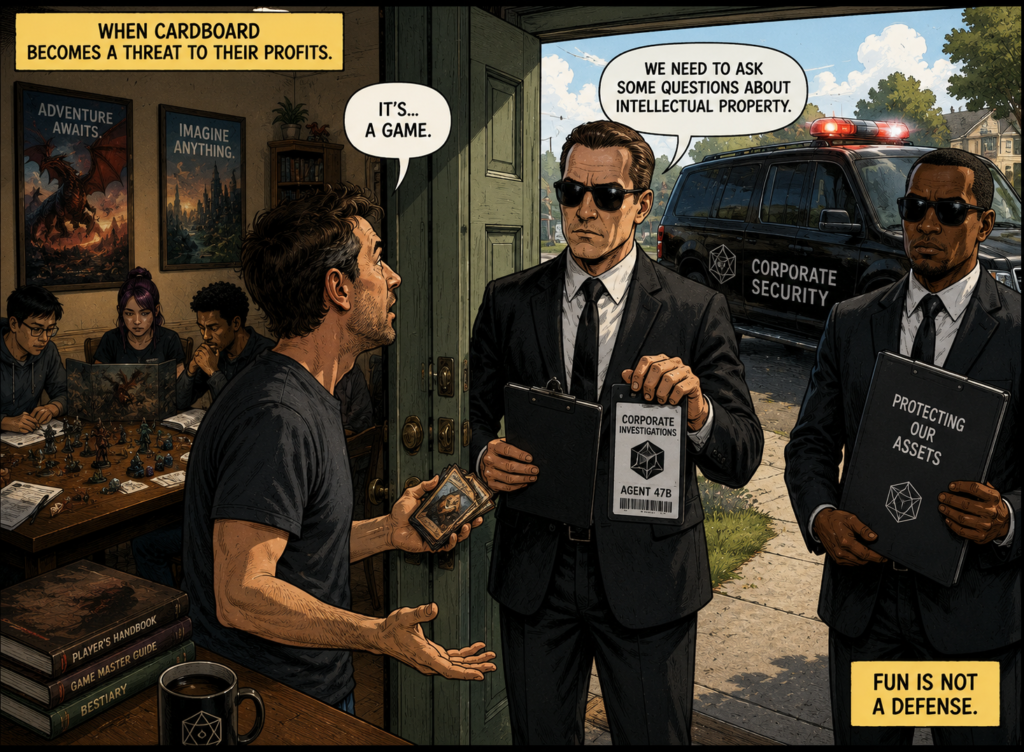
In April 2023, a YouTuber known as oldschoolmtg received Magic: The Gathering cards from the then-unreleased March of the Machine: The Aftermath set. According to his account, he had ordered March of the Machine collector boosters from a seller and apparently received Aftermath product instead, possibly because of confusion between the similarly named products. He opened the cards on his YouTube channel before the set’s official release. Wizards of the Coast wanted the unreleased product back and wanted to determine how it had gotten into circulation.
Then Pinkerton agents showed up at his home.
That last sentence is what transformed what could have been an ordinary product-security investigation into one of the most remarkable corporate-public-relations disasters in recent tabletop history.
Wizards subsequently confirmed that it had hired Pinkerton to recover the product. The company told Polygon that the agency was part of an investigation into the premature distribution and disclosure of the cards and maintained that its objective was to retrieve the unreleased material and determine how it had entered the marketplace. Wizards also said it had attempted to contact the YouTuber before agents arrived at his home. The YouTuber disputed aspects of how those contacts and the visit unfolded, describing the agents as intimidating and saying that his wife had been frightened by the encounter.
Those distinctions matter. There is no reason to turn the story into something it was not. Wizards did not dispatch an armed Shadowrun corporate strike team to execute a gamer who had stolen trade secrets from a subterranean laboratory. The cards apparently reached him through ordinary commerce, and Wizards had a legitimate business interest in discovering how unreleased products had escaped its distribution controls.
But that almost makes the decision more astonishing.
This was a fucking card game.
There were other ways to handle this.
Call him. Email him. Have an attorney contact him. Send a formal demand for preservation and return of the mistakenly distributed product. Contact the seller. Investigate the distributor. If genuine theft or criminal misconduct is suspected, contact appropriate law enforcement. If necessary, pursue whatever legitimate civil remedies are available.
Instead, the name that entered the story was Pinkerton.
That name carries historical baggage that anyone interested in American labor history immediately recognizes. The Pinkerton National Detective Agency was founded in the nineteenth century and became deeply associated with industrialists, private security, strikebreaking and violent confrontations with organized labor. The most infamous example was the 1892 Homestead Strike, when Henry Clay Frick brought hundreds of Pinkerton agents into the conflict between Carnegie Steel and striking steelworkers. A gun battle followed, leaving people dead on both sides. The Pinkertons consequently became one of the enduring symbols of private corporate force in American history.
The modern Pinkerton organization is not literally the nineteenth-century detective agency preserved in amber. It is now owned by the Swedish security company Securitas and operates as a contemporary corporate risk-management and security organization. History nevertheless matters to brands. Corporations spend fortunes precisely because names acquire associations. If a company deliberately continues using a name with more than a century of historical recognition behind it, it cannot reasonably expect everybody to forget what that name means.
That is why the Wizards incident landed with such force among gamers.
Wizards of the Coast did not merely send investigators.
Wizards sent the fucking Pinkertons.
The irony becomes almost perfect because Wizards publishes Magic: The Gathering and, through its ownership by Hasbro, has been one of the central corporate forces behind Dungeons & Dragons. These are games built around adventure, power, monsters, treasure, heroes, villains and morally questionable organizations. The tabletop hobby has spent decades imagining tyrannical guilds, corrupt merchant houses, mercenary companies and sinister institutions employing hired muscle to protect their interests.
Then reality produces a corporate dispute involving cardboard fantasy cards, and somebody decides private investigators should appear at a customer’s residence.
You could barely parody it.
More importantly, the incident occurred during a period in which Wizards had already damaged a great deal of goodwill among tabletop gamers. Only a few months earlier, the company had become engulfed in the controversy surrounding proposed changes to the Dungeons & Dragons Open Gaming License. The original OGL 1.0a had helped create an enormous third-party publishing ecosystem around D&D. When a leaked draft of a proposed replacement surfaced in January 2023, publishers and players reacted furiously to provisions involving deauthorization of the old license, reporting requirements and royalty structures for some successful creators.
The backlash became enormous enough that Wizards retreated. Executive producer Kyle Brink apologized for the company’s handling of the matter, and Wizards eventually announced that it would leave OGL 1.0a in place while placing the Dungeons & Dragons 5th Edition System Reference Document under a Creative Commons license. That was not a minor concession. Creative Commons licensing placed those rules materials under an established irrevocable framework outside Wizards’ unilateral control.
That episode is worth remembering because it demonstrates one of the answers to the central question of this essay: How do ordinary people fight a corporation without becoming shadowrunners?
- They stop buying things.
- They cancel subscriptions.
- They organize.
- They publish.
- They complain loudly.
- Competitors offer alternatives.
- Creators threaten to take their work elsewhere.
- Customers make the economic consequences of a decision larger than whatever economic benefit management expected to receive from it.
That is not as exciting as rappelling down the side of an Aztechnology pyramid while the street samurai exchanges fire with corporate security, but in the real world it can work considerably better.
The OGL controversy demonstrated something corporations occasionally forget: a customer community is not merely a revenue source. In a hobby such as tabletop role-playing, the community actually produces an enormous portion of the value surrounding the corporate product. Game Masters create adventures. Players recruit new players. Fans maintain websites, produce videos, write reviews, organize conventions, teach newcomers, paint miniatures, build campaign worlds and spend thousands upon thousands of unpaid hours making the game culturally significant.
A corporation can legally own trademarks and copyrights. It cannot manufacture ❤ love by itself.
That distinction should terrify executives who manage beloved intellectual properties.
If you are entrusted with something millions of people care about, your responsibility is not merely to determine the maximum amount of money those people can be persuaded to surrender this quarter. You are a steward of something that existed before many current employees arrived and, if you do your job properly, should continue after they are gone.
Games Workshop has repeatedly confronted another version of this tension with Warhammer. In 2021 the company revised its intellectual-property guidelines and explicitly prohibited fan-made games and animations based upon its intellectual property. That happened while Games Workshop was developing Warhammer+, its own subscription service containing officially produced animated material. The resulting fan reaction was intense, particularly because Warhammer had developed an enormous ecosystem of fan animations, lore channels, modifications and other derivative creativity. Some prominent fan creators discontinued or altered projects amid the changing environment, and a boycott movement emerged among portions of the community.
Again, intellectual-property ownership is real. Games Workshop has legitimate reasons to protect its copyrights and trademarks. Wizards has legitimate reasons to protect unreleased products. Hasbro has legitimate reasons to make money from D&D. These are businesses, not monasteries.
The question is what kind of corporate culture develops around ownership.
There is a tremendous difference between saying, “This belongs to us, therefore we have responsibilities toward it,” and saying, “This belongs to us, therefore everybody else exists to extract value from it.”
That distinction applies far beyond tabletop gaming.
- A corporation may own a railroad, but human beings ride it.
- A corporation may own an apartment complex, but human beings live there.
- A corporation may own a social network, but human relationships occur there.
- A pharmaceutical company may own a patent, but sick people need the medicine.
- A publisher may own a game, but an entire culture can grow around that game.
Ownership creates rights. It should also create obligations.
This is one reason I do not want this essay misunderstood as an argument that every corporation is evil. That would actually weaken everything I am trying to say. If corporations were inherently and inevitably evil, there would be very little point discussing corporate morality. Asking a corporation to behave ethically would be like asking a tornado to reconsider its behavior.
Corporations are made of human beings. They can therefore make better decisions.
They can also admit when they make bad ones.
Wizards ultimately did that during the OGL crisis. Its response was not perfect, and the company did not suddenly cease being a profit-seeking corporation, but public resistance changed the outcome. That matters. It proves that corporate behavior is not an irresistible natural force. Management proposes something. Customers respond. Employees respond. Creators respond. Journalists investigate. Competitors react. The corporation recalculates.
That is power confronting power without anybody firing a shot.
The tabletop industry is especially useful for studying this because we can watch corporate behavior among companies whose products we actually love. It is easy to condemn some chemical conglomerate whose name means nothing to us. It becomes much more psychologically difficult when the corporation makes the game sitting on our bookshelf.
That is where Shadowrun itself becomes important.
The property has passed through a complicated history of publishers and corporate arrangements since FASA introduced it in 1989. Catalyst Game Labs has been stewarding the tabletop role-playing game for many years now, and I am perfectly willing to criticize decisions in Shadowrun when I think criticism is warranted. I am primarily interested in the FASA-era material through Third Edition, and my own Shadowrun JCd12 project approaches the game from that older foundation. But criticizing corporations does not require manufacturing enemies where they do not exist. If Catalyst keeps Shadowrun alive, develops its world intelligently and treats the thing with respect, then it deserves credit for doing so.
In fact, there is something wonderfully appropriate about Shadowrun continuing to interrogate corporate power decades after its creation. The names and technologies change, but the basic subject refuses to become obsolete. Corporate domination in 1989 meant arcologies, extraterritorial megacorporations, company security forces and enormous Japanese zaibatsu-inspired conglomerates. Today we have algorithmic management, platform monopolies, private digital territories, biometric surveillance, gig workers directed by software, multinational supply chains, private security contractors and corporations with annual revenues larger than the economic output of entire countries.
The cyberpunk costume changes. The question underneath it remains the same: What happens when private concentrations of wealth acquire enough power that ordinary people increasingly have to live according to rules they did not write?
And there is another side to corporate identity that deserves attention before we leave this subject. Companies love telling us what they are. They have mission statements, mottos, logos, corporate values and carefully manufactured personalities. Google famously told employees, “Don’t be evil.” SC Johnson has spent generations presenting itself as “A Family Company.”
I am not going to tell the reader whether Google has lived up to “Don’t be evil,” or whether SC Johnson has always behaved as the kind of wholesome family company its branding suggests.
Go investigate them.
The more interesting question is what those declarations ought to mean to the people who work beneath them.
If your company says it does not do evil, you should be ashamed to help it do evil. If your company calls itself a family company, you should lose sleep when it behaves in ways unworthy of that name. If your organization claims integrity, integrity should not be decorative language printed beside the elevators at corporate headquarters. Membership in an institution should create moral responsibility toward what that institution claims to represent.
There is a scene in The Equalizer that captures the principle I mean. Denzel Washington’s Robert McCall confronts corrupt police officers and invokes the meaning of the badge they wear. The point is not merely that they violated regulations. They disgraced a symbol that was supposed to stand for something.
A corporate logo should mean something too.
And perhaps that is where the Pinkerton episode ultimately becomes more interesting than the joke. The problem is not merely that Wizards hired a company with a notorious historical name. The deeper problem is what happens when an institution becomes so concerned with protecting property, controlling information and managing risk that somebody inside it stops asking the simplest human question:
What are we becoming?
That question applies to Wizards. It applies to Games Workshop. It applies to Amazon, PayPal, TikTok, Greyhound and Instacart. And, if I am going to be fair, it applies to the people on the other side of the table too. Because Shadowrun contains one enormous moral complication that prevents its anti-corporate fantasy from becoming childish.
The shadowrunners usually work for corporations.
Mr. Johnson Is Paying You: The Hypocrisy at the Heart of Shadowrun
There is an inconvenient fact sitting at the center of Shadowrun that prevents its hatred of megacorporations from becoming simplistic: shadowrunners spend an awful lot of their time working for them.
That is one of the smartest things about the setting.
It would have been easy to create a game in which the player characters were straightforward revolutionaries. Aztechnology is evil, so you fight Aztechnology. Renraku is oppressive, so you fight Renraku. The megacorporations rule the world, and the shadowrunners are heroic outlaws waging a guerrilla war against them. There is certainly room to play Shadowrun that way, and some campaigns can lean heavily into that kind of resistance. But the traditional shadowrun is considerably dirtier. Somebody wants something done without his name attached to it. He hires a Mr. Johnson. The Johnson hires disposable criminals. Those criminals break into somebody else’s property, steal something, destroy something, extract somebody, plant something, sabotage something, protect something or occasionally kill somebody. They receive their money and disappear back into the shadows.
The corporation gets what it wants without officially doing anything.
That arrangement is brilliant because it solves one of the problems we have been discussing throughout this essay: responsibility. The megacorporation can distance itself from the act through layers of deniability. The executive did not raid the laboratory. The corporation’s security forces did not cross a rival’s territory. Nobody wearing an Ares badge shot anybody. Some criminals committed an unfortunate crime, and Ares is shocked—shocked—that anybody would suggest it had anything to do with the incident.
The shadowrunner is part of the corporate machine precisely because he is officially outside it.
That should make anyone who plays Shadowrun uncomfortable once in a while.
Suppose Mr. Johnson hires your team to break into a chemical laboratory and steal evidence that a corporation has contaminated a town’s drinking water. Perhaps the Johnson represents a journalist, an environmental organization, the victims themselves or even an employee inside the corporation whose conscience finally overwhelmed his fear. That can be a genuinely heroic shadowrun. You are criminals according to the law, but the moral purpose of the crime may be defensible. You trespass, hack computers, defeat security systems and steal confidential information because those actions expose something considerably worse.
Now change one detail.
The Johnson actually works for the corporation’s largest competitor.
The competitor does not give a damn about poisoned children. It wants the evidence because exposing the scandal will destroy its rival’s stock price, cripple a competing product and allow it to seize market share.
Did the morality of your run change?
The people drinking the water still benefit if the truth becomes public. The guilty corporation still deserves exposure. Your team’s actions may still produce a good result. Yet you were not Robin Hood. You were a corporate weapon being aimed at another corporation.
Now change another detail. Your Johnson tells you that a competing pharmaceutical company possesses research showing that one of its products is dangerous. Your assignment is to steal the research. You assume you are going to expose the company. After the handoff, however, your employer buries the evidence because it is developing a competing product with exactly the same problem and does not want regulators asking broader questions about the entire class of drugs.
You got paid.
What exactly did you accomplish?
This is where the morality of Shadowrun becomes considerably more interesting than “corporations bad, runners good.” The runners inhabit the same economic system they despise. They need nuyen. They need ammunition, medical treatment, cyberware, magical supplies, vehicles, safehouses, fake identities and information. They have landlords. They have dependents. They have addictions. They have ambitions. Some simply want better guns and faster cars. Whatever their motives, somebody has to pay for all of it, and the people with the most money are very often the same institutions supposedly ruining the world.
The shadowrunner therefore faces a miniature version of the corporate moral problem.
How much is your conscience worth?
That question should matter every time a Johnson puts a number on the table. A team may have rules. No children. No wetwork. No trafficking people. No jobs against a particular community. No knowingly helping certain corporations. Perhaps they will steal corporate research but refuse to destroy medical research. Perhaps they will extract an executive who wants to defect but refuse to kidnap somebody who does not want to leave. Those principles create the beginnings of a moral identity.
Then the Johnson doubles the offer.
That is where the game gets interesting.
It is easy to have principles when nobody is bidding against them. The real test comes when keeping the principle hurts. Maybe your street samurai desperately needs surgery. Maybe the decker owes dangerous people money. Maybe somebody’s sister needs to disappear before a gang finds her. Maybe the team finally has enough money within reach to stop living from run to run.
Now Mr. Johnson offers fifty thousand nuyen for something you said you would never do.
Seventy-five.
One hundred thousand.
At some point, the player discovers whether his character possesses a moral prohibition or merely a price.
Corporations face exactly the same test on a larger scale. A company can write beautiful ethical principles while those principles cost nothing. “We care about our employees.” Wonderful. What happens when treating them well reduces the quarterly return? “Safety is our highest priority.” Wonderful. What happens when delaying a product for additional testing costs $300 million? “Our customers come first.” Wonderful. What happens when making cancellation intentionally difficult increases revenue? “We protect the environment.” Wonderful. What happens when the environmentally responsible process costs twenty percent more?
A principle that disappears when it becomes expensive was never much of a principle.
The shadowrunner cannot escape that judgment merely because he is cooler than the executive. The leather jacket, cyberarm and Predator pistol do not confer moral superiority. If anything, the runner sometimes has fewer excuses because the transaction is so naked. He does not have an investor-relations department preparing language about strategic realignment. Johnson tells him what somebody wants done and how many nuyen somebody will pay him to do it.
The runner chooses.
That is why I think Shadowrun works best when the players occasionally discover that the job they accepted is not what they thought it was. This should not become a cheap Game Master trick where every Johnson inevitably betrays the team. If every employer lies, every mission contains a secret atrocity and every extraction target turns out to be innocent, players stop making moral judgments because they learn that information itself is meaningless. The uncertainty has to be credible. Sometimes the job really is exactly what Johnson said it was. Sometimes the corporation genuinely has the better side of a particular dispute. Sometimes the supposedly oppressed person is lying. Sometimes a runner’s prejudices about a corporation lead him to the wrong conclusion.
But sometimes the runners discover a room they were not supposed to see.
That is one of the great Shadowrun moments.
- The assignment was to retrieve a prototype. Nobody mentioned the test subjects.
- The assignment was to erase a database. Nobody mentioned what the database documented.
- The assignment was to extract a scientist. Nobody mentioned that she does not want to be extracted.
- The assignment was to destroy a shipment. Nobody mentioned that people in the Barrens need what is inside it.
At that point the game stops being about whether your character can defeat the security guards. It becomes about what your character does now that completing the mission and doing what he believes is right are no longer the same thing.
And there is an even uglier problem: the security guards themselves.
The corporate security officer standing in your way may not know anything about the atrocity upstairs. He might be earning a paycheck. He might have two children. He might believe he is protecting legitimate scientific research from heavily armed criminals—which, from where he is standing, is exactly what he is doing. The shadowrunners burst into his workplace carrying automatic weapons, magic and illegal cyberware. His employer tells him to stop them.
Then the players call themselves the heroes.
Maybe they are.
But the dead security guard’s widow may have a different opinion.
This is where violence in Shadowrun should retain some moral weight. The fantasy of fighting an evil corporation is enormously satisfying precisely because real people so often feel powerless against giant institutions. In reality, you cannot solve a three-year dispute with a corporate bureaucracy by hiring a decker to crack the mainframe. You cannot recover your stolen wages by storming an arcology. You cannot expose a toxic chemical program by casting an invisibility spell and walking into the executive records room. Shadowrun lets us fantasize about possessing enough skill, nerve and firepower to make institutions that normally seem untouchable suddenly vulnerable.
That fantasy is part of the fun, and there is nothing wrong with enjoying it as fiction.
But Shadowrun becomes much more interesting when it refuses to tell us that carrying a gun against a bad institution automatically makes the person carrying the gun good. The runner who kills for money without caring why is behaving according to exactly the principle we condemn when corporations do it: money has become a substitute for conscience.
The scale is different. The mechanism is remarkably similar.
A corporation says, “This action increases shareholder value.”
A shadowrunner says, “It’s just a job.”
Both statements can perform the same moral function. They turn a decision into a transaction and encourage the person making it to stop asking what the transaction actually does to another human being.
That is why Mr. Johnson matters so much symbolically. He does not merely provide adventures. He represents the attempt to sever money from moral responsibility. He gives you only the information required to perform the task because the less you know, the less likely you are to object. He may not tell you who ultimately benefits. He may not tell you who ultimately suffers. He buys a specific action from you and leaves the moral context outside the contract.
The corporation has compartmentalized its conscience, and the shadowrunner has become one of the compartments.
A Face can make this even more interesting. I have traditionally been much more attracted to the combat-oriented characters—the street samurai, mercenaries and other people who solve immediate problems through force—than to playing the Face. But when thinking seriously about what resistance to corporate power ought to look like, the Face suddenly becomes fascinating. So does the decker. So does the investigative journalist. So does anybody whose primary weapon is information rather than a firearm.
Imagine a Shadowrun campaign in which destroying a corporation does not mean blowing up its headquarters. The runners discover evidence of systematic criminal behavior. The decker authenticates it and traces the financial relationships. The Face cultivates employees willing to talk. A journalist contact verifies the story. The team extracts a whistleblower before corporate security can silence or discredit her. They place copies of the evidence in enough locations that destroying one server accomplishes nothing. They manipulate rival corporations into turning against the target. They expose executives individually so responsibility cannot disappear behind the corporate name. They destroy the company’s reputation, contracts and political protection rather than its buildings.
That could be a devastating shadowrun without anybody dying.
In some circumstances, it could be more devastating because nobody dies. Blow up a laboratory and the corporation can call the runners terrorists. Release authenticated internal documents proving that senior executives knowingly poisoned people, and suddenly the corporation has a very different problem.
Information can be a weapon.
So can reputation, organization, boycotts, labor action, litigation, competition, whistleblowing, investigative journalism and public humiliation. The OGL revolt discussed in the previous section demonstrated the principle on a relatively harmless scale. D&D players did not need to burn down Wizards of the Coast. They needed to make the proposed policy economically and reputationally painful enough that the corporation changed course.
That is also why the journalist archetype in Cyberpunk has always been such an interesting idea. Cyberpunk fiction understands that power does not consist exclusively of who possesses the biggest gun. Sometimes the decisive question is who controls the story, who possesses the evidence and who can make other people believe what is true. A corporation that can survive bullets may not survive everyone discovering what it has actually done.
Yet even those methods do not completely solve the moral problem. A journalist can sell out. A Face can manipulate innocent people. A decker can destroy someone’s life with information. Activists can lie. Whistleblowers can have ulterior motives. A rival corporation can weaponize truthful information for entirely selfish reasons. Nobody becomes morally pure simply by choosing a nonviolent character class.
The standard has to remain conscience.
That is ultimately the deeper lesson I take from Shadowrun. The game certainly helped teach teenage me that some corporations can be evil and that wealth and power can facilitate terrible behavior. But the more important lesson is not to distrust corporations merely because they are corporations. It is to distrust any structure—corporate, governmental, criminal or personal—that teaches human beings to substitute money, orders, procedure or institutional loyalty for moral judgment.
A shadowrunner who accepts every job because the nuyen is good has already internalized the megacorporation’s morality.
He has simply incorporated himself.
The Merchant Has Become King
If the problem were merely that some corporations occasionally behave badly, the solution would be relatively simple. Prosecute the crimes, punish the executives responsible, compensate the victims, change the regulations and move on. But I think something larger has happened. We have constructed a civilization in which commerce has ceased to be merely one important human activity among many and has instead become one of the principal forces by which almost everything else is measured. The merchant has not merely prospered within the kingdom. Increasingly, the merchant has become king.
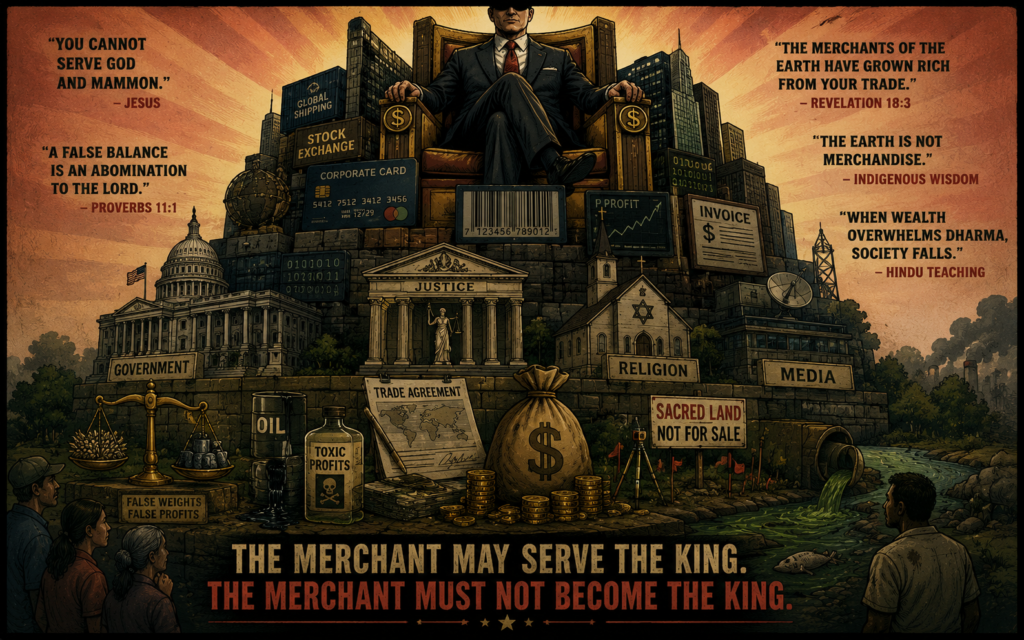
That distinction matters because there is nothing inherently wicked about commerce. Human beings need merchants. We need farmers, craftsmen, manufacturers, traders, lenders, builders, transporters and people willing to take risks to bring something useful into existence. Money itself is not evil. Wealth itself is not evil. A prosperous society in which ordinary people can build businesses, own property and improve the material conditions of their families can accomplish tremendous good. The problem begins when the values appropriate to a marketplace become the supreme values of a civilization.
A merchant has to ask what something costs. A ruler has to ask what something is worth.
Those are not always the same question.
This is one reason the traditional Hindu conception of social orders is interesting even if one does not accept Hindu theology. Classical varna theory distinguishes, in broad terms, the Brahmin associated with religious and intellectual functions, the Kshatriya associated with rulership and warfare, the Vaishya associated with agriculture, cattle raising and commerce, and the Shudra associated with service and labor. The historical realities of caste in India are vastly more complicated and often considerably uglier than that simple theoretical arrangement, so I do not want to romanticize it. What interests me here is the underlying philosophical idea that different human functions possess different virtues and that civilization becomes disordered when one function consumes all the others.
Within that framework, the merchant performs a legitimate and necessary role. The merchant is supposed to be good at commerce. He understands exchange, property, production, scarcity and accumulation. But those skills do not automatically make him the person best qualified to determine the highest purposes of civilization. If everything is governed according to commercial logic, then eventually everything acquires a price. Forests become timber inventories. Homes become investment vehicles. Human attention becomes advertising inventory. Personal information becomes data. Illness becomes a market. Education becomes a product. Art becomes content. Friendship becomes engagement. A person’s working life becomes human resources.
Even the language tells us what has happened.
The human being becomes a resource.
I do not need to believe that every executive who uses the phrase human resources secretly despises humanity. Most probably never think about the phrase at all. That is precisely why language is worth examining. Institutions teach us what to notice. A corporation necessarily needs to know how many employees it has, what they cost, what skills they possess and how effectively labor is being deployed. Those are legitimate administrative questions. But once the economic description of the person becomes the dominant description, something essential disappears. The employee is simultaneously somebody’s husband, daughter, father, neighbor, believer, citizen, friend and perhaps caretaker of an elderly parent. The spreadsheet cannot contain all of that because the spreadsheet was never designed to.
The spiritual traditions of the world have been warning about this problem for thousands of years.
In the teachings attributed to Jesus, the warning is unusually severe. “Ye cannot serve God and mammon” is not an obscure theological remark. The saying appears in Matthew 6:24 and Luke 16:13, and its force comes precisely from the language of service. Jesus does not merely warn that money can occasionally tempt somebody into doing something naughty. He places God and Mammon in opposition as rival masters. A person can possess wealth, but when wealth becomes the master, another loyalty has taken command.
The word mammon itself should not be turned carelessly into the name of some ancient pagan god unless we specify that later Christian tradition sometimes personified it that way. In the sayings of Jesus, the underlying Aramaic term concerns wealth or possessions. That is actually more interesting for this essay. We do not need a literal demon named Mammon sitting invisibly inside the boardroom. Wealth can function as a master perfectly well without supernatural assistance.
A corporation organized primarily around increasing financial return faces this temptation structurally. Every moral consideration that interferes with the financial objective risks being translated into a cost. Better wages cost money. Safer equipment costs money. Pollution controls cost money. More customer-service representatives cost money. More durable products may reduce repeat sales. Giving an exhausted employee another day off costs productivity. Maintaining a bus station costs money. Allowing a customer enough time to resolve an account problem costs employee labor. Ethical behavior may ultimately strengthen a business, but there are circumstances in which doing the right thing quite plainly costs more than doing the wrong thing.
That is when we discover which master is actually being served.
The Hebrew Scriptures are equally unwilling to separate economic behavior from morality. Torah does not treat commerce as some morally neutral zone in which anything is acceptable provided the market agrees. Leviticus commands honest measures. Deuteronomy condemns having differing weights and measures for fraudulent advantage. The prophets repeatedly connect national wickedness with exploitation of the poor, corruption and dishonest commerce. Amos is particularly vicious toward people eager for the Sabbath to end so that they can resume selling grain, diminishing the ephah, enlarging the shekel and falsifying the balances. Their religiosity and their business practices cannot be separated because the same God judges both.
That principle seems almost embarrassingly obvious, yet modern corporate structures are exceptionally good at compartmentalization. A man can consider himself morally upright in his private life while participating professionally in practices he would find disgusting if performed personally. He may be a generous father and a loyal husband. He may donate to charity. Then Monday morning arrives and he approves a policy designed to make cancellation deliberately difficult because reducing customer churn improves revenue.
The corporation provides moral insulation.
Scripture does not.
The merchant who uses dishonest weights cannot answer that the weights belonged to the company. The executive cannot make wickedness righteous merely by spreading responsibility among enough departments. If a corporation consists of human beings, then somewhere within every corporate act are human decisions, even when reconstructing precisely who bears responsibility becomes difficult.
The Book of Revelation gives commerce an even darker apocalyptic treatment. Revelation 18 describes the fall of Babylon and portrays the merchants of the earth mourning because the great commercial system that enriched them has collapsed. The inventory is deliberately extravagant: gold, silver, precious stones, fine cloth, perfumes, wine, oil, flour, cattle, horses, chariots and finally “slaves, and souls of men” in the King James Version. The Greek expression at the end concerns human beings or human lives; whatever translation one prefers, the literary movement is horrifying. The marketplace has expanded until human beings themselves appear within the catalogue of merchandise.
Elsewhere, Revelation 6 contains the passage I had been remembering about wheat, barley, oil and wine. During the opening of the third seal, the rider on the black horse appears with balances, followed by a proclamation concerning the price of wheat and barley and the command, “see thou hurt not the oil and the wine.” Interpreters have debated the economic and symbolic significance of those details for centuries, and I do not want to pretend that the verse supplies a simple modern economic program. What is unmistakable is that Revelation imagines economic life—prices, scarcity, commerce, luxury and the distribution of necessities—as spiritually significant. The marketplace is not outside the moral universe.
That is something modern capitalism desperately needs to remember.
- A balance sheet can tell us whether a corporation made money. It cannot tell us whether the corporation deserved to make money.
- A stock price can tell us what investors currently believe an ownership share is worth. It cannot tell us whether the underlying institution is good.
- GDP can increase because something wonderful happened. GDP can also increase because something terrible happened and enormous amounts of money were subsequently spent dealing with the consequences.
Economic measurement is extraordinarily useful, but it is not moral judgment.
This is where the idea of the Kali Yuga provides another interesting comparison. In Hindu cosmology, the Kali Yuga is the final and most morally degraded of the four yugas, an age characterized by declining dharma, materialism, conflict, dishonesty and spiritual deterioration. Different Hindu traditions interpret the details differently, and modern claims about exactly which social class “rules” the Kali Yuga should not be casually presented as though every Hindu scripture teaches one simple formula. Nevertheless, the association between a degraded age and the increasing domination of material appetite gives us a useful philosophical lens. A civilization becomes spiritually sick when accumulation ceases to be a means toward human flourishing and human beings instead become means toward accumulation.
- You do not have to be Hindu to recognize the possibility.
- You do not have to be Jewish to understand dishonest scales.
- You do not have to follow Jesus to understand the danger of serving wealth.
- You do not have to believe in Revelation to recognize a marketplace capable of eventually putting human beings themselves into the inventory.
Different traditions arrive at remarkably similar anxieties because they are observing something ancient in human nature. Material wealth is useful enough that we need it, powerful enough that we pursue it and seductive enough that we can eventually forget what it was supposed to be useful for.
That is the spiritual problem underneath the corporate problem.
The corporation did not invent greed. Wall Street did not invent exploitation. Capitalism did not invent the human capacity to lie for material advantage. Ancient merchants cheated customers with false weights thousands of years before anybody knew what a shareholder was. Kings have exploited people. Priests have exploited people. Communist governments have exploited people. Criminal organizations exploit people. Families can exploit their own members. Replacing corporations with some other institution does not magically remove human wickedness.
But institutions can magnify particular weaknesses.
A military institution can magnify aggression and obedience. A religious institution can magnify dogmatism and spiritual authority. A bureaucracy can magnify conformity and indifference. A commercial institution can magnify acquisitiveness. None of those institutions must necessarily become wicked, but each needs countervailing virtues precisely because its strengths can become its pathologies.
The merchant therefore needs something outside commerce capable of telling him no.
This is one of the reasons I reject the idea that unrestricted capitalism should be treated as though it were a self-correcting moral system. Markets are extremely useful mechanisms for coordinating economic activity. They are not prophets. Price signals tell us about supply and demand; they do not reveal righteousness. Competition can punish inefficiency, but competition can also reward whoever finds the cheapest way to externalize costs. Consumers can punish bad companies, but only when they know what is happening, possess meaningful alternatives and can afford to choose according to conscience rather than necessity.
A starving person does not exercise consumer sovereignty in quite the same manner as somebody choosing between two luxury automobiles.
- Neither does a sick person desperate for medicine.
- Neither does a worker who needs rent money tomorrow.
- Neither does a traveler trying to reach his wife while she battles cancer.
The more desperate the human being becomes, the less romantic the language of voluntary exchange begins to sound.
This is also where Native American perspectives belong in the conversation, especially because Shadowrun itself made Indigenous peoples central to its imagined political transformation of North America. There is no single “Native American view” of wealth, property or commerce. The Lakota are not the Navajo; the Crow are not the Kumeyaay; the many Indigenous peoples of California possessed different languages, economies, political traditions and relationships with land. Reducing all of them to the stereotype that “Native Americans did not believe in property” would merely replace corporate mythology with another mythology.
What can be said is that Indigenous peoples across North America repeatedly experienced the consequences of governments and commercial interests treating land primarily as an exploitable economic resource while the people already living upon that land understood their relationship to it in much broader social, ancestral, political and spiritual terms. California offers especially brutal examples. The Gold Rush produced not merely economic development but dispossession, violence, forced labor and catastrophic population decline among Native peoples. In later generations, mining, water projects, dams, ranching, logging, development and other economic interests repeatedly collided with tribal sovereignty, sacred places, subsistence practices and environmental concerns. Similar patterns occurred throughout the West.
The point is not that Native peoples existed outside economics. They traded. They managed resources. They fought over territory. They made political calculations. Human beings remain human beings. The lesson is that a society can look at a mountain, river or valley and see a commodity while another people look at the same place and see ancestry, obligation, identity and sacred responsibility. Once the first society possesses overwhelming political and military power, its economic vocabulary can erase the second society’s entire category of value.
The spreadsheet wins because the spreadsheet does not contain a column for sacred.
Shadowrun understood something important when it imagined Native peoples violently reasserting political power in a future North America. The game’s Native American Nations are fantasy, and aspects of their portrayal deserve the same critical scrutiny we would apply to any fictional treatment of Indigenous cultures. But the underlying historical grievance was not invented. Land, resources, sovereignty and the power of states and corporations to decide what happens to communities are real subjects with real histories.
That returns us to the question of who should rule the merchant.
My own answer is unapologetically political. I do not believe democracy or republican government represents the highest possible form of government, and I favor an absolute monarchy in which the sovereign possesses enough real authority to subordinate economic institutions to the good of the nation. My preferred economic arrangement consequently resembles state capitalism far more than laissez-faire capitalism. I do not want corporations powerful enough to tell the state what the rules will be. I want a state powerful enough to tell corporations what civilization requires of them.
That proposition obviously creates another enormous danger: what happens when the monarch is wicked? Concentrated governmental power can become monstrous just as concentrated corporate power can. History supplies more than enough evidence of that. Monarchism does not abolish the problem of human character; it makes the character of the sovereign extraordinarily important. My argument for monarchy therefore cannot simply be “concentrated power is good.” I already rejected the cliché that power inevitably corrupts, because I do not believe power mechanically transforms every person who possesses it into a villain. The meaningful questions are who possesses power, what obligations govern its use, what kind of person has been entrusted with it and whether responsibility can be clearly assigned when that power is abused.
That last point is crucial to my criticism of corporations. I want responsibility to have a face.
If a company poisons a community, cheats its workers, steals from inventors, conceals lethal dangers or commits crimes serious enough that an ordinary person would spend decades in prison, I do not find it morally satisfying to hear that “the corporation” paid a fine. Which human being was responsible? Who knew? Who ordered it? Who could have stopped it? Who benefited? Who decided not to act?
The merchant should be allowed to become wealthy by serving society well. I have no problem with that. Build something magnificent. Employ people. Invent something useful. Transport people comfortably. Make medicine that heals them. Create games that give them thirty years of memories with their friends. Become rich doing it.
But wealth should remain the reward for service, not the definition of success itself.
Otherwise Mammon stops being something the merchant possesses.
Mammon becomes the king.
Somebody Has to Be Responsible
If corporations are going to possess enormous power, then somebody has to be responsible for what they do.
That sounds almost insultingly obvious, but one of the strangest characteristics of the modern corporation is how difficult that proposition becomes once something goes terribly wrong. When an individual commits a crime, our language naturally searches for a person. Who did it? Who planned it? Who knew about it? Who benefited? Who could have stopped it? But when an enormous organization causes harm, language itself begins changing. The company did it. Management made the decision. The board approved the policy. The department failed to act. Procedures were inadequate. Controls broke down. Mistakes were made.
By whom?
That question should haunt corporate law.
A corporation can possess many of the practical advantages of personhood when those advantages are useful. It can own property, enter contracts, sue and be sued, borrow money, employ people and continue existing while the human beings operating it come and go. There are good reasons for many of these legal arrangements. Modern civilization could hardly conduct large-scale commerce if every change in ownership required an enterprise to be dismantled and recreated from scratch.
But the abstraction becomes morally dangerous when responsibility travels in the opposite direction.
A corporation can act through ten thousand human beings while somehow allowing every individual human being to say that he personally did not make the corporation’s decision. The junior employee followed procedure. The supervisor followed company policy. The regional manager implemented instructions from headquarters. The executive relied upon reports prepared by subordinates. The board relied upon management. The shareholders merely owned stock.
Everybody participated in the machine.
Nobody was the machine.
This is where I fundamentally disagree with the idea that sufficiently large corporate fines constitute adequate punishment for sufficiently serious corporate wrongdoing. Sometimes a financial penalty is entirely appropriate. If a company overcharges customers, restitution makes sense. If it violates a regulatory requirement, a fine may create an economic incentive for compliance. If it causes environmental damage, it should pay to repair that damage insofar as repair is possible. Corporations should absolutely be made financially responsible for harms they cause.
But money cannot substitute for personal accountability when human beings knowingly commit serious crimes through corporations.
If I knowingly poison somebody, I cannot resolve the matter merely by paying a percentage of my annual income. If I organize a conspiracy to commit fraud, I cannot explain that the conspiracy generated $10 million and therefore agree to return $4 million as the cost of doing business. If I deliberately conceal conduct that kills people, society does not ordinarily respond by calculating a fine sufficiently large to discourage me from doing it again.
Yet once an institution becomes sufficiently large, financial punishment begins to seem strangely natural.
That creates an obvious moral hazard. If the expected profit from wrongdoing exceeds the expected cost of getting caught, punishment can become another business expense. A corporation does not need to think, “Is this wrong?” It merely needs lawyers, accountants and risk analysts capable of asking a different question: “What is our probable exposure?”
That is not justice.
That is pricing.
The cases discussed earlier demonstrate why the distinction matters. Volkswagen’s emissions conspiracy involved identifiable human decisions. Purdue Pharma’s admitted criminal conduct did not emerge spontaneously from the walls of an office building. Tobacco-company deception was carried out through executives, lawyers, scientists, marketers and institutional strategies. Corporate wrongdoing is ultimately performed by human beings, even when corporate organization makes tracing the responsibility difficult.
I therefore think corporate accountability should move aggressively upward.
The greater your authority, the greater your responsibility.
That principle is almost the opposite of what frequently happens in large bureaucracies. A low-level employee can be fired immediately for violating a relatively minor policy while senior leadership can preside over institutional catastrophe and depart with compensation packages worth more money than the employee will earn in his lifetime. Corporations sometimes speak endlessly about accountability while practicing accountability primarily downward.
I would reverse that presumption.
If you are the person at the top, then being at the top should mean something more than receiving the largest paycheck.
It should mean that you have accepted responsibility for the institution.
This does not mean that a chief executive should automatically go to prison because an employee at a warehouse steals somebody’s wallet. No serious system of justice should punish a person for something he genuinely could not reasonably have known about or prevented. Criminal responsibility requires distinctions involving knowledge, intent, negligence, authority and causation. A corporation employing hundreds of thousands of people will inevitably contain employees who commit crimes despite sincere efforts by leadership to prevent them.
But leadership should not be allowed to construct ignorance as a defense.
If executives know that they can escape responsibility by ensuring that incriminating information never formally reaches their desks, then the organization has created an incentive for cultivated blindness. The executive does not ask the dangerous question. The subordinate learns not to volunteer the dangerous answer. Reports become sanitized as they travel upward. Eventually the man with the greatest authority becomes the person who officially knows the least.
That is backwards.
Authority should create a duty to know.
If you command an organization capable of affecting millions of people, you should be expected to build systems capable of discovering what that organization is doing. If workers are being systematically abused, if customers are systematically defrauded, if dangerous products are being concealed, if environmental regulations are routinely evaded or if criminal conduct has become part of the business model, “I didn’t know” should immediately lead to another question: Why the hell didn’t you know?
Perhaps there was genuine deception beneath you. Perhaps competent systems existed and somebody successfully defeated them. That matters.
But perhaps you did not know because knowing would have been inconvenient.
That matters too.
This is one of the reasons I find monarchy intellectually attractive as a model of responsibility, and it is also why I sometimes imagine corporations themselves functioning more like monarchies. I am not saying that every business needs a man sitting on a golden throne wearing a crown. I mean something much simpler: I want to know who is responsible.
Put a name on the institution.
If Phil Knight is the ruler of Nike, then Nike’s conduct becomes Phil Knight’s responsibility while he rules it. If somebody else assumes that authority, the responsibility travels with the office. The precise corporate governance structure could vary, but the principle would remain: society should be able to point toward a human being and say, “You command this institution. You are responsible for making sure it does not become wicked.”
There is something psychologically powerful about that.
Compare “Nike did this” with “John Smith did this.”
The first statement describes a cloud.
The second describes a man.
Human beings understand responsibility through persons because morality itself operates through persons. A corporate logo cannot feel shame. A trademark cannot repent. A building cannot go to prison. A share certificate cannot decide that what happened was wrong.
People can.
This does not mean boards of directors and collective deliberation have no value. A wise leader should seek counsel. Indeed, an absolute monarch who refuses advice is likely to become a terrible monarch. The problem is not that groups discuss decisions. The problem is allowing group decision-making to dissolve responsibility. Ten people voting for something wicked should not somehow produce less responsibility than one person ordering it.
If anything, there are ten responsible people.
This principle also challenges the common invocation of shareholder interests. Executives sometimes speak as though shareholders were an invisible sovereign whose demands override ordinary morality. The CEO may personally care about workers, communities or long-term environmental consequences, we are told, but he has fiduciary obligations to shareholders.
That argument is frequently exaggerated. American corporate law does not generally command executives to maximize immediate profit at every moment regardless of every other consideration. Corporate directors ordinarily possess considerable discretion in determining what advances the interests of the corporation. But even if the strongest version of shareholder primacy really were legally mandatory, I would consider that an indictment of the law rather than a moral defense of the executive.
No economic arrangement should transform “somebody paid me to do it” into a moral justification. We would never accept that defense from a shadowrunner.
- Mr. Johnson offered a great deal of money.
- The shareholders wanted the return.
- The contract required it.
- The market demanded it.
- Everybody else was doing it.
- My competitors would have done it if I didn’t.
These are explanations. They are not absolution.
This is also where my political philosophy diverges sharply from conventional American capitalism. I do not think the state should merely referee competition among corporations while treating private economic power as something almost sacred. I believe the political sovereign should stand above corporate power and possess enough authority to intervene decisively when a corporation becomes harmful to the society in which it operates.
In the system I would prefer, a corporation exists because its existence serves some legitimate human purpose. A telephone company exists because people need communication. A transportation company exists because people need transportation. A pharmaceutical company exists because people need medicine. A grocery company exists because people need food distributed efficiently. A game company exists because people want entertainment, imagination and community. Profit rewards successful performance of that function, but profit does not become the function itself.
This also changes the way we think about monopolies.
The conventional objection to monopoly is powerful and generally correct: if one corporation controls an entire market, consumers lose the protection provided by competition. The monopoly can raise prices, reduce quality, mistreat customers and stagnate because there is nowhere else to go. In a laissez-faire environment, that concentration of private power can become extraordinarily dangerous.
But competition itself creates pathological incentives too. Two companies racing against each other can cut labor costs, outsource jobs, reduce product durability, squeeze suppliers and search constantly for cheaper ways to produce the same thing. Competition can generate innovation, but it can also become a race toward whatever corner can be cut without losing the customer.
Under a genuinely powerful and benevolent sovereign, monopoly becomes a different theoretical possibility. Imagine one national telephone company whose mission is not to defeat another telephone company but simply to provide the best possible telephone service. Imagine one automobile manufacturer whose responsibility is to build safe, durable, excellent vehicles rather than continually manipulate model cycles, market segmentation and competitive positioning. The absence of market competition would ordinarily make those arrangements dangerous, but in the system I am describing there would still be opposition.
The sovereign would be the opposition.
If the company began producing garbage, the sovereign could intervene. If executives abused workers, remove them. If prices became predatory, change them. If management became corrupt, investigate it. If necessary, replace the leadership entirely. The corporation would possess operational authority but not ultimate sovereignty.
Of course, this creates an enormous requirement: the monarch has to be good.
A wicked absolute monarch overseeing monopolistic corporations could create something considerably worse than contemporary capitalism. Instead of corporations competing with one another and government retaining at least some ability to constrain them, corporate and political power could fuse into a single oppressive structure.
Shadowrun fans should immediately recognize the danger. Give the wrong ruler absolute political authority over enormous corporations and you have not defeated the megacorporation. You have created one.
That objection does not make me abandon monarchy, but it does identify what monarchism actually requires: the moral formation of the sovereign becomes one of the most important political problems in the entire society. Power itself is not evil. I reject the cliché that power inevitably corrupts and absolute power inevitably corrupts absolutely. If that proposition were literally true, then God, possessing absolute power, would necessarily be absolutely corrupt, which demonstrates the philosophical absurdity of treating the aphorism as a universal law.
Power reveals character, magnifies consequences and increases temptation. Those propositions I can accept.
Therefore the more power somebody possesses, the more serious his moral obligations become.
That principle should apply to kings and CEOs alike.
The ruler of a nation should fear disgracing his crown. The commander should fear disgracing his uniform. The police officer should fear disgracing his badge. The executive should fear disgracing the company whose name he represents.
This is why corporate slogans should not merely be advertising.
If a company announces that it is a family company, then its employees should regard conduct inconsistent with that declaration as shameful. If a company says that integrity is one of its values, an employee who discovers fraud should understand that exposing the fraud is an act of loyalty to the company rather than betrayal. If a corporation claims that customers come first, management should be embarrassed when its systems obviously treat customers’ time as worthless.
The corporate name should become a standard employees are expected to live up to rather than a mask they are permitted to hide behind.
That would require changing something deeper than regulation. It would require recovering the concept of honor.
Modern corporate language loves values but seems less comfortable with honor. Values can be printed on a website. Honor makes demands upon the person. Honor says that there are things you do not do even when they are profitable, even when they are legal and even when nobody is likely to catch you, because doing them would make you unworthy of the name you carry.
That is the missing ingredient in much of our discussion about corporate ethics.
- Rules matter.
- Audits matter.
- Regulation matters.
- Criminal prosecution matters.
- Transparency matters.
- Competition can matter.
- Government oversight matters.
But civilization cannot write enough regulations to make dishonorable people honorable. At some point somebody has to look at a profitable opportunity and say, “No. We do not do that.”
And when corporations refuse to say no—when the regulators fail, the courts fail, politicians have been bought or captured, and ordinary people discover that the institution hurting them is vastly richer and more powerful than they are—we arrive at the most dangerous question in this entire essay.
What are ordinary people morally permitted to do about it?
When the Law Is Not Enough
Once we accept that corporations can commit genuine wrongdoing, and once we accept that governments and courts do not always stop them, we arrive at the uncomfortable question that cyberpunk fiction has been asking almost from the beginning: what is an ordinary person morally permitted to do when the institution harming him is vastly more powerful than he is?
There is an easy answer, and it is usually the first answer given in respectable society. Vote. File a complaint. Contact the regulatory agency. Hire an attorney. Organize a boycott. Write to your representative. Protest. Unionize. Contact journalists. Sue. Expose the wrongdoing publicly. Use every peaceful and lawful mechanism available to you.
I agree.
In fact, I would go considerably further than merely acknowledging those methods. They should ordinarily be the first weapons taken from the arsenal because they can accomplish something violence frequently cannot: they can correct an injustice without creating another victim. A successful lawsuit can compensate people who were harmed. A whistleblower can expose wrongdoing without destroying innocent employees’ livelihoods. Investigative journalism can force information into public view. A boycott can make misconduct economically expensive. Organized labor can change the balance of power between workers and management. Public humiliation can sometimes accomplish what a regulator will not. Consumers can abandon a company. Competitors can exploit its weakness. Prosecutors can put actual human beings in prison when crimes can be proved.
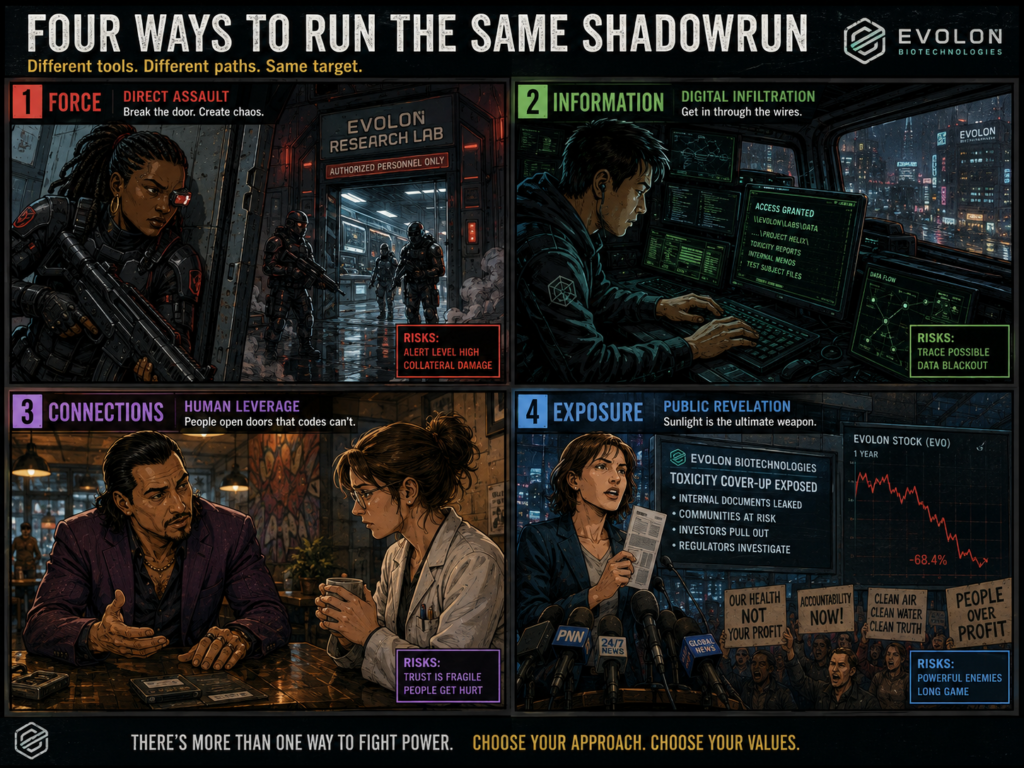
The Dungeons & Dragons OGL revolt discussed earlier provides a comparatively mundane but useful example. Nobody needed to attack Wizards of the Coast employees. Customers cancelled D&D Beyond subscriptions, creators publicly objected, publishers began considering alternatives, journalists covered the controversy, and the reputational and commercial consequences became sufficiently serious that Wizards retreated. That is exactly what peaceful resistance to corporate behavior is supposed to accomplish: make doing the objectionable thing more costly than abandoning it.
But peaceful resistance has a serious weakness that its advocates sometimes do not like discussing.
It requires somebody on the other side to care.
A boycott works if lost customers matter. A protest works if the institution can be pressured. A lawsuit works if courts are available, the plaintiff can survive the expense and delay, a remedy exists, and the judgment can eventually be enforced. Regulation works if regulators possess sufficient authority and are willing to use it. Elections work only to the extent elected governments actually constrain the institutions being challenged. Public exposure works if the public cares and if reputational damage produces consequences.
What happens when none of those conditions exists?
That is not a theoretical question. Political philosophy has wrestled with it for thousands of years. Nearly every civilization recognizes some circumstances in which resistance to authority becomes morally permissible. The disagreement concerns where the boundary lies. When does obedience cease to be a virtue? When does resistance become justified? When does resistance become a duty? And when does violent resistance cease to be resistance and become merely vengeance?
Those questions become especially interesting when the oppressive power is private rather than governmental.
A robber points a gun at somebody and demands his money. Few people regard the victim’s right of self-defense as philosophically mysterious. Now suppose ten armed men seize a village’s food. The principle remains recognizable. Suppose a criminal organization systematically extorts a neighborhood. Again, most people can understand why the victims may possess a right to defend themselves.
But suppose the harmful institution possesses a corporate charter, lawyers, lobbyists and a logo.
At what point does the moral analysis change?
Legally, it can change enormously. Morally, the answer is less obvious.
I want to be careful here because there is an enormous difference between discussing the ethics of resistance and encouraging somebody to attack a real company or its employees. I am doing the former. There are thousands of angry people in the world capable of convincing themselves that an inconvenience constitutes oppression and that oppression licenses whatever they wanted to do anyway. Somebody getting banned from a social-media platform does not suddenly acquire a moral right to attack the company’s offices. A bank freezing an account while investigating suspicious activity does not automatically constitute warfare. Greyhound giving somebody terrible service does not make the bus driver an enemy combatant.
Anger is not a declaration of war. That distinction is indispensable to everything that follows.
At the same time, I reject absolute pacifism. If an institution is knowingly killing, poisoning, enslaving or otherwise inflicting grave violence upon human beings, I do not believe the victims acquire a moral obligation to continue suffering indefinitely merely because their oppressor has organized itself into a corporation. There are circumstances in which violence is defensive rather than aggressive, and there are circumstances in which refusing to resist violence simply leaves violent power uncontested.
This is where Ward Churchill’s Pacifism as Pathology and Peter Gelderloos’s How Nonviolence Protects the State become relevant, although neither book should be treated as scripture merely because it challenges respectable political assumptions. Churchill’s essay attacks what he regards as the fetishization of nonviolence within activist movements, particularly the tendency to transform one tactic into an absolute moral doctrine. Gelderloos makes a related anarchist argument: movements that insist upon exclusively nonviolent resistance can, in his analysis, become predictable and containable precisely because the state knows the boundaries beyond which they refuse to go.
There are serious objections to both arguments. Violence can alienate the very population a movement needs. It can give authorities justification for repression. It can escalate beyond anyone’s control. It can kill innocent people. It can attract participants who are more interested in violence than justice. It can destroy a movement morally from within. It can turn yesterday’s victims into tomorrow’s tyrants. Historical movements also provide strong evidence that disciplined nonviolent resistance can sometimes defeat extraordinarily powerful opponents.
The choice is therefore not between cowardly pacifists and courageous revolutionaries. That is adolescent politics. The real question is what actually reduces injustice without creating something worse.
That question is also why I resist the tendency to discuss violence as though it were a single moral category. Smashing an empty machine is not morally identical to killing a security guard. Sabotaging equipment being actively used to harm people is not identical to bombing an office containing uninvolved employees. Defending yourself against somebody trying to kill you is not identical to assassinating somebody because you believe his employer is evil. Property destruction, sabotage, self-defense, armed rebellion, terrorism and murder may all involve physical force, but collapsing them into one word—violence—can conceal more than it reveals.
Shadowrun is almost uniquely suited to exploring these distinctions because the game allows us to construct circumstances extreme enough that the moral boundaries become visible without anybody in the real world getting hurt.
Imagine that a megacorporation has poisoned a district.
The residents complain. Nothing happens. The corporation owns the local media. Regulators have been bribed. Lawsuits disappear into a corporate court system. Witnesses are intimidated. The government cannot intervene because the facility possesses extraterritorial status. Corporate security guards the evidence. More people become sick.
Now Mr. Johnson offers the runners a job.
- Get inside.
- Steal the evidence.
- Get it out.
Suddenly trespassing, burglary, hacking and theft become difficult to condemn in the ordinary manner because the legal order itself has ceased to provide meaningful justice. The runners are breaking the law in order to expose a greater violation.
Now make the situation harder.
- Corporate security discovers them.
- The guard draws his weapon.
- Can the runners shoot him?
The answer is no longer obvious. The guard may know nothing about the poisoning. Perhaps he believes he is protecting a legitimate research facility against heavily armed criminals. From his perspective, the runners are exactly what the corporation says they are. If the runners kill him merely because he happens to stand between them and the evidence, then their supposedly righteous mission has acquired an innocent corpse.
Perhaps the street samurai uses gel rounds. Perhaps the mage incapacitates him. Perhaps the Face talks past him. Perhaps the decker prevents the alarm from reaching him in the first place.
Suddenly morality has become tactical.
That is one of the things I love about tabletop role-playing at its best. Ethical principles stop being abstractions because the players have to decide what their characters actually do. It is easy to announce that violence should be a last resort. It becomes more interesting when the Game Master places a frightened twenty-two-year-old security guard between you and evidence that could save thousands of lives.
What does last resort mean now?
That is also where the distinction between illegal and immoral becomes indispensable to cyberpunk. Shadowrunners are criminals by definition. If legality were identical to morality, there would be very little moral ambiguity in the game. The corporation owns the building. The runners broke into it. Case closed.
But Shadowrun constantly asks whether law itself can become an instrument of power. Corporate extraterritoriality pushes that idea to its logical extreme. The megacorporation does not merely influence the rules; on its own territory it effectively becomes the sovereign authority. Something can therefore be simultaneously illegal according to corporate law and morally necessary according to the runner’s conscience.
Real life is obviously less convenient. We do not possess a Game Master who can tell us with certainty that the corporation is evil, the documents are genuine and the scientist we are rescuing is innocent. Real people operate with incomplete information. They misinterpret evidence. They believe propaganda. They become angry. They rationalize revenge. They convince themselves that opponents are monsters.
That uncertainty should make the threshold for real-world violence extraordinarily high.
It should not make the threshold metaphysically impossible.
Israelite scripture itself does not teach that human beings must passively accept lethal aggression. Exodus 22 discusses the killing of a thief breaking in at night in a way that recognizes circumstances of defensive force, while also distinguishing circumstances in which killing would no longer be justified. The distinction matters more than attempting to turn the verse into a modern statute: the moral tradition recognizes that context changes the character of force. Ecclesiastes famously says there is “a time to kill, and a time to heal,” just as there is a time for war and a time for peace. The Tanakh does not inhabit a moral universe in which force is inherently evil. It inhabits a world in which force can be righteous, wicked, necessary, excessive, defensive or murderous depending upon who is using it, against whom, and why.
Neither does Jesus’ command to love one’s enemies mean that an enemy acquires unlimited moral permission to harm other people. Loving an enemy places demands upon the character of the person resisting him; it does not magically transform injustice into justice. There is an enormous moral difference between stopping someone because he must be stopped and hurting someone because you enjoy his suffering.
That difference matters even in a fictional gunfight.
A shadowrunner who kills because killing is entertaining is not morally equivalent to a shadowrunner who reluctantly uses lethal force to prevent an atrocity. The dice may produce the same wound. The moral action is not the same.
This is why the Robin Hood fantasy embedded within Shadowrun deserves to be taken seriously rather than dismissed as adolescent rebellion. Robin Hood remains culturally powerful because he represents a recurring human intuition: legality can become detached from justice. The outlaw can sometimes possess the stronger moral claim precisely because lawful authority has become corrupt.
But Robin Hood contains a warning too.
Every criminal thinks he has a reason.
Every terrorist believes some story about why ordinary rules no longer apply to him. Every murderer can invent an injustice. Every revolutionary movement can construct a narrative in which its victims deserved what happened. Once somebody grants himself permission to ignore law because he believes himself righteous, the most important restraint remaining is his conscience—and human beings possess a remarkable ability to corrupt their consciences when hatred becomes pleasurable.
So the heroic outlaw needs stricter moral standards, not fewer standards.
That is the paradox.
If you are going to break a rule because you claim that a higher moral law requires it, then you have assumed the burden of demonstrating that higher obligation through your conduct. You should care more about innocent life, not less. You should require stronger evidence, not weaker evidence. You should exhaust less harmful alternatives when those alternatives remain genuinely available. You should distinguish the guilty from the merely associated. You should remain capable of mercy. You should be able to stop once the threat has been stopped.
Otherwise resistance becomes another excuse for power.
And that brings us directly back to the corporation. If my complaint throughout this essay is that corporations allow money to replace conscience, then I cannot answer corporate wickedness by allowing anger to replace conscience. The entire argument collapses if I condemn one institution for rationalizing harm while giving its opponents unlimited permission to rationalize their own.
That does not mean surrender.
It means resistance has to remain subordinate to morality.
In the real world, that ordinarily means organizing, documenting, exposing, boycotting, suing, voting where one believes voting can help, supporting whistleblowers, building competing institutions, withdrawing cooperation and making corporate misconduct expensive. It means forcing responsibility out from behind the logo and attaching names to decisions. It means refusing to let the corporation control the only narrative about what happened.
And in the extreme case—where genuine grave violence is being inflicted, where innocent people face immediate serious harm, and where peaceful remedies genuinely cannot protect them—the moral questions become those of defense rather than customer dissatisfaction.
That boundary must remain difficult to cross. It should be difficult. Human life is too valuable for anything else.
Shadowrun, however, allows us to cross that boundary in imagination. It gives us a world deliberately constructed so that the corporations really can possess armies, sovereign territory, secret laboratories, assassins, black operations and governments effectively beneath them. It then gives us characters capable of fighting back.
That is part of the catharsis.
- The man who spends three years trying to persuade a corporation to give him access to his own royalties cannot raid an arcology.
- The exhausted traveler cannot hack Greyhound’s host because the bus company treated him like cargo.
- The worker being manipulated by a gig-economy algorithm cannot summon a fire elemental into corporate headquarters.
- The family whose story disappears beneath an automated moderation system cannot roll Computer and discover exactly which line of code silenced them.
But the shadowrunner can.
For a few hours around a table, the enormous institution is no longer untouchable. The little person has skills the corporation fears. The locked door can be opened. The hidden file can be stolen. The whistleblower can be extracted. The secret can become public. The executive who believed himself unreachable can suddenly discover three shadowrunners sitting in his office.
That fantasy does not require us to become violent people.
It allows us to imagine what it would feel like if power finally had to answer to somebody.
And perhaps the most interesting Shadowrun campaign is not one in which the players simply become better criminals. Perhaps it is one in which they gradually decide what they are actually fighting for. Because destroying something wicked is only half a political philosophy.
Eventually somebody has to build something better.
What Would a Good Corporation Actually Look Like?
It is easy to criticize corporations. It is considerably harder to describe what we actually want them to become. If the argument of this essay ended with the conclusion that corporations are evil, capitalism is rotten and somebody ought to tear everything down, it would ultimately suffer from the same moral laziness I have been criticizing. Destruction is not a complete philosophy. If PayPal, Amazon, Greyhound, TikTok, Volkswagen, Purdue Pharma and every other corporation I have criticized suddenly disappeared tomorrow, human beings would still need financial services, books, transportation, communication, automobiles and medicine. Somebody would eventually organize people and resources to provide those things, and before long we would have organizations that looked suspiciously like corporations again. The meaningful question is therefore not merely how to defeat a wicked corporation. It is how to make a corporation worth defending.
I think we begin by rejecting the idea that the fundamental purpose of a corporation is to make money. Making money is necessary for most businesses to continue operating, and profitability can be evidence that a corporation is doing something people value. But that is different from saying profit is its purpose. A restaurant exists to feed people. A railroad exists to transport people and freight. A publisher exists to produce and distribute books. A pharmaceutical company exists to develop and manufacture medicine. A grocery store exists to distribute food and other necessities. Profit allows these institutions to continue accomplishing their purposes, reward the people who created and operate them, invest in improvements and survive periods of difficulty. Once profit becomes the purpose itself, however, everything else becomes negotiable.
That distinction sounds philosophical until you experience it as a customer. Greyhound and the Mexican intercity bus companies I have recently traveled with perform essentially the same basic function: they move people between cities over long distances. Yet the experience can communicate radically different ideas about what the passenger is. On the Mexican coaches I have ridden, considerable thought has obviously gone into the human experience of spending hours aboard the vehicle. Comfortable reclining seats, adequate legroom, electrical outlets, entertainment systems, curtains and blinds, thoughtfully designed restrooms and professional drivers communicate that the passenger is somebody whose journey matters. The major bus terminals can feel more like airports than the depressing stereotype Americans associate with bus travel. The corporation is still making money from me. I am not confused about that. But the exchange can feel mutually beneficial: I give the company money, and the company appears to take pride in transporting me comfortably and professionally.
That is what commerce is supposed to feel like.
Contrast that with the business mentality that asks how little can be provided before customers finally refuse to pay. How tightly can the seats be packed? How few employees can we schedule? How long can customers wait on hold? How difficult can we make refunds? How cheaply can something be manufactured? How much advertising can we force into the experience? How much customer frustration can we tolerate before it begins affecting revenue? Those questions may be perfectly rational within a particular conception of capitalism, but they gradually transform the customer from the person being served into a resource being harvested.
The same thing happens to workers. A good corporation should not regard labor as merely another expense to be minimized. Wages obviously affect operating costs, and no business can simply pay everybody whatever amount would make them happiest. But there should be an enormous moral difference between asking, “What can this enterprise reasonably afford to pay?” and asking, “What is the lowest amount these people will tolerate because they are desperate enough to need the job?” The first question treats workers as participants in an enterprise. The second treats their vulnerability as leverage.
My experience with the gig economy helped crystallize this distinction for me, which is part of why I wrote Chasing the Carrot. The genius of many gig platforms is that they can make a worker feel simultaneously independent and controlled. You are supposedly your own boss, but software determines what opportunities you see, how information is presented to you, how customers evaluate you and sometimes whether continuing to work is economically worthwhile. Traditional employment at least makes the hierarchy obvious. Algorithmic management can conceal the boss inside a telephone.
A good corporation should want the people working for it to prosper because their prosperity is evidence that the enterprise itself is healthy. That does not mean everybody receives identical compensation or that hierarchy disappears. The person who founded a successful company, invested capital, assumed enormous risk and made unusually valuable decisions may reasonably become wealthy. I do not object to wealth. What I object to is the strange moral arithmetic by which executives congratulate themselves over record performance while the people whose labor produced that performance cannot afford ordinary life.
The customer deserves the same consideration. A good company should be ashamed of wasting people’s time. This is one reason the endless understaffed checkout lines and compulsory self-checkout machines irritate me so much. The corporation has discovered that some labor can be transferred from itself to the customer. I scan the groceries. I bag the groceries. Increasingly, I am expected to perform tasks employees once performed, while the savings from that transferred labor do not necessarily arrive in my pocket. Perhaps automation genuinely makes a particular operation more efficient, and there is nothing inherently immoral about self-checkout. I sometimes prefer using it. The moral question appears when the customer no longer has a meaningful choice and the company’s convenience is purchased with the customer’s time.
Time is part of the price of everything we buy, although corporations rarely print it on the receipt.
If I spend forty minutes fighting an authentication system designed supposedly to protect me, those forty minutes were taken from my life. If I spend an hour on hold because a company decided employing enough customer-service representatives was too expensive, the corporation has transferred a cost to me. Its spreadsheet records lower labor expenses. My spreadsheet, if I kept one for the remaining minutes of my existence, would record the difference.
A genuinely customer-oriented corporation would measure those costs too. It would ask how much human frustration its procedures create. It would consider false positives in fraud prevention to be genuine failures rather than acceptable collateral damage. It would recognize that an elderly person locked out of an account, a traveler whose card suddenly stops working overseas and an author unable to access his royalties are not merely support tickets. The corporation exists to serve those people. The system should therefore bend toward solving their problems rather than demanding that human beings continually reorganize themselves around the system.
A good corporation also has obligations to the community that makes its existence possible. Businesses depend upon roads, utilities, educated workers, courts, police, stable currency, communications infrastructure and generations of accumulated human knowledge. Even the most brilliant entrepreneur did not manufacture civilization himself. There is therefore nothing unreasonable about expecting successful corporations to leave their communities better than they found them. That responsibility can take ordinary forms: maintaining property, paying workers well, preventing pollution, contributing taxes, supporting useful local institutions, training employees and refusing to externalize costs onto everyone else.
I would extend that obligation to the nation. This is where unrestricted global capitalism frequently asks people to accept behavior that I find morally grotesque. A corporation may have been created within a particular country, educated its workforce through that country’s institutions, protected its property through that country’s laws, built its customer base among that country’s people and benefited from generations of infrastructure paid for by those people. Then somebody discovers that labor is cheaper elsewhere, and suddenly loyalty becomes economically irrational. Factories close. Communities collapse. The corporation congratulates itself for improving efficiency.
From the spreadsheet’s perspective, perhaps it has.
From the nation’s perspective, something else happened.
This does not mean international trade is inherently wrong, nor that every product must be manufactured entirely within one country’s borders. Nations benefit enormously from trade, specialization and exchange. The problem is the assumption that the corporation owes nothing to the human community from which it emerged beyond whatever obligations can presently be enforced by contract or statute. I reject that premise. Loyalty is a moral category. A corporation should possess some loyalty to its workers, customers, community and country precisely because corporations expect those people to possess loyalty toward the corporation.
This is why corporate identity should mean more than branding. Earlier I mentioned companies that publicly associate themselves with moral ideas: family, integrity, service, innovation, responsibility or even Google’s famous former injunction, “Don’t be evil.” I am less interested in scoring those corporations against their slogans than I am in the concept itself. Suppose employees actually treated a corporate declaration as an oath. Suppose somebody discovered that his division was doing something shameful and thought, “We do not do this here. This is not who we are.” Suppose management rewarded that response instead of punishing the employee for creating trouble.
A corporate culture like that could become morally powerful.
Human beings want to belong to things. This desire is not inherently sinister. Military units use it. Religious communities use it. Families use it. Sports teams use it. Nations use it. Shadowrun understands it exceptionally well because its corporations are not merely businesses; they develop identities, cultures, loyalties and rivalries. Employees can belong to the corporation almost as though they belong to a nation. Cyberpunk presents this as frightening because corporate belonging can consume every other loyalty, but the psychological mechanism itself can be directed toward good ends. A corporation could cultivate pride in craftsmanship, customer service, honesty and responsibility just as easily as it cultivates quarterly targets.
The crucial difference would be whether loyalty flows both directions. A corporation that demands loyalty from employees while regarding them as disposable is not a community. It is manipulating the human desire for community. If management expects workers to sacrifice during difficult periods, workers should share substantially in prosperous periods. If employees are expected to protect the company’s reputation, the company should protect employees from abuse. If the corporation calls itself a family, it had better understand that firing thousands of people to improve one quarter’s financial statement makes the word family sound obscene.
This brings us back to leadership. I want the leader of the corporation to understand himself not merely as its highest-paid employee but as the custodian of its honor. The corporation should have a recognizable mission, and the person at the top should be accountable for ensuring that every level of the organization remains consistent with that mission. He cannot personally supervise every transaction, but he can create the culture in which those transactions occur. He can decide what gets rewarded, what gets punished, what gets measured and what gets ignored.
Corporate incentives reveal corporate morality much more reliably than corporate slogans do.
If an employee receives a bonus for selling something regardless of whether the customer needs it, management should not be surprised when customers are manipulated. If managers receive bonuses for reducing labor costs regardless of what understaffing does to workers and customers, management should not pretend to be baffled when service deteriorates. If executives are rewarded overwhelmingly according to short-term share performance, society should not be astonished when long-term consequences receive less attention. People respond to incentives. A corporation that creates wicked incentives and then condemns employees for following them is attempting to outsource its conscience downward.
A good corporation would therefore reward behavior consistent with its actual purpose. A transportation company should reward safe, courteous, reliable transportation. A hospital should reward excellent care. A bank should reward trustworthy stewardship of people’s money. A publisher should reward excellent books. A game company should reward excellent games and responsible stewardship of the worlds its customers love. Financial success should follow excellence rather than become a substitute for it.
This is where tabletop gaming provides a surprisingly useful example. A company stewarding a beloved game inherits something more complicated than an inventory of intellectual property. Thousands or millions of people have invested portions of their lives in that imaginary world. They remember characters they played twenty years ago. They remember friends who sat at those tables, some of whom may now be dead. They remember adventures, conventions, arguments over rules and ridiculous dice rolls. Legally, the corporation owns the property. Culturally, however, something much larger has grown around it.
That is why I want companies such as Catalyst Game Labs to succeed when they steward something like Shadowrun well. I do not want every corporation destroyed. I want corporations to deserve the communities that form around their work. I can prefer the FASA-era Shadowrun material and build Shadowrun JCd12 from the parts of that tradition I love while still recognizing the value of a company continuing to publish the game, develop the Sixth World and introduce new players to it. Criticism should not require hostility for its own sake. When a corporation does something good, say so. When it does something excellent, reward it. Buy the product. Recommend it. Tell the company what it got right.
The carrot matters along with the stick.
Ultimately, my definition of a good corporation would be surprisingly simple. It is a body of human beings organized to perform some useful function for other human beings, while allowing the people who participate in that enterprise to prosper from doing it well. Profit matters because the organization has to survive. Leadership matters because responsibility has to reside somewhere. Workers matter because they make the enterprise function. Customers matter because serving them is the reason the enterprise exists. Community and country matter because no corporation exists independently of civilization. Moral limits matter because there are things no amount of money should purchase.
Such a corporation could become enormously wealthy without becoming evil. In fact, enormous wealth could become evidence of enormous service if the wealth were accumulated through genuinely improving human life rather than manipulating, exploiting or poisoning it.
That is the corporation I would defend.
And it produces an interesting contrast with the traditional cyberpunk imagination. Cyberpunk asks us to imagine what happens when corporations become powerful enough to behave like governments. Perhaps we should reverse the question. What happens when corporations become powerful enough that we begin demanding from them the virtues once demanded from rulers: responsibility, stewardship, loyalty, justice, protection and concern for the common good?
Once we ask that question, wealth itself becomes morally interesting. If a corporation has obligations beyond accumulating money, then so does the individual. A shadowrunner who finally cracks open the right corporate vault and becomes rich has to decide what wealth is for. A fantasy adventurer dragging a treasure chest out of a dungeon faces the same question.
What Is the Treasure For?
One of the strangest assumptions built into fantasy role-playing is that acquiring treasure requires almost no moral explanation. The adventurers descend into the dungeon, defeat whatever occupies it, discover the treasure chamber, and begin calculating shares. Nobody needs to explain why the characters want the gold. Of course they want the gold. Gold buys better armor, better weapons, horses, magical equipment, property, influence and eventually the freedom to pursue whatever ambitions the characters possess. In Shadowrun, the treasure chest becomes a credstick and the dungeon becomes a corporate research facility, but the economic structure remains surprisingly familiar. You take the dangerous job. You survive. Mr. Johnson transfers the nuyen. You spend it improving your ability to survive the next dangerous job.
Then you do it again.
There is nothing inherently wrong with that. People work partly because they want to improve their material circumstances, and a role-playing game should allow characters to enjoy the rewards they have earned. If my shadowrunner risks being shot by corporate security, chased by Lone Star, fried by hostile IC and double-crossed by a Johnson, I certainly expect him to care about getting paid. The economic desperation of the Sixth World is part of what makes Shadowrun work. A character who needs nothing has considerably less reason to meet a stranger in the back booth of a nightclub at midnight and agree to burglarize a Renraku facility.
But after spending this entire essay asking what corporations believe money is for, fairness requires asking the same question of the characters.
Suppose the runners finally make it.
Not merely enough money for ammunition and rent. Real money. Perhaps they uncover something nobody expected during a run. Perhaps the paydata turns out to be extraordinarily valuable. Perhaps they negotiate a percentage rather than a flat fee. Perhaps they acquire something that can be sold for a fortune. However it happens, the characters who have spent years complaining about rich corporate executives suddenly possess enough wealth that they no longer have to live from job to job.
What happens next?
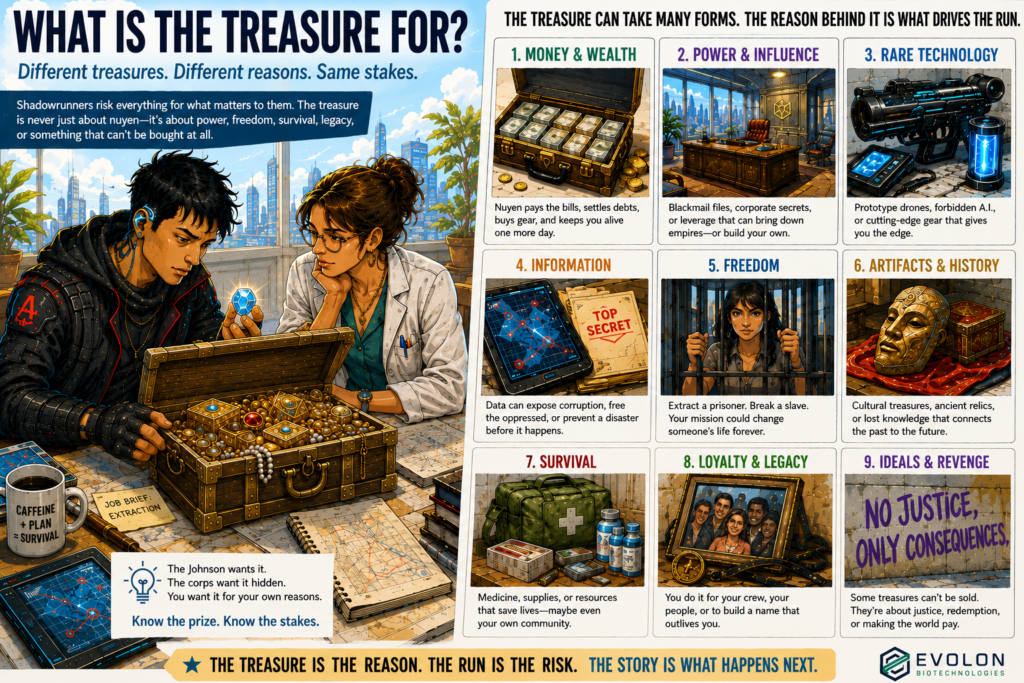
A particularly materialistic runner might answer that immediately. Better cyberware. Better guns. Better armor. Better apartment. Better vehicle. Better lifestyle. There is always another upgrade. Shadowrun is especially good at making wealth seductive because the setting contains so many wonderful things to buy. Cyberware can literally make you stronger, faster and more dangerous. Money does not merely purchase status; it can purchase capability. The runner who acquires enough nuyen can transform his body into something the broke version of himself could scarcely afford to imagine.
Yet that produces exactly the treadmill we have been criticizing in corporations. Accumulation justifies more accumulation. The next acquisition becomes the reason for the previous one. There is never a point at which the person asks whether he has enough because the system does not contain an obvious definition of enough.
That is not merely a game-design question.
Modern consumer capitalism depends heavily upon dissatisfaction. If everybody purchased what he genuinely needed, enjoyed what he possessed and stopped wanting replacements until those things actually needed replacing, enormous portions of the economy would behave differently. Advertising therefore does not merely inform people that products exist. At its most manipulative, it creates deficiencies. Your telephone works, but it is no longer the newest telephone. Your automobile works, but another one communicates greater status. Your clothes cover your body perfectly well, but fashion has changed. Something you were perfectly content with yesterday becomes inadequate today because somebody successfully changed the standard against which you measure it.
The shadowrunner can fall into exactly the same trap. He hates the megacorporation but measures success according to the megacorporation’s values. More money. More equipment. More consumption. More personal power.
The corporation has conquered him without hiring him.
This is one of the reasons I built a different relationship with wealth into Gloria Nocturna. Characters certainly can acquire substantial wealth. They should. Adventurers risk their lives, overcome terrible dangers and can eventually become powerful people. I do not want to remove the pleasure of opening the treasure chest and discovering that the characters have become rich. Wealth creates possibilities, and possibilities are wonderful fuel for role-playing.
But Gloria Nocturna asks what the characters are going to do with those possibilities.
Members of the Black Order are not simply independent adventurers collecting treasure for themselves. They belong to a religious and military institution engaged in a struggle against the Gloom. Consequently, a significant portion of what they acquire can return to the Order and support its larger work. That immediately changes the meaning of treasure. The characters may still want excellent equipment and personal comforts, but wealth also becomes logistical power. Money can support the institution that trains people, sends them into dangerous places and continues fighting after any particular player character is gone.
More importantly, wealth can be invested directly into the places the characters are trying to save.
The Gloom in Gloria Nocturna is not merely a monster waiting in a cave for somebody to stab it. It affects domains. Consequently, combating it can involve improving the human environment of a community. If characters acquire wealth and want to help raise the condition of a domain, there are countless things they might finance according to the circumstances of that particular place. They might help establish or strengthen a town watch where people are terrified to leave their homes after dark. They might repair a road whose deterioration has isolated farms from a market. They might restore a neglected cemetery so that the dead are treated with dignity. They might clean filth from a riverbank, repair a bridge, restore a public building, support an orphanage, improve sanitation, finance lamps along dangerous streets or help rebuild something destroyed by violence or disaster.
The precise improvement matters less than the principle: treasure can become civilization.
That is a much more interesting use of wealth than simply watching a number increase on the character sheet.
Imagine the role-playing consequences. The party arrives in a miserable settlement early in the campaign. The cemetery is overgrown. The bridge is collapsing. Travelers disappear along the road. There are too few trustworthy watchmen. Buildings damaged years ago remain abandoned because nobody has enough money to restore them. The characters complete missions there, make allies and eventually leave.
Months later, they return.
The bridge they financed is standing.
Children are crossing it.
The watchmen they helped equip recognize them. The cemetery has been restored. Merchants are returning because the road has become safer. Somebody has opened a business in the building the characters helped repair. A family lives differently because of something the players chose to do with treasure they could have spent upon themselves.
That makes wealth visible.
More importantly, it makes goodness visible.
A player can point at part of the campaign world and say, we did that. Not because the Game Master awarded experience points for killing the correct number of monsters, but because the characters acquired power and voluntarily decided to use some of it for other people.
There is an important distinction here. I do not want charitable spending to become a disguised tax imposed by the Game Master. If the rules effectively say, “You found ten thousand coins, but six thousand automatically disappear into the Good Person Fund,” there is no moral decision. The interesting part is choosing between competing goods. The character might desperately want a superior weapon. The party might need horses. Somebody may want to purchase a house. The Black Order needs support. Meanwhile, the village where they have been operating desperately needs a repaired well.
Now wealth creates character.
The miser becomes visible because he could help and chooses not to. The generous character becomes visible because generosity actually costs him something. The practical character might argue that buying better weapons allows the party to protect more people later. The idealist might insist that people are suffering now. Another character might distrust the Black Order’s leadership and prefer giving directly to local people. Somebody else may believe strengthening institutions is more useful than charity.
There is no need for the Game Master to announce which answer is morally correct. The argument itself is role-playing.
Shadowrun could benefit enormously from the same question. What happens when runners begin investing in the neighborhood instead of merely using it as scenery between jobs? The Sixth World is filled with places where corporate and governmental institutions have abandoned people. A successful runner might finance a street clinic, pay a local doctor, improve security around an apartment building, help a family establish a business, maintain a safehouse that also serves people besides the team, purchase equipment for a community organization, protect a neighborhood Matrix host or simply make sure certain people eat.
The possibilities become even more interesting because generosity creates consequences.
If you pay to improve security in a neighborhood, somebody may resent the new security. If you finance a clinic, a gang may decide the clinic owes protection money. If you establish a business, a corporation may decide it wants the property. If you feed people, more desperate people may arrive. If you become known as the runner who helps people, suddenly everybody has something they desperately need you to fix.
Doing good creates plot.
That is one reason I dislike game economies in which wealth exists primarily as a mechanism for purchasing increasingly powerful equipment. Money is one of the most versatile forms of agency imaginable. It can alter relationships, communities and institutions. A rich player character should be capable of changing the campaign world in ways that have nothing to do with adding another modifier to a combat roll.
This also exposes the hypocrisy discussed earlier from another direction. Imagine a team of shadowrunners who constantly condemn megacorporate greed. They complain about executives living in luxury while people starve in the Barrens. They ridicule wageslaves obsessed with consumer goods. They condemn corporations for hoarding resources and abandoning communities.
Then the runners become rich.
They buy luxury apartments, exotic vehicles, cutting-edge cyberware and enormous arsenals while the same people continue starving outside.
What precisely was their objection to the executives?
Apparently it was not that wealthy people should possess obligations toward the communities around them. Their objection was that somebody else got rich first.
That is a much uglier realization, and therefore a much better role-playing opportunity.
None of this requires asceticism. I do not believe wealth is inherently sinful, nor do I think a character—or a real human being—should feel guilty merely because he enjoys something expensive. There is nothing righteous about making everybody equally miserable. A beautiful house can be good. Excellent food can be good. Fine clothing can be good. Art, craftsmanship, travel, entertainment and comfort are genuine human goods. The moral problem begins when possessing them requires us to stop seeing the people around us or when accumulation becomes detached from every purpose except accumulation itself.
The Biblical attitude toward wealth is more complicated than the slogan that money is evil. Abraham is wealthy. Job is wealthy. Solomon possesses extraordinary riches. Torah contains laws protecting property and regulating commerce. At the same time, the Hebrew Scriptures repeatedly condemn exploitation, fraudulent measures, withholding what is owed to workers and indifference toward the poor. Wealth creates possibilities, and possibilities create responsibility.
Jesus intensifies the warning because wealth can become a rival master. His teaching about the rich man and Lazarus is particularly relevant. The rich man’s condemnation is not presented as the result of breaking into Lazarus’s house or physically assaulting him. Lazarus lies suffering at his gate while the rich man lives splendidly. The horror is proximity without responsibility. The suffering person is close enough to see, and wealth makes helping possible, yet nothing happens.
That is a terrifying standard precisely because it reaches beyond criminal law.
- A corporation can obey every regulation and still be dishonorable.
- A wealthy person can obey every law and still be selfish.
- A shadowrunner can fulfill every contract and still become a bastard.
Morality begins where compliance ends.
That is what I ultimately want wealth to mean in Gloria Nocturna. Wealth is not merely a reward. It is another kind of power entrusted to the character, and power reveals what somebody values. Give a poor character ten coins and we learn what he needs. Give him ten million and eventually we learn who he is.
The same standard should apply to corporations. If a corporation becomes enormously successful, its wealth creates opportunities to improve products, reward workers, serve customers, strengthen communities and build things that outlive the people presently running it. A company capable of doing those things and choosing to do them deserves respect. Wealth produced through genuine service and then used responsibly can become something magnificent.
The alternative is Mammon’s treadmill: acquire so that you can acquire more, grow because growth itself has become the objective, increase the number because the number must increase.
There is no final square on that character sheet. There is always another zero.
Perhaps that is the most important economic question a role-playing game can quietly teach somebody to ask. Not, How much treasure did we get? Not even, How fairly should we divide it?
What is the treasure for?
Gloria Nocturna gives one answer: use some of it to push back the Gloom. Make the domain better because you passed through it. Leave behind something that was not there before you arrived.
And that idea brings us back to the game that started this entire essay. Shadowrun has been asking questions about corporations, wealth and power since 1989. But more than three decades have passed since FASA created the Sixth World. The corporations of our own world changed tremendously during those decades, and Shadowrun itself passed through different publishers and creative teams.
So an important question remains: did the Sixth World keep up?
Did Shadowrun Keep Up With the Corporations?
There is an interesting problem with writing cyberpunk for thirty-seven years: eventually the future you were warning people about begins arriving, and sometimes reality invents things stranger than the dystopia did.
When Shadowrun appeared in 1989, its megacorporations drew upon fears that already existed. Multinational corporations were becoming increasingly powerful. Japan’s extraordinary economic growth made Japanese corporate power seem particularly important to Americans during the 1980s, something reflected throughout the cyberpunk of the period. Corporate raiders, leveraged buyouts, deregulation, globalization, environmental controversies and increasingly sophisticated computer networks all contributed to an atmosphere in which imagining corporations eventually becoming quasi-sovereign powers did not require an enormous leap. Shadowrun exaggerated those anxieties magnificently. Give corporations extraterritoriality. Give them military forces. Give them arcologies. Let employees essentially become corporate citizens. Put the most powerful corporations above many governments and give them their own Corporate Court.
Then wait thirty-seven years.
We did not get Renraku.
We got Amazon, Google, Meta, TikTok, Uber, Palantir, enormous financial institutions, multinational pharmaceutical corporations, private military contractors, algorithmic management and technology companies possessing astonishing quantities of information about billions of human beings. The resemblance is not literal, and exaggerating it would actually make Shadowrun less interesting. Amazon cannot declare its warehouse sovereign territory and shoot federal investigators at the border. Google does not possess a seat on an orbital Corporate Court. Walmart does not issue nationally recognized passports.
But the fundamental Shadowrun question aged remarkably well: what happens when private concentrations of wealth become powerful enough that governments, communities and individual human beings increasingly have to negotiate with them as centers of power rather than merely businesses?
That question is still at the heart of modern Shadowrun.
Catalyst Game Labs’ current treatment of the megacorporations makes that explicit. Its Sixth Edition corporate sourcebook, Power Plays, published in 2021, describes the megacorporations as simultaneously the shadowrunners’ employers and adversaries, “the source of cash and the source of despair.” The book updates the Big Ten and other corporate powers specifically because runners still need to understand the institutions that employ them, manipulate them and dominate the world around them. The publisher’s own description goes further and says that knowing the corporations is the first step toward bringing them down.
That tells me something important about Catalyst’s stewardship of the setting.
They did not sanitize the corporations.
That deserves credit.
It would have been possible, over successive editions, for the megacorporations to become little more than factions. Pick your favorite corporate logo the way somebody picks a football team. Renraku has this aesthetic, Ares has that aesthetic, Aztechnology has another aesthetic, and here are the equipment bonuses associated with each. Certainly some players enjoy particular corporations, and Shadowrun deliberately gives them distinctive cultures and personalities. That is part of the fun.
But the corporations cannot become merely cool.
If that happens, something essential to Shadowrun dies.
The megacorporations are supposed to be impressive. They are supposed to build extraordinary things. They employ brilliant people. They produce technology runners desperately want. They can offer careers, security, housing, healthcare and entire corporate communities. That attractiveness is necessary because otherwise nobody would willingly participate in the system. A corporation that does nothing except torture puppies in a volcano headquarters is not frightening. It is stupid.
The frightening corporation is the one that makes your life comfortable enough that you stop asking what it is doing somewhere else.
Earlier editions understood this extremely well. The old FASA corporate material did not treat megacorporations merely as monsters waiting at the end of a dungeon. Corporate Shadowfiles examined corporate economics and structures. By Third Edition, Corporate Download updated the major corporate players and their internal struggles. FASA’s Corporate Punishment went directly after the moral predicament of the runners themselves: its three adventures put shadowrunners into brutal corporate power struggles in which, as the book’s own description explains, the runners become pawns who must survive being used and abused by the corporations paying them.
That is pure Shadowrun.
The corporation does not necessarily hate you.
It may not think about you enough to hate you.
You are an asset temporarily useful for accomplishing something that cannot be attached to the corporate name.
The FASA era also demonstrated that corporate dystopia could become something more complicated than greed. Renraku Arcology: Shutdown, published in 1998, took one of the ultimate symbols of corporate civilization—the enormous self-contained Renraku Arcology in Seattle—and turned it into a nightmare when the facility sealed itself with approximately 100,000 people trapped inside. The arcology had represented the corporate promise taken toward its logical conclusion: work, shop, live and participate in an environment largely constructed by the corporation. Then the doors closed.
There is something almost allegorical about that even before we get into Deus and the artificial-intelligence storyline. Corporate paternalism says, Come inside. We can provide everything.
The cyberpunk writer asks, What happens when the door locks behind you?
As Shadowrun moved beyond FASA, the corporate sourcebooks continued appearing almost edition by edition. The titles themselves form a kind of historical record of the game’s continuing fascination with corporate power: Corporate Shadowfiles in the early era, Corporate Download for Third Edition, Catalyst’s Corporate Guide for Fourth Edition, Market Panic for Fifth Edition and Power Plays for Sixth Edition. Modern players sometimes treat these books simply as lore updates—who owns whom, which corporation rose or fell, which CEO is scheming against another—but collectively they demonstrate something more important. The corporate world is not background decoration in Shadowrun. It is one of the setting’s principal characters.
Catalyst’s 2010 Corporate Guide is particularly revealing because it did not limit itself to profiles of the Big Ten. Its contents explicitly examined corporate structures, money, the Business Recognition Accords, the Corporate Court, the Zurich-Orbital habitat and corporate life itself, including what it means to exist as a corporate citizen or “wageslave.” The book’s own promotional description calls the megacorporations “monoliths of power” and describes the people living within their structures as drones trapped inside them.
Again, that is not a sanitized interpretation of the Sixth World.
Catalyst has continued the basic critique.
But maintaining the critique does not mean the nature of corporate power has remained static. One of the strengths of Shadowrun is that corporations rise, merge, collapse, mutate and replace one another. Richard Villiers is almost a running joke built around corporate reincarnation. Fuchi disintegrates; pieces of corporate power reorganize themselves. NeoNET rises and later falls. Spinrad Global enters the AAA ranks. The names on the skyscrapers change while the underlying concentration of private power survives.
That is perhaps more realistic than keeping exactly the same ten corporations forever.
Real capitalism does this constantly. Sears once seemed immortal. General Electric became almost synonymous with American industrial power. Kodak dominated photography. Blockbuster dominated video rental. MySpace seemed enormously important until it did not. Corporations that appear permanent can disappear astonishingly quickly, while the economic structures that produced them remain.
Cyberpunk therefore makes a mistake when it treats the corporation itself as immortal.
Capital is considerably better at reincarnation.
Destroy one company and its patents are sold, employees scatter, competitors purchase its divisions, investors move their money and somebody acquires whatever profitable pieces remain. Shadowrun has repeatedly done versions of this with its corporate history, and that gives the Sixth World an important dynamism. The megacorporate system is larger than any individual megacorporation.
This also reinforces the argument I made earlier about responsibility. If a corporation can die while its assets, personnel and institutional knowledge migrate elsewhere, then punishing the corporate abstraction becomes even stranger. The logo disappears. The human beings remain.
Modern Shadowrun has also had to deal with forms of power that the cyberpunk of 1989 could only partially anticipate. Information has become vastly more important. Media manipulation, reputation management, social networks, pervasive surveillance and the ability to shape what populations perceive are forms of corporate power every bit as interesting as an armored security team. Horizon is probably the clearest Shadowrun expression of that development. A corporation centered upon media, public relations, entertainment and information demonstrates that controlling people does not always require pointing a gun at them.
Sometimes you control the story.
That feels substantially more contemporary than the old image of the corporate executive protected by cybered security guards. The guards still matter, of course. But a corporation capable of influencing what millions of people believe happened may possess a more useful weapon than the guards.
Our own world should make that obvious. Social-media companies do not merely own websites. Their algorithms participate in deciding what billions of human beings encounter. Search engines participate in determining what information becomes easy to find. Recommendation systems influence what people watch, buy, discuss and sometimes believe. Financial platforms can decide that a transaction appears suspicious. Gig platforms can influence what work somebody receives. None of these systems needs to possess consciousness or malicious intent to exercise enormous power over human behavior.
That is a very Shadowrun kind of power, even when nobody involved looks like a Shadowrun villain.
And that is precisely where I think future Shadowrun material should continue pushing.
Do not merely give me a corporation with better drones.
Give me a corporation that has become indispensable.
Give me a corporation whose services everybody hates but nobody can realistically stop using. Give me a corporation that provides identity verification to half the planet. Give me one whose algorithm determines whether millions of people are considered trustworthy enough to rent apartments. Give me a corporation whose medical AI is better than most human physicians but whose internal priorities are opaque. Give me a company that provides free education to poor children and quietly acquires extraordinary quantities of behavioral data while doing it. Give me a transportation corporation that genuinely provides magnificent service and therefore makes entire populations willing to tolerate whatever else the company is doing.
Make the corporation useful enough that destroying it would hurt innocent people.
That is the corporate dystopia worth exploring now.
The cartoonishly evil corporation is easy. Blow up its secret laboratory and collect the nuyen. The genuinely frightening corporation runs the hospital where your daughter receives treatment, the financial network where your money exists, the communications network through which you contact your wife, the identity system required to access government services and the cloud infrastructure storing half your life.
Now discover that it is doing something terrible.
What are you going to do?
That question brings Shadowrun directly into the twenty-first century.
There is also another reason I want to give Catalyst credit here rather than treating the current publisher as some enemy simply because it is a corporation publishing a game about evil corporations. Shadowrun has survived. That matters to me. FASA closed its doors as an active role-playing publisher decades ago, yet the Sixth World did not disappear with it. Different companies and creative teams carried the property forward, and Catalyst has now stewarded the tabletop role-playing line through multiple editions. Whatever criticisms I may have of particular rules, directions or later-edition choices, continuing to publish Shadowrun means somebody encountering the game today can still discover the same basic question that fascinated me when I was young.
Catalyst also appears willing to keep the megacorporations villainous enough that the central premise still works. Power Plays does not advertise itself as a celebration of wonderful multinational employers. Its own copy says these corporations “ruin your day” and “screw up the world.” Shadowrunners need information about them partly because they may need to bring them down.
Good.
Keep doing that.
A corporation publishing Shadowrun should understand the wonderful irony of its position. It is selling us a game that teaches us to distrust corporations. I hope everybody involved finds that as amusing as I do.
More importantly, I hope they understand that keeping that distrust alive is part of preserving what makes the setting meaningful. Shadowrun should never become corporate cyberpunk in which the logos remain but the critique disappears. The Sixth World needs its ugliness. It needs wageslaves. It needs exploited neighborhoods. It needs corporate deniability. It needs executives making decisions whose consequences they will never personally experience. It needs corporations capable of providing astonishing benefits while committing astonishing wickedness somewhere beyond the customer’s sight.
Because that is the version that resembles reality enough to hurt.
At the same time, I would not want every corporation in Shadowrun portrayed as equally evil in precisely the same way. That would become boring and philosophically useless. One corporation might possess an atrocious environmental record while treating employees exceptionally well. Another might genuinely improve millions of lives while ruthlessly crushing competitors. Another might have a comparatively honorable chief executive fighting an institutional culture he cannot fully control. Another might publicly appear monstrous while secretly preventing something even worse. Individual employees can be decent people. Individual executives can possess consciences. Corporate factions can fight internally over what the company should become.
Give me people inside the machine.
That makes deciding whether to destroy the machine considerably harder.
It also prevents the game from making the same mistake that real political rhetoric frequently makes: treating membership in an institution as proof of individual moral guilt. The Renraku receptionist is not responsible for every Renraku black operation. The Ares janitor does not deserve a bullet because Damien Knight made a terrible decision. The Aztechnology employee trying to feed his family is not automatically a blood magician. If Shadowrun teaches us anything useful about institutions, it should teach us to distinguish the organization from every individual trapped, prospering or simply living inside it.
That distinction becomes especially important for shadowrunners because they themselves exist within the same compromised world. They buy corporate products. They take corporate money. They use corporate technology. They depend upon corporate infrastructure. They may despise wageslaves while secretly envying their stability. They might spend Tuesday night denouncing corporate oppression and Wednesday afternoon purchasing a new piece of cyberware manufactured by one of the megacorporations they supposedly hate.
That hypocrisy is not a flaw in Shadowrun.
It is one of the reasons Shadowrun still matters.
Thirty-seven years after the game’s creation, the most interesting question is no longer whether Jordan Weisman and the other early creators correctly predicted the literal corporations of the twenty-first century. They did not need to. Prophecy is not the standard by which good science fiction should be judged. The important thing is whether they identified pressures that would remain meaningful.
They did.
Private wealth can become political power. Corporations can become powerful enough to negotiate with governments rather than merely obey them. Technology can make institutions more powerful while making individual responsibility harder to locate. Human beings can become dependent upon corporations they despise. Corporations can offer extraordinary comfort while demanding extraordinary loyalty. Information can become as powerful as physical force. And people operating outside respectable society can sometimes see things that respectable society has decided not to notice.
Those ideas survived 1989 extraordinarily well.
Catalyst’s task is not to preserve them in amber. It is to keep asking what they mean now.
And our task as players is not merely to admire the neon skyline.
We have to decide what we are going to do when Mr. Johnson calls.
What Shadowrun Actually Taught Me About Corporations
I started playing Shadowrun when I was young enough that I was not sitting around contemplating corporate governance, fiduciary responsibility, regulatory capture or the moral implications of limited liability. I was interested in cyberware, magic, guns, dragons, elves, Orks, deckers, street samurai and the extraordinary idea that fantasy and cyberpunk could somehow occupy the same world without destroying each other. I certainly did not pick up Shadowrun because I wanted an education in economics. Nevertheless, somewhere among all those sourcebooks, Mr. Johnsons and impossible runs against megacorporate facilities, the game planted an idea in my head that remained there long after the dice stopped rolling.
Some corporations are evil.
Not all corporations. Shadowrun did not turn teenage me into somebody who believed that every business owner was a villain or that earning money was inherently immoral. What it taught me, perhaps without my realizing it at the time, was that wealth and institutional power could become dangerous when separated from human accountability. It taught me to look at the enormous corporate logo on the side of the skyscraper and ask what was happening behind it. It taught me that the clean lobby, beautiful advertising and reassuring public-relations language might not tell the entire story. Most importantly, it taught me to understand a corporation as something capable of possessing interests different from the interests of the individual human beings caught inside it.
That turned out to be a useful idea to carry into adulthood.
I have spent much of this essay talking about corporations that have angered me personally because I do not want this discussion to remain safely theoretical. It is easy to condemn Aztechnology. Aztechnology does not control my money. Renraku has never locked me out of an account. Ares has never put me on hold. Saeder-Krupp has never made me stand at an ATM in Mexico and discover that my card has once again been disabled for international transactions after I had already told the financial institution that I was living overseas. Fictional corporations make wonderfully convenient villains because they cannot actually inconvenience us.
Real corporations can.
PayPal taught me how maddening corporate paternalism becomes when a company insists that inconveniencing me is actually protecting me. I lived in Mexico for years. I needed access to my own money in Mexico. Yet international transactions could repeatedly become a problem despite my having already communicated where I was and what I needed. When a replacement card became necessary because of a malfunctioning chip, sending that card to the foreign address where the customer actually lived became another obstacle. Each individual policy could be explained. That is what corporations are extraordinarily good at doing. There is always a policy. There is always a security reason. There is always a procedure. There is always somebody who is terribly sorry for the inconvenience.
But eventually I learned to ask a different question: Who is the system actually designed to serve?
That question has followed me through almost every corporate experience discussed in this essay.
Amazon and ACX gave me a far more serious example. Being unable to access audiobook royalties for years while the audiobooks themselves remained commercially available was not an amusing inconvenience to me. It affected my livelihood and my family. I repeatedly established my identity to a standard that would have satisfied ordinary authorities, yet the corporate system could remain more powerful than the human evidence placed before it. Meanwhile, my experience producing audiobooks through ACX exposed another absurdity: I repeatedly encountered fraudulent projects in which people apparently did not possess the rights to the books they wanted produced. I spent my own time identifying and reporting suspicious listings. ACX could subsequently remove them, confirming that the problem was real.
Why was I doing their security work for them?
That question is larger than ACX. Modern corporations have become exceptionally skilled at transferring labor and risk outward while keeping the benefits inward. The customer troubleshoots the account. The shopper scans and bags the groceries. The passenger navigates the automated system. The gig worker supplies the automobile, fuel, maintenance, telephone and much of the risk. The user reports the scammer. The customer waits on hold because hiring enough people to answer telephones would cost the corporation more money.
Each individual inconvenience looks trivial when isolated.
The pattern is not trivial.
I wrote Chasing the Carrot because the gig economy made that pattern especially visible to me. The language of independence can conceal an extraordinary amount of control. You are supposedly free, but the algorithm decides what you see. Ratings matter. Incentives change. Information is strategically presented. The company can experiment with the worker’s behavior on a scale no ordinary supervisor could possibly manage personally. There does not need to be a cigar-smoking villain in a boardroom deciding how to torment somebody. The system can produce exploitation through incentives, metrics and software.
That observation takes us back to one of the central questions with which this essay began. Why do corporations sometimes seem psychopathic?
After all the research we have examined, I think the least interesting answer is that corporations are simply filled with psychopaths. Actual psychopathy and the related clinical concepts we discussed earlier are more complicated than the popular image of the remorseless corporate executive, and the research does not justify pretending that every CEO is Patrick Bateman. There certainly can be individuals with unusually callous, manipulative or antisocial traits who find positions of power attractive or useful. But we do not need a boardroom filled with clinically psychopathic people to produce behavior that looks psychopathic from the outside.
We merely need a system in which conscience continually loses arguments to incentives.
One executive wants to do the decent thing, but it costs too much. Another worries about the quarterly report. Another believes competitors will take advantage if the company behaves differently. Another says the lawyers have approved it. Another says it is technically legal. Another says shareholders expect growth. Another assumes somebody else investigated the ethical implications. Another privately dislikes the decision but does not want to jeopardize his career. Nobody has to twirl a mustache. Everybody merely has to surrender a little responsibility.
At the end, the corporation does something no individual person in the room wants his own name attached to.
That is more frightening than the psychopath theory.
The psychopath can be removed.
The system can manufacture replacements.
This is why I have repeatedly returned to personal responsibility throughout this essay. I do not want wickedness disappearing into a logo. I do not want to hear merely that Amazon did something, PayPal did something, Volkswagen did something, Purdue did something or some government agency did something. I want to know which human beings knew, which human beings decided, which human beings possessed the authority to stop it and which human beings benefited from allowing it to continue.
Perhaps that instinct is connected to my monarchism more deeply than I realized when we began this essay. I like responsibility to have a face. If the kingdom is failing, there is a king. If the army is disgraced, there is a commander. If the corporation is behaving wickedly, I want somebody at the top who understands that the privilege of command includes the burden of answering for what happens beneath him. Committees can advise. Boards can deliberate. Experts can recommend. But authority without responsibility is one of the most dangerous arrangements human beings have invented.
My recent experiences with Greyhound brought these questions out of economics and into something much more ordinary: human dignity. After my wife returned from Tijuana to Guanajuato while battling cancer, I eventually had to make my own way across the United States and back into Mexico. For part of that journey, that meant Greyhound. The experience made me appreciate just how much the design of a business communicates what that business thinks about the people using it.
Travel on the better Mexican intercity coaches and the difference can be astonishing. Large terminals can feel like airports. Coaches can have deeply reclining comfortable seats, generous space, power connections, entertainment systems, thoughtful nighttime lighting, curtains and well-designed restroom arrangements. Drivers can communicate professionalism and hospitality. The entire experience says that you are a traveler and that getting you comfortably and safely from one city to another is the company’s profession.
Too much of my Greyhound experience communicated something different.
It communicated that I was somebody who needed Greyhound.
That is an important distinction. A corporation serving a customer asks how it can make the experience better. A corporation exploiting necessity asks how unpleasant the experience can become before the customer finds another option. When somebody has little money, cannot afford an airline ticket, does not own a car or simply needs to reach another city immediately, his bargaining power is limited. That vulnerability becomes part of the economic equation whether the corporation consciously intends it or not.
And then you encounter something as absurd as a driver preventing passengers from using the onboard restroom because she dislikes the smell created when people open the door.
Everybody has a bladder.
There are moments when the entire philosophy of corporate responsibility can be reduced to something that simple. Human beings need to urinate. Human beings need water. Human beings need sleep. Human beings become hungry. Human beings become sick. Human beings need access to their money. Human beings sometimes lose their telephones. Human beings forget passwords. Human beings become old. Human beings become confused. Human beings occasionally arrive at the counter carrying backpacks and looking poor.
Build systems for human beings.
That should not be revolutionary.
Yet my encounters with businesses while traveling have repeatedly reminded me how quickly ordinary dignity becomes conditional. Walk into the wrong place looking like somebody who might be homeless and suddenly a restroom that exists twenty feet away becomes unavailable. Sit in the wrong place too long and suddenly somebody wants to know whether you have purchased something. The individual employee may be enforcing a policy. The manager may be worried about previous incidents. There may be legitimate reasons behind some restrictions. But the cumulative experience teaches the person on the receiving end something about how economic status determines whether he is treated as a customer, a nuisance or a potential threat.
Shadowrun taught me to notice that hierarchy.
The Sixth World simply makes it visible.
There is the corporate executive in the arcology, the wageslave with a corporate SIN, the ordinary citizen, the squatter and finally the SINless person whom the system barely recognizes as existing. That is exaggerated cyberpunk worldbuilding, but exaggeration is useful because it reveals the shape of something. The person with fewer resources possesses fewer meaningful choices, and the institution with more resources can increasingly dictate the terms of the interaction.
That is also why TikTok’s moderation has angered me during my family’s struggles. While my wife has been battling cancer and we have needed financial support and public awareness, I have repeatedly experienced videos being restricted, removed or struck while discussing matters that are not abstract content categories to me. They are my family’s life. From the platform’s perspective, however, there must be policies governing medical claims, fundraising, sensitive subjects and whatever else an automated or human moderation system believes it has encountered.
That difference in perspective is precisely the problem.
To the corporation, it is content.
To the human being, it is his wife.
No content-moderation system operating at enormous scale can understand every human circumstance perfectly. There are legitimate reasons for platforms to restrict fraudulent medical claims, scams and dangerous misinformation. I understand that. But acknowledging the difficulty does not erase the consequences of getting it wrong. When corporations create systems capable of governing communication among enormous populations, mistakes stop being merely technical mistakes. They can affect people’s ability to speak, earn money, organize assistance and tell their own stories.
The megacorporation does not need an assault cannon to possess power.
Sometimes it merely needs a button marked Community Guidelines.
This is where the teenage lesson from Shadowrun has matured for me. I no longer think the most frightening corporation is necessarily the corporation whose executives are consciously evil. The frightening corporation is the one that has become so large, so complicated and so insulated by procedure that ordinary human conscience can no longer find the person with authority to fix something obviously wrong.
- You call.
- The representative understands.
- The representative cannot change it.
- You ask for a supervisor.
- The supervisor understands.
- The supervisor cannot change it.
- You submit an appeal.
- The appeal is denied.
- You prove your identity.
- The system still wants another verification.
- You explain the circumstances.
- The policy does not contain a field for your circumstances.
- Nobody necessarily hates you. Nobody necessarily wants you harmed. Nobody may even disagree with you.
- And nothing changes.
That is bureaucratic evil in one of its purest forms: harm without hatred.
It is also why I do not believe consumer choice alone solves the problem. “Just use another company” sounds wonderful until another company does not meaningfully exist, until switching carries enormous costs, until every company uses similar practices or until the service has become effectively necessary for participation in modern life. Competition can discipline corporations, but dependency can discipline customers.
That is why corporations need morality above the market.
- It is why they need law.
- It is why they need leadership.
- It is why they need shame.
And when all of those fail, it is why people need methods of resistance.
But Shadowrun taught me one more lesson that complicates all of this, and perhaps it is the most important lesson in the game.
The shadowrunner is not automatically the good guy.
He can complain about corporate greed while killing somebody for nuyen. He can condemn executives who put profit before conscience and then accept a contract without asking what Mr. Johnson actually wants done. He can ridicule wageslaves for selling themselves to corporations while selling his own gun to whichever corporation pays him tonight. He can tell himself that he is free because he does not wear a corporate badge while allowing money to determine his morality just as completely as the executive upstairs.

The difference between the shadowrunner and the corporation can become merely one of scale.
That changes the meaning of the entire game.
The deepest enemy in Shadowrun is not Aztechnology, Renraku, Ares, Saeder-Krupp or Mitsuhama. It is not even the megacorporate system itself.
It is the substitution of money for conscience.
The corporation says the profitable thing must be done because competition requires it. The executive says the shareholders require it. The employee says his supervisor requires it. The shadowrunner says Mr. Johnson paid for it. Everybody transfers moral responsibility somewhere else.
Eventually nobody is responsible.
That is the trap.
And perhaps this is why the best Shadowrun campaigns eventually stop being about whether the characters can complete the mission. Competent runners probably can. The interesting question becomes whether they should. What happens when the decker discovers what the stolen file actually contains? What happens when the Face realizes Mr. Johnson lied? What happens when the street samurai discovers that the security officer guarding the target is somebody he knows? What happens when the corporation offering 100,000 nuyen is unquestionably wrong?
What is your conscience worth?
- There should be runs the characters refuse.
- There should be money they will not take.
- There should be people they will not kill.
There should be moments when finishing the mission exactly as ordered would be easier and more profitable than doing what is right.
Otherwise the runners have learned nothing from the corporations they claim to hate.
That lesson extends far beyond role-playing games. I do not think the answer to corporate wickedness is poverty, hatred of commerce or the destruction of every large institution. I do not think wealth automatically corrupts. I do not think every CEO is a psychopath. I do not think every employee bears equal responsibility for everything his employer does. I do not even think capitalism itself is the enemy.
I think conscience must outrank commerce.
A corporation should make money by doing something worthwhile exceptionally well. Its workers should benefit. Its customers should benefit. Its community should benefit. Its nation should benefit. Its leaders should be proud enough of the organization’s name that wrongdoing beneath that name personally humiliates them. When the corporation becomes enormously powerful, its moral obligations should become greater rather than smaller.
The same should be true of individuals.
If I become wealthy, wealth increases what I can do. If my Gloria Nocturna character becomes wealthy, suddenly he can help push back the Gloom not merely with his sword but by improving the places through which he travels. If the shadowrunner becomes wealthy enough that he no longer needs Mr. Johnson, perhaps the most important character advancement he ever receives is the ability to finally say no.
Maybe that is freedom.
Not possessing enough money to buy everything but possessing enough conscience that money cannot buy you.
That is what Shadowrun ultimately taught me about corporations, although it took me decades to understand the lesson. The megacorporation is frightening because it possesses enormous power without necessarily possessing a corresponding conscience. But the solution cannot merely be giving that power to somebody else. Governments can become monstrous. Revolutionaries can become monstrous. Shadowrunners can become monstrous. Kings can become monstrous. Ordinary people can become monstrous.
The question follows everyone who acquires power:
What are you going to do with it?
When Mr. Johnson Slides the Credstick Across the Table
I did not learn to distrust corporations from an economics textbook. I learned it partly from Shadowrun.
That sounds almost ridiculous when stated plainly. Shadowrun is a game about elves with cybernetic arms, shamans summoning spirits, deckers breaking into computer systems, dragons running corporations and heavily armed criminals accepting suspicious jobs from men named Mr. Johnson. I came to it as a young teenager because all of that sounded incredibly cool. I was certainly not expecting Jordan Weisman and the other people who created the Sixth World to leave me contemplating the morality of capitalism more than thirty years later.
But that is one of the strange powers of role-playing games. Sometimes they teach us things without announcing that a lesson has begun.
Shadowrun introduced me to a world in which the corporation was no longer merely the place where somebody worked. The corporation could become a government, a culture, a military power, an intelligence service, a landlord, a healthcare provider, a manufacturer, a media empire and sometimes practically a religion. It could give a person an identity and then own so much of the infrastructure surrounding that identity that leaving became almost unimaginable. It could employ decent people and still do terrible things. It could manufacture wonderful products and still destroy lives. It could hire you on Monday and send somebody deniable to eliminate you on Friday.
The game exaggerated corporate power because cyberpunk exaggerates things. That is part of the genre’s job. But exaggeration does not make the warning meaningless. A caricature works because it enlarges features that were already there.
And then I grew up.
The world did not become the Sixth World. There was no Awakening in 2011. Dragons did not return. Goblinization did not transform part of the human population into Orks and Trolls. Corporations did not receive Shadowrun-style extraterritorial sovereignty. The United States did not break apart according to the game’s timeline. I cannot walk into a street clinic and purchase wired reflexes.
Yet some of the questions Shadowrun taught me to ask became increasingly difficult to dismiss.
Who actually controls the institutions upon which I depend? Who is responsible when those institutions hurt somebody? What happens when the person answering the telephone agrees that something is wrong but has no authority to correct it? What happens when the supervisor cannot correct it either? What happens when a corporation knows that most customers cannot realistically fight it? What happens when an algorithm makes decisions affecting human lives and nobody interacting with the affected person understands precisely why the system made its decision? What happens when the corporation becomes powerful enough that abandoning its services is theoretically possible but practically devastating?
Most importantly: what happens when making money and doing what is right cease pointing in the same direction?
That is where the cyberpunk question becomes a moral question.
The answer I have reached is not that corporations are inherently evil. I have criticized enough corporations in this essay that somebody could easily mistake that for my conclusion, but it is not. Human beings organize themselves because cooperation allows us to accomplish things individuals cannot accomplish alone. A man cannot personally build a modern passenger aircraft, operate a national communications network, manufacture millions of automobiles, distribute food across a continent or produce every component necessary for a modern computer. Large organizations are inevitable in any technologically sophisticated civilization.
Corporations can accomplish magnificent things.
That is precisely why their corruption matters.
The greater an institution’s capacity to do good, the greater its capacity to do harm. The same organization capable of developing medicine can conceal dangerous information about medicine. The same financial institution capable of allowing somebody to access money across continents can lock him out of that money. The same communications platform capable of allowing an ordinary family to tell its story to millions of people can prevent that story from being heard. The same transportation company capable of carrying somebody thousands of miles can treat him as though his dignity were an unnecessary operating expense.
There does not need to be a conspiracy behind every instance of this.
- Sometimes incompetence is enough.
- Sometimes bureaucracy is enough.
- Sometimes indifference is enough.
- Sometimes an incentive nobody bothered to question is enough.
- …and sometimes people really do know exactly what they are doing.
That distinction matters because criticizing corporate power should never require us to become stupid about it. Calling every corporate mistake evil makes the word evil useless. Calling every unpleasant policy criminal makes it harder to identify actual corporate crime. Calling every executive a psychopath reduces serious questions about psychopathy, institutional incentives and leadership to an insult. If we are going to accuse corporations of hiding behind propaganda, then their critics have an obligation not to replace corporate propaganda with propaganda of their own.
The documented cases are already bad enough.
We do not need to invent villains.
Companies have poisoned communities. Companies have concealed dangers. Companies have conspired to manipulate markets. Companies have stolen intellectual property. Companies have exploited workers. Companies have deliberately designed products to fail or become obsolete sooner than necessary. Companies have deceived regulators and customers. Companies have treated fines as expenses and human suffering as liability exposure. Companies have hired private security and investigative organizations to protect corporate interests. None of that requires a dragon sitting behind a desk.
That is why the fantasy of Shadowrun remains satisfying.
In ordinary life, power is frustratingly asymmetrical. An individual customer may spend hours trying to resolve something that the corporation could fix in minutes if the correct human being simply decided to fix it. A worker may know that a corporate policy is ridiculous but possess no power to change it. A community may spend years fighting an institution possessing vastly greater financial and legal resources. An inventor may discover that defending an invention costs a fortune. A whistleblower may risk a career merely by telling the truth.
The shadowrunner lives in a fantasy where the powerless person can become dangerous enough that the powerful have to listen.
That is exhilarating.
The door they said could never be opened can be opened. The file they said you would never see can be copied. The scientist who knows too much can be extracted. The evidence can escape the laboratory. The corporate security system can be defeated. The executive can discover that the people he regarded as disposable somehow made it through every layer of security and are now standing in his office.
It is the fantasy of making power answer for itself.
There is nothing wrong with enjoying that fantasy. Grand Theft Auto allows us to enjoy criminality without becoming car thieves. Horror games allow us to encounter things we would never want to encounter in reality. Wargames allow us to fight battles without killing anyone. Shadowrun allows us to burglarize megacorporations, destroy laboratories, steal prototypes, expose secrets and occasionally fill fictional corporate security personnel with fictional bullets.
Nobody gets hurt.
The moral freedom of fiction is one of its great pleasures. We can examine extreme possibilities without paying their real-world price.
But the best Shadowrun stories should make the fantasy uncomfortable occasionally, because the runners themselves are criminals working inside exactly the economic system they condemn. Mr. Johnson is usually not paying them to overthrow capitalism. He is frequently paying them because one corporation wants something done to another corporation without fingerprints leading back to the employer.
The shadowrunner can therefore become corporate outsourcing with an assault rifle.
That is the joke beneath the entire profession.
- You hate the corps.
- The corps pay you.
- You complain that corporate executives will do anything for money.
- Then Mr. Johnson names his price.
What do you do?
That is why I think one of the most important moments in a Shadowrun campaign should sometimes be the moment when the runners refuse the run. Not because the pay is insufficient. Not because security is too dangerous. Not because they have negotiated badly.
Because the job is wrong.
The Johnson can increase the offer.
Still no?
Now we know something about these characters that no amount of cyberware, attributes, skills or reputation could tell us. We know what they cannot be bought to do.
That is character.
And that lesson applies just as ruthlessly to the corporations themselves. I do not judge a corporation by whether it makes money. It is supposed to make money. I judge it by what it refuses to do for money.
- Would it knowingly sell something dangerous?
- Would it deceive the customer?
- Would it destroy a community if doing so were profitable and legal?
- Would it abandon loyal workers because another workforce is cheaper?
- Would it waste millions of hours of customers’ lives because employing enough people to solve their problems would cost more?
- Would it manipulate addiction?
- Would it suppress inconvenient information?
- Would it treat somebody’s illness, poverty or desperation primarily as an economic opportunity?
- Would it do something shameful because everybody involved could hide behind the corporate name afterward?
Tell me what the corporation refuses to do and I will begin to understand its character.
The same standard applies to the merchant, the king, the revolutionary, the shadowrunner and me.
This is where the spiritual dimension of the essay finally becomes unavoidable. Jesus’ warning that one cannot serve God and Mammon is not a prohibition against earning money. It is a statement about sovereignty. Something is going to occupy the highest place in the hierarchy of values. If money occupies that place, then everything beneath it eventually acquires a price.
The frightening question is not whether I possess money. It is whether money possesses me. That is true for an individual and it is true for an institution.
A corporation that regards profit as a necessary consequence of performing its mission well can remain a servant. A corporation that regards everything else as subordinate to profit has changed masters. It may still publish beautiful statements about integrity, community, family and responsibility. Those words mean nothing if they disappear the moment righteousness becomes expensive.
The ancient warning about dishonest scales therefore belongs in the same conversation as the cyberpunk megacorporation. So does the prophetic condemnation of merchants who exploit desperation. So does Revelation’s horrifying image of commerce expanding until human lives appear among the merchandise. So do Indigenous objections to reducing land, water and sacred relationships entirely to commodities. So does the Hindu warning about material appetite overwhelming dharma. These traditions are not identical and should not be mashed together into some vague universal religion. But they repeatedly encounter the same human danger from different directions.
The material world is good enough to become an idol.
Commerce is useful enough to become a master.
Wealth is powerful enough to make us forget what wealth was for.
That is why the answer cannot simply be better laws. We need good laws. Corporate crime should be punished. Executives responsible for serious crimes should face personal consequences rather than allowing the corporation to purchase absolution through fines. Governments should prevent corporations from becoming powers unto themselves. Workers need meaningful protection. Consumers need meaningful remedies. Communities need the ability to defend themselves against institutions whose resources dwarf their own.
But no regulatory code will ever be long enough to replace conscience.
- Somebody will always discover the loophole.
- Somebody will find the thing that is technically legal.
- Somebody will encounter a situation lawmakers did not anticipate.
At that moment the entire civilization depends upon a human being saying, “I could do this, but I should not.”
- That person might be a CEO.
- He might be a programmer.
- He might be a bus driver.
- He might be a cashier.
- He might be a king.
- He might be a shadowrunner.
That is also why resistance must possess a conscience. Earlier I argued that nonviolence cannot be transformed into an absolute rule requiring human beings to submit indefinitely to grave violence. I stand by that. If an institution is genuinely killing, poisoning or brutalizing people, the fact that the aggressor possesses incorporation papers does not give it some mystical immunity from the moral principles of defense.
But anger cannot become our Mammon either.
If I condemn the corporation because profit allows it to justify anything, I cannot build a resistance movement in which outrage allows me to justify anything. Innocent people remain innocent. Human life remains valuable. Evidence matters. Proportionality matters. Less harmful alternatives matter. Mercy matters. The person wearing the corporate uniform is still a person.
Otherwise I have simply become another institution capable of explaining why my objectives make somebody else’s humanity inconvenient.
Shadowrun can teach that lesson too.
The best runner is not necessarily the runner with the highest Body, the fastest reflexes, the largest dice pool or the most expensive cyberware. Perhaps the best runner is the one who knows when not to pull the trigger. The Face who talks past the guard rather than killing him has accomplished something. The decker who exposes the evidence instead of selling it to another corporation has made a decision. The team that protects the whistleblower after discovering what the run is really about has crossed the boundary between mercenary work and heroism.
And the runner who becomes rich eventually faces the same question as the corporation.
What is the treasure for?
That is why I built that question into Gloria Nocturna. I want characters who acquire wealth to have opportunities to transform it into something besides personal equipment. Restore the cemetery. Repair the bridge. Support the Order. Protect the neighborhood. Clean the riverbank. Strengthen the watch. Improve the domain. Push back the Gloom.
Leave somewhere better than you found it.
Perhaps that is not a bad standard for a corporation either.
Imagine judging corporate success partly by that question. Did this company leave the town better than it found it? Did its workers become better off because it existed? Did its customers receive something worth what they surrendered? Did it make its nation stronger? Did it produce something durable, beautiful, useful or healing? Did the people who carried its name behave as though that name meant something?
Did it push back the Gloom, or did it add to it?
That is a considerably more demanding standard than quarterly earnings.
I was a teenager when Shadowrun began teaching me to ask these questions. I did not have this vocabulary then. I was not thinking about limited liability or corporate personhood. I had not dealt with PayPal, ACX, Amazon, TikTok, Instacart or Greyhound. I had not written Chasing the Carrot. I had not traveled across Mexico and compared its long-distance coaches with American bus travel. I had not watched my wife battle cancer while simultaneously fighting institutions and algorithms for access, money and attention. I had not spent decades watching corporations become more technologically powerful and more deeply woven into ordinary human life.
I just knew the megacorps were dangerous.
Thirty-some years later, I think teenage me was onto something.
But the adult conclusion is more complicated than “corporations are evil.” Corporations are groups of human beings, and groups can magnify both human brilliance and human wickedness. Corporate structure can obscure responsibility. Incentives can suppress conscience without requiring anybody to announce an evil intention. Wealth can purchase political and cultural power. Bureaucracy can produce cruelty without hatred. Technology can increase an institution’s power while making the person responsible for a particular decision almost impossible to find.
And yet corporations can also build extraordinary things.
The question is what kind of people they become when they build them.
So I do not want a world without corporations. I want corporations that deserve to exist. I want businesses proud enough of their names that their leaders would be ashamed to see those names associated with exploitation. I want workers who understand that loyalty to an institution sometimes means refusing to participate in its wrongdoing. I want executives who understand that enormous authority creates enormous responsibility. I want governments powerful enough to stop corporate wickedness without themselves becoming another form of unaccountable institutional wickedness. I want customers treated as human beings rather than revenue streams and workers treated as human beings rather than resources.
And when corporations fail that standard, I want people willing to resist them intelligently, courageously and morally.
Maybe that is why Shadowrun still speaks to me.
The neon is wonderful. The cyberware is cool. The magic makes the setting unlike anything else. I still love the Orks, Trolls, shamans, deckers, street samurai, fixers and dragons. I still love the rain-soaked streets of Seattle and the ridiculous pleasure of planning a job that will inevitably go wrong.
But underneath all of that is a question I did not understand when I first encountered the game.
- Mr. Johnson sits across the table.
- He explains the job.
- He leaves out several important details.
- Then he slides the credstick toward you.
- You look at the money.
- You look at your team.
And eventually, whether you are a shadowrunner, a CEO, a worker, a consumer, a king or simply another human being trying to survive in a world obsessed with wealth, you have to answer the same question:
What won’t you do for money?
About the Author