Death has always occupied a strange place in tabletop role-playing games. It is one of the easiest ways to establish danger, one of the oldest consequences built into adventure games, and one of the most powerful events that can happen during a campaign. Players charge into haunted dungeons, gunfights, wars, vampire nests, alien installations, and forgotten tombs knowing that somewhere behind the Game Master‘s screen there is at least the possibility that their character will not come back out alive. Because of that, there is a familiar assumption in role-playing circles that death is necessary for meaningful stakes. If the player characters cannot die, the argument goes, then there is nothing to fear. If there is nothing to fear, there is no tension. And if there is no tension, there is no game.
I don’t think that is true.
Death certainly can give a story tremendous weight but is it necessary in a tabletop role-playing game?
Some of the greatest moments in novels, movies, television, and role-playing campaigns revolve around somebody dying. A heroic sacrifice can complete a character arc. An unexpected death can suddenly transform the direction of an entire story. The murder of a friend can become the reason another character spends the next twenty sessions hunting someone across the world. A soldier dying in the arms of another soldier may accomplish more emotionally in five minutes than several sessions of ordinary adventuring. Death has enormous narrative power precisely because human beings understand what it means.
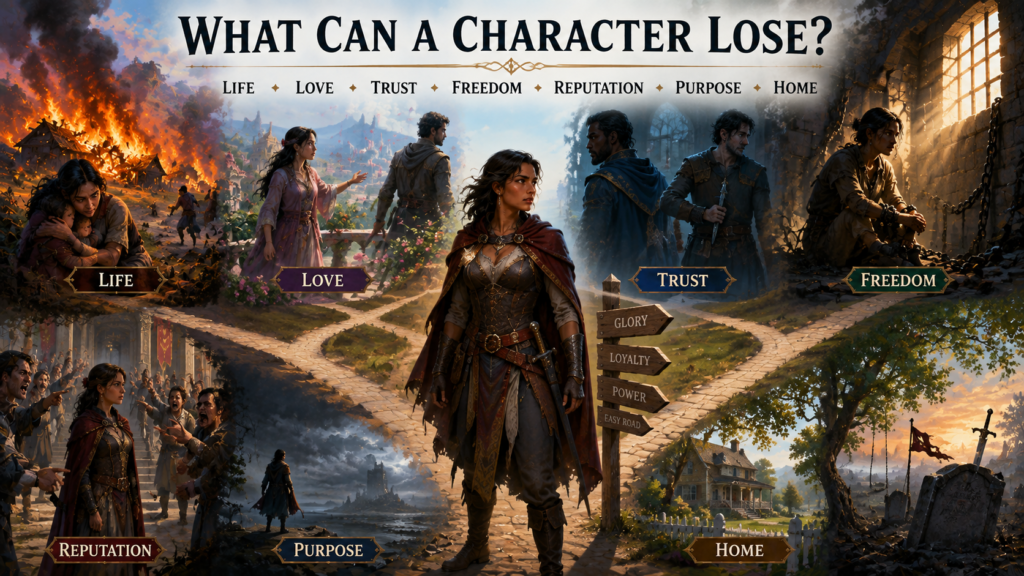
But death is not the same thing as stakes (i.e., what’s at stake, or what could the character lose).
We already know this from virtually every other form of storytelling. A protagonist does not have to die for a story to matter. There are excellent films in which all of the principal heroes survive. There are television series where the audience becomes deeply invested in characters despite reasonably expecting that most of them will still be alive next week. There are stories about saving a marriage, rescuing a child, preventing a war, solving a murder, preserving a community, protecting someone’s reputation, recovering something that was lost, or simply becoming a better human being. None of those stories require the protagonist’s corpse—or the boiled and chewed up remains of his friend’s corpse—at the end to justify everything that came before.
What gives a story stakes is the possibility that something the characters care about can be lost.
Death is simply one particularly powerful form of loss.
That distinction matters tremendously when designing a tabletop role-playing game because a player character occupies a peculiar position that a character in a novel does not. A novelist can decide that one of her protagonists dies on page 427 because she believes it makes the novel stronger. The fictional character does not object. At a role-playing table, however, that character belongs partly to another real person. A player may have spent six months, two years, or ten years developing that character. He may know the character’s childhood, habits, favorite foods, enemies, lovers, failures, religious convictions, ambitions, and private fears. Other players may have developed fictional relationships with that character over hundreds of hours of shared play.
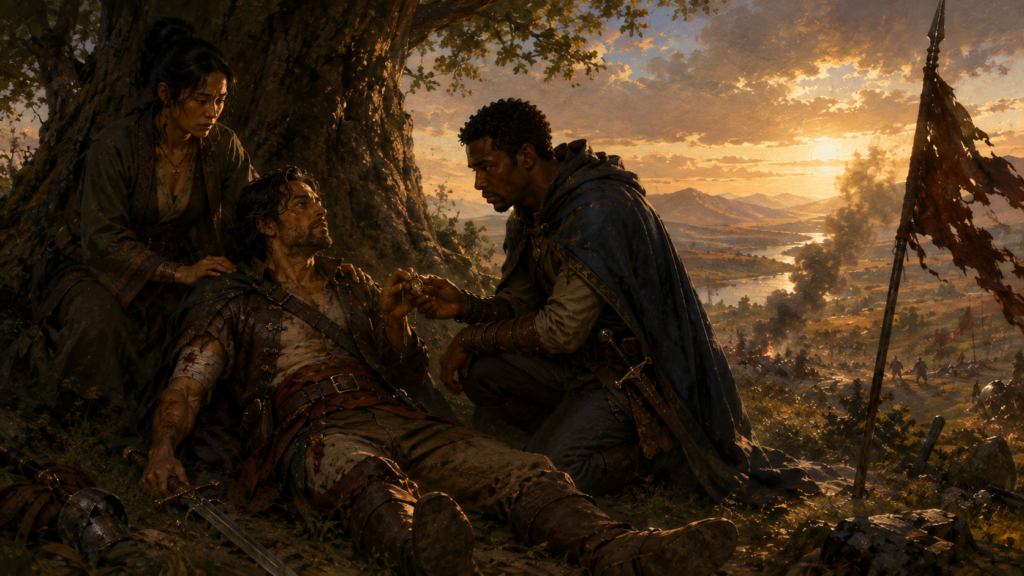
The GM therefore has to deal with two realities at once. Inside the game, perhaps Sergeant Calder has just taken a musket ball through the chest and is bleeding to death in the mud. Outside the game, Mark has been playing Calder every Saturday night for the last eighteen months and has three pages of plans for what he hopes to do with him next.
That does not mean Calder should be protected from death. It means his death actually means something.
That is the philosophy behind death in Jack’s Cinematic d12, the universal tabletop role-playing ruleset used by Gloria Nocturna, RIVET, Shadowrun JCd12, No Quarter, and other game worlds. JCd12 is not designed around the proposition that player characters must regularly die to prove that the game is dangerous. Neither is it built around the opposite proposition that protagonists deserve to survive because they are protagonists. Characters are intended to be competent, cinematic people who can accomplish extraordinary things, but the rules never promise them plot armor. In Gloria Nocturna, combat is explicitly intended to make the player feel like an action star who can survive incredible odds while still acknowledging that the character may not make it to the end of the movie.
The question is therefore not simply, “Can this character die?”
The more useful question is, “What does death mean in the kind of story we are creating?”
I Have Been the GM Who Didn’t Want to Kill Them
Part of the reason I eventually began thinking seriously about this subject is that I have been the Game Master who simply did not want to kill the player characters.
I don’t mean that the rules said the characters were immortal. They weren’t. I don’t mean that the players had negotiated some campaign where death was forbidden. They hadn’t. I simply liked the characters, knew that the players liked their characters, and sometimes found myself reluctant to be the person responsible for ending one of them. There is a natural temptation for a GM to think, They’ve put so much into these characters. Everybody is having fun. Why ruin it?
That instinct isn’t necessarily bad. It can come from caring about the experience of the people sitting at the table. But if it is allowed to quietly control the game, it creates another problem.
Eventually players can figure it out.
A dragon stops being frightening if everyone knows the GM would never actually let it eat anybody. A machine gun stops being frightening if everyone at the table understands that no matter how recklessly they behave, some convenient explanation will always save them. The Game Master can describe blood, fire, screams, explosions, collapsing buildings, and armies of monsters, but if the players understand at some deeper level that the consequences are theatrical, then the danger becomes part of the scenery.
The gun is firing blanks.
That is especially destructive for certain kinds of players because some people genuinely want the possibility of getting their character killed. They don’t necessarily want their character to die, but they want to know that their decisions matter enough that death could be the consequence of making a spectacularly bad one. They want tactical choices to matter. They want preparation to matter. They want retreat to occasionally be the intelligent decision. If they arrogantly walk through the front door of a fortified building after ignoring every warning that twelve armed men are waiting inside, they do not want the GM secretly rearranging reality so that those men suddenly forget how firearms work.
For those players, danger is part of the challenge.
Other players want something very different. A new role-player may create one character, immediately fall in love with her, and primarily want to discover that person’s life. A younger player may experience the destruction of a favorite character much differently than someone who has been gaming for thirty years. Someone may be interested primarily in intrigue, relationships, exploration, mysteries, humor, or character development. Even among experienced players, one person may regard a character sheet as a beloved fictional person while another sees it partly as an entertaining machine that will eventually explode and be replaced.
Neither approach is inherently more mature or more authentic.
This is why discussions about “how lethal should a TTRPG be?” often miss the first design problem. Before lethality is a probability question, it is a communication question.
A Game Master needs enough emotional intelligence to understand who is sitting at the table. What sort of story are these people trying to create? How experienced are they? How attached are they to these particular characters? Do they want an unforgiving tactical challenge? Do they want pulp heroes who usually survive? Are they intentionally playing a doomed military unit? Is this a comedy where spectacular death might send everyone into hysterics? Is this a long-form drama where one death could radically transform every surviving character?
Those questions should not be treated as awkward conversations that somehow contaminate “real” role-playing. They are part of good Game Mastering.
JCd12 approaches the table somewhat like an improvised film production. The GM is not merely a referee enforcing equations, and the players are not merely consumers waiting to discover what the GM has written. Everyone is collaborating on a story whose precise shape nobody completely controls. When a catastrophic moment arrives, there is therefore nothing wrong with talking about it. A GM might look at the table and say, “This could be a death scene. What do you guys think this would mean for the story?” That conversation does not require ignoring the rules or falsifying a die result. It means deciding how an established consequence should enter the shared fiction.
There is an important distinction here because I do not believe in fudging dice.
If the Game Master rolls a 3 and tells everyone it was a 9 because he prefers the result, then I have difficulty understanding why the die was rolled in the first place. The dice exist because nobody at the table, including the GM, is supposed to completely control what happens next. Once we ask the dice a legitimate question, we should be willing to hear that answer.
Good Game Master intervention happens around that result, not by lying about it.
The GM decides whether a roll was necessary. The GM interprets what the result means in the fiction. The rules may provide legitimate ways for Favor, medicine, magic, miracles, or other characters to intervene. A mortally wounded character might be Marked for Death rather than instantly removed from play. The table might decide that a death should happen at the end of the scene rather than in the middle of a combat round. But if the die says something terrible happened, pretending that it rolled something else undermines the very uncertainty that makes tabletop role-playing different from simply telling one another a story.
The Laughable Deaths of Our Shadowrun Characters
My experiences with Shadowrun taught me the other side of how a table can react to player character death.
There were games where we became attached to our characters, certainly, but we also enjoyed creating them. Character creation was part of the entertainment. The setting encouraged colorful criminals, mercenaries, cybered street fighters, magicians, riggers who could control vehicles and robots with their mind, and other people who had made a professional decision to enter an occupation in which somebody might eventually shoot them with an assault rifle. A character could, and most likely would, get caught in a hail of gunfire, blown apart by an explosion, or otherwise encounter a situation where nobody at the table needed a philosophical symposium to determine what had happened.
That dude was dead. Super dead.
There wasn’t anything to heal. There wasn’t a dramatic loophole hidden behind a rule. We would look at the situation, sometimes laugh at the absolute brutality of what had just happened, and eventually create another character.
And we had fun.
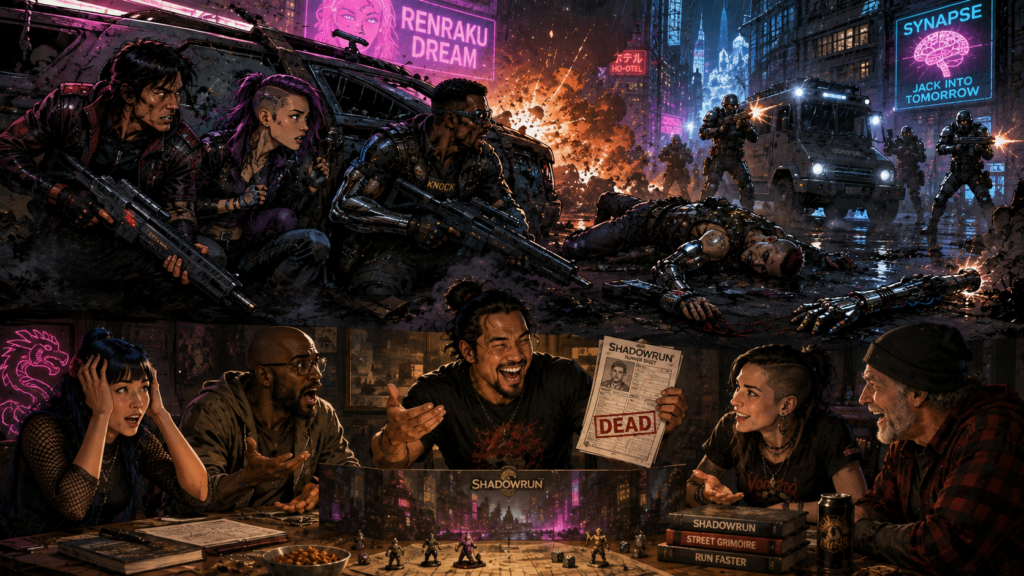
That experience matters to me because it demonstrates how many different relationships can exist between a player and a character. Character death does not always need mournful music and a fifteen-minute farewell speech. Sometimes a death is tragic. Sometimes it is shocking. Sometimes it is frustrating. Sometimes it is a heroic culmination of months of play.
And sometimes your heavily armed cyberpunk criminal gets turned into hamburger 🍔 because he did something stupid, and everybody laughs.
Those experiences are not contradictory. They are part of what makes tabletop role-playing unusually flexible. The fictional characters can respond to an event with absolute horror while the human beings controlling them are laughing around the table. No actual human life has been lost. Nobody has really been shot. The players have the freedom to explore death from whatever emotional distance fits that campaign and that moment.
That does not make the fictional event meaningless. In fact, the difference between what the players feel and what the characters feel can create some of the most interesting role-playing afterward. The players may be laughing about Frank’s spectacular demise while their characters are standing over what remains of a friend they have known for three fictional years.
The next question is what happens to them: what happens to their surviving teammates?
And that is where death in JCd12 begins to become considerably more interesting than simply determining whether somebody needs a new character sheet.
Why Losing an Imaginary Person Can Still Matter
There is something psychologically peculiar about role-playing that we sometimes overlook because those of us who have been doing it for years are so accustomed to it. A tabletop role-playing game asks you to repeatedly imagine yourself as someone who does not exist. You are not merely watching that person, as you might watch the protagonist of a movie. You are continually being asked to consider what that person sees, what that person knows, what that person wants, and what that person chooses to do. The GM describes a situation, and instead of asking, “What happens next?” you are asked, “What do you do?” The “you” in that sentence is simultaneously the player sitting at the table and the imaginary person whose decisions the player has agreed to make.
Over a long campaign, that creates an unusual kind of attachment. The player accumulates memories of things that never literally happened. You remember the night your character nearly died in an alley. You remember the NPC who betrayed you, the village you saved, the ridiculous argument you had with another player character, the enemy who escaped, and the promise you made to somebody twenty sessions ago. You may even remember these events with some of the same emotional vocabulary you use for things that actually happened: I was furious when he betrayed us. I loved that character. I felt terrible when she died.
None of this requires confusing fantasy with reality. Quite the opposite: one of the remarkable things about fiction is that human beings can know perfectly well that something is imaginary and nevertheless become emotionally invested in it. We cry over movies while knowing that the actor who just “died” probably went to lunch after filming the scene. We become angry at fictional betrayals and relieved by fictional rescues. Role-playing adds another dimension because we are not merely observing the fictional person’s decisions. For several hours, we are helping make them.
This is one reason character death can affect a player even though everyone at the table understands that no human being has actually died. Something real has nevertheless ended. The character may have represented months or years of creative effort. Relationships between player characters have developed through hundreds of decisions that could not have been completely predicted when those characters were created. Plans existed for the character’s future. There were unresolved conflicts, ambitions, promises, and relationships. When the character dies, all of those possibilities disappear with him.
Yet tabletop role-playing offers another interesting possibility. Instead of merely experiencing fictional death as an observer, players can explore what it means to survive somebody else’s death from inside another person’s perspective. If my character has adventured beside yours for three fictional years, and then watches your character die, why should my character simply shrug, collect your equipment, and continue toward the dungeon’s next room?
Traditional role-playing has always allowed players to portray grief voluntarily. A good role-player can decide that a character mourns a fallen companion regardless of whether the character sheet contains a rule requiring it. But when designing JCd12, I wanted the mechanics themselves to acknowledge something very simple about violence: sometimes surviving is not the end of what happened to you.
That is where Mental Trauma becomes relevant to death.
In JCd12, Watching Your Friend Die Can Hurt You
Jack’s Cinematic d12 does not use traditional hit points. I am not going to thoroughly explain the wound system here, because this is an article about death rather than an explanation of JCd12 combat, but the distinction is important. JCd12 treats bodily injury through 🩸Physical Wounds and psychological injury through 🧠Mental Trauma. The two systems deliberately parallel one another because a human being can be injured in more than one way.
A character who suffers sufficiently catastrophic physical injury can reach a point where ordinary wound resolution is no longer enough. A 💀Critical Physical Wound can trigger a 💀Roll Against Death, or R.A.D.💀Roll. A character whose psychological condition reaches 💀Broken Mental Trauma can similarly face a 💀Roll Against Dissolution. In other words, the system recognizes both the destruction of the body and the possibility that a mind can be pushed beyond what it can endure.
That second half matters enormously when thinking about death as a game mechanic. If one member of a group is brutally killed, the mechanical consequences do not necessarily stop with the dead character. The people who witnessed it may be traumatized by it. Someone who loved the dead character may be affected differently from someone who barely knew him. The circumstances matter. Watching a companion peacefully succumb to an illness after everyone has had an opportunity to say goodbye is not psychologically equivalent to watching that same companion torn apart in front of you.
The Gloria Nocturna Player’s Handbook explicitly treats the death of a teammate as the kind of experience that can leave lasting 🧠Mental Trauma, and that trauma does not necessarily disappear because the surviving character gets a night’s sleep. Recovery can require time, introspection, relationships, catharsis, or other meaningful experiences. This is important because it allows death to propagate through a campaign without requiring the GM to kill additional characters. One person dies, but several characters’ stories may change.
Imagine that a group has spent twenty sessions together. One character dies saving another. The survivor does not simply lose a combat asset from the party roster. Perhaps he now carries guilt because he believes the other person should never have needed to save him. Perhaps he becomes excessively protective of the replacement character. Perhaps he hesitates the next time someone proposes the same kind of dangerous plan. Perhaps he becomes reckless because he no longer cares whether he survives. Perhaps the dead character’s last words become something he thinks about for the rest of the campaign.
The 🧠Mental Trauma system gives the rules a way to recognize that something happened, while still leaving the actual meaning of that trauma to role-playing.
This also prevents a peculiar problem that sometimes appears in violent games. A group of adventurers can watch friends die, kill dozens or hundreds of people, encounter mutilated bodies, survive torture, confront supernatural horrors, and then behave psychologically as though none of it ever happened. Their bodies are mechanically real because the rules track every sword wound and bullet. Their minds exist only when the players voluntarily remember that they have them.
JCd12 does not assume that every violent experience automatically traumatizes every character, nor should it. People respond differently to terrible events, and characters should too. But the system gives psychological consequences mechanical existence when circumstances warrant them. Death can therefore become more than a method of removing one character from the campaign.
A meaningful death mechanic should not only ask what happened to the person who died. It should also ask what happened to everyone who survived them.
That principle is particularly important in Gloria Nocturna, but it extends naturally to RIVET, No Quarter, Shadowrun JCd12, and any other setting built upon the JCd12 rules. The exact sources of trauma will differ radically from one world to another, but the underlying idea remains the same. Violence has consequences, and those consequences do not necessarily end when the bleeding stops.
Roll Against Death: Let the Dice Speak
Eventually, however, there comes a moment when all of the philosophy has to become a rule. A character has suffered catastrophic injury. The question is no longer whether he has been hurt. The question is whether he is going to live.
That is the purpose of the Roll Against Death.
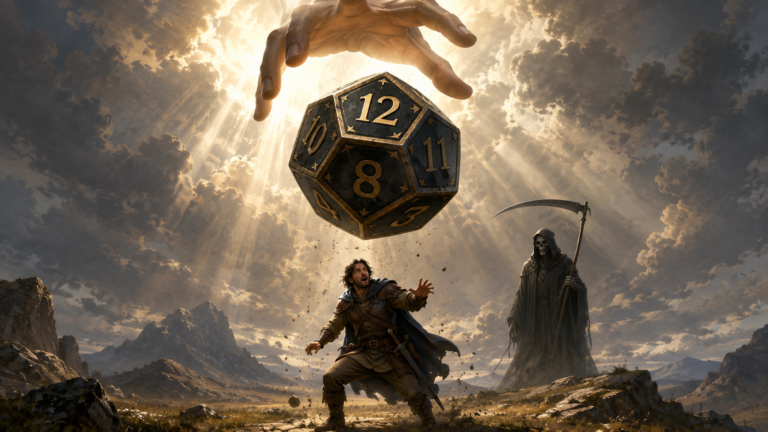
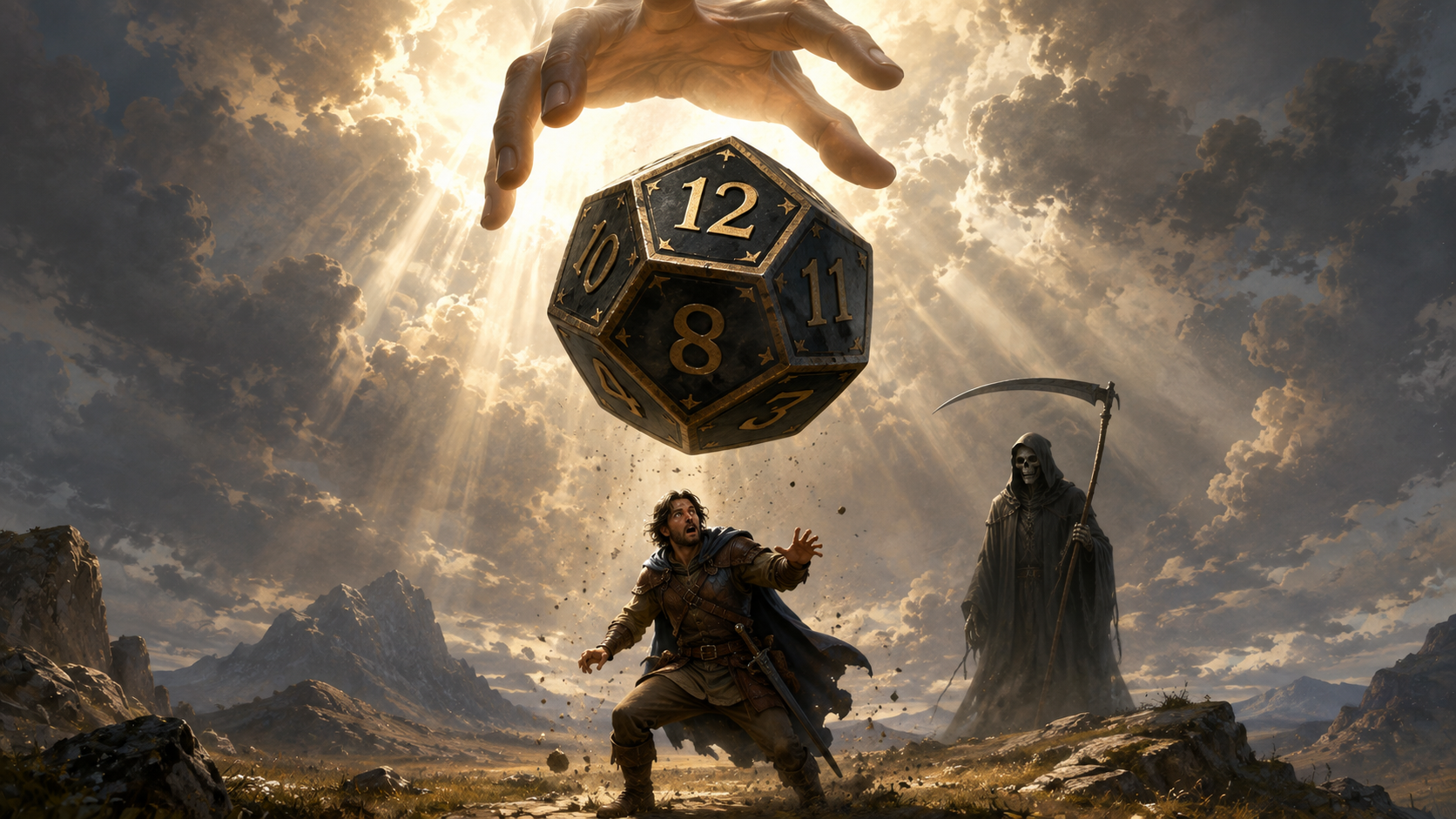
When a character suffers a Critical Physical Wound under the circumstances described by the JCd12 wound rules, the player rolls 1d12. On the current R.A.D. table, a result of 1–4 means immediate death or that the character is Marked for Death. A result of 5–8 leaves the character unconscious or severely dazed. A 9–11 means the character remains alive and conscious but is too badly injured to continue fighting. A natural 12 produces miraculous survival: the character is barely alive, clinging to life against the odds. The psychological equivalent, Roll Against Dissolution, likewise ranges from severe psychological consequences through complete psychological destruction or death.
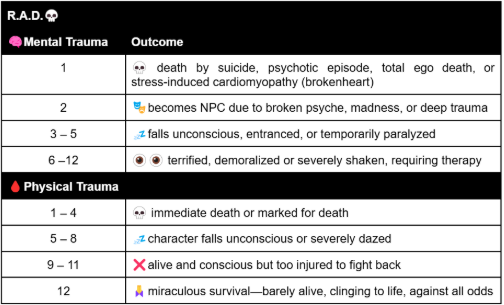
I like this better than simply watching a numerical pool of hit points descend toward zero because the roll represents a recognizable dramatic moment. Something terrible has happened, and now everybody at the table knows exactly what question is being asked.
Does this character survive?
And when we ask the dice that question, I believe we should listen to the answer.
I do not fudge dice. I do not think a Game Master should roll a 3, dislike the consequence, and announce that he rolled an 8. If we already decided what result we wanted, there was no reason to roll the die. Randomness is useful precisely because it temporarily takes authorship away from everyone at the table. The GM does not know what is about to happen. The player does not know. For one small moment, the story belongs to the die.
That does not eliminate Game Master judgment. Quite the opposite. The GM has enormous responsibility for determining when a roll is appropriate, what circumstances modify events, which rules apply, and what the resulting event actually looks like within the fiction. Favor may provide another chance. Medicine may matter. Magic may matter. A miracle may genuinely be possible in a setting where miracles exist. The character might be Marked for Death rather than dropping dead at that exact second. All of those are legitimate parts of the game because they operate openly through the rules and the fiction.
What the GM should not do is secretly transform failure into success and then pretend the dice made the decision.
There is also a limit to what a Roll Against Death is intended to accomplish. Dice resolve uncertainty. They are not obligated to manufacture uncertainty where none reasonably exists. If an ordinary human character deliberately jumps into molten lava, there may be no meaningful question for the d12 to answer. If someone’s body has been completely destroyed, rolling to determine whether he is merely “severely dazed” would make the fictional world less believable rather than more dramatic.
JCd12 does, however, inhabit worlds in which extraordinary things can happen. Magic exists in some settings. Favor exists. Miracles can exist. The spell book for Gloria Nocturna, the Codex Arcanum, , even contains magic capable of challenging death itself under extraordinary circumstances. The existence of those possibilities does not mean that ordinary cause and effect disappears. It means that when the impossible happens, there should be an actual reason within the game for the impossible to have happened.
That leaves us with a useful distinction: the rules adjudicate uncertainty, the fiction establishes what is possible, and genuine miracles are extraordinary precisely because they can overturn what would otherwise have been certain.
The dice should be allowed to surprise us. They should not be required to make nonsense possible, and they should never be secretly rewritten merely because we are afraid of what they said.
Marked for Death: Sometimes Death Needs Another Ten Minutes
One of the practical problems with character death has very little to do with fictional realism and everything to do with the fact that tabletop role-playing is played by real people sitting around a table. Suppose four players are halfway through a four-hour session when one character suffers a catastrophic wound. The dice are rolled, the result is lethal, and the rules say that the character is dead.
What does the player do for the next two hours?
That question sounds mundane compared with discussions about mortality, dramatic stakes, and heroic sacrifice, but it is an important game-design problem. The character may have died appropriately. The GM may have adjudicated everything fairly. The player may even think the death was fantastic. None of that changes the fact that one of the people who came over to play a game on Saturday night may now have nothing to do.
One solution is to make character death sufficiently difficult that it rarely interrupts play. Another is to make replacement characters disposable and easily inserted. JCd12 provides another possibility through the Marked for Death rule.
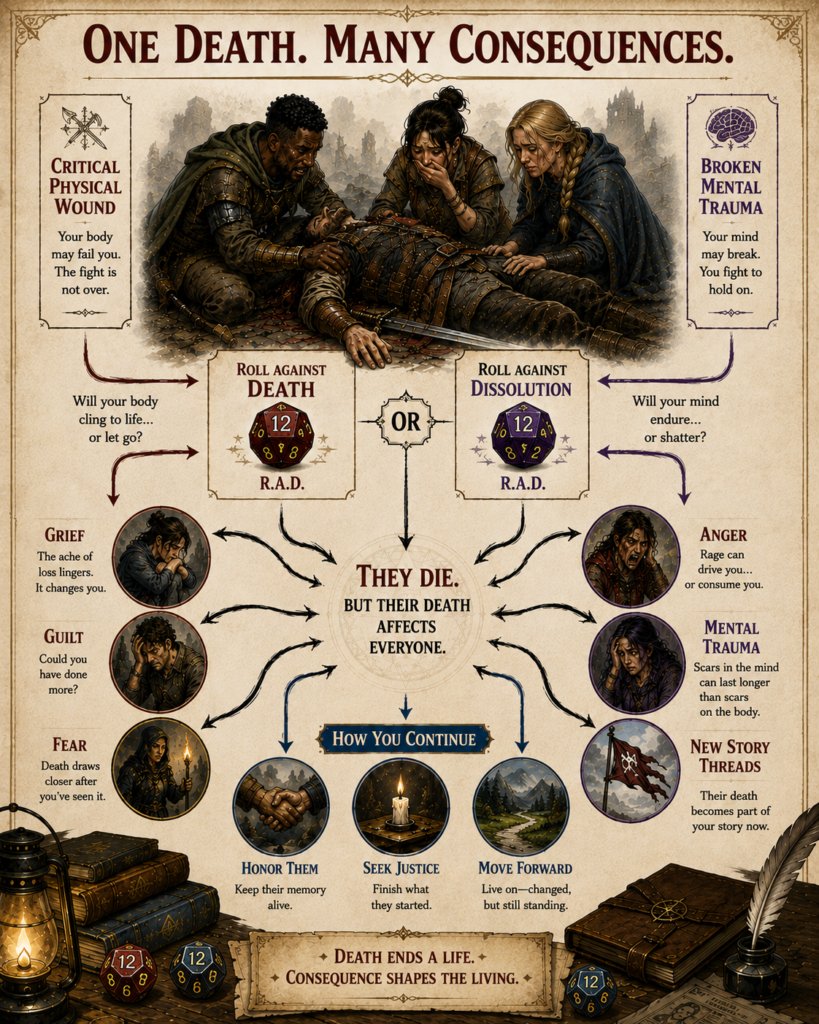
When a Roll Against Death produces a lethal result, death does not necessarily have to occur at that exact second. The character can instead be Marked for Death. The outcome has not been erased. The GM has not secretly changed the die. The character is going to die. What changes is the timing. The existing Gloria Nocturna Player’s Handbook describes Marked for Death as an alternative particularly useful when the player does not have another character ready, allowing the doomed character to remain in play until a suitable moment during the current or following session.
That seemingly small distinction opens an enormous amount of storytelling space.
A mortally wounded soldier might continue fighting long enough to get his companions out of the building. A dying knight might remain conscious until the battle is over and finally collapse when he sees that the people he protected are safe. A cyberpunk mercenary might spend his remaining time transmitting evidence that will bring down the corporation responsible for his death. Someone might stagger home. Someone might ask for a priest. Someone might confess something he has concealed for twenty sessions. Someone might die cursing his enemies. Someone might make everybody laugh with his last words.
Or the death might remain ugly, abrupt, and meaningless.
That possibility matters too. Not every human being receives a beautifully constructed final scene, and not every fictional character needs one. Sometimes the brutality of an unexpected death is precisely what gives it power. Marked for Death is not a requirement that the GM transform every casualty into an operatic sacrifice. It is a tool that allows the table to decide that the mechanical determination of death and the dramatic moment of death do not always need to be simultaneous.
This is also where the cinematic philosophy of JCd12 becomes especially important. Imagine that we were collaboratively improvising a movie rather than playing a conventional RPG. One of us says, “I think this character should die here.” We would naturally begin discussing what that means. Does he die immediately? Does he know that he is dying? Does another character realize it before he does? Would his death be more powerful at the end of this scene? Is there something unresolved between these two characters that suddenly becomes enormously important because there are only five minutes left to resolve it?
Those are not necessarily attempts to save the character. They are questions about directing the death scene.
The same conversation can happen at a JCd12 table. The GM can look around and say, “All right. This result means he’s going to die. Do we want him to die right here, or would it make a better story if he’s mortally wounded and we let this play out?” The player whose character is dying should obviously matter enormously in that conversation. Perhaps he immediately says, “No. This is perfect. He dies right here.” Perhaps his eyes light up because he suddenly knows exactly what his character would try to accomplish with his remaining minutes.
The result of the die remains intact.
What changes is what everyone does with it.
The rule also works alongside another practical recommendation already present in Gloria Nocturna: players can prepare additional characters, and the GM can keep appropriate replacement characters available. If a replacement is ready, there may be no reason to delay death at all. The original character dies, everyone reacts, and the GM finds an organic opportunity to introduce the replacement. The objective is not to protect characters from mortality. It is to prevent mortality from unnecessarily ejecting a player from the game.
That distinction is essential. The character can die without game night dying with him.
Emotional Intelligence Is a Game Master Skill
No death mechanic, however carefully designed, can tell a Game Master everything he needs to know about the people sitting around his table.
A veteran role-player who enthusiastically signed up for a brutally lethal military campaign may respond to losing his third character with laughter and immediately reach for his backup character sheet. A teenager playing her first long-term character may experience an unexpected death very differently. One player may desperately want tactical consequences and become frustrated when the GM protects him from his own mistakes. Another may have spent two years exploring a character’s relationships and regard an arbitrary death as the destruction of the part of the campaign she most enjoyed.
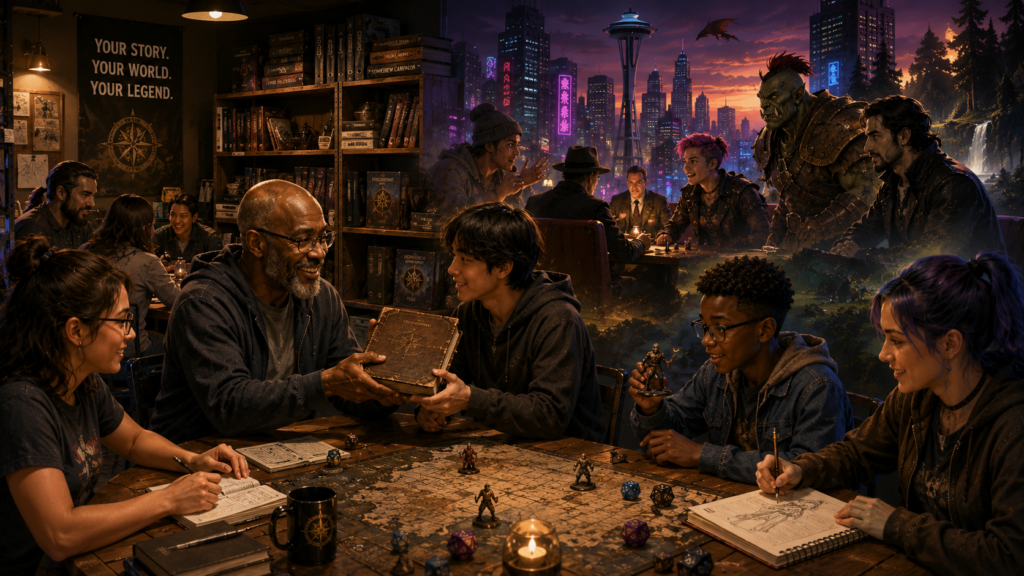
This is why good Game Mastering requires emotional intelligence in addition to knowledge of the rules.
That does not mean constantly protecting players from uncomfortable emotions. Fear, grief, anger, disappointment, uncertainty, and loss can all be part of an extraordinary role-playing experience. Horror games deliberately make people uncomfortable. Tragedies deliberately make people sad. A player can be genuinely upset that a beloved character died while simultaneously believing that the death made the campaign better.
The GM’s job is not to guarantee that nobody ever feels bad. It is to understand what kind of experience everyone agreed to create.
Much of this can be established before play begins. If I am preparing a campaign in which careless decisions are likely to get characters killed, I should tell the players that. If combat is intended to be genuinely dangerous, they should know it. If I expect retreat, surrender, negotiation, preparation, and tactical caution to sometimes be necessary for survival, that expectation should not be revealed for the first time when half the party is already dead.
The players then get to decide whether that sounds enjoyable.
A player who says, “I want my decisions to matter, and if I do something tactically stupid enough to get myself killed, then kill me,” is telling the GM something important. Protecting that character through hidden intervention would not necessarily be kindness. It might actually deprive the player of the game he asked to play. The possibility of failure is part of the satisfaction of success. Surviving a dangerous situation through good decisions means considerably less when the player knows bad decisions would have produced the same result.
But communication does not have to end after the campaign begins. Circumstances change. Players become more attached to characters than they expected. A campaign that began as ridiculous entertainment can unexpectedly develop serious relationships and emotional weight. A character created as a joke can somehow become the emotional center of the entire group. Good Game Masters notice these things.
They also notice reactions at the table.
When a catastrophic result appears, there is nothing inherently wrong with discussing what happens next. JCd12’s collaborative, cinematic approach actually encourages that kind of conversation when it improves the game. The GM can ask whether a death scene would strengthen the story. The players can discuss what the death might mean. Someone can say that he would rather let the dice fall brutally and move on. Someone else might suggest that Marked for Death would create a much stronger conclusion.
What should not happen is for “collaborative storytelling” to become a euphemism for eliminating consequences whenever somebody dislikes them. A player who knowingly walks into a lethal situation does not acquire plot armor merely because he has become attached to his character. Likewise, a GM should not invoke “realism” as an excuse to gleefully destroy characters when that is plainly not the kind of campaign the table agreed to play.
The goal is trust.
Players should be able to believe that the Game Master is not trying to defeat them, while also believing that he will allow their choices and the rules to have consequences. The GM should be able to trust the players to accept genuine failure, while the players should be able to trust the GM not to manufacture arbitrary deaths merely to demonstrate how dangerous his world is.
When that trust exists, character death becomes much easier to handle because everyone understands that the death belongs to the story rather than to an adversarial contest between player and Game Master.
You Can Actually Plan Who Dies
There is another possibility that tabletop role-playing games sometimes shy away from because we have become accustomed to treating unpredictability as sacred: a character’s death can be planned in advance.
That does not necessarily mean scripting an entire campaign. It does not mean deciding every choice the players will make or determining precisely how every scene will end. It means recognizing that predetermined events and emergent play can coexist.
Imagine six players preparing for a particularly brutal JCd12 campaign. Before the first session, the GM tells them, “Everybody needs to create a backup character. I’ve already randomly determined that at least two of the original six characters are going to die during this story. I know which two. You don’t.”
Immediately, the campaign feels different.
Every dangerous situation now contains another layer of uncertainty. The players know death is coming, but they do not know for whom. Perhaps the character who appears obviously doomed survives the entire campaign. Perhaps the seemingly central protagonist dies unexpectedly in the fourth session. Perhaps everyone begins interpreting ordinary events as foreshadowing that isn’t actually there.
The GM has predetermined that something will happen without necessarily predetermining how it happens.
There are many variations on the idea. The GM could secretly tell one player before a session, “Your character is going to die tonight.” That player now participates in constructing the final chapter of the character’s life. Perhaps he begins saying things he has postponed saying. Perhaps he takes a risk he ordinarily would not take. Perhaps he arranges for someone else to inherit something important. Perhaps he tells nobody and plays the character exactly as he normally would, allowing the final moment to arrive without warning for everyone else.
Or the player might be the person who proposes the death. A character’s arc may have reached a point where sacrifice feels appropriate, and the player can privately discuss that possibility with the GM. Knowing the destination does not necessarily tell either of them what road will lead there.
I would not want every campaign to work this way. If every death is planned, one of the unique pleasures of tabletop gaming—the possibility that nobody knows what happens next—can begin to disappear. But planned death is another legitimate instrument in the Game Master’s toolbox, particularly in a system explicitly concerned with cinematic storytelling.
It also reveals something important about what makes tabletop role-playing different from writing a screenplay. Randomness is part of the difference, but randomness is not the whole difference. A TTRPG is collaborative. The participants make decisions independently. Scenes develop through interaction between people rather than through one author’s complete control. Even when everyone knows that Hamlet is going to die at the end, there can still be enormous uncertainty about what the characters will say, choose, discover, sacrifice, and become before the end arrives.
A predetermined death therefore does not automatically destroy player agency. The real question is what has been predetermined.
If I tell a player exactly what his character will think, what decisions he will make, whom he will love, whom he will betray, what he will say, and precisely how he will die, I have effectively taken the character away from him. But if we agree that this person’s story ends in death and leave everything else to play, an enormous amount of agency remains.
Sometimes knowing that a character will die can even make playing him more interesting.
And sometimes nobody should know anything at all until the bullet hits.
D&D, Shadowrun, Call of Cthulhu—and Different Philosophies of Dying
Different role-playing games teach players to think about death differently. That is easy to overlook because death can appear to be a universal mechanic: the character is alive, something terrible happens, and now the character is dead. But the rules surrounding that transition tell players a great deal about the fictional world they inhabit. How difficult is it to die? How predictable is death? What opportunities exist to prevent it? Can somebody bring you back afterward? Does psychological destruction matter alongside physical destruction? How quickly can another character replace you?
These are not merely mechanical questions. They influence behavior.
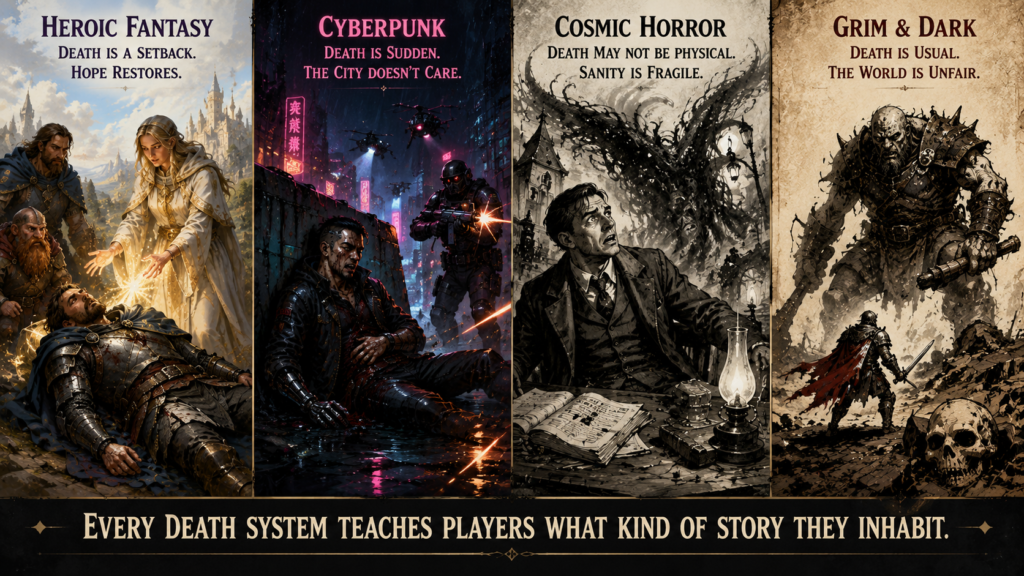
Dungeons & Dragons: Death as a Reversible State
Dungeons & Dragons provides the most obvious comparison because its basic vocabulary has influenced how millions of people understand tabletop role-playing games. Characters have hit points. Attacks and other harmful effects reduce those hit points. In modern D&D, reaching 0 hit points does not normally mean immediate death; an adventurer can fall unconscious and begin making death saving throws, while allies have opportunities to stabilize or heal the character. Certain sufficiently extreme circumstances can still kill someone outright, but there is usually a mechanical interval between falling and dying.
There is nothing inherently wrong with that design. In fact, it solves several problems extremely well. It gives the other players an opportunity to save their friend. It creates dramatic moments where someone is bleeding out while the rest of the party desperately tries to reach them. It reduces the frequency with which a single unfortunate roll abruptly destroys a character. It also fits the heroic fantasy that modern D&D generally attempts to provide.
But D&D goes further. At sufficient levels, death itself can become reversible through magic. The details depend upon the spell and circumstances, but the larger fictional principle is unmistakable: being dead does not necessarily mean that your story is over.
That changes death.
If resurrection is extraordinarily rare, mysterious, or costly, returning someone to life can itself become the subject of an adventure. If resurrection becomes sufficiently accessible, however, death begins to resemble another condition that adventurers have procedures for correcting. The party may grieve, but everyone also knows that the important practical question is whether they can recover the body and obtain the necessary magic.
Again, that isn’t necessarily bad game design. It creates a particular kind of fantasy world. If priests can genuinely return people from death, intelligent people living in that world ought to behave differently because of it. Kings, wealthy merchants, soldiers, murderers, religious institutions, and ordinary people should all understand death differently than people in our world do. Resurrection magic is not merely a convenient spell on a character sheet. Taken seriously, it is a civilization-changing fact.
The danger comes when resurrection is common enough to reduce death’s emotional importance but the fictional world continues pretending that death means what it means to us.
That is something I want JCd12 games to avoid. A character may return from death in some JCd12 settings. Miracles can happen. Magic can accomplish extraordinary things. Reincarnation exists within some of my game worlds. But I do not want death to function like an inconvenient status effect that can routinely be removed after the adventure.
If somebody comes back from the dead, I want it to feel like somebody came back from the dead.
Shadowrun: Sometimes the Guns Win
Shadowrun approaches danger from a very different genre. It is a world of professional criminals, corporate security forces, automatic weapons, explosives, cyberware, magic, gangs, assassins, and extremely bad decisions made at two in the morning because somebody thought the plan was better than it actually was. Its damage mechanics have varied across editions, but Shadowrun has never needed the enormous pools of abstract hit points associated with high-level fantasy adventurers to make characters increasingly capable.
That contributes to the atmosphere.
A competent shadowrunner can become extremely dangerous. Better equipment, cyberware, magic, experience, contacts, preparation, and good tactics can dramatically improve the odds of survival. But none of those things need to transform a human body into something that can casually absorb absurd amounts of gunfire. Violence retains the possibility of suddenly becoming catastrophic.
That is part of what my friends and I enjoyed about it. Sometimes the guns simply won.
The important thing is that this did not always make character death emotionally devastating. As I described earlier, we enjoyed making Shadowrun characters. Sometimes losing one was part of the fun. There was something darkly amusing about spending all that time creating some elaborate cybered badass only for circumstances, terrible tactics, or terrible luck to reduce him to a cautionary tale.
Shadowrun JCd12 preserves the danger appropriate to that world while changing the machinery underneath it. JCd12 does not need to make every character fragile in order to make firearms frightening. It can allow highly competent cinematic protagonists while treating catastrophic wounds as catastrophic wounds. The Roll Against Death then asks the important question when an injury becomes severe enough that survival is genuinely uncertain.
The difference matters because lethality and competence are not opposites.
A game can let the characters be very good at what they do while maintaining the possibility that a bullet through the wrong part of the body can end somebody’s career permanently. In fact, competence can make death more meaningful because the player understands that survival usually depends upon using that competence intelligently rather than relying upon an ever-growing reservoir of abstract durability.
Call of Cthulhu: What If Your Body Survives and Your Mind Doesn’t?
Call of Cthulhu provides a more interesting comparison for JCd12 because it asks a question that many combat-oriented RPGs historically treated as secondary: what happens when the character survives physically but cannot simply walk away psychologically unchanged?
Its famous Sanity mechanics are central to the kind of horror Call of Cthulhu is trying to create. Investigators encounter things human beings were never supposed to understand, and the danger is not limited to claws, bullets, teeth, and tentacles. Knowledge itself can become dangerous. Discovering what is actually happening may be psychologically destructive even when the investigator escapes physically unharmed.
JCd12’s Mental Trauma is not the same mechanic and is not trying to reproduce Call of Cthulhu’s particular vision of cosmic horror. The comparison is valuable precisely because both systems recognize a principle that extends far beyond horror gaming: the survival of the body does not necessarily mean that the character escaped unharmed.
JCd12 formalizes that through Mental Trauma and, at the extreme, the Roll Against Dissolution. Broken Mental Trauma can push a character toward psychological collapse just as catastrophic Physical Wounds can push a character toward death. This becomes particularly relevant to our subject because death itself can become one of the experiences that damages the survivors.
A character watches his closest friend die.
He survives.
That does not necessarily mean he won.
This is one reason I resist reducing “stakes” to the probability of player-character death. Call of Cthulhu demonstrates the usefulness of threatening something besides the character’s heartbeat. JCd12 broadens that idea beyond cosmic horror by treating psychological injury as something that can matter in fantasy, cyberpunk, war stories, science fiction, horror, and other genres. The precise cause changes with the setting, but the underlying human question remains recognizable.
What can happen to you that survival alone cannot fix?
Deathbringer and the Pleasure of a Dangerous Game
At the harsher end of the spectrum are games and styles of play that deliberately embrace lethality. Professor Dungeon Master’s Deathbringer is useful here because its grim approach represents something I think should be taken seriously rather than dismissed as primitive game design. A dangerous game can create a particular kind of pleasure. When players know that combat is genuinely hazardous, they begin looking for ways to avoid fighting fair. They prepare. They ambush. They negotiate. They retreat. They use the environment. They ask questions before charging through the door.
Most importantly, survival feels earned.
That does not mean every game should be Deathbringer, any more than every movie should be a grim tragedy. A campaign that constantly feeds characters into a meat grinder can eventually make death less meaningful rather than more meaningful. If I have gone through eight characters and have learned not to become attached to number nine because he will probably be dead by Thursday, the game may remain tactically exciting while losing another kind of emotional investment.
That may be exactly what the table wants.
The mistake is assuming that one approach represents “real” role-playing and the others are cowardly compromises. A brutally lethal dungeon crawl, a heroic fantasy campaign where death is rare, a Call of Cthulhu investigation where psychological destruction is more frightening than bodily injury, and a cinematic JCd12 campaign can all produce excellent games. They simply ask players to form different relationships with their characters and with danger.
Every death system teaches the players what kind of story they are inhabiting.
Resurrection Can Ruin Death
If making death too easy can weaken its importance, making resurrection too easy can create an even stranger problem.
I like resurrection as an idea. Some of the worlds I create contain magic, miracles, reincarnation, and other possibilities that make death more complicated than biological extinction. I do not believe that fantasy becomes automatically better by declaring that every death must be irreversible. On the contrary, returning someone from the dead can be one of the most extraordinary events imaginable.
The problem begins when the extraordinary becomes routine.
The Codex Arcanum, which contains the spells for Gloria Nocturna, approaches resurrection through a progression of increasingly extraordinary magic rather than treating every return from death as equivalent. At the lower end, the apparent “resurrection” can be deliberately uncertain: a tiny animal that seemed dead begins moving again, leaving open the possibility that it was never truly dead. More powerful forms move toward genuinely restoring life, while the most extreme resurrection magic requires extraordinary circumstances and exceptional rolls, potentially culminating in Divine Intervention.
That uncertainty is important to me. Imagine a magician holding a dead bird, performing some strange ritual, and watching the bird suddenly flutter away. Did he resurrect it? Was the animal merely stunned? Did magic restart a body that had not yet crossed whatever metaphysical boundary separates life from death?
Nobody necessarily knows.
Now compare that with someone who has unquestionably been dead long enough that there can be no ordinary explanation for returning. If that person opens his eyes again, we are no longer dealing with unusually successful medicine. Something miraculous has happened.
The difficulty of resurrection should rise accordingly.
This is where I think some fantasy games risk undermining their own stories. If death can be reliably reversed whenever the party possesses the correct spell, sufficient money, and an intact enough corpse, then rational players will begin treating death according to those rules. They should. They are not doing anything wrong. If resurrection is a dependable service within the fictional universe, then treating it as a dependable service is intelligent role-playing.
The problem is that the emotional language of the story may continue pretending otherwise.
- Everyone cries because Aldric died.
- Then someone remembers they have enough money.
- Aldric gets better.
Do that often enough and the table learns something: death is not really the thing everyone keeps saying it is.
JCd12 settings can permit resurrection without requiring resurrection to become ordinary. 🙏Favor can matter. Extraordinary magic can matter. A natural 12 can matter. Divine Intervention can matter. The precise possibilities depend upon the game world, because a universal system should not impose identical metaphysics upon every setting. But the underlying design principle is that returning from genuine death should not casually erase death’s significance.
A miracle is powerful partly because you cannot depend upon one.
That distinction also preserves the value of the 💀Roll Against Death. If every failed R.A.D.💀Roll merely begins a predictable sequence in which the party carries the corpse to the nearest resurrection specialist, then the tension of rolling against death eventually becomes financial and logistical rather than existential. There may be settings where that is appropriate, but it is not the default feeling I want from death in JCd12.
If someone dies, that death should matter even in a universe where death is not necessarily the final word.
Reincarnation: Death Without Oblivion
Reincarnation creates another possibility because resurrection and reincarnation do not have to mean the same thing.
In game worlds where reincarnation exists, death can remain completely real. The character’s body dies. His companions bury him. His marriage ends. His children grow older without him. His enemies continue their plans. His unfinished work remains unfinished. The people who loved him grieve because, from their perspective, he is gone.
Another life does not erase any of that.
This makes reincarnation particularly interesting from a game-design perspective. Resurrection can potentially restore the existing character to the existing story. Reincarnation can instead preserve some form of continuity while allowing death to retain its consequences. Years might pass. Decades might pass. The new person may not remember the previous life at all, or those memories may emerge only partially depending upon the metaphysics of the particular setting. The reincarnated person may occupy a different culture, family, social class, body, or historical period.
The old life still ended.
That distinction matters because the problem with easily reversible death is not necessarily the proposition that consciousness or existence continues after bodily death. The problem is erasing consequences. If death changes nothing because the character walks back into the tavern tomorrow and resumes the same adventure, death begins losing its dramatic power. If death separates people, ends relationships in their existing form, changes history, produces grief, and begins an entirely different life somewhere else, then continued existence does not make the death meaningless.
JCd12 is a universal ruleset, so not every game world needs to answer these metaphysical questions in the same way. Some worlds may offer resurrection. Some may include reincarnation. Others may make death absolute and unknowable. What matters is that the mechanics respect the cosmology of the setting rather than casually undermining it.
And even after saying all of that—after designing Roll Against Death, Mental Trauma, Marked for Death, miraculous survival, resurrection magic, and worlds in which reincarnation can exist—I think there is an even more interesting question to ask.
What if we designed a role-playing game where none of this mattered because the player characters simply could not die?
Could We Make a Great RPG Where Nobody Can Die?
After spending this much time explaining why I designed rules for death, catastrophic injury, 🧠Mental Trauma, Marked for Death, miraculous survival, and even resurrection, I want to turn the entire argument around.
I would like to play a tabletop role-playing game in which the player characters absolutely cannot die.
Not a game where death is unlikely. Not a game where the GM secretly protects the protagonists while pretending that every battle might kill them. Not a game where death occurs but resurrection is automatic. I mean a game in which the rules tell everyone before character creation begins: your character is immortal, and nothing that happens during this campaign can kill you.
At first glance, that sounds like a terrible idea. If you cannot die, why should you care about walking into the dragon’s lair? Why fear the gunman? Why run from the monster? Why bother planning an assault when you can simply walk through the front door?
Those are good questions, but they reveal how accustomed we have become to using death as the easiest possible answer to the question of stakes.
Take death away and the game designer has to become more creative.
Perhaps the characters are immortal beings who descend from the heavens into less-developed civilizations. Nothing those civilizations possess can kill them. A spear through the chest hurts but eventually heals. Fire burns them but cannot destroy them. Disease cannot take them. They might survive for thousands of years. Everyone at the table knows this.
Now give them responsibility for people who are not immortal.
Suddenly the spear is frightening again, but for a different reason.
The immortal character cannot lose his own life, but he can fail to save a village. He can watch a civilization destroy itself. He can accidentally introduce technology that results in a war. He can fall in love with someone who will grow old while he remains unchanged. He can become worshiped as a god despite desperately trying to convince people that he isn’t one. He can make a political decision whose consequences last for five hundred years. He can save one kingdom and inadvertently create an empire that enslaves three others.
His immortality may actually make some consequences worse because he has to live with them.
That immediately suggests dozens of other things a supposedly invulnerable character can lose. Freedom matters if immortals can be imprisoned. Memory matters if minds can be altered. Reputation matters if society can turn against them. Relationships matter because other people can leave, betray them, or die. Moral integrity matters because an immortal person can become someone he never intended to become. Nations can fall. Families can disappear. Missions can fail. Promises can be broken. Innocent people can suffer because of the character’s decisions.
- An immortal king can lose his kingdom.
- An immortal husband can lose his wife if she is not immortal.
- An immortal general can lose his army if they are not immortal.
- An immortal explorer can become trapped somewhere for three hundred years.
- An immortal hero can save the world and discover that everyone now hates him for how he did it.
None of those consequences requires a dead player character.
The idea becomes even more interesting if immortality is not merely an excuse for unlimited violence. If getting shot fifty times cannot kill me, I may initially become reckless. But what happens when the people standing beside me are mortal? Walking into the gunfire may be easy. Convincing the frightened civilians behind me to trust that I can get them out alive is something else entirely.
A game built around that premise could still contain tremendous danger. The danger has simply moved.
This thought experiment is important to me because it tests the premise behind everything else in this article. If we can imagine an exciting campaign in which every player knows with absolute certainty that his character will survive, then death cannot be the fundamental source of dramatic tension in a tabletop role-playing game.
Death is one kind of stake. It is not the definition of stakes.
In some ways, declaring the characters immortal might force everyone at the table to confront consequences that conventional combat-heavy games allow us to ignore. You cannot solve every problem by asking how many hit points the enemy has. You cannot measure success solely by whether your character survived the adventure. The game has to ask harder questions.
- What were you trying to protect?
- Did you protect it?
- And what did it cost everyone else?
What About a Game Without Violence?
We can push the same thought experiment further. If a role-playing game does not require death to create stakes, does it even require violence?
Obviously not. There are already role-playing games aimed at younger audiences and particular genres where combat is greatly reduced or absent. But I do not think nonviolent role-playing needs to be confined to children’s games. An adult campaign could contain intense conflict without making physical violence the principal means of resolving that conflict.
A political campaign could revolve around preventing a war rather than winning one. An investigative campaign could focus on uncovering corruption. Characters might be diplomats trying to keep two hostile nations at the negotiating table, journalists attempting to expose something powerful people want concealed, merchants trying to save a failing enterprise, explorers attempting to cross an unknown continent, or members of a community trying to survive a catastrophe together. Relationships themselves can create stakes: marriages, friendships, families, rivalries, loyalties, betrayals, promises, and competing obligations can all generate conflict without anybody drawing a sword.
Even a game such as Shadowrun invites the experiment. What would happen if a group attempted to complete runs while avoiding violence whenever possible? Suddenly information becomes enormously valuable. Social engineering matters. Disguises matter. Surveillance matters. Contacts matter. Hacking matters. Bribery matters. Timing matters. Knowing which security guard is going through a divorce and therefore arrives fifteen minutes early every Thursday might accomplish more than bringing another assault rifle.
Violence can even remain possible without becoming desirable. If the objective is to enter a corporate facility, steal information, and disappear without anyone realizing a shadowrun occurred, then shooting the first security guard may represent failure rather than success. The corpse creates evidence. The corporation locks down the building. Police become involved. Someone investigates the murder. The dead guard had a family. Suddenly the easy solution creates ten new problems.
That is another useful lesson for game designers: if combat is always the most mechanically developed, entertaining, and effective way to solve problems, players should not be blamed for solving their problems through combat. Games teach people how to play them through the systems they reward.
None of this means I want JCd12 to abandon violence. Gloria Nocturna, RIVET, Shadowrun JCd12, No Quarter, and other JCd12 settings can contain brutal violence, and the system needs serious mechanics for what happens when that violence becomes catastrophic. That is precisely why the Roll Against Death exists.
The point is that the existence of good death mechanics should never prevent us from designing interesting reasons for the players to desperately want something other than survival.
So When Should a Character Die?
After all of this, the practical question remains. The battle is happening. The character is bleeding. The dice are on the table. When should the Game Master actually allow a player character to die?
There cannot be one universal answer because there cannot be one universal campaign. What I want instead is consistency between the kind of game everyone agreed to play, the fictional circumstances, the decisions the players made, and the rules everyone agreed to use.
Sometimes a character should die because the dice say he dies.
Sometimes he should die because he knowingly did something so catastrophically dangerous that survival ceased to be a reasonable outcome. If a player knows that a corridor is covered by six machine guns and decides to casually walk down it anyway, the GM does not owe him survival simply because he has played the character for two years. Player agency becomes meaningless if the consequences of decisions disappear whenever those consequences become unpleasant.
Sometimes death should happen because the fictional circumstances leave no ordinary possibility of survival. JCd12 has rules for Favor, magic, extraordinary intervention, and miracles where the setting permits them, but those things should matter precisely because ordinary reality still matters. If the only possible explanation for survival would be a miracle, then survival should require something that actually justifies a miracle.
Sometimes the table may have agreed beforehand that characters are going to die. Sometimes a particular death may even have been planned. Sometimes the player himself may decide that the natural conclusion of his character’s story is sacrifice. Sometimes nobody planned anything and a terrible roll suddenly changes the campaign forever.
All of those deaths can work.
What I reject is the idea that the GM needs to kill characters periodically to demonstrate that he is a serious Game Master.
There is no quota.
Three characters surviving a dangerous five-year campaign does not prove that the GM was soft. Ten characters dying in six months does not prove that another GM was courageous. The question is whether the danger was credible, whether decisions mattered, whether the rules were applied fairly, and whether the resulting game delivered the experience the people at that particular table wanted.
The reverse is equally important. A GM should not quietly decide that a beloved character cannot die and then manipulate the game to guarantee that outcome. If I do not want a die to answer a question, I should not ask the die that question. If I decide that a roll is legitimate and everyone understands what is at stake, I should respect the result.
Do not roll a 3 and tell the players you rolled an 8.
If the character survives, let him survive because the rules, his choices, his companions, his preparation, his Favor, his magic, his extraordinary luck, or an actual miracle saved him. Those things become meaningful precisely because failure was real.
And if he dies, do something with it.
Perhaps Marked for Death gives him another scene. Perhaps the player immediately reaches for a prepared second character. Perhaps everyone around the table sits silently for a moment because nobody expected this. Perhaps the other characters acquire Mental Trauma. Perhaps somebody swears revenge. Perhaps an old promise suddenly becomes somebody else’s responsibility.
Or perhaps everyone laughs because the idiot really did charge six machine guns.
There is room for all of those deaths in tabletop role-playing.
Death Is Not the Story. What Death Does Is the Story.
- A character dying is not automatically good storytelling.
- A character surviving is not automatically bad storytelling.
Those statements seem obvious when written down, yet discussions about RPG lethality often behave as though we have to choose between two extremes. Either characters possess plot armor and therefore nothing matters, or the GM must maintain a sufficiently impressive body count to prove that the campaign has consequences.
I designed death in Jack’s Cinematic d12 because I want neither.
I want the player to know that when his character suffers a catastrophic wound, something genuinely frightening has happened. I want the 💀Roll Against Death to mean what its name says. I want the natural 12 that produces miraculous survival to feel miraculous because everybody understood what the other results could have meant. I want Favor, medicine, magic, and extraordinary intervention to matter because the danger they overcome was real. And when the result finally is death, I want the game to recognize that death as something more consequential than removing one miniature and placing another on the table.
That is why 🧠Mental Trauma belongs in this discussion even though it is not technically a death mechanic. Death happens to the person who dies, but loss happens to the living. A companion’s death can alter another character’s behavior, relationships, confidence, beliefs, ambitions, and psychological condition. The Gloria Nocturna Player’s Handbook explicitly allows death to create continuing 🧠Mental Trauma and new story threads among the survivors. The campaign does not merely lose a character. It acquires a history.
Marked for Death serves the same philosophy from another direction. The dice can establish that a character is doomed without necessarily requiring the player to put down his character sheet that instant. Sometimes the right ending is immediate and brutal. Sometimes the right ending needs another ten minutes.
And sometimes there should be no ending at all.
That may be the most important conclusion I have reached while thinking about death in JCd12. I can stand behind mechanics intended to make death frightening and consequential while simultaneously wanting to experiment with games where the protagonists are completely immortal. There is no contradiction because the purpose of the mechanics was never to kill characters.
The purpose is to make consequences matter.
- A character can survive and lose everything.
- A character can die and accomplish everything.
- A character can sacrifice himself for people he loves.
Another can survive something impossible and spend the remainder of the campaign trying to understand why. An immortal character can discover that eternal life provides no protection against grief. A pacifist can risk everything without ever drawing a weapon. A group of cyberpunk criminals can watch their friend get blown to pieces and laugh while their characters are psychologically devastated by what they just witnessed.
Tabletop role-playing can contain all of these things because it is not merely a simulation of combat and it is not merely collaborative fiction. It is a peculiar form of storytelling in which rules, imagination, chance, performance, and human choice continually interfere with one another. Nobody completely controls the outcome. That is part of what makes the medium extraordinary.
Death is one of the most powerful tools available to it. It should therefore be treated as a tool rather than as an obligation. Death can make a story meaningful. But death is not what makes stories meaningful. Mortality, consequence, attachment, sacrifice, failure, responsibility, and change do. Sometimes the character dies.
And sometimes the more interesting question is: what will that character become if he survives?
About the Author