D&D Combat Isn’t Deadly Enough—But Instant Death Isn’t the Answer
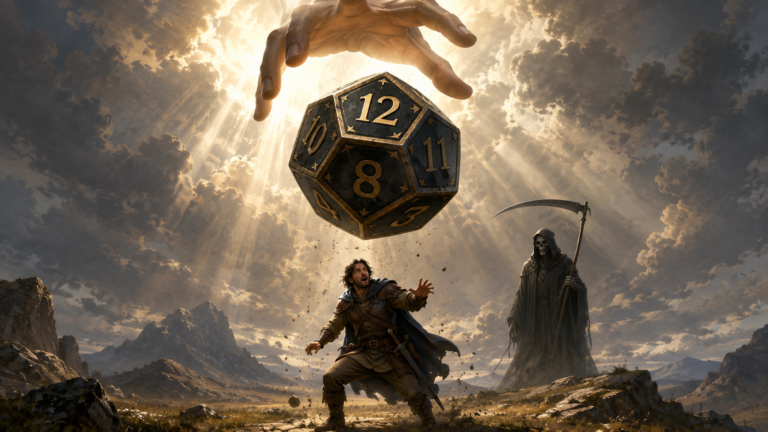
One of the strangest things about modern Dungeons & Dragons combat is that it can look extremely dangerous while remaining structurally safe.
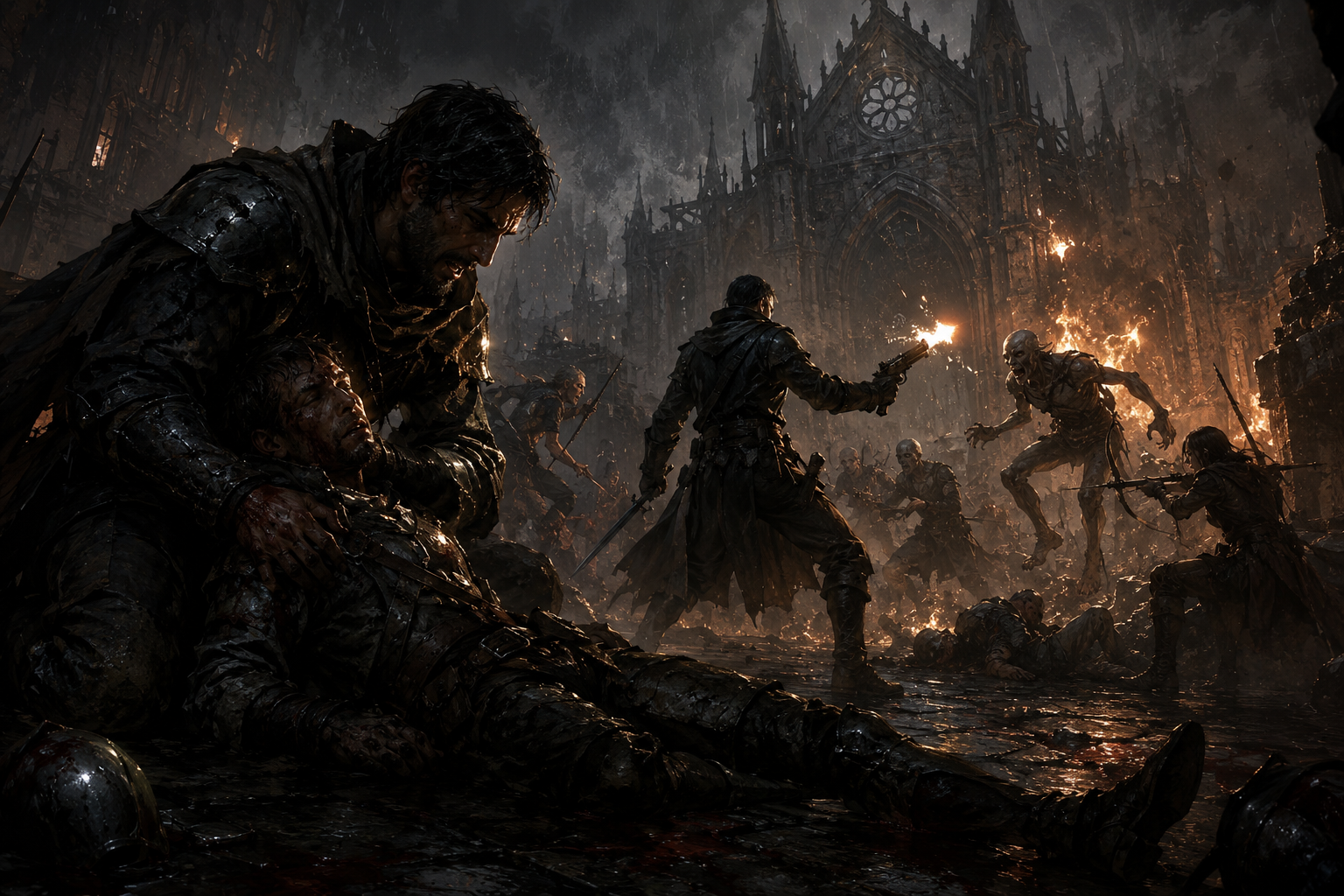
The battlefield may be covered in fire. The wizard may be unconscious. The fighter may have only six Hit Points remaining. The cleric may be out of healing spells. The Dungeon Master may be describing shattered shields, blood-soaked armor, and monsters closing in from every direction. Everyone at the table may feel as though the party is moments away from destruction.
Yet experienced players often understand that the game is quietly working to keep them alive.
The encounter was probably designed around their level. The monsters were probably selected according to an encounter-building formula. The party likely possesses healing magic, death-saving throws, short rests, long rests, resurrection spells, defensive class features, and several opportunities to recover from a disastrous mistake. Even when a character falls to zero Hit Points, that does not necessarily mean the character is dead. It often means the character has entered a temporary waiting room where an ally still has several rounds to intervene.
None of this is inherently bad. Players invest time, emotion, and imagination into their characters. A campaign can be ruined when a beloved protagonist dies because of one bad roll during an insignificant fight. The rules should not casually destroy characters whom players have spent months developing.
The problem is not that D&D tries to protect player characters. The problem is that combat frequently creates the appearance of danger without producing enough uncertainty, consequence, or lasting cost to justify that appearance.
The answer, however, is not to make every sword blow instantly fatal.
A game does not automatically become more exciting because monsters deal twice as much damage. Increasing damage may raise lethality, but lethality is only one part of the experience. If characters die suddenly before players can understand the danger, react intelligently, or make meaningful decisions, the result is not tension. It is randomness.
The design objective behind Jack’s Cinematic d12 (JCd12) is different:
Characters should usually accomplish remarkable things, but players should never be certain that every protagonist will reach the end of the movie.
That principle shapes the combat system used in Gloria Nocturna and all other game worlds that use the JCd12 universal tabletop role-playing game ruleset. Combat is intended to feel cinematic, fast, intense, and dangerous. Characters are capable action heroes, but they are not invulnerable superheroes. They can survive extraordinary situations through discipline, preparation, skill, teamwork, tactical competence, and occasionally Favor—but not because the rules guarantee that the protagonists must win.
The distinction matters.
Difficulty, Attrition, Lethality, and Tension
In designing combat in a TTRPG, there are four separate concepts to carefully consider: difficulty, attrition, lethality, and tension.
Difficulty
Difficulty measures how hard it is to accomplish the objective.
A battle can be difficult even when death is unlikely. The party may need to stop a ritual before midnight, prevent an enemy from escaping, protect civilians, hold a bridge, recover a document without destroying it, or capture a criminal alive. The characters may survive regardless, yet still fail the mission.
This is one reason combat should not always be reduced to eliminating every enemy on the battlefield. If victory simply means lowering every opponent to zero Hit Points, the encounter becomes a mathematical exercise. More interesting battles give the players something to accomplish under pressure.
A difficult encounter asks: Can the characters achieve what they came here to do?
It does not necessarily ask: Will they survive?
Attrition
Attrition measures how many resources the encounter consumes.
Hit Points, ammunition, spells, healing supplies, Favor, equipment, time, morale, and physical endurance may all be depleted during a dangerous mission. D&D commonly uses attrition as its primary method of producing challenge. One encounter consumes some Hit Points and spell slots. The next consumes more. Eventually, the party reaches the climactic battle with fewer resources available.
This approach can work, but it often produces an artificial rhythm. The party is not necessarily frightened by one enemy. They are frightened because the enemy is the fifth obstacle since their last long rest. Attrition can produce strategic pressure, but resource depletion is not automatically tension. Players may simply calculate whether they have enough healing, spell slots, and class abilities remaining to continue.
Attrition asks: How much will this encounter cost?
Lethality
Lethality measures how likely someone is to die.
A highly lethal system makes death mechanically probable. Weapons may inflict serious injuries, characters may have limited protection, recovery may be slow, and one disastrous decision may end a life.
Lethality creates real stakes, but too much lethality can damage a campaign. When death is too sudden or too arbitrary, players stop developing emotionally complex characters and begin treating them as disposable pieces. That may be appropriate for certain games. A military horror campaign about doomed soldiers can benefit from a high casualty rate. A long-running character drama usually cannot.
Lethality asks: How likely is it that someone will not survive?
Tension
Tension measures how uncertain and consequential the situation feels to the players.
Tension is the most important and most difficult quality to design. It does not come merely from damage numbers. It comes from meaningful decisions made without complete certainty. Players feel tension when they understand that something valuable may be lost, when their choices can change the outcome, and when the consequences will continue after the dice stop rolling.
A battle can be lethal without being tense. If a monster kills a character before anyone could reasonably respond, the table may feel shocked or irritated rather than tense. A battle can also be tense without being especially lethal. The characters may be trying to prevent a child from being taken, stop a fire from reaching a powder store, or keep an important witness alive. Everyone may survive while the campaign changes permanently because the party failed.
Tension asks: Do the players understand what may be lost, and do their decisions genuinely matter?
Why More Damage Does Not Solve the Problem
The simplest way to make combat appear more dangerous is to increase enemy damage. This often produces the wrong result.
When monsters hit harder, characters fall faster. The Dungeon Master may believe this creates urgency, but it can instead reduce meaningful decision-making. A character who loses most of his health before taking a turn has not been challenged tactically. He has simply been punished by initiative order and dice variance.
Instant death has the same problem.
If a trap, critical hit, or failed saving throw kills a healthy character without warning, the event may be memorable, but memorability is not the same as good design. Players should usually be able to recognize danger, make choices, take precautions, retreat, spend resources, or accept risk knowingly.
Death is most satisfying when the table can trace it backward through the story.
- The character died because the party entered the fortress without scouting.
- The character died because he held the doorway while his companions escaped.
- The character died because the healer had already spent the last of her supplies.
- The character died because the group ignored repeated warnings about the vampire.
- The character died because he chose to protect someone else.
Those deaths carry meaning because they emerge from accumulated choices.
A character who dies because a monster rolled maximum damage during an otherwise routine encounter has not necessarily participated in a meaningful tragedy. Sometimes the dice must be allowed to speak harshly, but the system should not confuse random brutality with dramatic consequence.
Cinematic Does Not Mean Safe
The term cinematic is often mistaken for invulnerability. In some games, “cinematic action” means that heroes leap through windows, survive explosions, defeat crowds of enemies, and recover in time for the next scene. The protagonists are protected because the genre assumes that they must continue.
Jack’s Cinematic d12 uses the word differently.
Cinematic play means that actions are presented with clarity, momentum, and consequence. Characters are encouraged to act boldly. Turns are structured around meaningful action rather than slow accounting. Combat should contain movement, interruption, environmental danger, desperate decisions, and visible stakes.
The characters can accomplish things that ordinary people could not. That does not mean they cannot die. An action hero is compelling partly because survival is not guaranteed. The audience may expect the protagonist to win, but the story must preserve enough uncertainty that victory still feels earned.
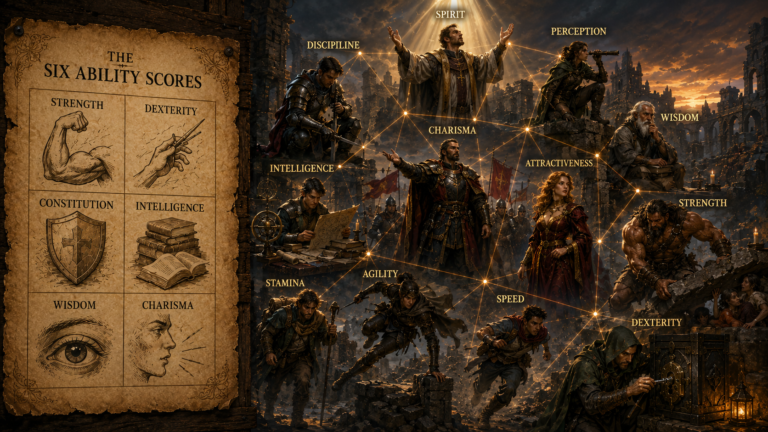
JCd12 characters are therefore competent. They possess Attributes, Attribute PRISMs, Skills, special abilities, Favor, and the opportunity to act decisively. Their competence allows them to survive situations that would destroy ordinary people. However, competence is not immunity.
- A skilled soldier may hold a position under fire, but he can still be wounded.
- A healer may save a dying companion, but she cannot be everywhere.
- A disciplined character may resist terror, pain, and corruption, but repeated exposure leaves marks.
- A group may defeat the monster and still lose the village.
The goal is not to make player characters weak. Weak characters do not create cinematic action. The goal is to make capable characters confront situations that remain dangerous despite their competence.
Tactical Discipline Should Matter More Than Encounter Balance
Many D&D encounters are built around the assumption that the party should be able to win if it uses its abilities reasonably well.
JCd12 takes a different approach.
Survival should depend upon discipline, teamwork, strategy, professionalism, and tactical competence. That means players should care about preparation.
- Did they investigate the location?
- Did they bring the proper equipment?
- Did they identify escape routes?
- Did they understand the enemy?
- Did they conserve ammunition?
- Did they protect the healer?
- Did they use cover?
- Did they retreat when the situation became impossible?
- Did they allow pride to override judgment?
The Game Master should not merely ask whether the enemy’s statistics are mathematically appropriate for the party. The better question is whether the situation makes sense within the world.
A vampire lord should not become weaker because the player characters arrived too early. A squad of trained soldiers should not forget how to use cover because the party is inexperienced. A collapsing building should not become harmless because the encounter is not considered “deadly.” The world should remain believable. The players survive by understanding it.
This does not mean the GM should surprise new characters with impossible opposition and then congratulate himself for running a realistic campaign. Information must exist. Warnings must matter. Retreat must be possible when the fiction permits it. Players should have opportunities to gather intelligence and improve their position.
An unfair world can still be run fairly.
Serious Wounds and Mental Trauma
Hit Points are useful because they are simple, but they can make injuries feel abstract. A character may lose most of his Hit Points, sleep for several hours, and return to full effectiveness. The fight looked terrible, but nothing meaningful remains.
Gloria Nocturna separates bodily harm from the broader consequences of suffering. Physical wounds and mental trauma can continue beyond the immediate action scene. Pain, fear, exhaustion, spiritual pressure, and witnessed horror should matter. This does not mean every injury must produce a table of broken bones and infected organs. Excessive medical detail can slow the game and discourage action. The purpose of serious wounds is not to simulate a hospital. The purpose is to preserve consequence.
- A character who survives a gunshot may require treatment.
- A character who witnesses an atrocity may carry mental trauma into later scenes.
- A soldier who continues fighting while wounded may succeed, but that choice should cost him something.
- A healer becomes more important when injuries cannot be erased automatically.
Recovery scenes become part of the campaign rather than a pause before the next dungeon. The result is that survival and victory are no longer identical. The heroes may win the battle and still spend the following week treating wounds, mourning the dead, repairing equipment, confronting fear, and deciding whether they are willing to return.
Favor as Limited Protection
Favor gives characters a small measure of cinematic providence. It may allow a failed roll to be rerolled or improved. It represents divine aid, destiny, exceptional resolve, or the moment in which fortune bends just enough to keep the story moving.
But Favor is limited. That limitation is essential.
If a character can endlessly reverse failure, then failure has no weight. If Favor is rare, spending it becomes a meaningful decision.
- Do I use Favor to make this attack succeed?
- Do I save it in case I must resist a deadly effect?
- Do I spend it to cross the collapsing bridge?
- Do I preserve it for the final confrontation?
Favor does not remove danger. It gives the player a limited ability to respond to danger. That is a better form of protection than hidden immunity because the player can see the resource, understand its value, and choose when to risk losing it. The character is not safe because the GM secretly intends to keep him alive. The character survives because the player made a deliberate choice to spend something precious.
Teamwork Should Prevent Death
Another problem with highly lethal games is that individual characters can die before the rest of the group can meaningfully intervene. JCd12 is intended to reward coordinated play.
A party should survive because its members behave like a functioning team.
- The soldier controls the dangerous approach.
- The healer reaches the wounded.
- The assassin removes the enemy threatening the rear.
- The Sapper changes the battlefield.
- The Minstrel protects morale.
- The Priest or Prophet resists spiritual corruption.
- The Driver keeps an escape route available.
Different classes do not merely inflict different forms of damage. They help the group endure different forms of danger. This is especially important in Gloria Nocturna because the characters belong to the Black Order and operate as Special Detachments. They are not strangers who happened to meet in a tavern. They are organized specialists whose survival depends upon one another.
A lethal system becomes frustrating when death feels isolated and unavoidable. It becomes dramatic when the entire table recognizes that someone is in danger and must decide what it is willing to risk to save them.
Failure Should Continue the Story
A dangerous combat system should not assume that every failed objective ends the campaign.
- The party may retreat.
- The villain may escape.
- The village may fall.
- The relic may be stolen.
- The characters may be captured.
- The wounded may require extraction.
- The enemy may gain territory.
- The Gloom (the Intangible force of Evil) may spread.
These outcomes are not substitutes for death. Death remains possible. They are additional consequences that make combat meaningful without requiring a body count after every encounter. This is one of the most important differences between tension and lethality.
When death is the only serious consequence, the GM must constantly threaten to kill characters in order to make scenes matter. When the world can change in other ways, the GM gains many more tools. Players can survive and still regret what happened.
- They can fail and return stronger.
- They can win and discover that the cost was greater than expected.
- They can save themselves while condemning others.
- They can accomplish the objective but carry wounds that shape the next chapter.
The Desired Feeling
Combat in tabletop role-playing games that are using Jack’s Cinematic d12 ruleset should make players feel powerful enough to act and vulnerable enough to think.
- They should not be afraid to attempt remarkable actions.
- They should be afraid to act carelessly.
- They should know that teamwork, preparation, and courage can overcome terrible odds.
- They should also know that no rule guarantees that every protagonist will survive until the end.
That is the balance I am pursuing. Not safety disguised as danger, or arbitrary death disguised as realism. Not heroes who cannot lose, nor victims who never had a chance. The ideal is a game in which characters are capable of extraordinary accomplishments, but every survival feels earned, every wound matters, and every player understands that the final scene is promised to no one.
Learn about the “RAD Roll” or “Roll Against Death or Disillusionment.”
About the Author