How Corporate Greed Turned Everyday Life Into a Toxic Nightmare—and What We Can Do About It
By John Alan Martinson
Wake Up and Look Around
Imagine waking up tomorrow morning and deciding that you’re finally going to take your health seriously. You’re going to stop eating fast food, eliminate junk food, cut back on sugar, eat more vegetables, and generally stop treating your body like a garbage disposal. Congratulations! You’re off to a good start. Unfortunately, that’s when you discover that avoiding the obvious garbage is only the beginning of your problems.
That nice, healthy breakfast you’re preparing might be cooked in a deteriorating nonstick frying pan. Your plastic spatula might contain recycled industrial chemicals. Your drinking water might contain contaminants you can’t pronounce. Your vegetables might carry pesticide residues. Your food containers might release microscopic plastic particles, particularly when heated. And you haven’t even finished breakfast.
Then you go into the bathroom. There’s your toothpaste, shampoo, conditioner, deodorant, lotion, cosmetics, and toilet paper. More manufactured products, more chemical formulations, more packaging, and more questions about substances you probably never realized you were exposing yourself to. You get dressed in polyester clothing, walk across synthetic carpeting, sit on furniture containing polyurethane foam, and spray some air freshener because apparently the natural smell of a human dwelling has become unacceptable. By the time you leave the house, you’ve encountered an astonishing collection of industrial chemicals, many of which your great-grandparents would never have recognized.
And this is supposed to be normal? I believe we’re approaching a point in human history when ordinary people are going to become increasingly furious about what corporations have done to our food, water, environment, and everyday consumer products. I’m not talking about some imaginary conspiracy in which every chemical is secretly designed to kill us. I’m talking about documented carcinogens, toxic contaminants, environmental pollution, endocrine-disrupting substances, corporate misconduct, and regulatory failures. Some of these problems are already established beyond reasonable dispute. Others are still being investigated. And the sheer number of possible exposures makes understanding the situation extraordinarily difficult for ordinary people.
But here’s the question that bothers me most: Why should we have to become amateur toxicologists just to live in our own homes?
The Food Industry: What Exactly Are We Eating?
Let’s start with the obvious suspect: the modern food industry. Walk into a supermarket and look around. Entire aisles are devoted to brightly colored products that have been engineered, formulated, preserved, packaged, advertised, and transported through an industrial system designed to maximize sales. Some of these products barely resemble the agricultural ingredients from which they originated.
Take Doritos and Takis. They’re recognizable examples of industrial snack foods built around refined ingredients, added fats, intense seasonings, and carefully developed textures. Their exact formulations vary by product and country, but the larger business model is unmistakable: manufacture something convenient, inexpensive to distribute, intensely flavorful, and attractive enough that people keep buying it. Now, I’m not suggesting that eating a bag of Doritos automatically gives you cancer. That’s not how cancer works. But if your diet consists primarily of industrial snack foods, sugary drinks, packaged desserts, and highly processed convenience meals, the scientific evidence gives you plenty of reasons to reconsider.

A major 2024 review published in The BMJ examined 45 pooled analyses involving nearly 9.9 million participants. Greater consumption of ultra-processed foods was associated with numerous adverse health outcomes, including cardiovascular disease, type 2 diabetes, obesity, and mortality. The researchers identified associations across 32 health outcomes. Not every association was equally convincing, and observational studies cannot establish that every ingredient causes the reported diseases. Nevertheless, the overall findings were substantial enough to support public-health measures aimed at reducing dependence on ultra-processed foods. In other words, this isn’t just somebody on the internet complaining that modern food doesn’t taste like Grandma’s cooking. There are serious scientific reasons to question what we’re eating.
Consider artificial food dyes. In January 2025, the U.S. Food and Drug Administration revoked authorization for Red No. 3 in foods and ingested drugs. Food manufacturers were given until January 2027 to reformulate affected products. Why? Because studies demonstrated that high doses caused cancer in male laboratory rats. The FDA maintains that the mechanism responsible for those tumors is specific to rats and does not occur in humans, which is an important scientific distinction. But here’s what I find remarkable: a synthetic color additive with a decades-long history of cancer concerns remained authorized in food until the twenty-first century. And what was its essential purpose? To make food red. We’re not talking about an ingredient necessary to prevent starvation or preserve human civilization. We’re talking about making candy, frosting, and other products look prettier. Apparently, the natural colors of food weren’t sufficiently entertaining.
Then there’s brominated vegetable oil, which was used in certain citrus-flavored beverages to keep flavoring ingredients from separating. In July 2024, the FDA revoked its authorization after research identified potential adverse health effects. Think about the absurdity. We chemically modify vegetable oil with bromine, put it into beverages for a technical manufacturing purpose, distribute those beverages commercially, and eventually determine that the ingredient should no longer be permitted. How many people drinking those beverages had any idea what brominated vegetable oil was? Probably not many. And why should they have needed to? The manufacturer knew what it was. The regulators knew what it was. The consumer just wanted something to drink.
The same industrial mentality extends into ice cream, cheese, baked goods, coffee beverages, and countless other products. People share videos of ice cream that seems reluctant to melt or processed cheese that behaves strangely when heated. Some of these demonstrations are misleading because stabilizers, emulsifiers, moisture content, and cooking conditions can dramatically affect how foods behave. But the legitimate question remains: how much food engineering is necessary, and whose interests does it serve? Ice cream can contain stabilizers that influence texture and melting. Processed cheese can contain emulsifying salts that change how proteins and fats behave when heated. Those ingredients are not automatically poisonous, but they illustrate how far industrial food manufacturing has moved beyond simply preparing recognizable ingredients.
And consider the controversy surrounding acrylamide, a chemical formed during certain high-temperature cooking processes, including coffee roasting and the frying of potatoes. It causes cancer in laboratory animals at sufficiently high exposures, although typical dietary exposure has not been conclusively established as a cause of human cancer. The point isn’t that Starbucks is secretly selling cups of cancer. It’s that the chemistry of our food deserves serious scrutiny, including when substances arise during processing rather than being deliberately added. We need to stop assuming that a product is harmless simply because it is familiar, popular, legal, and sold by a multibillion-dollar corporation.
Your Kitchen: A Chemistry Laboratory Disguised as a Place to Make Dinner
Suppose you’ve decided to avoid processed food entirely. You’re buying fresh vegetables, preparing meals from scratch, and making a genuine effort to eat healthier. Wonderful. Now let’s investigate the kitchen equipment. Start with nonstick cookware. For decades, certain nonstick coatings were manufactured using chemicals from the PFAS family, including PFOA, which became notorious because of environmental contamination and serious health concerns. PFAS are commonly called forever chemicals because many persist in the environment for extraordinarily long periods. Certain PFAS have been associated with kidney and testicular cancers, immune-system effects, cholesterol changes, and other health problems.
The history of these chemicals contains one of the most disturbing examples of corporate misconduct in modern industrial America. In 2005, the Environmental Protection Agency announced a settlement with DuPont involving $10.25 million in civil penalties for violations that included failures to report substantial risk information concerning PFOA. Some of the information involved dated back to 1981. Let that sink in. This wasn’t a situation in which everyone was completely ignorant until some brilliant scientist suddenly discovered a problem. Federal regulators found that significant information had not been properly disclosed.
Later, the independent C8 Science Panel identified probable links between PFOA exposure in affected communities and six diseases, including kidney cancer and testicular cancer. In 2017, DuPont and Chemours agreed to settle approximately 3,550 personal-injury claims for $670.7 million, without admitting liability. This is the sort of history that should make people furious. We’re talking about industrial chemicals, environmental contamination, serious diseases, and information that should have been available to regulators. Ordinary families were left dealing with the consequences, and the problem with industrial pollution is that you cannot simply decide not to purchase it. If a company contaminates your community’s water supply, you don’t get to decline the exposure at the supermarket checkout.
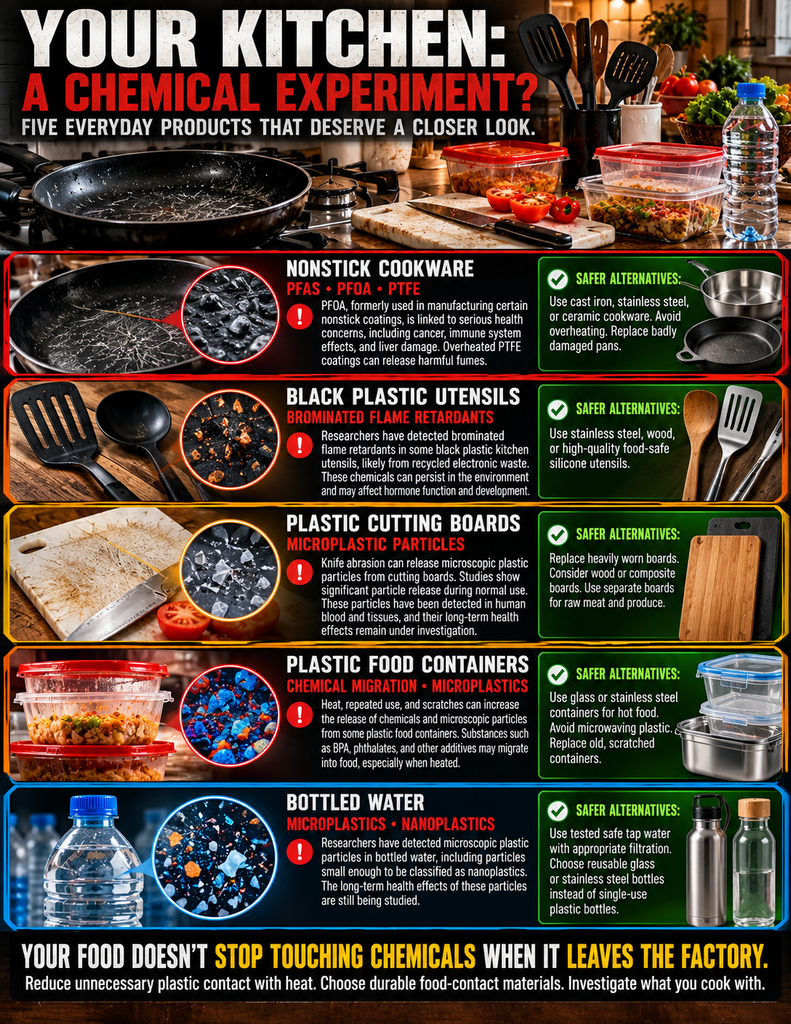
Now let’s talk about black plastic kitchen utensils. Researchers have found brominated flame retardants in some black plastic household products, including cooking utensils. One suspected source is recycled plastic originating from electronic equipment, where flame retardants are used for entirely different purposes. Think about that for a moment. Plastic associated with electronic equipment can enter recycling streams and potentially end up in objects intended for food contact. Your soup spoon should not require an investigation into the disposal history of a television.
Research published in 2024 brought considerable attention to this issue, although a subsequent mathematical correction reduced one widely publicized exposure estimate. The correction matters, but it doesn’t erase the underlying finding that inappropriate industrial chemicals were detected in some consumer products. That’s the real problem: inadequate control over what materials enter the products people use around food.
Then we have plastic cutting boards, plastic storage containers, disposable bottles, and plastic packaging. Researchers have documented microplastic release from various plastic products, including cutting boards and certain food containers. Heating, abrasion, and repeated use can increase particle release under particular conditions. Scientists have also detected microplastics in human blood and various tissues. Research into their long-term health consequences is ongoing, and detection alone doesn’t establish that they caused a particular disease.
But I find the larger situation extraordinary. We manufacture enormous quantities of plastic, surround our food with it, package our water in it, and then act surprised when scientists discover microscopic plastic particles inside human bodies. How did we reach a point where plastic contamination became an ordinary subject of nutritional research? The kitchen should be where we prepare nourishment, not where we unknowingly introduce unnecessary industrial contaminants into it.
The Bathroom: Apparently, We Need Chemicals to Wash Off the Chemicals
Now let’s move into the bathroom. Here we find an impressive collection of products that people purchase specifically to keep themselves clean, attractive, and healthy. Shampoo, conditioner, body wash, toothpaste, deodorant, cosmetics, moisturizers, perfume, shaving products, and toilet paper. Every morning, millions of people rub, spray, brush, and massage manufactured formulations onto their bodies without having the slightest idea what many of the ingredients actually do. And why would they? Most people have jobs, families, responsibilities, and lives to live. They don’t have three hours every morning to investigate the toxicological history of their deodorant.
Yet some personal-care products have contained substances associated with endocrine disruption, allergic reactions, reproductive concerns, or environmental persistence. Certain cosmetics have been found to contain PFAS, sometimes associated with water resistance, durability, or other performance characteristics. Some PFAS can persist in the environment and accumulate in living organisms. The risks depend on the particular chemical and the exposure involved, but the broader contamination problem is well established.
And then there’s toilet paper. Yes, toilet paper. A 2023 study in Environmental Science & Technology Letters identified PFAS in toilet paper and investigated its contribution to wastewater contamination. The researchers estimated that toilet paper could contribute approximately 6.4 to 80 micrograms per person annually of a particular PFAS compound to wastewater systems. That study did not establish that wiping yourself with toilet paper causes cancer. Its finding concerned environmental contamination. But it revealed yet another pathway through which persistent industrial chemicals can circulate. At what point do we get to purchase an ordinary household product without wondering whether it contributes to the planet’s chemical contamination? Apparently, even toilet paper isn’t exempt from investigation.
Some fragrance formulations use chemicals such as phthalates, a family containing substances with very different properties and toxicological profiles. Certain phthalates have been associated with reproductive and developmental concerns, leading to restrictions in particular applications. Other cosmetic ingredients have raised questions involving hormonal activity, sensitization, or contamination. Not every lotion, shampoo, or cosmetic product contains dangerous concentrations of these substances. But consumers often face incomplete ingredient disclosure, complicated formulations, and marketing terminology that tells them very little about actual exposure.
And then there’s the word natural. Apparently, printing a leaf on a bottle is supposed to settle the matter. A product can contain natural ingredients and still be irritating, contaminated, or unsuitable for certain people. Likewise, a synthetic ingredient is not automatically dangerous. What matters is what the substance actually does, how much of it is present, and how people are exposed. The industry should be required to provide meaningful answers to those questions.
Water introduces another set of concerns. Depending on the location, drinking water can contain industrial contaminants, agricultural runoff, naturally occurring arsenic, lead from plumbing, PFAS, or other substances. Fluoride has also become a subject of renewed scientific debate. A 2024 report from the U.S. National Toxicology Program concluded, with moderate confidence, that higher fluoride exposure, such as drinking water containing more than 1.5 milligrams per liter, is associated with lower IQ in children. That finding does not establish the same effect at the lower concentrations commonly used in American community water fluoridation, but it demonstrates why exposure levels matter.
Taking a hot shower doesn’t magically turn every dissolved substance in the water into something you inhale. Fluoride does not simply evaporate with steam under normal shower conditions. But hot showers can create aerosols, and some volatile water contaminants can enter indoor air. The actual risks depend on what is present in the water. The lesson is simple: find out what’s in your water rather than assuming that clear water is necessarily clean water.
The Bedroom: Eight Hours Surrounded by Industrial Materials
Now consider the room where you spend roughly a third of your life. Your mattress may contain polyurethane foam. Your pillows might be filled with synthetic fibers. Your blankets, bedsheets, curtains, and clothing may contain polyester or nylon. Your furniture may include adhesives, coatings, synthetic upholstery, and chemical treatments. Synthetic textiles shed microscopic fibers during washing and use, and researchers have documented synthetic microfibers in indoor environments and household dust.
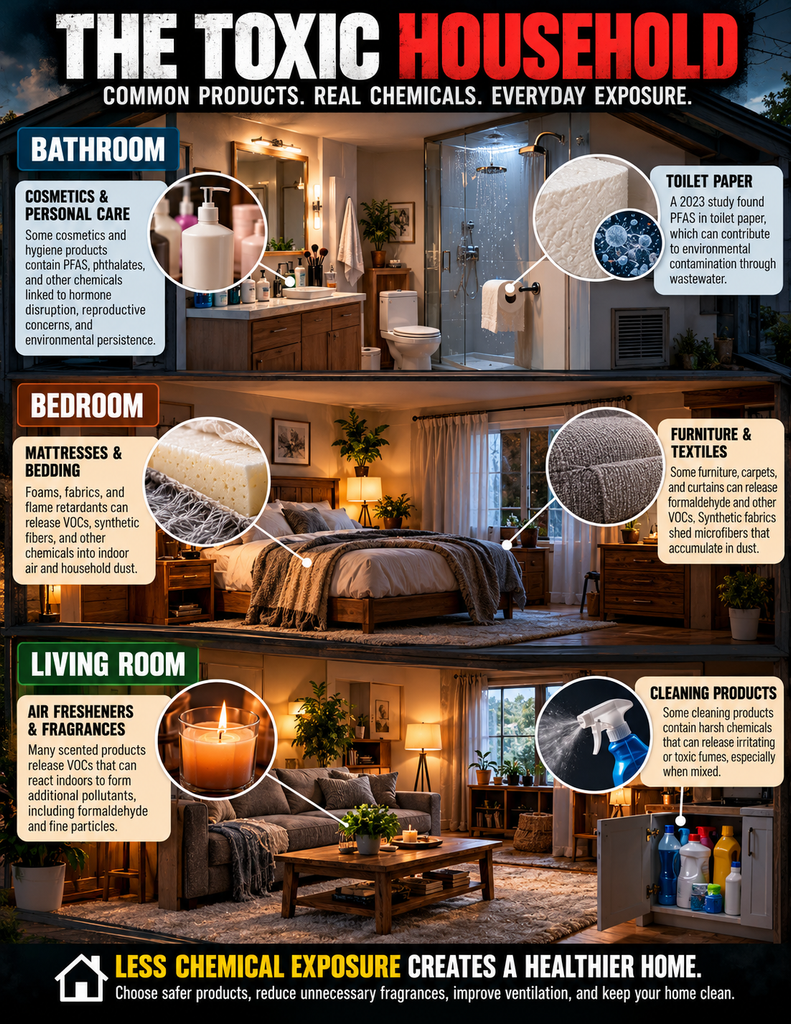
Some furniture and textiles have historically contained flame retardants or stain-resistant treatments that raise legitimate health or environmental concerns. Certain manufactured wood products can also release formaldehyde, an established human carcinogen, particularly when emissions are elevated. Formaldehyde is especially important because it demonstrates that this conversation isn’t limited to speculative fears about unfamiliar substances. It is a recognized carcinogenic hazard, and controlling emissions from building materials is a genuine public-health concern.
Your bedroom should be a place of rest. Instead, depending on the products and materials present, it can become another source of chemical exposure. I’m not suggesting that every polyester shirt is poisoning its owner or that sleeping on a foam mattress automatically causes cancer. I’m saying that we’ve filled our homes with manufactured materials while most consumers know almost nothing about their composition, emissions, or long-term environmental effects.
And that ignorance is profitable. Manufacturers understand their products far better than the people buying them. The burden of investigating potential problems too often falls on independent researchers, journalists, regulators, and consumers long after the products have entered millions of homes.
The Air Inside Your Home: What Is That Smell?
People worry about pollution outdoors. Factories, highways, industrial facilities, agricultural spraying, and vehicle exhaust are obvious concerns. But what about the air inside your house? Consider scented candles, incense, aerosol sprays, air fresheners, cleaning products, furniture emissions, gas stoves, and fragrances. Certain household products release volatile organic compounds, or VOCs. Some fragrance chemicals can react with ozone indoors and contribute to the formation of additional pollutants, including formaldehyde and fine particles. Combustion from candles, cooking, and gas appliances can also contribute to indoor particulate pollution or other contaminants.
The Environmental Protection Agency has acknowledged something particularly interesting about products labeled low VOC or no VOC. Those labels do not necessarily mean that a product is free of toxic volatile chemicals. Some substances are exempt from particular VOC regulatory definitions because those rules focus on outdoor ozone formation rather than comprehensively evaluating indoor toxicity. Think about the absurdity. A consumer sees a reassuring label, assumes the product is healthier, and may have no idea that the terminology addresses only a particular regulatory measurement. We’ve created a marketplace where understanding the meaning of a product label sometimes requires understanding the history of environmental regulation. Wonderful. Exactly what everybody wanted when they went shopping for cleaning supplies.
Modern consumers have been conditioned to believe that everything should smell like something else. Your bathroom should smell like tropical fruit. Your living room should smell like a mountain forest. Your laundry should smell like an imaginary spring meadow. Your car should smell like a pine tree manufactured in a chemical factory. Apparently, the natural scent of clean fabric and fresh air is no longer sufficiently impressive.
Some scented products produce relatively modest exposures under ordinary conditions. Others can contribute meaningfully to indoor pollution, especially in poorly ventilated spaces. The issue isn’t that every pleasant smell is dangerous. It’s that manufacturers have normalized adding unnecessary fragrance chemicals to an astonishing range of everyday products, and the consumer is left to figure out which ones matter. Meanwhile, genuinely dangerous indoor hazards such as radon, tobacco smoke, carbon monoxide, and significant combustion pollution deserve serious attention. A healthy home should prioritize clean air, not merely air that smells expensive.
Pesticides, Agriculture, and the Corporate Control of Food
Everything we’ve discussed so far leads back to agriculture. Before food reaches your kitchen, it may have been grown using herbicides, insecticides, fungicides, synthetic fertilizers, and other agricultural inputs. Modern industrial agriculture has increased productivity enormously, but it has also created environmental and occupational health problems that cannot be dismissed. Agricultural workers can experience substantial pesticide exposure. Certain pesticides have been associated with neurological effects, reproductive problems, acute poisoning, or increased risks of particular diseases. Pesticide drift can affect surrounding communities. Agricultural runoff can contaminate waterways. Some substances persist in soil or accumulate in ecosystems.
And then there’s glyphosate, one of the world’s most widely discussed herbicides. In 2015, the International Agency for Research on Cancer classified glyphosate as probably carcinogenic to humans. Other regulatory authorities, including the U.S. Environmental Protection Agency, have reached different conclusions about cancer risk under expected exposure conditions. That disagreement deserves examination, not slogans. But even setting aside the glyphosate controversy, the documented history of pesticide poisoning and environmental contamination provides ample reason to demand stronger oversight.
Now consider the increasingly concentrated agricultural seed industry. Major multinational corporations control significant portions of commercial seed markets, agricultural chemicals, and patented crop technologies. Seed patents and licensing agreements can restrict how farmers reproduce and reuse certain commercial varieties. Farmers may become dependent on companies that supply both the seeds and associated agricultural products. This is not the same thing as saying every genetically modified crop is poisonous. Genetic engineering is a technology, and its consequences depend on the particular trait, crop, and agricultural system. Nor is seedless fruit evidence that corporations have genetically sterilized the world’s food. Many seedless varieties are produced through conventional breeding or naturally occurring reproductive characteristics.
But corporate control over agricultural genetics is a legitimate political and economic concern. Who gets to decide which seeds farmers can plant? Who controls access to important agricultural technologies? What happens when a small number of enormous corporations gain disproportionate influence over the foundations of food production? And what happens when farmers become economically dependent on proprietary products they cannot freely reproduce? These questions are not merely about agriculture. They’re about sovereignty. A civilization that cannot maintain meaningful control over its food supply is placing an extraordinary amount of power in private hands.
There’s another injustice here. People with substantial disposable income can often afford specialty products, independent water testing, high-quality cookware, less processed food, and more carefully sourced agricultural products. Poor families frequently have fewer options. They buy what’s affordable, available, and convenient. Sometimes they live in communities disproportionately affected by industrial pollution or contaminated water. Then society has the audacity to lecture them about making better choices. What choices? If someone works exhausting hours, has limited transportation, and struggles to afford groceries, telling them to purchase expensive organic produce and replace their entire kitchen is not a serious public-health strategy. It’s an insult.
The goal should be to make safer products and nutritious food broadly accessible, not to create a two-tier society in which wealthy people purchase cleaner environments while everyone else accepts whatever the industrial system provides.
Cancer, Toxicity, and the Chemical Burden of Modern Life
Now we arrive at the most serious question. How much of this industrial chemical environment is contributing to cancer and other chronic diseases? Cancer is not one disease with one cause. It encompasses many diseases involving abnormal cellular growth, and its causes include inherited genetic factors, aging, infections, radiation, environmental exposures, and other biological processes.
Some exposures are conclusively carcinogenic. Tobacco smoke, asbestos, benzene, arsenic, certain forms of ionizing radiation, and ultraviolet radiation are established examples. Processed meat is classified by the International Agency for Research on Cancer as carcinogenic to humans, based on sufficient evidence concerning colorectal cancer. Red meat is classified as probably carcinogenic. Other substances are associated with endocrine disruption, neurological damage, reproductive harm, or immune-system effects rather than conclusively established cancer risks. And then there are chemicals whose long-term effects remain incompletely understood.
This is where the modern industrial environment becomes particularly difficult to evaluate. People aren’t exposed to one chemical at a time under perfectly controlled laboratory conditions. They’re exposed to mixtures through food, water, air, dust, clothing, consumer products, and occupational environments. Scientists can study individual substances, but understanding the combined effects of multiple exposures over decades is much more complicated. Researchers are investigating whether certain chemical mixtures produce additive or interacting effects, particularly when substances affect similar biological pathways. And that’s before considering differences in age, genetics, pregnancy, health, occupation, and individual susceptibility.
We also need to distinguish the detection of a substance from evidence of harm. Finding microplastics in human tissue, for example, establishes exposure. It does not automatically establish that those particles caused cancer. But widespread exposure is itself a legitimate reason to investigate. We should not have to wait until contamination has affected millions of people before asking whether the substances involved belong in consumer products. The history of asbestos, lead, tobacco, and certain industrial chemicals should have taught us that lesson. Apparently, we require additional demonstrations.
What You Can Actually Do: Take Back Your Household
By now, you might be looking around your home and wondering whether you should throw everything into the street. Please don’t. That would be expensive, wasteful, and potentially dangerous if you decide to start dismantling appliances in a fit of chemical outrage. The goal isn’t to become terrified of everything you own. The goal is to become informed enough to recognize unnecessary exposures and eliminate the ones you reasonably can. And some changes are surprisingly straightforward.
Start with your kitchen. Stop unnecessarily heating food in plastic containers. Glass, stainless steel, and appropriate ceramic cookware can reduce reliance on plastic for hot-food contact. Examine your nonstick cookware. If coatings are badly damaged, peeling, or deteriorating, replace the affected items. Avoid overheating nonstick pans, particularly when empty. Consider replacing questionable black plastic utensils with stainless steel or wooden alternatives intended for food contact. Use durable cutting boards, clean them properly, and replace heavily damaged ones.
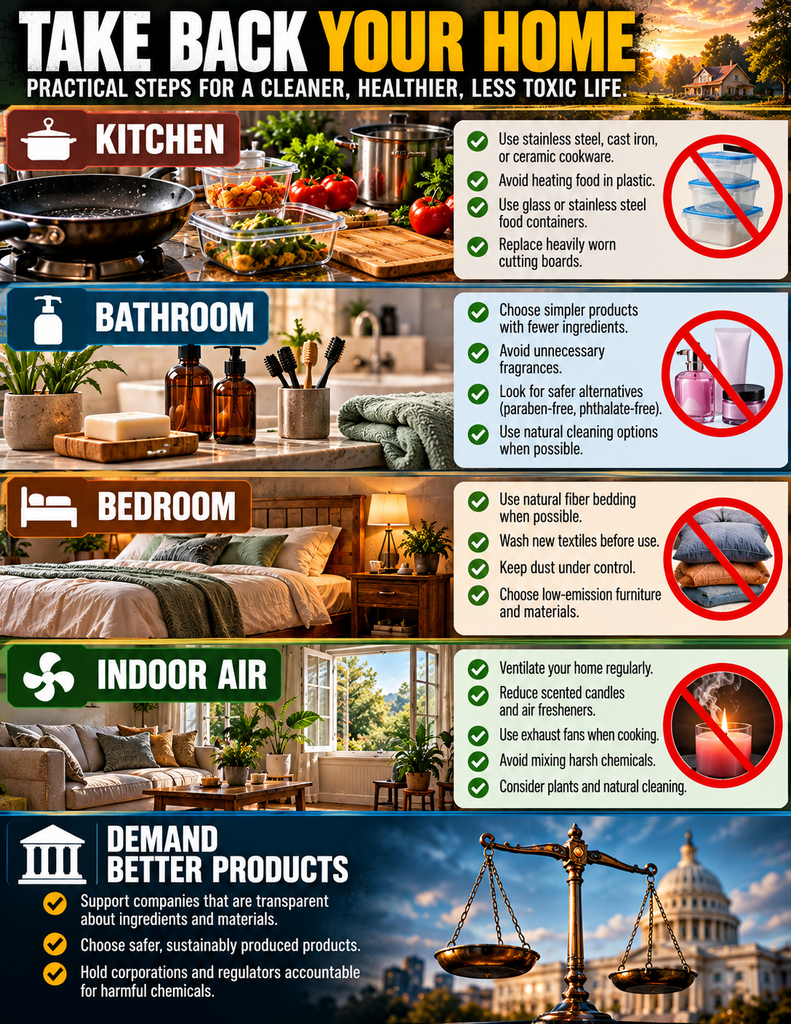
Reduce your dependence on bottled water where a safe, reliable drinking-water alternative exists. If your water supply is questionable, investigate local water-quality reports and select filtration based on the actual contaminants present. Not every filter removes every contaminant. A filter designed to improve taste is not necessarily capable of removing arsenic, lead, PFAS, or microorganisms. Buy equipment that solves a real problem rather than trusting expensive marketing. And whenever possible, prepare more meals from basic ingredients instead of relying on highly processed packaged foods. You don’t need to become a professional chef. You need a few dependable recipes and enough knowledge to recognize what you’re eating.
Next, take a serious look at the products you use in your bathroom. Do you really need six different scented products to accomplish what ordinary soap and water can accomplish? Consider reducing unnecessary fragrances, particularly if someone in the household experiences irritation or respiratory symptoms. Look for meaningful ingredient disclosure. Pay attention to product recalls and credible reports of contamination. If you’re concerned about cosmetics, investigate the specific product and manufacturer rather than assuming that everything marketed as natural is safe. Remember that a substance being present in a product doesn’t automatically mean it enters your bloodstream in dangerous quantities. Skin absorption varies enormously between chemicals. The objective is to reduce meaningful exposure, not to panic over every unfamiliar ingredient.
Then reconsider your bedroom. Wash new textiles before use, keep household dust under control, and improve ventilation where practical. When replacing bedding or clothing, consider natural fibers if you want to reduce reliance on synthetic textiles. But don’t bankrupt yourself replacing perfectly functional possessions because someone on social media declared polyester an immediate death sentence. Prioritize known problems, damaged materials, and products with credible evidence of concerning emissions or contamination. If you purchase new furniture, investigate emissions certifications and the materials used.
And stop unnecessarily polluting your own air. Reduce aerosol fragrances and heavily scented products. Ventilate during cooking and cleaning. Use kitchen exhaust fans that vent outdoors where available. Never mix cleaning chemicals indiscriminately. In particular, mixing bleach with acids or ammonia-containing products can release dangerous gases. Address established hazards such as carbon monoxide and radon where relevant. If you burn candles or incense frequently, consider reducing their use, especially in small or poorly ventilated rooms. Perhaps we can collectively rediscover the revolutionary concept of opening a window when outdoor air quality permits.
Finally, become a more difficult consumer. Read labels. Investigate manufacturers. Learn which substances have established health concerns. Don’t confuse expensive packaging with safety, or attractive advertising with scientific evidence. Pay attention when regulators recall products, restrict chemicals, or publish contamination findings. Support manufacturers that provide meaningful transparency and demonstrate responsible practices. And when you discover a product with a documented safety problem, tell other people. A consumer who understands the issue and shares reliable information can influence purchasing decisions far beyond their own household.
But remember something important: you should not have to spend your entire life doing this. The fact that ordinary people must devote so much effort to navigating industrial exposure is part of the problem we’re trying to solve.
The Next Revolution: Make Corporations Answer
I believe the next great revolt of the common people may be directed against the corporations that control our food, agricultural inputs, and everyday consumer products. And frankly, I think such a revolt is overdue. I’m not talking about burning down supermarkets, attacking employees, or destroying factories. I’m talking about a serious, organized, politically consequential movement in which ordinary people refuse to tolerate preventable contamination, deliberate concealment, and the prioritization of corporate profits over public health.
We need independent testing, meaningful chemical disclosure, stronger restrictions on demonstrably hazardous substances, accountability for executives who knowingly conceal serious risks, and compensation for people harmed by corporate misconduct. We need governments willing to confront enormous corporations rather than behave as though economic growth excuses every consequence.
I’m a supporter of state capitalism under a benevolent sovereign. I believe private enterprise can create wealth, encourage innovation, and contribute enormously to civilization. But I also believe that businesses must remain subordinate to the welfare of the people. A corporation is not a sovereign nation. It is not a moral authority. It does not possess some divine right to manufacture whatever it wants, conceal whatever it finds inconvenient, and leave the public to pay for the consequences. And a government that cannot protect its citizens from preventable industrial harm is failing one of its most fundamental responsibilities.
Capitalism has existed for only a tiny fraction of human history. Its modern industrial form is younger still. Yet people speak about it as though a few centuries of economic growth have conclusively established its superiority for all eternity. That’s a remarkably short-sighted way to evaluate civilization. Human beings live brief lives. We become accustomed to institutions that have existed longer than we have, and we mistake familiarity for permanence.
But imagine evaluating our economic arrangements from the perspective of someone who could live for ten thousand years, a million years, or longer. Imagine examining them from the perspective of God. Would a system that produced extraordinary wealth while contaminating water, spreading persistent chemicals, degrading ecosystems, and exposing people to avoidable hazards really deserve to be called successful? I don’t think so. A truly great civilization should be capable of sustaining human life and prosperity for thousands upon thousands of years. Its economic institutions should serve that purpose, not undermine it.
And that brings us back to the ordinary household. Look around your kitchen. Look at your bathroom. Look at your food, clothing, furniture, and drinking water. Ask questions, investigate, make changes where you can, and demand answers where you cannot. Stop assuming that because something is legal, familiar, and sold in every supermarket, somebody must have established that it is harmless under every condition of use. History has repeatedly demonstrated otherwise.
The next revolution doesn’t have to begin in the streets. It can begin with millions of people learning what’s in the products they use, refusing to accept unnecessary risks, supporting better alternatives, and demanding that governments hold manufacturers accountable. Because the fundamental question isn’t whether humanity possesses the technology to manufacture safer products. It’s whether we possess the moral courage to insist upon them.
Our food, our water, our homes, and our bodies should not be treated as expendable resources in somebody else’s business model. And if the corporations won’t recognize that responsibility voluntarily, then the people—and the governments that exist to protect them—must make them recognize it.
Research and Further Reading
For readers interested in examining the scientific and regulatory evidence discussed in this article, relevant sources include the 2024 review of ultra-processed foods in The BMJ, the FDA’s information on Red No. 3 and brominated vegetable oil, and the 2023 research on PFAS in toilet paper published in Environmental Science & Technology Letters.
Additional information is available from the Environmental Protection Agency regarding volatile organic compounds in household products and PFAS contamination, the National Toxicology Program’s assessment of fluoride exposure and neurodevelopment, and the International Agency for Research on Cancer’s Monographs on the Identification of Carcinogenic Hazards to Humans.
About the Author