All player character tests in the Gloria Nocturna ruleset are based off of the player character’s appropriate 💪Attribute, appropriate 🌈Attribute PRISM for the test, or the appropriate Attribute PRISM & 🛠️Skill. If the common person of average intelligence is able to perform a task without much study or practice (riding a bicycle, painting a room, lifting an object, etc.) then the GM will have the player use the character’s most appropriate Attribute PRISM. If a test only involves a singular attribute then the character only uses that Attribute. If the task would normally require that a person must have had at least several hours of instruction or practice to correctly perform the action, the GM will call for the player character to use an appropriate Skill in conjunction with its corresponding Attribute PRISM.
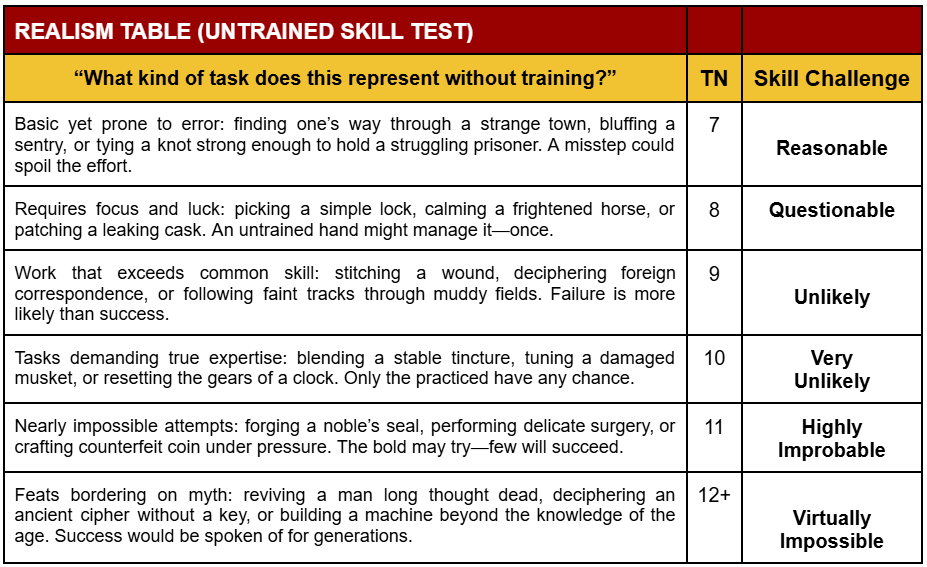
If a character has a Skill Rating of 0 in any particular skill, it does not mean he cannot perform the test, it just means he’s like the average person who has no training in the skill. He can perform the test with an amount of dice equal to the Attribute PRISM that is assigned to that Skill with a Realism Target Number determined by the GM, and the character may not use Action Star Dice.
UNSKILLED CHARACTER SKILL TEST
1d12 + Attribute PRISM
against Realism Target Number 7 – 12+
Characters have a variety of skills that they can learn and improve throughout their adventures. Each Skill is associated with an Attribute PRISM, which determines a character’s natural aptitude for that Skill. A character’s proficiency level in a Skill can range from 0 to +4, with 0 indicating no knowledge or capability and +4 representing the highest level of mastery that most entities can achieve. As characters increase their skill ratings by investing Experience Points, they become more capable and efficient, allowing them to overcome greater challenges and accomplish feats that were once impossible.
While the Attribute PRISM quantifies the mental, physical and spiritual characteristics that are typically involved in doing an action, possessing actual knowledge of how to properly perform the action is a considerable bonus. The Gloria Nocturna ruleset that is used for Gloria Nocturna primarily relies on the following formula to determine the success or failure of an action:
SKILL TEST
1d12 + Attribute PRISM + Skill
against a Realism Target Number usually between 7 – 12+
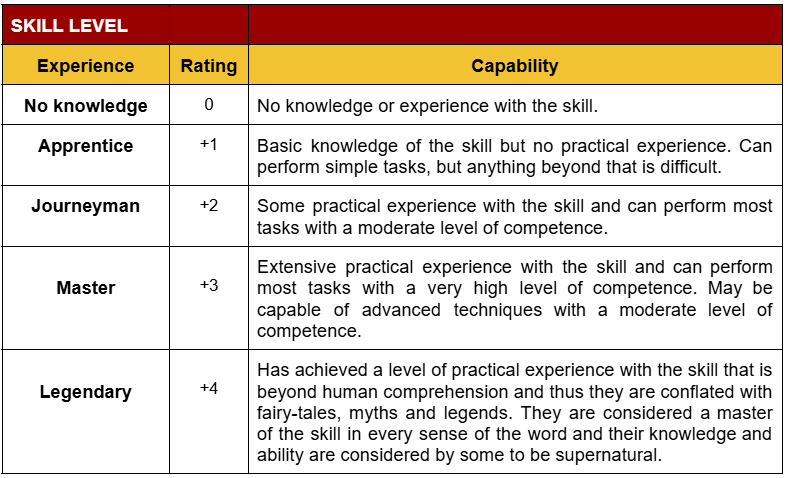
Attributes range from -3 to +4 for most humanoids. Skills range from 0 to +4. Skills are raised by spending Experience Points that are earned by accomplishing things in the game world.
Target Numbers
Player characters aim toward a Realism Target Number—often simply called the Target Number (TN)—whenever they roll dice. The TN is the score each die must meet or exceed to count as a success. Most beginning characters will be rolling 1d12 + an Attribute Prism modifier of +1 or +2 and a Skill modifier of +1 or +2, which makes a TN of 8 (Questionable) the baseline for a challenge that “demands focus, skill, or luck” and makes failure plausible. At this level, the character has to focus, but success is still likely if they are competent. This is the sort of difficulty you’d expect in cinematic action — it’s not about whether you can ride a horse, but whether you can do it under gunfire, while it’s pouring rain, with your nerves on edge.
The Realism Table gives guidance on what different TNs mean. At the lowest end, TN 1 is “Automatic.” If the character wants to open a door that isn’t locked, they don’t roll dice at all. TN 2–4 (“Practically Certain”) covers actions that only fail through distraction or stress. Riding a horse for a mile on a calm day might be TN 4, but the GM usually won’t even ask for a roll unless it happens during a chase scene or with bullets whizzing overhead.
TN 5–6 represent things that are “Very Likely” or simply “Likely” for capable characters. A trained boxer landing a clean punch on an unskilled opponent might be TN 5. Scaling a fence in broad daylight while no one is chasing you could be TN 6.
At TN 7, the action has moved into “Reasonable challenge” territory, where the outcome is challenging but certainly easily within reach of a skilled character. TN 8 (“Questionable”) is where tension grows — the action demands skill, luck, or both. Picking a lock in calm conditions might be TN 6, but doing it while guards patrol nearby and sweat drips into your eyes is TN 8. TN 9 (“Unlikely”) represents feats that even trained professionals may struggle with, such as picking the lock under fire.
At TN 10–11, success begins to feel extraordinary: dodging bullets while sprinting across an open street, or convincing a hostile mob to stand down with nothing but words. Finally, TN 12+ (“Virtually Impossible”) is reserved for legendary moments: firing a revolver to hit the fuse of a bundle of dynamite across the canyon, or leaping from the roof of one carriage to another while carrying another person.
By using the Realism Target Number, the system keeps rolls fast and easy to adjudicate. Players quickly understand the scale: TN 4–6 is routine in stressful play, TN 7–9 is serious but achievable, and TN 10–11 are difficult, and TN 12+ is the realm of legends. This approach also ensures that the dice stay meaningful: the TN tells you not just what to roll, but how incredible your character will look if they succeed.
🎬Example — Determining Realism
Consider a tense moment inside a half-collapsed stone chapel. Rain leaks through the broken roof, dripping steadily onto warped pews and scattered debris. A hostile figure moves between pillars, partially obscured by shadow and hanging cloth banners. He is armed and aware he is being hunted. Marcus, an infantryman in the Black Order, advances carefully. He has Reflexes PRISM +1 and Firearms +2. When the enemy suddenly bolts from cover, Marcus snaps his pistol up and considers the shot. The GM pauses to assess realism. The target is moving, the light is poor, and the chapel is cluttered with obstacles. This is not a controlled firing line. Under ideal conditions, firing at a clear, stationary target might be TN 6 (Likely). Here, the GM judges the circumstances to warrant TN 9 (Unlikely). With a total modifier of +3, Marcus must roll 6 or higher with 1d12 to reach 9 and succeed.
Impossible Target Numbers
The Target Number (TN) represents the difficulty of any given action. Most challenges fall within a TN range of 7 to 12, where 7 marks a tough but manageable feat, and 12 borders on the extraordinary. Yet there are moments when fate demands something even greater—when the task before a character is so daunting that no ordinary roll should succeed. To keep the game both cinematic and just, Gloria Nocturna handles such situations through Exploding Dice. When a player rolls a 12, the die “explodes”—meaning that the player rolls again and adds the new result to the first. This can push outcomes beyond the mortal limit of 12, allowing heroes to shatter the boundaries of possibility.
If a player rolls two 12s in succession, it is deemed Divine Intervention: something wondrous—and unmistakably authored by God—occurs. Arrows find their mark through storm and smoke, an enemy changes his allegiance, or a sword shatters chains meant to hold an innocent.
If, by the rarest stroke of fortune, a player rolls three 12s in a row, not only does a Divine Intervention event occur, but all of the character’s non-permanent Physical and Mental Trauma is immediately healed. In such moments, even the hardened unbeliever can only stare in disbelief—while the faithful know Heaven itself has briefly touched the battlefield.
Rolling 1
When a player rolls a 1 on a d12, the result is an Epic Fail—a moment when fate, misjudgment, or sheer bad luck turns dramatically against the character. This isn’t just a miss or mistake; it’s a turning point that complicates the story in meaningful ways. An Epic Fail should never feel random or cruel, but it should matter. The world responds harshly, the dice speak with weight, and the table remembers the outcome.
The higher the Target Number (TN), the worse the consequences of rolling a 1. If the challenge was minor (TN 6 or 7), the mishap might be merely embarrassing—spilled powder, a bruised ego, a lost opportunity. But at TN 9 or higher, the result can spiral into disaster: broken weapons, wounded allies, lost evidence, or unintended alarms. At TN 12+, the failure borders on catastrophic—injury, exposure, betrayal, or a consequence that permanently alters the situation. Handled well, an Epic Fail becomes a moment of legend—a scar the players will never forget.
Guidelines for the Game Master:
- Keep It Plausible. The failure should make sense within the fiction. Ask yourself, “What’s the most believable way this could go wrong?”
- Match the Tone. Epic Fails should reflect the grim and dramatic tone of the world—harsh, but never slapstick.
- Spread the Consequence. The higher the TN, the more people the failure should affect. A clumsy mistake at TN 10 might endanger the entire party, not just the one who rolled.
- Turn Pain Into Story. Use failure to deepen tension or character development. A failure that tests faith, courage, or loyalty is far more memorable than one that merely inflicts damage.
Base Target Number
But where do we begin? The Base Target Number represents the difficulty of an action under neutral, controlled, and reasonable conditions—before stress, danger, environmental factors, or narrative pressure are applied. It answers a simple question: What would this task require if nothing were actively working for or against the character? In practice, the Base TN is the GM’s starting point, usually set at TN 4, which represents an action that is practically certain for a capable person acting calmly and without interference.
Using a Base Target Number provides a more disciplined and transparent method of determining difficulty. Rather than inventing a final TN from scratch, the GM begins at TN 4 and then layers modifiers based on realism: time pressure, visibility, weather, opposition, fatigue, wounds, equipment quality, social tension, Gloom influence, and so on. Throughout this book are tables of modifiers that exist specifically to adjust the Base TN upward or downward in a consistent way. The final Target Number is therefore not arbitrary—it is the sum of concrete fictional factors acting upon an otherwise manageable task.
This approach reinforces the grounded tone of Gloria Nocturna. Most actions are not heroic by default; they become heroic because circumstances make them dangerous, desperate, or uncertain. A calm shot at a stationary target may remain close to the Base TN. The same shot, taken while wounded, under fire, in darkness, during a storm, rapidly escalates into TN 8, 9, or beyond. The Base Target Number keeps the system honest: difficulty emerges from the world, not from whim.
Advantage & Disadvantage
Advantage and Disadvantage represent situational factors that make an action meaningfully easier or harder by directly modifying the Target Number. Advantage reduces the TN, while Disadvantage increases it. These modifiers usually range from ±1 to ±3, with values beyond that (±4 or more) reserved for truly extreme conditions. Unlike bonuses to the roll itself, TN modifiers change the nature of the challenge, not the character’s competence.
Advantage (-1, -2, -3, etc.) reflects leverage: superior positioning, preparation, surprise, excellent tools, favorable terrain, clear information, or moral authority. A sniper firing from concealment, a negotiator armed with damning evidence, or a scout moving through familiar terrain may all gain Advantage. Disadvantage (+1, +2, +3, etc.) represents friction: darkness, chaos, injury, fear, hostile crowds, poor footing, time pressure, or conflicting goals. A wounded character sprinting uphill in the rain while pursued is operating under clear Disadvantage.
Multiple sources of Advantage or Disadvantage can stack, but the GM should always pause to ask whether they represent genuinely different pressures. The goal is not to bury the roll under math, but to express the fiction cleanly. In extreme cases, overwhelming Advantage may reduce a TN to the point where no roll is required, while overwhelming Disadvantage may push a TN beyond 12, forcing reliance on Exploding Dice and fate itself. Used properly, Advantage and Disadvantage keep the focus where it belongs: on the situation, the choices made, and the cost of acting in a harsh and unforgiving world.
🎬Example — Advantage & Disadvantage
June aims her rifle at the target. The GM declares, “Your Base Target Number is 4, and the target is close range (+0 Disadvantage) but the target is moving (+2 Disadvantage) and the rain is reducing visibility (+1 Disadvantage). However, you are braced and calm, because you used two Action Points to aim (–1 Advantage). That brings the final Target Number to 6 (Likely). Go ahead and roll your 1d12 + Reflexes PRISM + Firearms.”
🛠️24 Skills
Gloria Nocturna opts for the use of 24 very broad categories for skills rather than providing players with a long list of skills to choose from. The objective is to provide players a clear path for improving their chances for surviving any particular outcome, or otherwise being better prepared to accomplish various objectives the character has. Being successful at any skill is founded upon various core attributes. The average value of the 💪Attributes that a 🛠️Skill is founded upon is known as its 🌈Attribute PRISM.
🌈Physical Performance PRISM
Armed Combat – Governs the use of melee weapons—except for whips and nunchaku—such as axes, staffs, clubs, swords, knives, and spikes, where both force and speed of action are vital to delivering maximum damage. It also represents a character’s knowledge of reach, timing, and weapon balance, as well as the instinct to parry, disarm, or exploit an opponent’s weakness in close combat.
Unarmed Combat – Determines a character’s overall skill in hand-to-hand fighting, regardless of any particular martial style or technique. It covers strikes, grapples, throws, and defensive maneuvers using the body’s natural weapons — fists, feet, knees, elbows, and head. Those trained in this skill can turn even improvised brawls or desperate struggles into controlled and effective engagements.
Infantry Athletics – Measures the character’s physical agility and practical athleticism in battle or field conditions. It governs the ability to leap, pull oneself up, climb, roll, balance across narrow or unstable surfaces, and execute acrobatic maneuvers in dangerous or chaotic situations. It reflects not only raw fitness but also combat-oriented coordination, endurance, and battlefield agility.
Swimming – Reflects a character’s proficiency and confidence in the water, including the ability to swim in rough conditions, dive beneath the surface, and hold one’s breath for extended periods. It also encompasses basic knowledge of survival techniques such as floating, treading water, or rescuing another swimmer from drowning.
Man Skills – Represents a character’s capability in rugged, labor-intensive trades that demand strength, endurance, and resilience. Any roll concerning carpentry, construction, mining, carriage repair, blacksmithing, farming, gardening, firefighting, or similar disciplines relies on this skill. It embodies the hard-earned expertise of men accustomed to toil, danger, and the harsh conditions of physical labor — the backbone of civilization’s infrastructure.
🌈Reflexes PRISM
Firearms – Covers the use, maintenance, and tactical employment of pistols, muskets, rifles, shotguns, and early repeating weapons. It also includes the handling of heavier battlefield armaments such as swivel guns, cannons, and mounted weapons where applicable. Those skilled in Firearms understand loading procedures, accuracy under pressure, and the care required to prevent misfires or damage to delicate mechanisms.
Archery – Governs the use of bows and crossbows, emphasizing precision, timing, and an understanding of projectile arc and wind resistance. Archers must gauge distance and draw strength to ensure each shot strikes true, whether hunting in silence or loosing arrows amid chaos. It also includes maintenance of the weapon, proper stringing, and selection of suitable ammunition for differing purposes.
Throwing Weapons – Covers the use of weapons hurled by hand, including knives, axes, javelins, grenades, and sling stones. Success depends on the thrower’s timing, accuracy, and ability to judge distance and motion. Skilled users can employ thrown weapons both for hunting and combat, striking with deadly precision even in the heat of battle.
Whips & Nunchaku – Represents mastery over weapons that demand exceptional hand-eye coordination and reflexes. These flexible weapons rely on timing, control, and rhythm rather than brute strength.
Cloak & Dagger – Measures a character’s ability to move unseen, disguise themselves, and deceive those who might bar their path. It includes stealth, infiltration, disguise, and subtle subterfuge — from scaling walls and slipping through shadows to talking one’s way past guards. It also governs the art of breaking and entering, escaping confinement, and sensing traps or ambushes before they spring.
Mounts – Reflects the character’s proficiency in riding horses or other beasts of burden. It includes saddling, controlling, and maintaining composure under stress, whether in travel or mounted combat. Skilled riders can guide their mounts across difficult terrain and perform complex maneuvers while keeping balance and command.
Driver – Governs a character’s ability to control and maneuver horse-drawn carriages and wagons under various conditions. It involves understanding reinsmanship, braking, turning, and maintaining stability on rough or treacherous roads. A trained driver can handle panicked horses, overloaded carts, and high-speed escapes with practiced ease.
Seamanship – Encompasses knowledge of sailing, rowing, navigation, and shipboard duties. Those trained in Seamanship can read the winds, trim sails, and coordinate crews to maintain control in storms or combat. It also includes understanding of knots, rigging, tides, and the maintenance of vessels from rowboats to greatships.
Air Mastery – Represents a character’s understanding of experimental aerial conveyances such as kites, hang-gliders, dirigibles, or hot air balloons. This skill includes navigation of air currents, operation of flight controls, and quick thinking in response to sudden gusts or malfunctions. It is a rare and daring expertise, often reserved for inventors, explorers, and soldiers of visionary ambition.
Gadget Manipulation – Governs a character’s deftness with intricate mechanisms and delicate instruments. This includes the operation of complex devices such as steam-driven engines, clockwork contraptions, precision tools, or early mechanical conveyances. It also measures one’s aptitude in manipulating or disarming elaborate traps and puzzles, as well as in tasks requiring mechanical finesse, such as lock-picking and the delicate handling of gears, springs, and triggers.
🌈Influence & Allure PRISM
Social Skills – The ability to navigate social interactions and especially derive some benefit from an interaction, such as making new friends, earning respect, or seducing someone with charm and wit. It is also a measurement of their skills in persuasion, manipulation, lying, lie detection, interpreting human behavior, selling items, services or ideas, and is the domain of leadership, interrogation and diplomacy.
Underworld – The ability to move within criminal circles without causing friction, blending knowledge with social instinct. It covers understanding rank, reputation, and unspoken rules among thieves, smugglers, pirates, bandits, and black-market brokers. A character with Underworld knows who may be approached, who must be appeased, and who should be avoided entirely, as well as how to speak, gesture, bargain, or remain silent to maintain credibility. This skill governs negotiating illicit deals, recognizing hidden power structures, reading criminal etiquette, and navigating the underworld’s social hierarchies without attracting suspicion or retaliation.
🌈Spirituality PRISM
Spiritual Practices – The character’s familiarity with religion, theology, eschatology, paranormal and supernatural events and entities, and their overall knowledge of magic and the occult.
🌈Mental Performance PRISM
Higher Education – An approximation of how well-read and learned the character is in various areas of study, such as literature, history, philosophy, law, language, politics, economics, culture, mathematics and various fields of science.
Medicine – Represents a character’s knowledge and practical skill in the treatment of injuries and ailments, from simple first aid to advanced surgery. It encompasses the ability to dress wounds, set broken bones, stop bleeding, and stabilize the gravely injured, as well as a deeper understanding of human anatomy and the body’s natural processes. Those proficient in Medicine may also prepare and apply natural remedies, tinctures, and alchemical concoctions known to purge infection, mend tissue, or restore vitality. At higher levels, the character’s mastery extends to surgical procedures and the treatment of diseases using both traditional and experimental methods.
Survival – The character’s proficiency in camping, tracking, hunting, trapping, fishing, constructing natural shelters, land navigation, and their knowledge of the natural world. This skill can also be used to measure a character’s ability to survive in urban environments, as well as to survive being stranded at sea.
Technology – Reflects a character’s understanding of the most intricate and advanced mechanisms of the age. This includes knowledge of clockwork machinery, steam engines, pressure systems, gearworks, pneumatic devices, and other experimental inventions that blur the line between science and sorcery. Whereas Gadget Manipulation concerns the deft use of one’s hands, Technology represents theoretical and practical understanding — the ability to design, repair, or improve complex mechanisms, analyze their inner workings, and grasp emerging principles of engineering, chemistry, and natural philosophy that drive the era’s most ambitious innovations.
Explosives & Chemistry – Encompasses a character’s understanding of chemical reactions, volatile compounds, and the principles behind controlled destruction. This includes the creation, handling, and disarming of explosives such as powders, charges, and chemical mixtures used in warfare, mining, or sabotage. It also extends to the broader study of chemistry and alchemy — the refinement of reagents, the distillation of potent acids, and the transmutation of substances for practical or experimental purposes. Those skilled in this field may craft incendiaries, smokes, and healing draughts alike, wielding both the destructive and restorative powers of the alchemical sciences.
Intel & Investigation – Represents a character’s ability to gather, analyze, and interpret information from a variety of sources. This includes searching physical spaces for hidden objects or clues, studying documents and coded messages, and piecing together fragments of evidence to uncover truths others might overlook. In an age before modern computation, it also encompasses the skilled examination of ledgers, maps, journals, and witness accounts — the art of deduction through patience, logic, and observation. Those trained in this discipline excel at discerning patterns, connecting seemingly unrelated details, and uncovering secrets buried beneath layers of deception.
Using Man Skills
To demonstrate how skill tests work, we’ve selected the skill Man Skills as our first example. This is intentional, since this is the first point in the book where we move from theory into practical use of the system. The phrase “Man Skills” has nothing to do with gender. Instead, the word “man” is used in its older and broader senses: as a reference to manus, the Latin word for “hand,” and as shorthand for “mankind,” meaning humans in general as tool-using, world-shaping creatures. These are the skills that come from working with one’s hands and applying human ingenuity to survive, endure, and build. While many of these fields have historically been dominated by men, there are women who have mastered them just as well, and in the world of Gloria Nocturna, anyone may embody these abilities through their character.
Man Skills represent a character’s capacity to tackle the hard, physical trades of survival and civilization. These are not delicate or purely academic pursuits; they are rugged labors that require strength, stamina, and determination. Building a wooden barricade in the middle of a firefight, repairing a battered carriage under pressure, or constructing a makeshift furnace to get through the freezing night all fall under this category. Such efforts demand not only brute muscle but also patience and practical knowledge—the know-how that only comes from hours of sweat, problem-solving, and experience.
In play, Man Skills allow characters to perform the essential tasks that keep people alive and societies functioning. A hero without these abilities may be clever or charming, but when the power goes out, the walls fall, or the bridge collapses, it is the character with Man Skills who steps forward to restore order. By giving this set of talents a name that reflects humanity’s ancient relationship with tools and labor, the game underscores both their timeless value and their cinematic potential. These are the moments when a character’s grit and craft shine on screen, reminding everyone that survival often depends on what a pair of determined hands can achieve.
A character attempting a task covered by Man Skills will normally roll 1d12 + Physical Performance PRISM + Man Skills against a Realism Target Number determined by the Game Master according to the Realism Table. If the Game Master deems the task simple enough for the average person (swinging a hammer, changing a light bulb), no roll is needed unless the conditions are stressful or cinematic.
COMMON APPLICATIONS
- Construction & Carpentry: Building barricades, repairing structures, cutting lumber.
- Mechanical Repairs: Fixing vehicles, engines, farm equipment, or firearms.
- Heavy Labor: Mining, quarrying, blacksmithing, or hauling loads.
- Agriculture: Farming, gardening, irrigation, animal care.
- Emergency Response: Firefighting, sandbagging floods, clearing wreckage.
Crafting, Alchemy & Item Creation
Crafting is meant to feel as alive and cinematic as combat. Sparks at the forge, bubbling flasks in alchemical labs, improvised welders in a crumbling garage, or late-night coding in a neon-lit basement—all of these moments play out with the same mechanical backbone. The system is simple:
- the player describes what is being created,
- the Game Master determines the requirements and sets a Realism Target Number (TN),
- and dice are rolled to resolve the outcome.
All crafting relies on the twelve-sided die, and difficulty ranges from TN 1 (Automatic) to TN 12+ (Virtually Impossible).
The first step in crafting is stating the goal. A player must clearly describe what they are making or modifying, including any desired special property. A sword is just a sword unless the player specifies that they hope for it to be silent, unusually durable, or imbued with resonance. Once the goal is clear, the GM determines the resources, tools, and workspace required. These categories can be as straightforward as wood, iron, and a forge, or as elaborate as the most complex alchemical experiments. The quality of these inputs has a direct impact on difficulty. Proper workshops and fine tools would obviously reduce the TN, while makeshift setups and rushing the process raise it. Skilled helpers, if available, also bring the TN down.
Once the requirements are set, choose the test that fits the scene. The dice pool is always the appropriate 1d12 + Attribute PRISM + Skill unless the person is unskilled — and if so, they’ll have to default to the associated Attribute PRISM. The Realism Target Number should reflect the character’s skill level, and conditions in his favor or working against him. For forging a blade at the smithy, roll 1d12 + Physical Performance PRISM + Man Skills. For mixing a volatile compound or shaping a blast charge, roll 1d12 + Mental Performance PRISM + Explosives & Chemistry. For diagnosing and repairing a clockwork mechanism or steam-driven apparatus, roll 1d12 + Mental Performance PRISM + Technology. The number of dice that meet or exceed the TN determine the result. Exceeding it by several points produces a superior or even masterwork outcome with lasting benefits or unique properties.
Time is an essential component of crafting. Simple items like a rope net, a molotov, or a software patch may take only a Scene. Moderate tasks such as forging a steel sword or brewing a healing draught could take all day. Harder projects require several days, and very hard ones may demand weeks. Legendary creations, such as relics or experimental starship refits, may span entire story arcs. The GM can require milestone progress for projects of moderate or greater complexity, with two or three successful rolls spread across time. A failure does not end the effort but costs time, resources, or produces a mishap. Mishaps are never dull; they should push the story forward. A contaminated reagent, a dangerous flare-up, or the attention of rival scavengers might complicate the narrative even as the work continues.
Resources fall into three broad categories: Common, Rare, and Exotic. Common resources include wood, iron, scrap, or plastics—things available almost anywhere. Rare components are restricted, expensive, or controlled, such as titanium, mithril, or specialized circuits. Exotic materials are always narrative-driven, like dragon blood, alien isotopes, or black-market AI cores. The GM should treat Exotic costs as opportunities for quests or social complications rather than mere price tags.
An elixir that requires some rare ingredient isn’t about rolling dice to purchase it—it’s about slaying or bargaining with the beast that’s guarding it. Furthermore, crafting mishaps make failures cinematic.
A failed roll might waste materials, cause personal injury, or even create something unstable that works once before failing spectacularly. In some cases, accidents may attract predators, rivals, or authorities. If a player fails significantly, the GM can escalate the mishap. Mishaps reinforce the idea that even crafting carries tension, with consequences as memorable as those in combat. Item upgrades and modifications are also covered under these rules. Improving existing gear is rarely simple. A player can add or swap one property at a time: stabilizers for carriage mounted weapons, reinforced plating for armor, or hidden holds for carriages. Upgrading a Masterwork item adds another layer of difficulty, but also offers a greater sense of accomplishment. Reverse engineering also fits within this structure. Identifying an item’s purpose might be Reasonable (TN 7), uncovering hidden features could be Questionable (TN 8), and producing blueprints with a lot skill rating could be Unlikely (TN 9). With success, future builds of the same design become easier, lowering the Target Number and cutting time.
Examples across genres make this universal system flexible. A blacksmith might spend a day forging a steel sword with quality iron. Hitting the Target Number produces a functional blade; while achieving a result that’s 3 points or more above the Target Number produces a masterwork with a keen edge. An alchemist could brew a healing tonic in a day or spend weeks perfecting a volatile elixir said to strengthen the blood, sharpen the senses, or briefly awaken dormant abilities of the mind and flesh. In an 18th-century setting, a field alchemist might distill an antidote from local herbs or concoct a volatile powder to ignite a cannon more swiftly. A blacksmith-engineer could repair a damaged musket from spare parts or fashion a crude steam pump from salvaged fittings. The TN framework keeps such endeavors grounded in practical skill, while the narrative dressing reflects the ingenuity and peril of the age.
The philosophy behind crafting is that difficulty and resources should always reflect the story, not just mechanics. Better tools, mentors, or blueprints lower the TN, but nothing can make the impossible achievable without altering the fiction. When failure happens, it should push the drama forward rather than close it down. Sparks fly, glass shatters, circuits fry, and enemies take notice. Every die roll is a chance for spectacle, whether in the glow of a forge or the hum of a neon lab. This ensures that crafting never becomes a dry transaction but remains another way to tell the story cinematically.
Using Mental Performance Skills
Mental Performance governs the character’s ability to apply knowledge, analysis, and problem-solving across a wide range of situations. Where Physical Performance is about muscle and endurance, Mental Performance is about memory, comprehension, and clever application of learned skills. Whenever a player calls upon one of these skills, they roll 1d12 + Mental Performance PRISM + Skill vs. Realism Target Number (TN) set by the Game Master, and modified by circumstance. If the Game Master decides the task is trivial (reciting multiplication tables, recalling a famous proverb), no roll is needed unless it occurs under stress or danger.
Understanding Languages
Language is among the oldest and most potent instruments in any character’s arsenal. In the Gloria Nocturna ruleset the ability to understand, speak, and read languages is not treated as a separate skill with its own rating. Instead, it falls under the domain of Higher Education within the Mental Performance PRISM.
Every character is expected to record the languages they know as part of their backstory. This allows linguistic ability to arise naturally from a character’s upbringing and education rather than from point-buy mechanics. A bilingual childhood, study in a cloistered library, or service as a court interpreter all provide story-driven reasons for fluency, shaping how a character perceives and interacts with the world.
All human languages are drawn from the real world—Spanish, Russian, Japanese, Italian, and others—yet each belongs to a fictionalized world inspired by, but distinct from, our own history. The nations of this world mirror those of the 18th century, though their names, rulers, and histories diverge intentionally. This approach allows the game to blend immersive fiction with fragments of recognizable culture and history. Players may even find themselves picking up a few authentic words or phrases along the way, and those who speak multiple languages in real life can bring that skill naturally into their role-play—translating coded letters, interpreting dialects, or negotiating across borders.
Because the Gloria Nocturna ruleset uses a streamlined set of 24 Skills, there are no separate ratings for individual tongues. Instead, linguistic nuance comes from the character’s story and circumstance. When language plays a pivotal role—such as deciphering an ancient manuscript, interpreting an obscure dialect, or translating under duress—the Game Master may call for a roll of 1d12 + Mental Performance PRISM + Higher Education versus a Target Number (TN) determined by complexity or stress. The results often reveal personality and limitations. A scholar fluent in High Imperial might falter with rural accents. A soldier may know only the enemy’s crude slang, enough to bluff through a checkpoint. A sailor could read foreign trade ledgers yet struggle with their spoken phrasing. In this way, language becomes part of the living story rather than a line on a sheet—an instrument of expression, deception, and discovery.
DECIPHERING THE LANGUAGE
- Simple Phrases: No roll needed (ordering food, greeting, asking for directions).
- Conversational Use: TN 5–7, depending on fluency and context.
- Technical or Poetic Use: TN 8–10, such as translating legal codes or poetry.
- Deciphering Unknown Dialects: TN 11–12, bordering on the legendary.
🎬Example — Understanding Foreign Languages
Karolyn’s backstory notes she was raised in a bustling coastal city and speaks both English and Spanish. While investigating an abandoned dockside temple, she discovers a coded letter written in archaic naval Spanish. The Game Master sets TN 9 (Unlikely), as the phrasing is centuries old. Karolyn rolls her 1d12 + Mental Performance PRISM +1 and Higher Education +2, scoring 11—enough to discern that the message warns of an ambush at sea. Her sharp mind and maritime upbringing turn a forgotten dialect into the clue that saves her detachment.