A TTRPG oracle is a storytelling tool used to answer questions, introduce unexpected developments, and determine what happens when the storyteller does not already know—or does not want to decide—the answer. Oracles are most commonly associated with solo role-playing, where there is no traditional Game Master to determine how the world responds to the player. In this role, the oracle becomes something like an unseen GM: the player asks questions, rolls dice or consults another randomizing mechanism, and interprets the result within the context of the developing story. An oracle does not need to dictate precisely what happens. Its purpose is to provide enough uncertainty, inspiration, and direction for the storyteller to discover the story rather than simply deciding everything in advance.
Oracles are equally useful in traditional group play. Even an experienced Game Master sometimes reaches a moment when he genuinely does not know what should happen next—or simply does not want to know. Perhaps the players have wandered somewhere completely unexpected, an NPC must make a decision the GM had never considered, or several equally interesting possibilities present themselves. Rather than arbitrarily choosing one, the GM can ask an oracle and allow chance to influence the developing story. This can make a campaign surprising even for the person running it. An oracle can determine anything from weather, encounters, NPC reactions, rumors, treasures, locations, complications, and plot twists to something as consequential as whether an ally betrays the characters or an enemy unexpectedly comes to their aid.
The same principles extend beyond tabletop role-playing games. Novelists and screenwriters can use oracles to break through writer’s block, discover unexpected plot developments, create characters and locations, or explore possibilities they would not otherwise have considered. A writer might ask what complication interrupts a character’s plans, what an NPC secretly wants, what lies beyond an unexplored location, or what unexpected event changes the direction of the story. Several oracle results can even be generated in advance and arranged into the beats, scenes, or chapters of a larger narrative. Instead of replacing the writer’s imagination, an oracle disrupts predictable thinking and gives the imagination something unexpected to interpret.
The Lost Film Cells Oracle
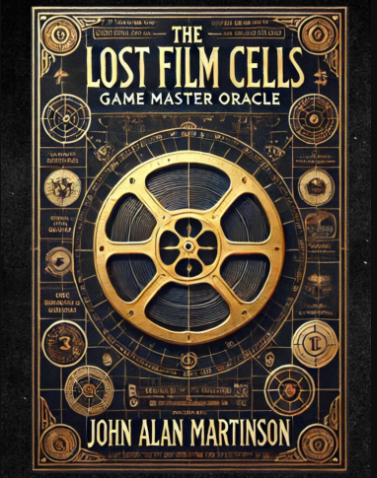
The Lost Film Cells Game Master Oracle is a visual storytelling oracle originally created for Jack’s Cinematic d12 Universal Tabletop Role-Playing Game Ruleset (JCd12), although it can be used with virtually any TTRPG system, setting, novel, screenplay, or other form of storytelling. The oracle consists of 24 mysterious film cells divided between Action Scenes and Non-Action Scenes. Each depicts a single evocative moment from an imaginary lost film whose characters, events, and larger story are unknown. The storyteller rolls a twelve-sided die to randomly select a film cell and then studies the image as though it were the only surviving frame of a forgotten movie, asking what might have happened before it, what might happen afterward, and—most importantly—what the image suggests about the story currently being told. The film cells can inspire plot developments, encounters, characters, locations, environmental conditions, mysteries, treasures, complications, motivations, and countless other elements. If inspiration does not immediately emerge, additional Abstract Focus and Object Focus results can narrow the interpretation. Film cells can also be juxtaposed, combined into sequences, assigned to characters or factions, or rolled in advance to help outline an entire adventure, campaign, novel, or screenplay. The descriptions and examples in the book are intended primarily to teach the method; ultimately, the true oracle is the combination of the 24 images, the dice, and your imagination. Use this oracle right now for FREE or purchase a digital copy book. Roll 2d12 right now and consult the following table to for immediate visual inspiration for what will happen next in your story, or to continue reading to learn more about how The Lost Film Cells oracle works.
🕎Each of the following film cells will be a link to a page, but it is the Sabbath and it’s my birthday, so I am going to relax and link the pages later.
LEFTMOST 1d12 RESULT
[1] Dreams – Action Scene ★ [2] Emotions – Action Scene ★ [3] Enemies – Action Scene ★ [4] Environment – Action Scene ★ [5] Evil – Action Scene ★ [6] Goals – Action Scene ★ [7] Good – Action Scene ★ [8] Inside – Action Scene ★ [9] Messages – Action Scene ★ [10] Opposition – Action Scene ★ [11] Outside – Action Scene ★ [12] Reality – Action Scene
RIGHTMOST 1d12 RESULT
[1] Dreams – Non-Action Scene ★ [2] Emotions – Non-Action Scene ★ [3] Enemies – Action Scene ★ [4] Environment – Non-Action Scene ★ [5] Evil – Non-Action Scene ★ [6] Goals – Non-Action Scene ★ [7] Good – Non-Action Scene ★ [8] Inside – Non-Action Scene ★ [9] Messages – Non-Action Scene ★ [10] Opposition – Non-Action Scene ★ [11] Outside – Non-Action Scene ★ [12] Reality – Non-Action Scene
Lost Film Cells Unearthed
This is the fictional history of The Lost Film Cells Game Master Oracle. The Los Angeles Fire of 2025, which reduced much of city to ash and rubble, was not just a catastrophe, it was a cultural reckoning, a burning away of illusions. For years, the opulence of Hollywood has been contrasted against the growing homeless population that lines its streets—two extremes of human existence coexisting within the same city. The fire did not discriminate. Luxury mansions and makeshift tents burned alike, leaving countless individuals displaced.
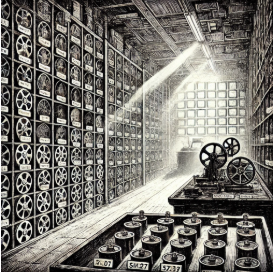
Many years after the Los Angeles Fire of 2025, among the ruins, in the charred remnants of what was once a grand estate belonging to a long-forgotten film collector, the film cells were uncovered. Some might call it a miracle that they survived at all, fragments of nitrate and celluloid preserved in a fireproof vault. Others might call it a cruel twist of irony that, amidst all the loss, it was these relics of fiction that endured while so many lives were irreparably altered.
Known simply as The Lost Film Cells, these fragments of cinema were carefully cataloged by the collector before his death, though he could only label them with cryptic single-word titles. He admitted that he had no knowledge of their origins, unable to trace them back to any known film, director, or studio. No record existed of the actors, the genre, or even the era that might connect these peculiar images to the vast catalog of cinematic history.
The cells were grouped into twelve pairs, with each pair sharing an enigmatic label—words like Goals, Outside, Inside, Enemies, and other relatively nondescript labels, within two categories, Action Scene and Non-Action Scene. Yet, the imagery within some pairs seemed almost contradictory, such as the pair labeled “Good,” where the Action frame depicts a romantic scene of a couple reuniting, but the Non-Action film cell labelled “Good” depicts an executioner in an empty town square. The collector’s intentions in naming the pairs, much like the identity of those depicted within them, remain entirely unknown.
Since their discovery, The Lost Film Cells have fascinated scholars, artists, and storytellers, each cell appearing as a fragment suspended in time. Those who have gazed upon the images claim that they evoke a sense of story just beyond reach, as if a hidden narrative lives within the unknown scenes. Theories have emerged, some suggesting that the cells are fragments from an experimental film, while others imagine they are scenes from a lost masterpiece destroyed before it could ever be released. However, the collector’s notes provide no further clarity, leaving future generations to speculate on what unifying tale might connect these obscure snapshots.
As centuries pass, The Lost Film Cells remain untouched by age yet brimming with possibilities. Their silent actors, unnamed and their stories untold, linger as haunting reminders of the power of the unknown, inspiring creators to fill in the gaps with their own tales. The Lost Film Cells have become a gateway, an oracle through which storytellers may glimpse pieces of an endless, fragmented story, yet to be fully unveiled.
How to Use The Oracle
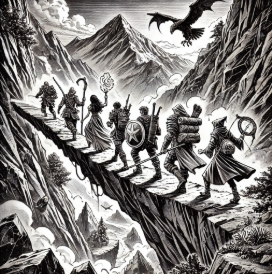
To inspire what happens next, the Game Master randomly selects a film cell by rolling 1d12 or 2d12, and then gazing at the image until an idea emerges on how the story should proceed. The GM imagines that the image is the only surviving frame or film cell of some unnamed film, as if the film cell was discovered by some future civilization at an archaeological dig site. Nobody knows what happened before or after the scene, nor is anything else known about the movie that the film cell has come from.
1d12 Standard Method
Using 1d12, the GM selects a Non-Action Scene film cell if there is no action currently taking place in the story and the situation doesn’t seem to be demanding a shift into action. If the characters are in a conversation with a sweet old lady at a restaurant, although it’s possible that a gang of scoundrels could burst into the establishment, if the GM doesn’t sense that’s appropriate, he will roll 1d12 to select a Non-Action Scene Film Cell. If the characters are peacefully traveling up a mountain on a narrow road, the GM might sense that although there isn’t any action currently taking place, the scene is begging for an avalanche, or for part of the road to give way, but he must let the film cell determine what happens next.
2d12 Indecisive Method
If the characters are in the midst of an action scene, it is almost always appropriate to roll 1d12 and select from the Action Scene film cells, to determine what happens next. If the characters are currently in a Non-Action Scene and the GM is unsure whether or not the scene should shift into action or continue with no action, the GM rolls 2d12, with one die representing Non-Action Scene film cells and the other representing the Action Scene collection. Whichever die rolls a higher number determines the film cell that is selected.
Writer’s Block Method
If a plot direction idea does not immediately come to mind, the Game Master rolls an additional 1d12 to determine the Abstract Focus. If again the GM still has not devised an idea for how the story will proceed, he rolls an additional 1d12 to randomly select an Object Focus.
Juxtaposed Method
The Lost Film Cells can also be juxtaposed by rolling 1d12 to select an Action Scene Film Cell and rolling a second 1d12 to select a Non-Action Scene Film Cell. The GM then merges the scenes in his mind to inspire what happens next.
Other Methods
Multiple film cells can be selected at once and arranged to outline the beats or chapters of a story. For instance, the GM might roll 3–5 times to create a sequence of film cells, using them to map out key moments in the narrative. This method is especially useful for pre-planning an overarching plot or building out a multi-session campaign.
Alternatively, film cells can be assigned to specific characters or factions within the story. Each cell becomes a symbol or event tied to that character or group, influencing their motivations, actions, or obstacles. This approach adds layers of depth and interconnectedness, as different story threads converge based on the chosen film cells.
The oracle can also be used as a thematic guide, with each film cell inspiring tone, mood, or atmosphere rather than specific events. In this case, the GM might select a cell to determine the emotional undercurrent of a scene—whether it feels tense, hopeful, or ominous—allowing players to react naturally to the environment’s evolving energy.
These methods encourage flexibility and experimentation, ensuring that The Lost Film Cells Oracle adapts to the unique needs and styles of any GM or group.
How Not to Use the Oracle
The actual oracle is not the book, with all the example outcomes provided, but the images. The book is intended to be read once or skimmed, and then only the images and dice are used, along with your imagination.
Yes/No Probability Oracle
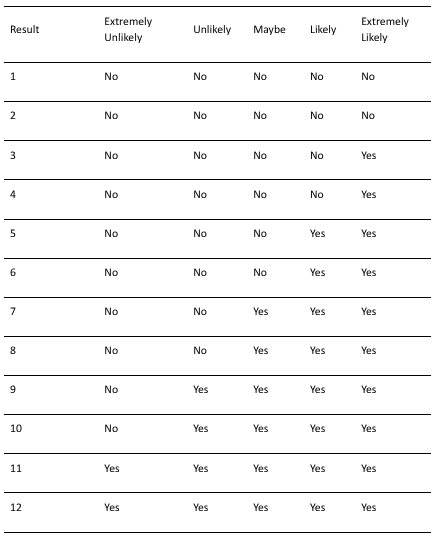
The Yes/No Probability Table is designed for situations where the storyteller needs a straightforward answer while still accounting for how probable the event actually is. Before rolling 1d12, the storyteller asks how likely a “yes” answer would be within the circumstances of the story, choosing between Extremely Unlikely, Unlikely, Maybe, Likely, or Extremely Likely. The die is then rolled and compared to the appropriate probability to produce a Yes or No answer. This allows common or logical events to remain more probable without making them certain, while extraordinary events remain possible without occurring too frequently. It is particularly useful when the storyteller wants chance to decide an uncertain question without ignoring what has already been established about the characters, setting, and situation.
“Expect the Unexpected” Open-Ended Question Oracle
The “Expect the Unexpected” Open-Ended Question Oracle is intended for situations where a simple Yes or No would not be interesting enough. Instead of accounting for probability, a 1d12 roll produces one of twelve more nuanced answers. These results frequently do more than answer the original question: they introduce complications, consequences, delays, opportunities, and unexpected directions for the story. The oracle is therefore especially useful when improvisation and discovery are more important than determining strict probability, transforming seemingly simple questions into new possibilities for plot development and creative problem-solving.
- Absolutely – The answer is a resounding “yes,” without hesitation or obstacles.
- Partially – The answer is “yes,” but only to a limited extent, with significant conditions or compromises.
- Not Yet – The answer is “no” for now, but it might change in the near future.
- In a Surprising Way – The outcome is “yes,” but it unfolds in an unexpected or unconventional manner.
- No, but Something Else – The answer is “no,” but another opportunity or unexpected twist arises as a result.
- With Difficulty – The answer is “yes,” but achieving it requires significant effort, sacrifice, or overcoming obstacles.
- Not at All – The answer is a clear and definitive “no,” with no possibility of change.
- Yes, but it Comes with a Price – The answer is “yes,” but the cost or consequences are significant.
- Unclear for Now – The outcome is uncertain, requiring more information, time, or effort to gain clarity.
- Yes, but Not How You Expect – The answer is “yes,” but the result or path forward is vastly different than anticipated.
- A Delayed Yes – The answer will be “yes,” but only after a delay or a prerequisite is fulfilled.
- No, but it Leads to Something Better – The answer is “no,” but it opens the door to a more favorable outcome or alternative.