How Artificial Intelligence Will Transform Tabletop Roleplaying into Interactive Movies
For more than fifty years, tabletop roleplaying games have asked players to imagine impossible worlds. Around a dining room table, strangers became heroes, villains, kings, dragonslayers, detectives, smugglers, starship captains, and wandering mercenaries. The Game Master described the scene, the players declared their actions, dice determined success or failure, and the rest unfolded in the imagination. That act of collective imagination has always been the heart of the hobby.
Yet imagination has also been one of its greatest limitations.
No matter how talented a Game Master might be, no matter how vivid the descriptions or emotionally charged the roleplaying, every player ultimately sees a slightly different version of the adventure inside his or her own mind. Ask five players what happened during last week’s climactic battle, and you’ll likely hear five different descriptions of the same event. The story is shared, but the visualization remains personal.
F or decades, technology has slowly chipped away at that limitation. Miniatures replaced coins and chess pieces. Beautiful painted maps replaced graph paper. Full-color rulebooks replaced monochrome pamphlets. Virtual tabletops allowed groups separated by continents to continue adventuring together. Three-dimensional environments, animated maps, dynamic lighting, surround sound, and digital character sheets have steadily pushed tabletop gaming closer to a cinematic experience.
Artificial intelligence represents something fundamentally different.
Rather than merely improving the tools surrounding a roleplaying game, AI has the potential to transform the final product of the game itself.
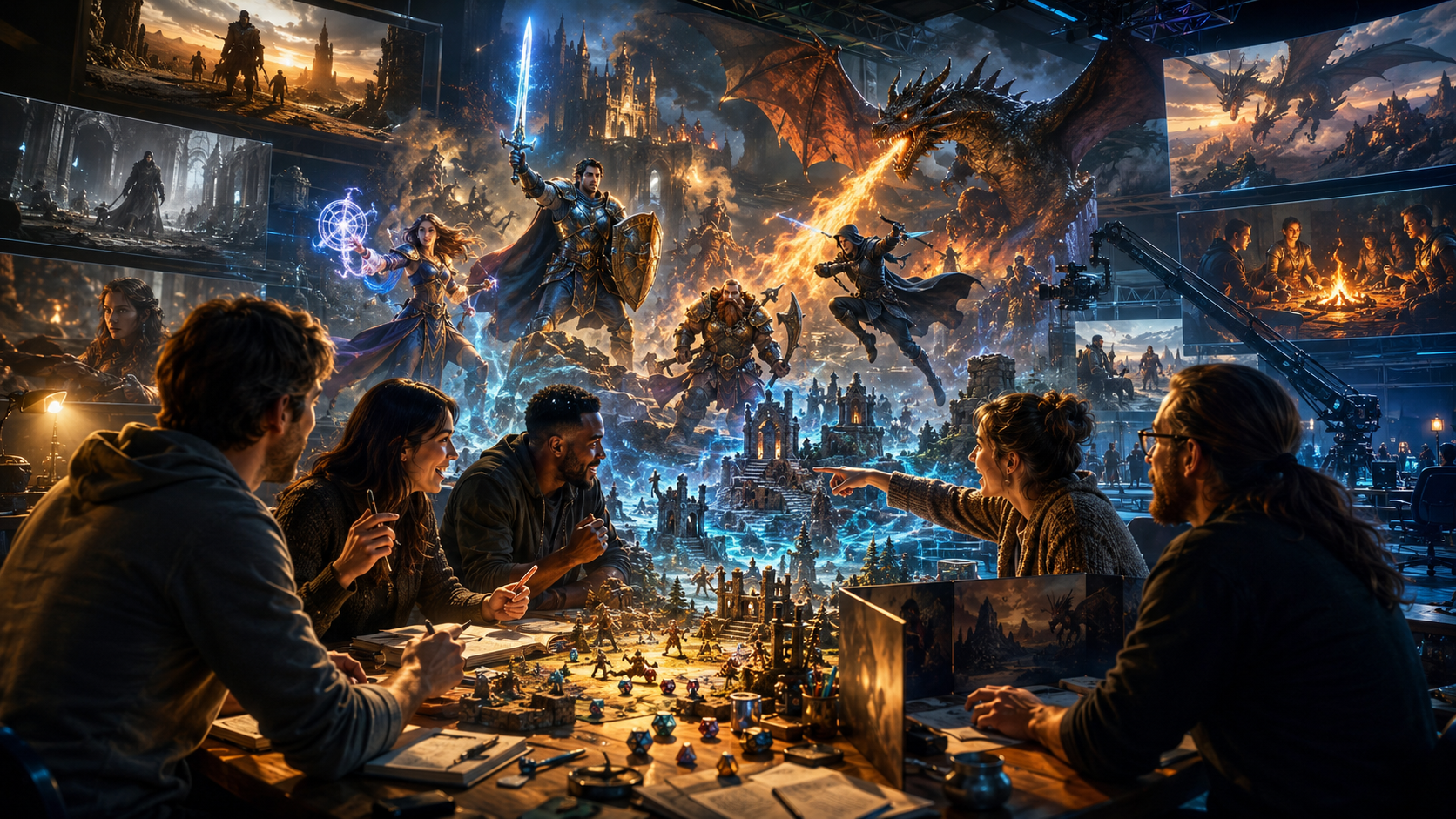
Imagine finishing a six-hour campaign session on Friday night. Everyone logs off the voice chatroom or leaves the table, already excited for the next adventure. Overnight, an artificial intelligence reviews the session transcript, understands every scene, identifies the important emotional moments, reconstructs the locations, generates cinematic camera angles, composes an orchestral soundtrack, casts digital actors to portray every character, records professional-quality dialogue, edits the scenes together, and delivers a polished feature-length movie the next morning.
The story you played becomes a film.
Not merely an animation of combat rounds or a replay of game mechanics, but a genuine cinematic adaptation that captures the pacing, emotion, tension, humor, and drama that emerged naturally around the table.
For many people, that still sounds like science fiction.
But only a few years ago, so did conversational AI capable of writing coherent dialogue, generating artwork in seconds, composing orchestral music, cloning voices, or producing convincing video from a simple text prompt. Each of those technologies now exists in some form and continues improving at a breathtaking pace.
No single breakthrough will suddenly transform tabletop campaigns into Hollywood productions. Instead, dozens of rapidly advancing technologies are converging toward the same destination. Language models continue becoming better storytellers. Video generation improves month after month. Character consistency, facial animation, voice synthesis, scene continuity, procedural editing, and AI-assisted filmmaking all continue advancing simultaneously. Each improvement removes another obstacle that once seemed impossible.
The destination is becoming easier to see.
Ironically, tabletop roleplaying games may be among the entertainment mediums best positioned to benefit from this revolution. Unlike traditional films, the stories already exist. The dialogue already exists. The character development already exists. The emotional investment is already there because the audience helped create it.
The only missing piece is the camera.
From Wargames to Collaborative Storytelling
Long before artificial intelligence entered the conversation, tabletop roleplaying games had already undergone one of the most remarkable evolutions in entertainment history.
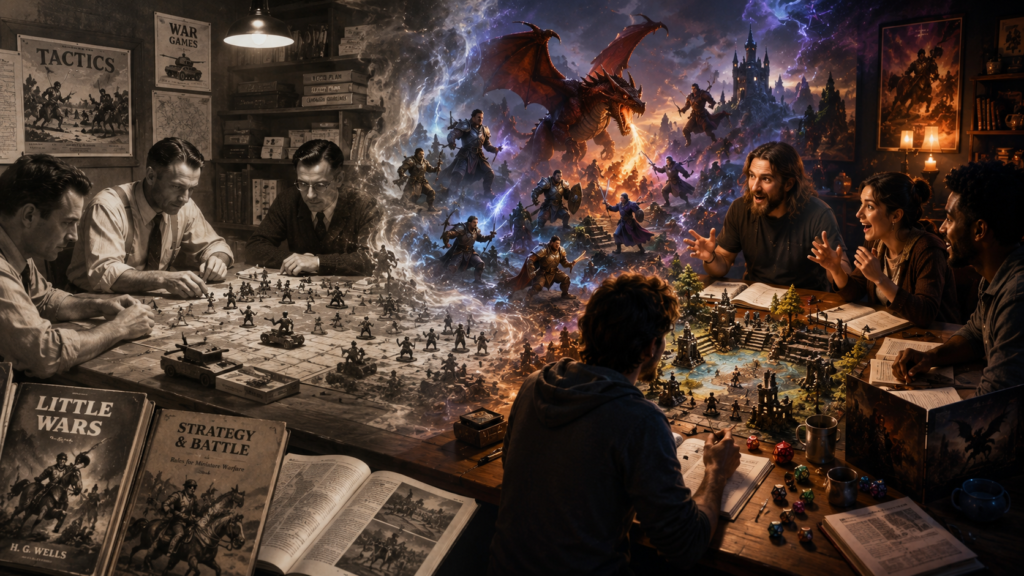
The roots of the hobby stretch back through military simulations and historical miniature wargaming. These games focused on recreating famous battles, emphasizing tactics, logistics, terrain, and strategic decision-making rather than individual characters. Players commanded armies rather than heroes. Success depended on maneuvering regiments instead of developing personalities.
Everything changed during the early 1970s.
Building upon these earlier wargames, Gary Gygax and Dave Arneson introduced an entirely different way to play. Instead of commanding hundreds of soldiers, players controlled a single individual. Rather than reenacting historical conflicts, they ventured into imagined worlds filled with monsters, forgotten ruins, mysterious treasures, and impossible magic.
With the publication of Dungeons & Dragons in 1974, an entirely new form of entertainment was born.
What made this revolutionary was not simply the fantasy setting or the use of dice. It was the realization that games could become collaborative stories.
Unlike a novel, where every event is predetermined by the author, or a film, where every scene has already been filmed, tabletop roleplaying creates narratives through spontaneous collaboration. The Game Master presents situations rather than scripts. Players solve problems creatively rather than selecting predetermined dialogue options. Dice introduce uncertainty that neither side fully controls. Every decision permanently alters the unfolding story.
No two campaigns are ever identical.
Over the following decades, the hobby expanded dramatically. Science fiction, horror, superheroes, cyberpunk, espionage, post-apocalyptic survival, historical fiction, westerns, anime, and virtually every other genre found a place around the gaming table. Rules evolved alongside player expectations. Some systems emphasized tactical realism. Others prioritized narrative freedom. Some focused on intricate character customization while others stripped mechanics down to encourage improvisation.
Despite their differences, they all shared the same fundamental idea: ordinary people gathering together to create extraordinary stories.
The rise of the internet accelerated this evolution even further. Online forums connected isolated gaming groups. Digital rulebooks made publishing more accessible. Streaming platforms introduced millions of viewers to actual-play campaigns, demonstrating that simply watching other people roleplay could itself become compelling entertainment. Virtual tabletops erased geographical limitations, allowing lifelong campaigns to continue despite careers, families, and international moves.
For perhaps the first time, roleplaying games began competing not merely with other tabletop games, but with every other form of entertainment.
Yet even after all these innovations, the final product remained largely unchanged.
When the session ended, what remained?
Memories.
Perhaps a few handwritten notes.
Character sheets.
Maybe an audio recording.
Occasionally a campaign journal.
The greatest adventures ever played often disappeared into history the moment the players left the table.
Artificial intelligence may finally change that—not by replacing imagination, but by preserving it in forms that previous generations of players could scarcely have imagined.
The AI Revolution Already Underway
The idea of turning a tabletop roleplaying campaign into a professionally produced film sounds ambitious, but the underlying technologies are already emerging around us. None of them are perfect, and none of them alone can accomplish the task. What makes this vision compelling is not a single breakthrough, but the convergence of many independent technologies advancing at remarkable speed. Artificial intelligence is simultaneously learning to write, illustrate, animate, compose music, generate voices, edit video, understand language, recognize emotion, and maintain visual consistency between scenes. Each year, capabilities that once required entire production studios become available to individual creators with ordinary computers.
Only a few years ago, AI-generated images consisted of blurry abstractions that were amusing precisely because they were so inaccurate. Human hands often had seven or eight fingers. Faces melted into the background. Objects blended together in impossible ways. Today, many AI-generated illustrations are difficult to distinguish from the work of professional artists, and they can be created in minutes instead of days. Video generation has followed a similar trajectory. Early demonstrations produced only a few seconds of surreal motion. Modern systems are rapidly approaching the ability to create coherent scenes with believable physics, expressive characters, and cinematic camera movement. Improvements continue arriving at such a pace that predictions made even twelve months earlier frequently become outdated.
Voice synthesis has experienced an equally dramatic transformation. Artificial intelligence can now produce convincing emotional performances, distinguish between dozens of speaking styles, maintain character voices throughout lengthy conversations, and even perform multiple roles within the same production. Music generation is advancing alongside it, allowing orchestral scores, ambient soundtracks, battle music, and emotional themes to be created dynamically for individual stories rather than licensed from existing catalogs.
Language models may ultimately prove to be the most important piece of the puzzle. Modern AI systems can summarize conversations, identify important plot developments, recognize recurring themes, maintain continuity between chapters, and restructure events into coherent narratives. While they are not flawless and still require human oversight, they already demonstrate abilities that were once considered uniquely human. As these systems continue improving, their role shifts from merely generating text to understanding stories themselves.
For tabletop roleplaying games, this distinction matters enormously. A campaign transcript is not simply a collection of words. It contains relationships, betrayals, sacrifices, mysteries, victories, defeats, jokes, emotional revelations, recurring villains, and character development that may span months or even years of play. The artificial intelligence of the future will not merely transcribe those events. It will understand them well enough to determine which moments deserve a close-up, which conversations require dramatic pauses, when silence is more powerful than dialogue, and how seemingly insignificant scenes early in a campaign foreshadow climactic events much later.
Even if today’s systems cannot yet perform every one of these tasks automatically, the direction of travel is unmistakable. Every major advancement reduces the amount of manual work required to transform imagination into finished media. A decade ago, creating a fantasy film required actors, costumes, cameras, lighting crews, editors, composers, visual effects artists, sound engineers, and millions of dollars. Increasingly, those responsibilities are becoming software capabilities rather than job descriptions. Human creativity does not disappear in this process. Instead, it shifts toward directing, guiding, refining, and imagining rather than executing every technical detail by hand.
Tabletop roleplaying games happen to produce exactly the kind of raw material these emerging technologies need. Every session contains dialogue. Every session contains conflict. Every session contains character interaction. Every session contains decisions with meaningful consequences. Unlike a blank page, a campaign transcript already possesses the most difficult ingredient in storytelling: a complete narrative waiting to be adapted.
The Death of Passive Entertainment
For most of human history, stories have been experienced in one direction. Someone creates them, and everyone else consumes them. A novelist writes a book. A filmmaker directs a movie. A television studio produces a series. Audiences purchase tickets, read the pages, or sit on the couch while someone else’s imagination unfolds before them.
Interactive entertainment began changing that equation. Video games allowed players to influence events, but only within boundaries established by the developers. Every dialogue tree, every branching path, and every possible ending still had to be written in advance. No matter how expansive a game became, players were ultimately exploring possibilities that someone else had already anticipated.
Tabletop roleplaying games broke that limitation decades ago. They offered something fundamentally different from every other medium because there was no predefined script. Players were free to attempt ideas that no game designer could have predicted. They could negotiate with monsters instead of fighting them, establish kingdoms instead of completing quests, betray allies, invent religions, build criminal empires, or ignore the main storyline entirely in favor of pursuing their own ambitions. The Game Master responded in real time, creating new scenes that had never existed before.
In many ways, tabletop roleplaying has always represented the highest form of interactive storytelling. The only limitation was that the finished product existed primarily in memory.
Artificial intelligence may remove that final barrier. Instead of merely participating in a story, players may soon preserve it in forms that rival professionally produced entertainment. The distinction between player and audience begins to disappear because the audience consists largely of the people who created the story in the first place. Rather than watching strangers save the kingdom, you watch your own party struggle through impossible odds, argue around campfires, celebrate victories, mourn fallen companions, and confront the consequences of choices that no screenwriter could have predicted because they emerged naturally from genuine human interaction.
This changes the value of every game session. A memorable campaign is no longer just an enjoyable evening with friends. It becomes source material. The transcript becomes the first draft of a screenplay. The characters become the cast of a future film. The setting becomes a virtual production environment that can be revisited again and again. Campaign journals become production notes instead of nostalgic souvenirs.
Perhaps the most exciting implication is that no two films would ever be the same. Every gaming group creates its own stories. Every Game Master has a different style. Every player approaches problems differently. While millions of people might watch the same blockbuster movie, no one else will ever produce exactly the same campaign that your group played together. Artificial intelligence does not erase the uniqueness of tabletop gaming; it amplifies it by allowing those unique stories to be experienced again in entirely new forms.
The future of entertainment may therefore become increasingly personal. Instead of asking, “What movie should we watch tonight?” groups may begin asking, “Which one of our adventures should we turn into a movie next?” That represents a profound shift in how stories are created, remembered, and shared, and tabletop roleplaying games may be uniquely positioned to lead that transformation.
The Game Session Is Already a Screenplay
One of the most fascinating aspects of tabletop roleplaying games is that many players already speak in cinematic language without realizing it. Game Masters talk about “opening scenes,” “dramatic reveals,” “cliffhangers,” “camera moments,” and “cinematic combat.” Players often describe memorable encounters by comparing them to scenes from their favorite films. Entire campaigns are remembered not by the statistics on a character sheet, but by the moments that felt worthy of the big screen.
That comparison is more accurate than most people realize.
A traditional screenplay consists of scenes connected by character decisions, dialogue, conflict, rising tension, and eventual resolution. While the format itself follows strict conventions, the underlying structure is remarkably similar to what naturally occurs during a tabletop roleplaying session. Every time the Game Master introduces a new location, a new scene begins. Every conversation between player characters and non-player characters resembles dialogue written for actors. Every unexpected complication increases dramatic tension. Every battle serves as an action sequence. Every difficult decision advances character development.
The difference is that a screenwriter carefully constructs these moments over months or years, while a roleplaying group creates them spontaneously around the table.
Consider an ordinary evening of adventuring. The party arrives in a village where something feels wrong. Strange disappearances have frightened the townsfolk. The heroes investigate clues, interview witnesses, argue over competing theories, discover an abandoned temple hidden beneath the cemetery, accidentally awaken an ancient evil, narrowly escape with their lives, regroup, formulate a desperate plan, and finally confront the villain in a climactic battle where one character sacrifices everything to save the others.
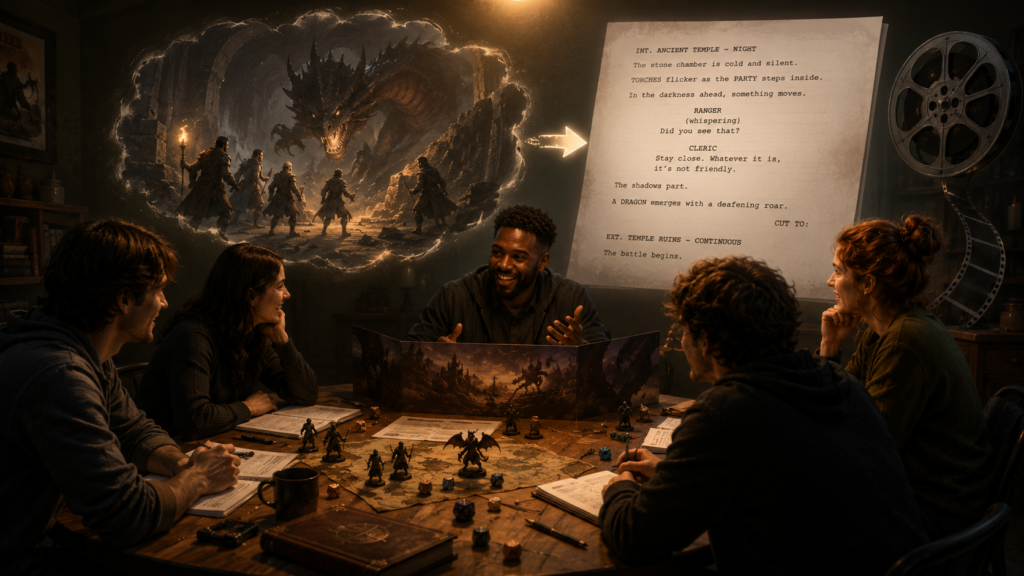
Strip away the dice rolls and game mechanics, and what remains?
The outline of a feature film.
The pacing may require adjustment. Dialogue may need refinement. Certain repetitive actions might be condensed, while particularly emotional conversations deserve expansion. Yet the core story already exists. Unlike adapting a board game or translating gameplay footage from a video game, the narrative itself requires relatively little invention because the players have already invented it through play.
Even failed adventures often make compelling stories. Some of the greatest moments in tabletop gaming arise precisely because heroes make mistakes. Plans collapse spectacularly. Trusted allies reveal themselves as traitors. A critical spell fails at exactly the wrong moment. A villain escapes when victory seemed certain. Characters argue, reconcile, evolve, and occasionally die. These events resonate because they were not predetermined by a novelist or film studio. They emerged naturally from unpredictable human decisions interacting with uncertain outcomes.
That unpredictability produces something surprisingly difficult for professional writers to imitate.
Authenticity.
When audiences watch a conventional film, they understand that every line of dialogue was intentionally written to move the plot forward. In a roleplaying campaign, conversations frequently wander in unexpected directions before suddenly producing profound emotional moments that no one planned. A joke told during the first session may become a defining characteristic of a beloved character three years later. A minor merchant invented on the spot to answer an unexpected question may eventually become one of the campaign’s most memorable personalities. Entire kingdoms have emerged because players became fascinated with details that the Game Master originally considered insignificant.
This organic quality gives tabletop stories a sense of discovery that scripted entertainment rarely achieves.
Artificial intelligence will not replace that spontaneity. Instead, it may become the editor that recognizes which moments deserve to remain exactly as they happened and which moments should be reorganized for pacing. Every experienced film editor understands that great stories are often discovered during the editing process rather than captured perfectly during filming. Future AI systems may perform a similar role for tabletop campaigns, identifying emotional arcs, eliminating repetitive mechanical discussion, restructuring scenes for dramatic impact, and preserving the heart of the adventure while presenting it in forms suitable for audiences.
The transcript, in other words, is not the finished screenplay. It is something arguably more valuable: the first draft created through genuine collaboration rather than solitary authorship.
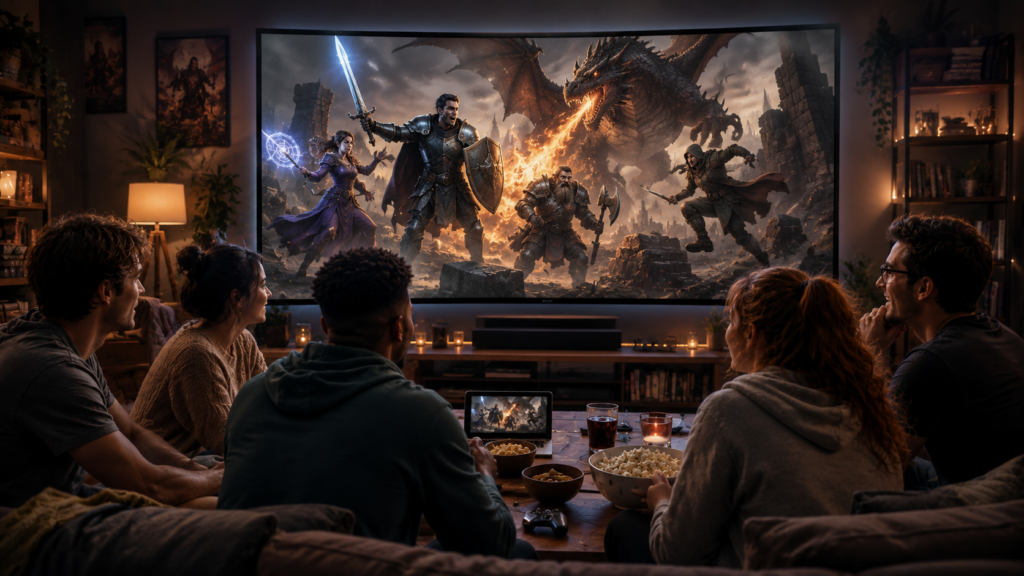
AI Actors and Digital Performers
If the campaign transcript becomes the screenplay, the next obvious question is who performs it.
The answer may ultimately be: anyone.
One possibility is that players create entirely original digital actors. Instead of selecting from existing celebrities, they design performers specifically for their campaign. Every scar, hairstyle, facial expression, voice, posture, and mannerism becomes customizable. These actors never age, never become unavailable, and remain visually consistent across every film, television episode, or animated adaptation generated from future campaigns. A beloved wizard introduced in one adventure could appear decades later in another campaign looking exactly as players remember.
Another possibility is even more personal.
Rather than inventing fictional performers, players could choose to portray their own characters. A simple facial scan, voice recording, or body reference might allow artificial intelligence to generate a cinematic version of the player as a knight, detective, pirate, space marine, or wandering samurai. Instead of merely imagining yourself as the hero, you become the hero on screen. Family and friends could literally watch your campaign unfold with you playing the leading role.
For many groups, this alone would transform the hobby. Campaigns would no longer exist solely as memories shared among participants. Parents could show their children adventures they played twenty years earlier. Longtime friends separated by distance could revisit stories that shaped their lives together. Characters who existed only in imagination could become recognizable digital performances preserved indefinitely.
A third possibility introduces an entirely different dimension to entertainment.
Imagine a future marketplace in which actors license their digital likenesses just as musicians license songs or photographers license images. Rather than hiring a celebrity to spend months filming on location, players might purchase a legitimate license allowing an AI system to portray one of their characters using that actor’s approved appearance, voice, and performance style. Perhaps your hardened mercenary is portrayed by one actor while another player chooses a completely different performer for her elven ranger. These licenses could vary in price, duration, genre restrictions, or commercial usage rights, creating entirely new business models for performers while giving fans opportunities that would previously have been unimaginable.
This concept often raises concerns about ethics and intellectual property, and rightly so. Any future built around digital performances must respect consent, contracts, and ownership of a person’s likeness. The goal is not unauthorized imitation, but licensed collaboration. Actors already lend their voices to animated characters, license their appearances for video games, and perform through motion-capture technology. Artificial intelligence may simply extend those existing relationships into more dynamic and accessible forms.
Of course, not every player will want Hollywood faces in their campaigns. Many groups will prefer original characters that belong exclusively to their own stories. Others may deliberately embrace stylized animation, comic-book aesthetics, hand-painted fantasy art, or photorealistic worlds that look unlike any existing film. Artificial intelligence dramatically expands creative possibilities rather than forcing everyone toward a single visual style.
The important point is not whether your paladin is portrayed by a famous actor, a completely original digital performer, or yourself. The important point is that, for the first time in history, tabletop roleplaying games may gain access to a cast capable of bringing every campaign to life without requiring auditions, film crews, costumes, or expensive production schedules.
When that becomes possible, the distance between “playing a game” and “making a movie” becomes remarkably small.
Every Campaign Becomes More Than a Movie
Although feature films are the most obvious destination for AI-assisted storytelling, they are unlikely to be the only destination. A single tabletop campaign contains enough information to generate an entire ecosystem of creative works, each emphasizing different aspects of the same adventure.
Consider what typically happens after an especially memorable campaign. Someone writes a campaign journal. Another player creates character portraits. The Game Master organizes notes into a world bible. Perhaps someone edits together audio recordings from the sessions or commissions artwork depicting the final battle. Every one of these projects requires separate effort, and most groups never find the time to complete them.
Artificial intelligence has the potential to automate much of that process while still leaving the players in creative control.
A campaign transcript could become a feature-length film for those who enjoy cinematic storytelling. The same transcript could also become a prestige television series, allowing slower pacing and more attention to individual characters. Players who prefer reading might generate a polished fantasy novel that expands descriptions, internal thoughts, and world-building details impossible to communicate visually. Others may choose a graphic novel, an audiobook performed by digital voice actors, or an illustrated campaign chronicle that resembles a beautifully published collector’s edition.
The remarkable aspect is that none of these works would require the story to be written from scratch. They would simply represent different adaptations of the same collaborative experience.
This mirrors what already happens in traditional entertainment. A successful novel becomes a movie. The movie inspires a television series. Comics expand the universe. Video games explore side stories. Art books collect concept illustrations. Encyclopedias document fictional histories. Fans consume the same world through multiple formats because each medium offers different strengths.
Tabletop roleplaying campaigns may eventually enjoy the same treatment.
Imagine completing a three-year fantasy campaign. By the following week, your gaming group possesses a hardcover novel chronicling the adventure, a professionally narrated audiobook, an eight-episode streaming series, a feature-length director’s cut, a campaign encyclopedia documenting every kingdom and important character, printable posters of the heroes, trading-card style character profiles, and an interactive timeline showing every major event that occurred during the campaign. None of these products replace the original experience around the table. Instead, they preserve it in ways that make it easier to revisit, share, and celebrate.
The implications extend beyond personal entertainment. Independent Game Masters could publish campaigns that evolved naturally through years of play rather than being written entirely in isolation. Particularly memorable adventures might develop communities of readers and viewers alongside traditional players. Game designers could demonstrate the intended feel of their systems through cinematic adaptations of actual play sessions instead of relying solely on written examples in rulebooks.
Most importantly, these adaptations preserve something that has historically been lost.
Thousands of extraordinary campaigns have disappeared forever because they existed only in memory. Legendary characters known only to a handful of friends vanished when notebooks were misplaced, hard drives failed, or gaming groups drifted apart over time. Artificial intelligence offers the possibility of preserving those stories with a permanence previously available only to professionally published fiction.
The greatest adventures in tabletop history may no longer end when the final experience points are awarded.
Why Rules Matter More Than Ever
As artificial intelligence becomes increasingly capable of transforming gameplay into finished media, an unexpected question begins to emerge.
Are all tabletop roleplaying systems equally suited for this future?
For decades, players have debated realism versus simplicity, tactical depth versus narrative freedom, crunchy mechanics versus rules-light design. Those discussions remain important, but AI introduces an entirely new consideration: how well does a game’s structure translate into compelling stories?
Many traditional systems devote enormous attention to bookkeeping. Players carefully track ammunition, encumbrance, movement rates, action economies, status effects, temporary modifiers, stacking bonuses, and countless other mechanical details. These systems can produce satisfying tactical experiences, but transcripts of actual play often contain long stretches devoted almost entirely to arithmetic, rules consultation, and procedural discussion.
Those conversations are essential while playing the game.
They are rarely interesting to watch in a movie.
Future AI systems will undoubtedly become better at recognizing and removing mechanical overhead from transcripts. Nevertheless, the more frequently gameplay pauses to resolve procedural questions, the more difficult it becomes to preserve the natural dramatic momentum that audiences expect from cinematic storytelling.
By contrast, game systems designed to keep attention focused on character decisions, meaningful consequences, dramatic pacing, and visual action naturally produce transcripts that require less adaptation. Conversations remain centered on what characters attempt rather than which modifier applies. The emotional rhythm of the session remains intact because mechanical interruptions occur less frequently.
This observation does not imply that one style of roleplaying is objectively superior to another. Different groups enjoy different experiences. Some players genuinely love detailed simulations and intricate tactical decision-making. Others prefer freeform improvisation with minimal rules. The hobby has always thrived because it supports this diversity.
However, if the goal is collaborative movie-making, certain design philosophies begin offering distinct advantages.
The ideal transcript resembles the rough cut of a screenplay rather than the minutes of a committee meeting. Scenes flow naturally into one another. Dialogue remains in character. Combat feels dramatic rather than procedural. Every important dice roll represents a meaningful turning point instead of a repetitive calculation. The mechanics quietly support the story instead of constantly demanding attention for themselves.
This perspective may influence future game design far more than many people currently realize. Designers may increasingly ask not only whether a rule is balanced or realistic, but whether it contributes to stories that remain engaging when adapted into novels, films, graphic novels, or television episodes.
Roleplaying games have traditionally been evaluated by how enjoyable they are to play.
In the coming decades, they may also be evaluated by how beautifully they adapt into other forms of storytelling.
It is within that context that systems intentionally designed with cinematic pacing become especially interesting. Rather than viewing roleplaying solely as an evening’s entertainment, they treat every session as the foundation for future creative works. One example of this philosophy is Jack’s Cinematic d12, a system built around the idea that players are not merely resolving encounters—they are collaboratively constructing scenes that already resemble the language of film.
Rather than emphasizing exhaustive simulation, the design encourages momentum, dramatic action, memorable character moments, and decisions that move the story forward. The goal is not to imitate cinema at the expense of gameplay, but to recognize that memorable campaigns already possess many of the qualities audiences associate with compelling films. If artificial intelligence eventually becomes the editor, cinematographer, and production studio, then the roleplaying session itself becomes the writers’ room.
In that sense, the future of tabletop gaming may not simply involve better rules or more sophisticated technology. It may involve recognizing that every great campaign is already the first draft of something much larger.
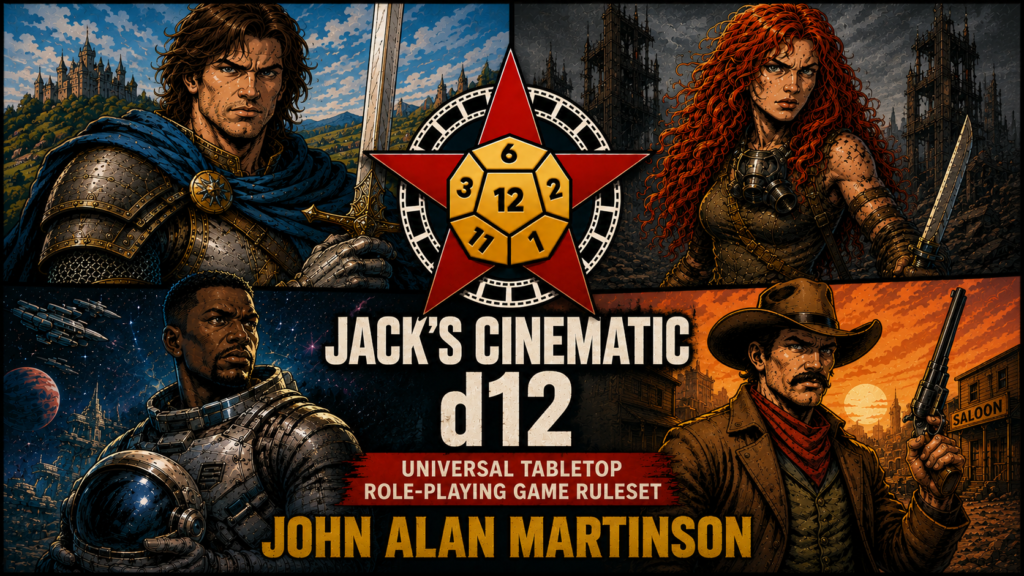
Jack’s Cinematic d12 and the Future of Collaborative Storytelling
When most people hear the phrase “cinematic roleplaying,” they immediately think of fast combat, exciting action scenes, or rules that encourage dramatic heroics. Those are certainly part of the equation, but they only scratch the surface of what the word cinematic can ultimately mean.
As artificial intelligence continues transforming the creative landscape, cinematic design takes on an entirely new significance. The roleplaying session itself becomes the creative work from which every other medium can emerge. A campaign is no longer simply something that happened around a table on Friday night. It becomes the source material for novels, films, television series, comic books, audiobooks, and countless other forms of entertainment.
From that perspective, the design philosophy behind a roleplaying system becomes critically important.
Jack’s Cinematic d12 was conceived around the idea that roleplaying should feel like participating in a great movie rather than managing a complex simulation. The objective is not to eliminate meaningful choices or tactical depth. Instead, it is to reduce unnecessary interruptions so the story maintains momentum. Players remain immersed in their characters rather than constantly stepping outside the fiction to resolve complicated procedures.
This distinction may seem subtle while playing, but it becomes increasingly significant when viewed through the lens of future AI-assisted storytelling.
Imagine two transcripts from different roleplaying sessions. In one, the majority of the conversation revolves around modifiers, rule lookups, action sequencing, resource accounting, and procedural clarification. In the other, players spend most of their time speaking as their characters, describing bold actions, making difficult decisions, negotiating alliances, arguing over moral dilemmas, and reacting emotionally to unfolding events.
Which transcript already resembles a screenplay?
The answer is obvious.
Artificial intelligence cannot create emotional investment where none exists. It cannot manufacture meaningful character relationships from pages filled primarily with mechanical discussion. The most memorable films succeed because audiences become invested in the people on the screen rather than the technical process used to create the production. The same principle applies to roleplaying games.
Jack’s Cinematic d12 embraces the idea that mechanics should quietly support dramatic storytelling rather than compete with it. Every rule should encourage players to imagine scenes rather than calculations. Every encounter should contribute to the larger narrative rather than existing solely as an isolated tactical puzzle. Every session should leave participants feeling as though they have experienced an adventure worthy of adaptation into another medium.
This philosophy also changes the role of the Game Master.
Traditionally, Game Masters have been described as referees, narrators, world-builders, or judges. While all of those descriptions remain accurate, the future may encourage us to think of them differently.
The Game Master increasingly resembles a director.
Like a film director, the Game Master establishes pacing, introduces dramatic tension, decides when to reveal information, controls the rhythm of scenes, develops supporting characters, and guides the emotional trajectory of the story. The players, meanwhile, become both actors and co-writers, constantly introducing ideas that neither the Game Master nor the rulebook anticipated.
No screenwriter working alone could predict every brilliant idea that emerges from four or five imaginative people interacting around the same table. One player’s reckless decision inspires another player’s sacrifice. An improvised joke evolves into a defining character trait. A villain originally intended to appear for a single session becomes the campaign’s central antagonist because the players become fascinated by him. Entire nations, religions, conspiracies, and family histories emerge through spontaneous collaboration rather than careful planning.
That collaborative creativity has always been one of tabletop gaming’s greatest strengths.
Artificial intelligence does not diminish it.
It preserves it.
Rather than replacing Game Masters or players, future AI systems may become production assistants that organize transcripts, identify recurring themes, maintain continuity, recommend improvements, and ultimately transform campaigns into finished creative works. The human imagination remains the engine driving the story. AI simply becomes another set of tools available to preserve and present that imagination.
Perhaps the most exciting aspect of this future is that it democratizes creative production. For generations, creating a feature film or publishing a professionally edited novel required enormous financial resources and access to specialized industries. Most gaming groups never imagined seeing their campaigns presented with that level of quality because the barriers were simply too high.
Artificial intelligence steadily lowers those barriers.
As the technology matures, ordinary groups of friends may possess creative capabilities that would have required entire studios only a generation earlier. The distinction between amateur and professional becomes increasingly blurred because the limiting factor shifts away from production budgets and toward imagination itself.
In that environment, tabletop roleplaying games are uniquely positioned to thrive because they already solve the hardest creative problem of all.
They generate original stories.
The Future of Tabletop Role-Playing Games
Predicting technology twenty years into the future is always a dangerous exercise. History is filled with confident predictions that never materialized and revolutionary breakthroughs that almost nobody saw coming. Few people in the early 2000s imagined carrying smartphones more powerful than the desktop computers of the day. Even fewer predicted that ordinary consumers would converse naturally with artificial intelligence capable of writing books, composing music, generating artwork, editing video, and assisting with software development. The lesson is not that every prediction eventually becomes reality. Rather, it is that once several important technologies begin converging, progress often accelerates far faster than anyone expects.
Imagine, then, that it is the year 2045.
A group of six friends gathers every Friday evening for a tradition they have maintained for over a decade. Some sit around the same wooden table where the campaign first began years earlier. Others join remotely through lightweight augmented reality glasses from different states and different countries. Physical distance has become almost irrelevant. The Game Master opens another chapter of an epic fantasy campaign that has been running for years. The heroes negotiate uneasy alliances, investigate ancient conspiracies, survive impossible battles, and make decisions that permanently reshape their world. They laugh, argue, celebrate unlikely victories, mourn fallen companions, and eventually conclude another unforgettable evening together.
When the session ends, something remarkable happens.
Nobody begins organizing handwritten notes. Nobody edits audio recordings. Nobody starts writing a campaign journal. The work has already begun.
Throughout the session, artificial intelligence has quietly recorded every spoken word, every important decision, every emotional turning point, and every significant event. It understands who the characters are, tracks continuity stretching back hundreds of previous sessions, recognizes dramatic pacing, identifies memorable dialogue, and organizes everything into a coherent narrative. Before anyone wakes the following morning, the entire adventure has already entered production.
By Saturday morning, every player opens a digital library containing an extraordinary collection of finished creative works generated directly from the previous night’s adventure.
The campaign has been transformed into a professionally edited feature film complete with cinematic photography, orchestral music, convincing visual effects, realistic performances, and seamless editing. Each player selected how his or her character would appear. Some chose completely original digital actors. Others chose idealized versions of themselves. Some licensed the likeness and voice of professional actors through official marketplaces that compensate performers whenever their digital performances are used.
Alongside the movie sits an expanded fantasy novel that enriches descriptions, smooths transitions, and explores characters’ thoughts while remaining faithful to every important decision made during the game session. An audiobook, narrated with expressive performances for every character, is already available. An illustrated collector’s edition showcases concept art, maps, monsters, important locations, and memorable scenes. A campaign encyclopedia automatically updates itself with every kingdom, organization, historical event, artifact, spell, and non-player character introduced during play. The orchestral soundtrack is released separately, allowing players to revisit the musical themes associated with beloved heroes and unforgettable villains. High-quality posters commemorate the campaign’s defining moments, while collectible character cards summarize years of accomplishments, relationships, equipment, and legendary deeds.
None of these projects required a Hollywood studio. None required a publishing company. None required a team of artists working for months behind the scenes. They emerged naturally from a story collaboratively created by friends who simply gathered around a table to play a tabletop roleplaying game.
Weeks later, another gaming group halfway around the world discovers the campaign online. They do not watch a shaky recording of people rolling dice or flipping through rulebooks. They experience a polished fantasy film, read the companion novel, browse the campaign encyclopedia, listen to the soundtrack, and become inspired to begin a campaign of their own. Their story is completely different, but it follows the same creative process. This cycle repeats thousands of times as ordinary gaming groups become independent creators capable of producing entertainment that once required enormous budgets and entire production studios.
Not every campaign will become a worldwide phenomenon, just as not every novel becomes a bestseller or every independent film wins an Academy Award. That has never been the point. The true revolution lies in allowing ordinary people to preserve extraordinary memories in forms that were previously available only to major publishers and Hollywood studios. Stories that once disappeared into fading memories, scattered notebooks, or forgotten campaign journals become permanent works that can be revisited for generations.
Children discover the campaigns their parents played decades earlier. Grandchildren watch adventures that took place long before they were born. Friends separated by careers, military service, illness, or thousands of miles continue sharing worlds they created together. Independent creators publish ambitious fantasy universes without needing investors, production companies, or multimillion-dollar budgets. The distinctions separating tabletop gaming, filmmaking, publishing, music, illustration, and interactive storytelling gradually disappear. They become different expressions of the same creative experience rather than separate industries competing for attention.
None of this diminishes the importance of the people gathered around the table. The players remain the authors. The Game Master remains the director. The dice still determine uncertainty. The laughter, suspense, friendships, triumphs, and heartbreak remain entirely human. Artificial intelligence simply preserves those experiences and presents them in forms that were previously impossible.

More than half a century ago, Gary Gygax and Dave Arneson demonstrated that games could become collaborative storytelling, forever changing tabletop gaming. Artificial intelligence may represent the next great evolution—not because it replaces imagination, but because it expands what imagination can become. The roleplaying session remains the beginning of the creative process rather than its conclusion. Every campaign becomes the foundation for films, novels, audiobooks, music, artwork, and forms of media that have not yet been invented.
The dice may still determine fate.
The players will still create the heroes.
The Game Master will still build the world.
The difference is that, when the adventure ends, the story may only be beginning.
About the Author