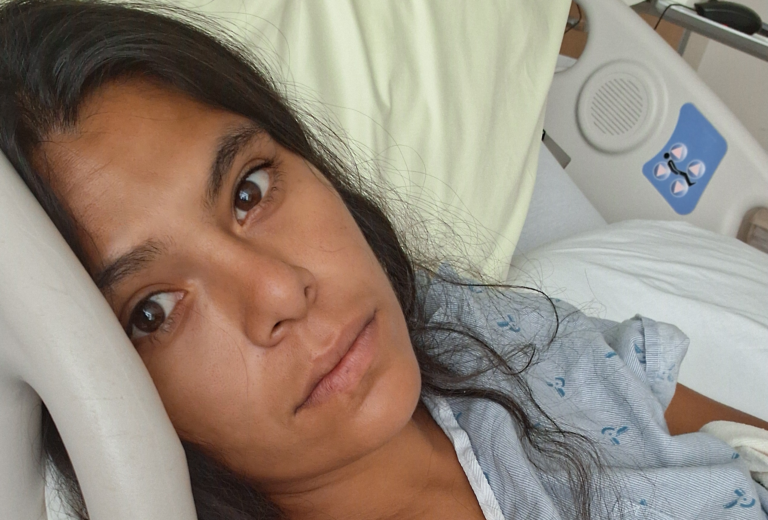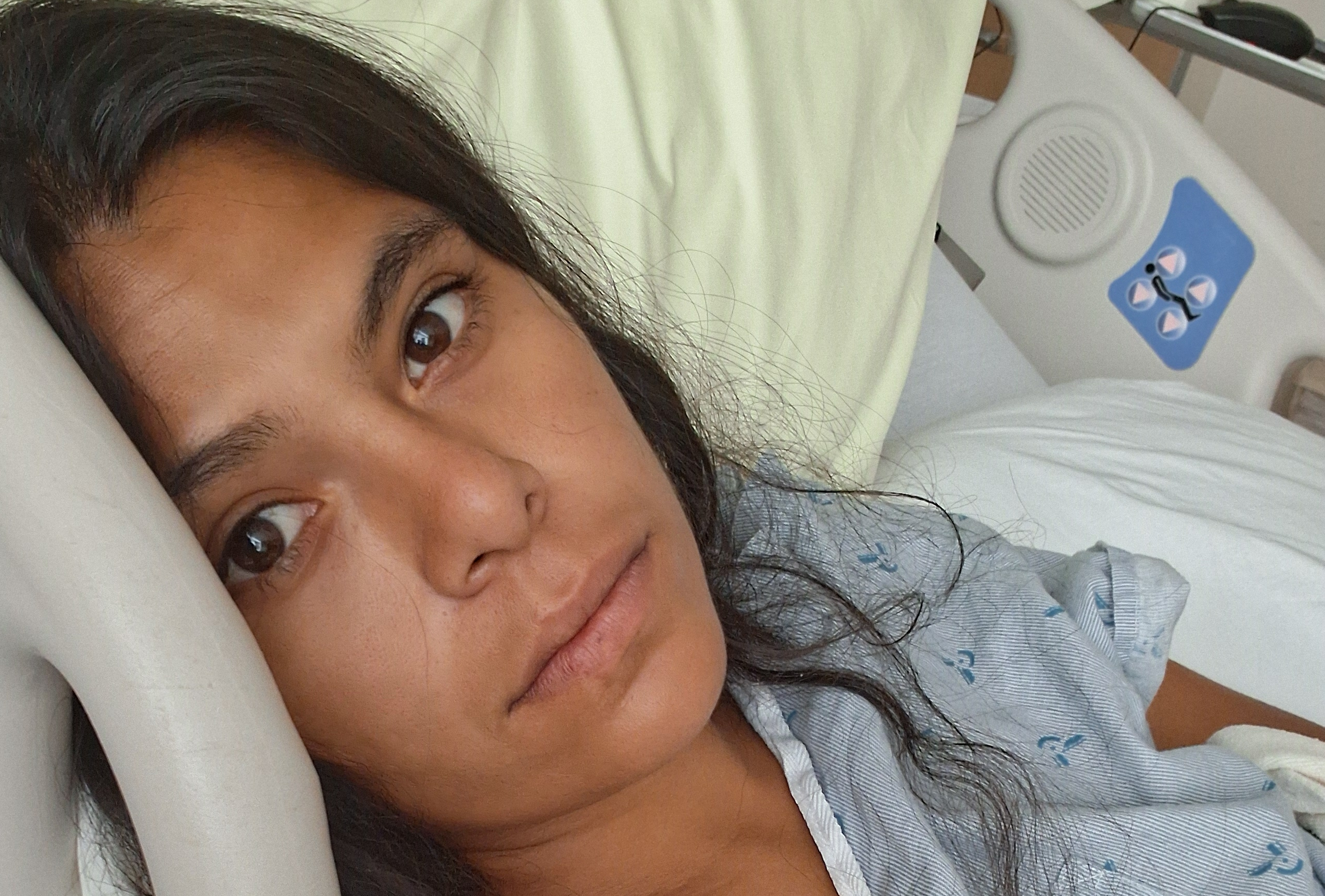
🫐Bere’s Healing Protocol
The 30-Minute Family Guide
❤️ Why I Wrote This
This is a brief introduction to 🫐Bere’s Healing Protocol, which is a detailed guide about the medical advice we have received and what we’re planning to do going forward to conquer cervical cancer, and restore my wife to great health. I am still working on writing and editing the book, but once it’s complete it will be available for FREE at this website.
I wrote 🫐Bere’s Healing Protocol because my wife, Berenice, became seriously ill, and I refused to be satisfied with understanding only one small piece of what was happening to her. Cancer may be the central disease we are fighting, but Berenice is not a tumor. She is an entire human being, and everything happening in her body is connected to everything else that allows her to remain alive, recover her strength, and have a good life.
The full version of this book became very long because every question seemed to lead to another question.
- What should she eat?
- How do we support her blood when she is severely anemic and facing kidney issues?
- What happens when a tumor interferes with the urinary system and places the kidneys at risk?
- What happens to the heart when the body retains an enormous amount of fluid?
- How much can we improve her chances of victory by getting good sleep, controlling pain levels, maintaining emotional health, love, and a beautiful and peaceful environment in which to recover?
- Which claims about conventional treatments (Western Medicine, Allopathic Medicine) are exaggerated, inadequately supported, or potentially dangerous?
- Which natural approaches have meaningful evidence behind them, which claims are exaggerated, and which might actually be dangerous?
- What does our faith teach us about healing, prayer, death, and the responsibility to fight for life?
Eventually those questions became 🫐Bere’s Healing Protocol.
But I also understand something practical: I cannot reasonably expect every member of our family to sit down and read an entire book that delves deep into the subject of health. That is why this shorter version exists. It is designed to take approximately fifteen to twenty minutes to read and give someone the most important ideas necessary to understand what we are trying to accomplish with Berenice’s health.
If something here interests you, concerns you, or makes you wonder why I reached a particular conclusion, read the corresponding chapter in the complete book. That is where the detailed explanations, research, qualifications, biblical discussions, and evidence belong. This version is a summary of what the book contains.
There is one principle that should be understood before anything else:
We are not merely fighting cancer. We are trying to strengthen and protect Berenice—the entire woman who has to survive the fight.
- That means protecting her kidneys and urinary system.
- It means rebuilding her blood and strength after severe anemia.
- It means paying attention to her heart.
- It means feeding her well instead of allowing illness to gradually consume the nutritional reserves her body needs.
- It means taking pain seriously.
- It means helping her sleep.
- It means keeping appropriate medical care involved while also examining nutrition, lifestyle, complementary approaches, and the things we can improve at home.
- It means reducing unnecessary stress and surrounding her with love.
And it means remembering why we are doing any of it.
Berenice has a daughter she wants to see grow up. She has places she wants to travel, things she wants to learn, a home she wants to build 🏡, experiences she wants to have, and years of life she still wants to live.
This protocol exists to help us fight for those years as intelligently as we can.
🏥 What Has Happened to Her Body
To understand why this protocol approaches Berenice’s health from so many different directions, the family needs to understand how complicated her situation became. This has never been simply a matter of saying, “She has cervical cancer,” and leaving the explanation there. The cancer created other serious problems, and some of those complications became dangerous in their own right.
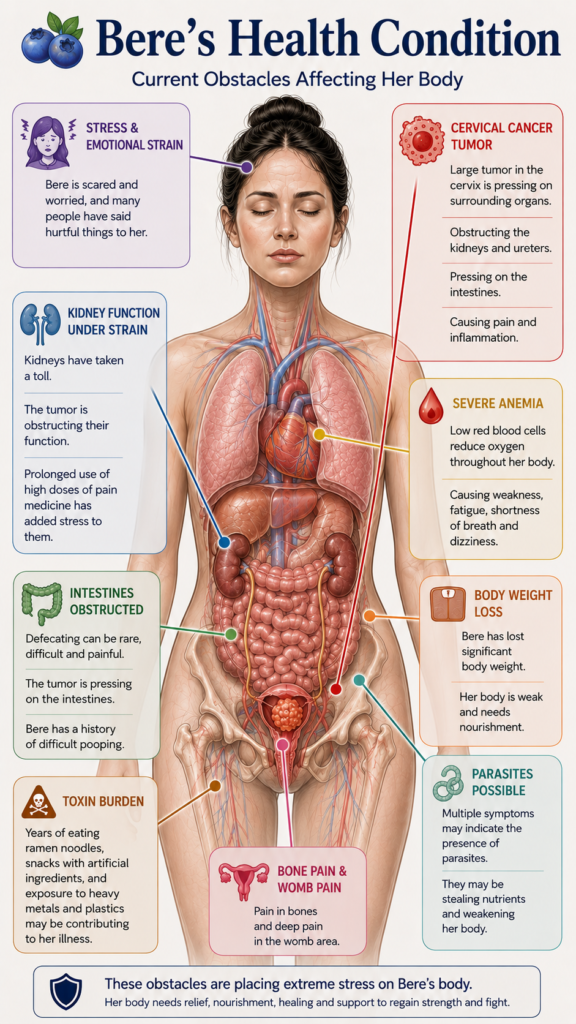
🇲🇽 Haga clic aquí para ver la versión en español de esta imagen.
Berenice’s cervical tumor grew large (5+ centimeters, about 2 inches) enough to place pressure upon surrounding organs, including her urinary system and intestines. One of the major concerns was obstruction involving the ureter and kidney. There were periods when she was producing extremely little urine, including a frightening period in which her body retained enormous amounts of fluid for several days. Even after a urinary catheter was installed, there were times when the amount coming out seemed completely inadequate compared with what her body was retaining.
She became severely bloated, and was at risk of lasting damage to her organs, including her brain and heart.
That matters because the kidneys are important in the fight against cancer. The kidneys regulate fluid and electrolytes and remove waste products from the blood. When urine cannot drain properly or kidney function deteriorates, the consequences can affect the entire body. That is why the urinary obstruction, kidney function, urine output, and methods of restoring drainage became major subjects in the complete protocol.
Berenice also developed serious anemia. Her red blood cell situation became severe enough that she required two blood transfusions. Red blood cells carry oxygen throughout the body, so severe anemia can contribute to weakness, exhaustion, shortness of breath, and increased cardiovascular strain. She was also placed on supplemental oxygen during this period.
At the same time, there were concerns about her heart. Her heart rate was described as slow and her heart as weak while her body was enormously overloaded with retained fluid. When a body is carrying an abnormal amount of fluid, the cardiovascular system can be placed under substantial stress. That is one reason I became so concerned not merely with “the cancer,” but with making sure her heart, blood, kidneys, and the rest of her body were protected as well.
Then something encouraging happened. After Berenice finally expelled a very large amount of retained fluid, the reports we received from her doctors were that the abnormal pressure or burden affecting her heart had improved and that her heart was functioning normally again. By August 19, 2026, additional blood work had been performed and Berenice told me that she was expected to be able to return home.
That was very good news.
But “her heart is functioning normally now” does not mean we simply forget what her body has been through. Nor does improvement in urine output mean kidney health no longer deserves attention. And receiving blood transfusions does not answer the longer-term question of why the anemia became so severe or how her body can be supported while rebuilding its blood and strength.
This is one of the most important ideas in the entire protocol:
Do not become so focused upon the tumor that we neglect the human body that has to survive it.
Cancer treatment and cancer decisions matter enormously. But so do kidney function, urinary drainage, anemia, oxygen delivery, cardiovascular health, nutrition, hydration, pain, sleep, strength, and psychological well-being. If one of those systems begins failing, it can become an emergency independently of whatever is happening to the tumor itself.
That is why the next part of this condensed guide begins with something every member of the family can understand and help with: 🥗 feeding Berenice and rebuilding her strength. 💪
🥗 Food Is Part of Rebuilding Her Strength 💪
One of the most practical things we can do for Berenice is also one of the most ordinary: feed her well.
Cancer and serious illness can place tremendous demands upon the body. Poor appetite, pain, nausea, hospitalization, inflammation, anemia, and the disease itself can all make it harder for somebody to maintain weight, muscle, and strength. Fasting long enough to trigger autophagy is important to battling cancer, I reject the idea that we should become so obsessed with “starving the cancer” that we accidentally starve the woman who is fighting it. Berenice needs enough energy and nutrition for her own cells, immune system, muscles, blood, and organs.
The full protocol goes deeply into individual foods and the evidence surrounding them. The short version is much simpler. I want Berenice eating a varied diet built around foods that provide real nutritional value and that her body can tolerate: adequate protein and calories, vegetables and fruits, iron-containing foods, and enough fluids according to what is medically appropriate for her kidneys and current condition.
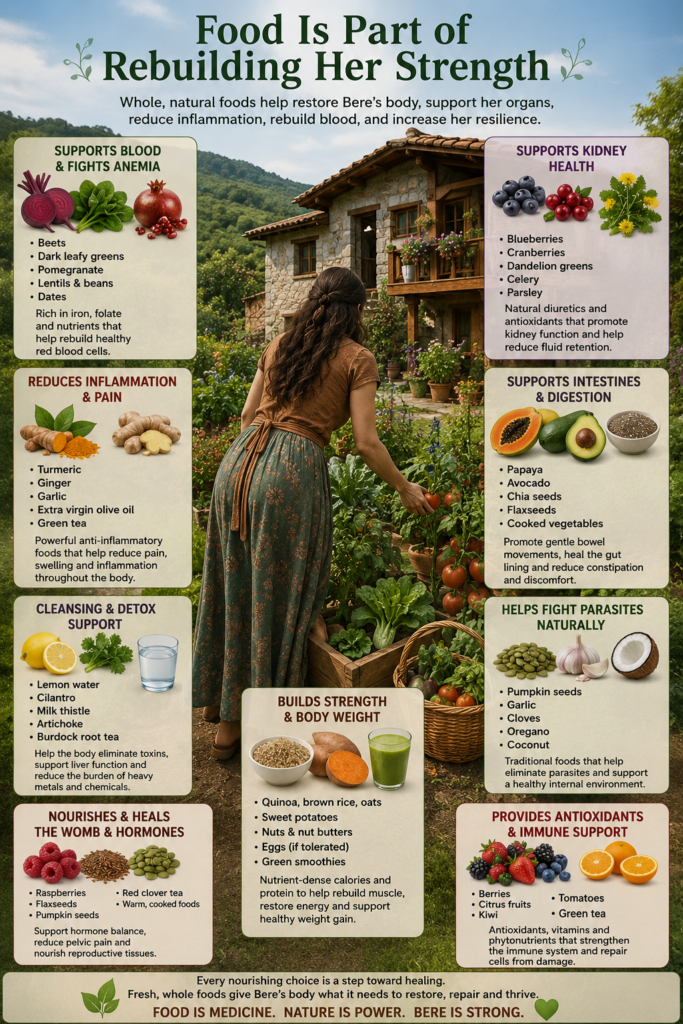
🇲🇽 Haga clic aquí para ver la versión en español de esta imagen.
Some foods appear repeatedly throughout the full protocol because they are particularly interesting nutritionally. We have emphasized 🫐berries, 🍅tomatoes, 🍇grapes, beets, pomegranates, and other colorful fruits and vegetables. These foods contain different combinations of vitamins, minerals, fiber, polyphenols, carotenoids, nitrates, and other compounds that have been studied for cardiovascular, metabolic, inflammatory, and general health effects.
❤ Beets are particularly interesting because dietary nitrate can be converted by the body into nitric oxide, which participates in blood-vessel function and circulation. That does not mean beet juice is a cure for heart disease or cancer. It means beets are a nutritious food with genuine physiological effects worth incorporating into the diet when medically appropriate.
❤ Pomegranate is another food we have taken a special interest in. It has an important place in the Bible and is also extensively studied today because of its polyphenols and other compounds. 🍇Grapes and 🫐berries likewise contain compounds that have attracted considerable cardiovascular and cancer research. 🍅Tomatoes provide lycopene and other nutrients. These foods are not chemotherapy disguised as groceries, but neither are they nutritionally meaningless. The complete book examines the research in much greater detail.
🍫High-cacao dark chocolate is another food I want Berenice to be able to enjoy in reasonable amounts. Cocoa contains flavanols thatYou’re right about the specific writing problem: the turmeric paragraph changes the pattern. Beets, pomegranate, berries, tomatoes, and cacao are introduced by explaining why they may be useful, whereas turmeric is introduced primarily as the setup for a warning. That makes the treatment of turmeric noticeably asymmetric.
Here’s the replacement beginning exactly where you specified:
🫚Turmeric is especially interesting because its best-known active compounds, the curcuminoids—particularly curcumin—have been extensively studied for their anti-inflammatory, antioxidant, and cell-signaling effects. Laboratory research has also investigated curcumin’s effects on numerous biological processes relevant to cancer, including inflammation, oxidative stress, cell proliferation, apoptosis (programmed cell death), angiogenesis, and signaling pathways involved in tumor growth. Turmeric can be incorporated into foods, while concentrated curcumin preparations provide substantially larger quantities and therefore deserve separate consideration regarding dose, absorption, and Berenice’s individual condition.
☀️ Vitamin D also deserves special attention. Vitamin D is much more than simply a vitamin associated with bones. The body uses vitamin D signaling in immune regulation, inflammation, muscle function, calcium metabolism, and normal cellular growth and differentiation. Vitamin D receptors are found throughout the body, and vitamin D status has consequently become an important subject of research in cancer and general health. For Berenice in particular, maintaining adequate vitamin D is relevant because prolonged illness, reduced activity, weight loss, limited sunlight exposure, and poor food intake can all make good nutritional status harder to maintain. The sensible objective is adequacy rather than blindly taking enormous doses; when possible, a blood measurement of 25-hydroxyvitamin D gives us considerably more useful information than guessing.
🍊 Vitamin C is another basic nutrient that becomes especially relevant when somebody is trying to rebuild a weakened body. Humans cannot manufacture vitamin C and must obtain it from food or supplementation. It is required for collagen production and tissue repair, contributes to normal immune function, acts as an antioxidant, and importantly for Berenice, helps the body absorb non-heme iron from plant foods. Because severe anemia has been one of the major obstacles she is facing, pairing plant sources of iron with vitamin-C-rich foods can be nutritionally useful. Citrus fruits are the obvious example, but strawberries, guava, kiwi, peppers, broccoli, tomatoes, and many other fruits and vegetables can contribute significant vitamin C.
These three examples also illustrate an important principle of the larger protocol. We are interested not merely in whether something carries the label natural, but in what it actually does inside the human body. Curcumin, vitamin D, and vitamin C participate in very different biological processes. The same is true of the polyphenols in berries and pomegranates, the lycopene in tomatoes, the dietary nitrate in beets, and the flavanols in cacao. Rather than searching for one miraculous substance, we are trying to understand how many useful nutritional components can work together within a diet that supports Berenice’s strength and recovery.
There is nevertheless an important individual consideration because of Berenice’s kidney problems. A food or nutrient that is ordinarily beneficial may need to be adjusted according to her actual kidney function, electrolyte levels, medications, nephrostomy output (tubes connected to her kidneys), and current laboratory results. This is particularly important when moving from ordinary foods to highly concentrated supplements. That isn’t an argument against natural medicine; it is an argument for practicing it intelligently. The objective should be to give her body what it needs in amounts appropriate to the body she has right now, rather than following generic doses designed for healthy people.
That is the philosophy I want the family to understand. We are not looking for one magical fruit, vitamin, herb, or supplement. We are building a nutritional environment in which Berenice has the raw materials her body needs while also investigating foods and natural compounds that have particularly interesting biological properties. Protein matters. Calories matter. Iron and the nutrients involved in normal blood formation matter. Vitamin C and vitamin D matter. Fruits and vegetables matter. Hydration matters. Maintaining muscle and body weight matters. Enjoying food matters too.
And if Berenice has very little appetite, arguing with her about whether every bite is theoretically perfect can become counterproductive. Sometimes the immediate victory is simply getting nourishing food into her.
Feed Berenice, not the cancer.
🩸 Protect the Blood, Kidneys, Heart, and Whole Body
Berenice’s anemia made the importance of blood impossible to overlook. Her anemia became severe enough that she received two blood transfusions 🩸🩸, providing red blood cells at a time when her body was struggling with a serious shortage. But the longer-term question remains equally important: what does her body need to build and maintain healthy blood of its own? That brings nutrition directly into the discussion. Iron is essential for hemoglobin production, while folate, vitamin B12, vitamin B6, vitamin C, protein, copper, and other nutrients participate in blood formation, iron utilization, or the processes that support healthy red blood cells. For Berenice, rebuilding strength therefore means paying serious attention to the nutritional resources her body uses to continually produce blood.
After the immediate crisis, however, we also have to ask what happens next.
The longer protocol emphasizes both feeding the blood and understanding why the blood became depleted. If her body is having difficulty producing red blood cells, that deserves medical investigation, which is why we need Berenice’s recent laboratory test results.
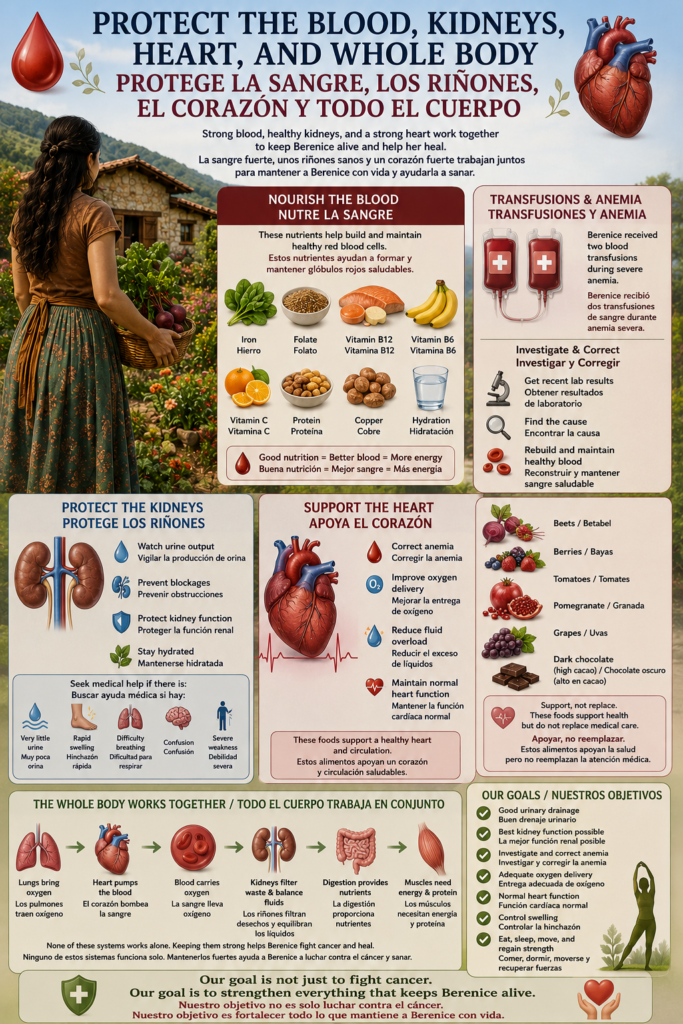
The kidneys are equally important. One of Berenice’s most frightening complications involved very poor urine output while her body accumulated fluid. When a tumor compresses the urinary tract, restoring drainage can become urgent because prolonged obstruction can injure a kidney. Catheters, nephrostomy tubes, ureteral stents, and other interventions exist for different kinds of obstruction, and the correct intervention depends upon where the blockage actually is. The essential family lesson is much easier to remember: pay attention to urine output and kidney function. A dramatic decline in urination, rapidly increasing swelling, difficulty breathing, confusion, severe weakness, or other major changes should not be dismissed while everyone waits for a particular food or supplement to work. Those can be signs that the situation needs medical attention.
Then there is the heart. 🫀
During the worst period of fluid retention and anemia, Berenice’s cardiovascular system was dealing with several stresses at once. Severe anemia means the blood carries less oxygen, which can force the cardiovascular system to compensate. Major fluid abnormalities can also affect the heart and circulation. Supplemental oxygen and transfusions were therefore part of a much larger effort to stabilize her body.
The encouraging news was that after she expelled a tremendous amount of retained fluid, we were told that her heart was functioning normally again. I am grateful for that. 🙏 But I still want cardiovascular health treated as something worth protecting rather than waiting until another crisis appears.
That is where many of the foods discussed in the complete protocol return: beets, 🫐 berries, 🍅 tomatoes, pomegranate, 🍇 grapes, and appropriate amounts of 🍫 high-cacao dark chocolate. They contain compounds that have been investigated for vascular and 🫀 cardiovascular effects, and they can form part of a heart-conscious diet.
This is also why the protocol repeatedly comes back to the whole person. The blood carries oxygen. The lungs bring oxygen into the body. The heart moves blood. The kidneys regulate fluid and remove wastes. The digestive system supplies nutrients. The muscles need energy and protein. None of these systems operates alone.
Cancer is the enemy we can name most easily, but Berenice needs the rest of her body strong enough to survive both the disease and whatever treatments or procedures become necessary.
So when the family asks, “How can we help her?” the answer is multifaceted.
- 💦 We want good urinary drainage and the best kidney function she can maintain.
- 🩸 We want her anemia investigated (laboratory test results) and corrected as much as possible.
- 🌬 We want adequate oxygen delivery.
- 🫀 We want her heart functioning normally.
- 🙂 We want pain controlled and mood control.
- 💪 We want her eating, sleeping, moving when she is able, and gradually regaining strength.
The objective is not merely to attack the cancer that is hurting Berenice. It is to strengthen everything that is keeping her alive.
🌿 Natural Medicine and Conventional Medicine Are Not Religions
One of the most important principles in 🫐Bere’s Healing Protocol is that I do not want us making decisions merely because something belongs to the category of “natural medicine” or “conventional medicine.” Neither label proves that something works, and neither label proves that something is worthless.
Berenice has already benefited from conventional medical care, which is also called Western Medicine or Allopathic Medicine. Blood transfusions supplied red blood cells when her anemia became severe. Oxygen supported her when oxygen delivery was a concern. Catheters and other procedures can address problems that food simply cannot mechanically correct. Pain medicine can relieve suffering. Blood tests can tell us things about kidney function, anemia, electrolytes, and the condition of the body that we cannot determine simply by looking at her.
These things matter.
At the same time, medical treatment does not eliminate the importance of many other aspects of the healing process. Berenice needs a lot more than what most hospitals provide:
- She needs the best food we can provide her. Hospitals do not provide the best food.
- She needs sleep. She sleeps best at home.
- She needs appropriate hydration. Hospitals are excellent at keeping patients hydrated but we can do this at home.
- She needs a healthy environment. Hospital rooms are not the most beautiful, tranquil or happy places to heal, but they are clean environments.
- She needs emotional support. Hospital visiting hours, and restrictions on the number of visitors, decrease the amount of emotional support she can receive.
- She needs movement and physical activity when her condition permits it. She can get exercise at home.
- She needs sunlight and fresh air when appropriate. Hospitals are notoriously terrible at providing their patients sunlight and fresh air.
- She needs the nutritional resources from which the body maintains and repairs itself. Hospitals only provide basic nutrition instead of meticulously targeted holistic nutrition.
That is where many natural and complementary approaches belong. The complete protocol examines individual foods, herbs, supplements, extracts, CBD products, and other approaches in considerably greater detail. Some have interesting evidence behind particular uses. Others have weaker evidence. Some claims circulating online go considerably beyond what research has actually demonstrated.
I want us willing to investigate all of it without becoming gullible about any of it.
The word natural deserves particular caution. A strawberry is natural. So is a poisonous mushroom. A substance does not become safe merely because it came from a plant, and concentrated extracts can behave very differently from eating ordinary amounts of the original food. Supplements can interact with medications, affect bleeding, alter blood pressure, or create additional concerns when the kidneys or liver are already under stress.
The reverse prejudice is equally unhelpful. Something should not be dismissed merely because it is a food, traditional practice, or natural substance rather than a pharmaceutical product. Natural medicines can be phenomenally powerful. Nutrition is biology. Sleep is biology. Exercise is biology. Stress is biology. The fact that these things are “ordinary” or “natural” does not make them irrelevant.
The standard should therefore be:
- What is the evidence?
- What is the potential benefit?
- What is the potential harm?
- What does Berenice’s current condition allow?
I do not want Berenice forced into a false choice between receiving appropriate medical care and living as healthfully as possible. I want us to use every responsible tool available to us while continuing to distinguish between something that supports health and something proven to treat the cancer itself. That distinction protects Berenice while still leaving us free to investigate possibilities.
The objective is not loyalty to a medical camp. The objective is Berenice getting better. It doesn’t matter if she is cured by Western Medicine, Holistic Medicine, or Prayer. What is important is that she is cured of this terrible disease!
🏡 Home, Love, Sleep, Comfort, and Stress
Healing does not occur only during the few minutes somebody is speaking with a doctor. Whatever medical treatment Berenice receives, she still has to live through all the hours between appointments and procedures. That makes her everyday environment important. I want her environment to communicate one thing to her body and mind as consistently as possible:
❤You are safe here. You are loved here. ❤
Rest. Eat. Sleep. Recover.
That means a clean and comfortable place to stay. It means access to the bathroom and whatever medical equipment she currently needs. It means good food within reach. It means helping her stay appropriately hydrated. It means keeping medications organized and the things she ingests, and changes in her mood or condition, and many other things are documented meticulously. It means controlling unnecessary noise and interruptions when she needs sleep.
💤 Sleep deserves particular attention because it is not wasted time. The body performs important immune, hormonal, neurological, and metabolic functions during sleep. Pain, anxiety, hospital interruptions, uncomfortable surroundings, and illness itself can all interfere with it. We should therefore treat a good night’s sleep as part of recovery rather than something that happens only after everything else has been accomplished.
🙂 Comfort matters for the same reason. Severe pain consumes attention and can interfere with eating, movement, sleep, and emotional well-being. Pain relief does not directly cure cancer, but that does not make it meaningless. A woman who is suffering less may be better able to sleep, eat, communicate, move, and participate in decisions about her own care.
Then there is stress.
It is important to be precise here. I am not saying that somebody gave Berenice cancer by upsetting her, nor am I saying that positive thinking alone can cure it. Cancer is far more complicated than that. But psychological stress is not imaginary. The nervous, endocrine, cardiovascular, and immune systems respond to stress, and prolonged severe stress can affect sleep, appetite, blood pressure, mood, and other aspects of health. That means the people around Berenice have some responsibility for what they add to her environment.
There may be legitimate disagreements about her care. Family members may believe different things about medicine, religion, food, relationships, or decisions that have been made. Those disagreements do not magically disappear because Berenice has become ill.
But there is a time and manner for disagreement.
A seriously ill woman should not have to spend precious energy defending herself from accusations, insults, condemnation, shouting, or people continually telling her that everything is her fault. Even when somebody believes a difficult conversation is necessary, it can be conducted with compassion. Do not make a seriously ill woman spend energy defending herself from the people who are supposed to love her.
❤ Love can be extremely practical. Bring her something she can eat. Wash dishes. Help clean the room. Sit with her. Let her sleep. Help with transportation. Keep track of something she is too exhausted to remember. Make her laugh. Hold her. Tell her something good about herself. Ask what she actually needs instead of assuming.
🏡 Home can be particularly valuable when it provides those things and when Berenice is medically stable enough to be there. Familiar surroundings, people she loves, familiar food, privacy, and control over her routine can all make home psychologically restorative. But “home” should never become an ideology either. If Berenice develops signs of a serious complication, home is not automatically safer merely because it feels better. Major changes in breathing, consciousness, urine output, bleeding, severe pain, fever, or other concerning symptoms may require prompt medical evaluation.
The goal is therefore not home instead of medicine. It is to make home part of the healing environment while using medical care when she needs it.
And wherever Berenice happens to be—home, hospital, clinic, or somewhere else—the family can provide something no machine can manufacture.
❤ She can know that the people around her want her to live. ❤
That matters because the next part of this guide deals with something medicine cannot put into an IV bag: faith, prayer, hope, and having reasons to keep reaching for tomorrow.
🙏 Faith, Prayer, and the Will to Live
This protocol would be incomplete if I discussed Berenice’s body while ignoring our faith. We are Messianic Karaite Jews. We believe in God, we believe prayer matters, and we believe that seeking healing is entirely compatible with seeking competent human help. The Tanakh repeatedly contains people crying out to God during sickness, danger, grief, and circumstances that appeared hopeless.
🙏 Prayer is therefore not something I want reserved for the moment when medicine has nothing left to offer. We can pray while doctors work. We can pray while preparing food. We can pray before making difficult decisions. We can thank God when something improves. We can ask for wisdom when we do not know what to do.
At the same time, I do not want to turn faith into another weapon against somebody who is sick. We should never tell a suffering person that if she had simply believed harder, or prayed harder, or possessed greater favor with God, she would necessarily have recovered. The Bible itself contains righteous people who suffered terribly. The difficult question of why one prayer appears to receive the answer we desperately wanted while another does not is discussed much more extensively in the complete book.
What faith can give us is a reason not to surrender possibility merely because circumstances are frightening.
The biblical story repeatedly presents restoration where people believed destruction had become final. Ezekiel’s vision of the dry bones uses one of the most extreme images imaginable: bones that are not merely dead but dry are restored, covered again with sinews, flesh, and skin, and given breath. Whatever theological dimensions we draw from that vision, its imagery is deliberately about life emerging where human observation would have declared life impossible.
The final biblical vision is likewise not one in which disease and death simply continue forever. Revelation 21:4 envisions a world in which death, mourning, crying, and pain are no more, while Revelation 22 returns to the Tree of Life. For us, this matters because death is not something that needs to be romanticized as though dying were God’s ultimate purpose for human beings. Scripture permits us to imagine something better: that we were designed to live!
That does not mean I can promise Berenice a miracle on command.
It means I can pray for one.
And while I pray, I can take meaningful action.
That distinction matters. Faith should not require us to become passive. If somebody prays for food and then has an opportunity to obtain food, refusing to eat would be a strange demonstration of faith. Likewise, praying for Berenice’s healing does not prevent us from investigating her anemia, protecting her kidneys, feeding her well, seeking appropriate medical treatment, reducing unnecessary stress, or changing things about her environment that we have the power to improve.
We pray as people who believe healing is possible, while acting as people responsible for doing everything wise that is within our power.
The complete book goes considerably farther into questions that cannot fit responsibly into a twenty-minute guide. It examines research into prayer and distant healing, extraordinary forms of human physiological self-regulation, consciousness and the structure of reality, the limits of what science has actually demonstrated, and the difference between fascinating possibilities and established facts. It also explores longevity, cryonic preservation, reincarnation research, past-life memories, and our religious hope for physical life in the World to Come.
Those subjects are worth investigating precisely because we do not think the boundaries of present human knowledge should automatically be confused with the boundaries of reality.
But none of those larger questions should distract us from something we can do tonight.
🙏Pray with Berenice.
Read Scripture with her if she wants to listen to you read. Take her to a synagogue when her health permits it and when we find a community where she will be welcomed and loved. Ask God for healing. Ask for wisdom. Give thanks for improvements. Ask for strength when the situation is frightening. And then get up from prayer prepared to do whatever good thing is actually within our hands to do.
🌠 Guard Her Dreams
After thousands of words about cancer, kidneys, anemia, food, medicine, prayer, and healing, there is a danger of forgetting the most important thing about this entire protocol: Berenice actually wants to live.
She has things she wants to do.
👧 First and most importantly, she wants to see her daughter grow up. She wants the years in which the child she has raised becomes an adult woman. She wants birthdays, conversations, disagreements, accomplishments, ordinary days, and the opportunity to discover who her daughter eventually becomes.
✈ She wants her Mexican passport. I want to establish my own passport situation and pursue Mexican citizenship, and we want to travel together. We have talked about Japan, Vietnam, Israel, different countries in Africa, cruises, beaches, and many other places. We do not need to know every destination now. Part of having a future is discovering new things you want to do with it.
💃 She wants to dance. She wants to take dance lessons and sometimes go to nightclubs. She wants beautiful clothes and wonderful dates with her husband. She is an introvert, but that does not mean she has stopped being a woman who wants to feel attractive, romantic, and alive.
🪡🧵 She wants a sewing machine. She wants to learn to sew well and develop the kind of practical household skills she admires in the capable woman described in Proverbs 31.
🏡 We dream about houses. A beautiful stone house in the country is the main one: green land, animals, gardens, unusual architecture, perhaps some subterranean rooms, and a ridiculously large kitchen where several people could cook at once. We have imagined a beach house 🏖 and even converting a 53-foot semi-truck trailer 🚛 into a comfortable tiny house simply because we think it would be interesting.
❤ Berenice also has dreams concerning love, sexuality, and family. She is bisexual, and we do not believe she should be shamed for that. We have talked about polygyny, sister wives, and a larger household. Other people do not have to want the same life we want, but they should be capable of respecting Berenice as an adult woman rather than using serious illness as an opportunity to condemn her for being herself.
And I want her beside me when my work succeeds.
I want my 🎲tabletop role-playing games and books to become successful enough to support our family and give us greater freedom over our lives. I want Berenice at the game table—as a player, or assistant Game Master. I want us traveling to events together. I want her to see the books succeed rather than someday having to dedicate that success to her memory.
These dreams are not all equally important, and some may change. Some require substantial money. Others require almost none. A sewing machine is easier than a country house. Going out for Vietnamese food is easier than traveling to Vietnam. Taking a walk somewhere beautiful is easier than buying a beach house.
That is useful because dreams do not have to remain fantasies until we can accomplish their largest possible versions.
Start somewhere.
- Get the passport.
- Buy the sewing machine when we can.
- Take her somewhere beautiful.
- Help her regain enough strength to dance.
- Work on the next book.
- Give her another birthday with her daughter.
This is not Berenice’s “bucket list” (i.e., a list of things a dying person wants to do right before they pass away). This is our list of reasons for her to keep living.
There is an important medical and psychological distinction here. I am not claiming that wanting something badly enough cures cancer. People who die from cancer did not fail because they lacked dreams, faith, or determination. But serious illness can make the future disappear from a person’s field of vision.
- 🤕 Pain reduces life to the next hour.
- 😩 Exhaustion reduces it to the next nap.
- 🏥 Hospitalization reduces it to the next procedure or blood test.
Family can help keep the larger future visible.
Talk about what we are going to do when she is stronger. Ask where she wants to travel. Ask what she wants the house to look like. Let her choose something she wants to eat. Make plans that assume she belongs in the future.
And above all, don’t ever think that she is a lost cause. She is Berenice, and we are not going to give up on her, but take her gently into the future.
🤝 What the Family Can Actually Do
After all the research, medical information, nutrition, prayer, and discussion about the future, the most important question for the family may be the simplest one:
What can we actually do for Berenice?
Nobody in the family has to become an oncologist. Nobody has to understand every study discussed in the complete 🫐Bere’s Healing Protocol. Nobody even has to agree with every conclusion I have reached. What matters is that we cooperate around something much more fundamental: we love Berenice, we want her alive, and we want to make her fight easier rather than harder. That begins with practical help.
- 🥗 Make sure she has nourishing food available and actually eats.
- 🧹 Help keep her surroundings clean and comfortable.
- 💤 Let her sleep when she needs to sleep.
- 🚗 Help with transportation, prescriptions, appointments, shopping, cooking, laundry, or whatever ordinary responsibilities become difficult while she is weak.
- 💊 Make sure her medicines are organized, and keep a journal of what medicines she has taken, rather than expecting an exhausted woman to remember everything herself.
- 👁 Pay attention when something changes significantly.
Her history of urinary obstruction, kidney problems, severe fluid retention, and anemia means that major changes in urination, swelling, breathing, bleeding, consciousness, weakness, or pain deserve to be taken seriously. Helping her obtain medical attention when something is genuinely wrong is part of caring for her.
But care is not only logistical.
Talk to her. Sit with her. Hold her. Make her laugh. Tell her she is beautiful. Ask what she wants instead of spending every conversation talking about what everybody else thinks she should do. If she wants prayer, pray with her. If she wants to read Scripture, read with her. If she wants to sleep, let her sleep.
And give her things to anticipate. Not every dream requires thousands of dollars. Take her somewhere pleasant when she is strong enough. Bring her something she enjoys eating.
Most importantly, do not make love conditional upon agreement (i.e., love her even if you disagree with her).
Family members may disagree with us about medicine. They may disagree with our theology. They may disagree with our views about relationships, sexuality, natural medicine, or any number of things discussed in the complete book. Those disagreements can be discussed at an appropriate time.
- They do not prevent somebody from bringing dinner. 🥗
- They do not prevent somebody from saying, “I love you.” ❤
- They do not prevent somebody from helping. 😊
We do not have to agree about everything in order to agree that we want Berenice alive.
That is the common ground I am asking the family to stand upon.
If everybody contributes something—food, transportation, money, time, prayer, companionship, cleaning, encouragement, research, or simply peace—then no single person has to carry everything. And Berenice should not have to carry anyone else while she is the one trying to recover.
🫐 The Protocol in One Page
If you remember nothing else from this condensed version of 🫐Bere’s Healing Protocol, remember this:
Protect the woman, not merely fight the cancer.
Cancer is the central disease, but Berenice is an entire living system. Protect her kidneys and urinary drainage. Monitor the anemia and understand why it is happening. Protect her heart and circulation. Feed her enough nutritious food to maintain and rebuild strength. Pay attention to hydration and electrolytes according to her current kidney function and blood tests. Take pain seriously. Help her sleep. Help her move and regain strength when her condition allows it.
Use medicine intelligently. Use food intelligently. Investigate complementary and natural approaches intelligently.
Do not assume something is right merely because it came from a hospital, and do not reject something merely because it came from a hospital. Do not assume something is good merely because it is natural, and do not assume something is worthless merely because it is natural. Ask what something does, what evidence supports it, what risks it carries, and whether it makes sense for Berenice’s actual condition right now.
Know the difference between supportive measures and treatments for the cancer itself. Good nutrition supports her body, but it does not mechanically open an obstructed ureter. Prayer can provide faith, hope, and spiritual strength, but prayer does not mean ignoring a medical emergency. A blood transfusion can rapidly replace desperately needed red blood cells, but it does not answer why the anemia developed in the first place. Different problems require different tools.
🔎 Keep learning, exploring, reading and researching.
And while we are doing all of that, create an environment in which healing has every reasonable advantage we can give it. Give Berenice good food. Give her rest. Give her cleanliness and comfort. Give her competent medical attention when she needs it. Reduce unnecessary stress. Give her affection. Give her dignity. Give her some control over her own life.
🙏 Pray for her.
Believe that improvement is possible, ask God for help, and continue moving forward.
The complete 🫐Bere’s Healing Protocol exists for anyone who wants to understand the reasoning behind this short guide. It contains the deeper discussions of cancer, nutrition, blood and heart health, kidney protection, pain, complementary approaches, faith and prayer, consciousness, longevity, and the future we are trying to preserve. This twenty-minute version cannot contain all of that evidence and argument without becoming another book. So if this is all you have time to read, remember the essentials and help us put them into practice.
Feed her. Help her rest. Take dangerous symptoms seriously. Help her get appropriate care. Reduce unnecessary stress. Pray for her. Listen to her. Love her. Give her something to look forward to.
We cannot guarantee what happens next.
But uncertainty is not helplessness. There is still an enormous amount that the people around Berenice can do.
And every one of us should begin with the simplest objective of the entire protocol:
Help Berenice live.
About the Author