LEFTMOST 1d12 RESULT
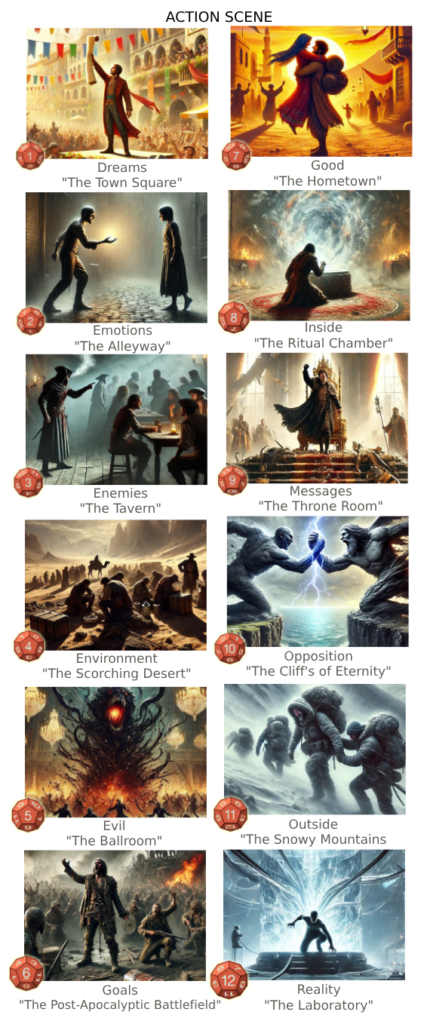
[2] Emotions – Action Scene
[3] Enemies – Action Scene
[4] Environment – Action Scene
[5] Evil – Action Scene
[6] Goals – Action Scene
[7] Good – Action Scene
[8] Inside – Action Scene
[9] Messages – Action Scene
[10] Opposition – Action Scene
[11] Outside – Action Scene
[12] Reality – Action Scene
The Action Scene Film Cells are used when something is already happening—or when the storyteller senses that it is time for something to happen—and wants the oracle to determine the direction the action takes next. Importantly, the film cell does not need to depict the same genre, historical period, technology, or setting as the story in which it is being used. The image is interpreted rather than reproduced literally. Suppose a medieval fantasy Game Master rolls Reality – Action Scene: The Laboratory, depicting a figure surrounded by machinery, cables, screens, and a tremendous burst of energy. There need not suddenly be a futuristic laboratory in the fantasy world. The GM might instead interpret the image as a wizard losing control of a magical experiment, a prisoner breaking free of enchanted restraints, an ancient mechanism awakening beneath the castle, or a tremendous surge of magical energy disrupting the characters’ plans. Conversely, Goals – Action Scene: The Post-Apocalyptic Battlefield, with its battered warriors rallying amid smoke, flames, and devastation, might inspire a science-fiction writer to have the crew of a starship rally against boarding enemies, or a modern thriller writer to introduce a desperate protest, riot, or last stand. The Scorching Desert might inspire an avalanche in an Arctic adventure because the important idea is not necessarily desert, but characters struggling against a hostile environment; The Tavern might inspire a confrontation aboard a space station because what matters is the image’s accusation, hostility, and sudden threat rather than its medieval surroundings. This separation between what the film cell literally depicts and what it suggests is central to The Lost Film Cells Oracle. The storyteller is not asking, “How do I put this picture into my story?” but rather, “If this were the only surviving frame of my story, what could it be telling me happens next?” That principle allows the same 12 Action Scene Film Cells to inspire countless developments across TTRPG campaigns, novels, and screenplays regardless of genre or setting.
RIGHTMOST 1d12 RESULT
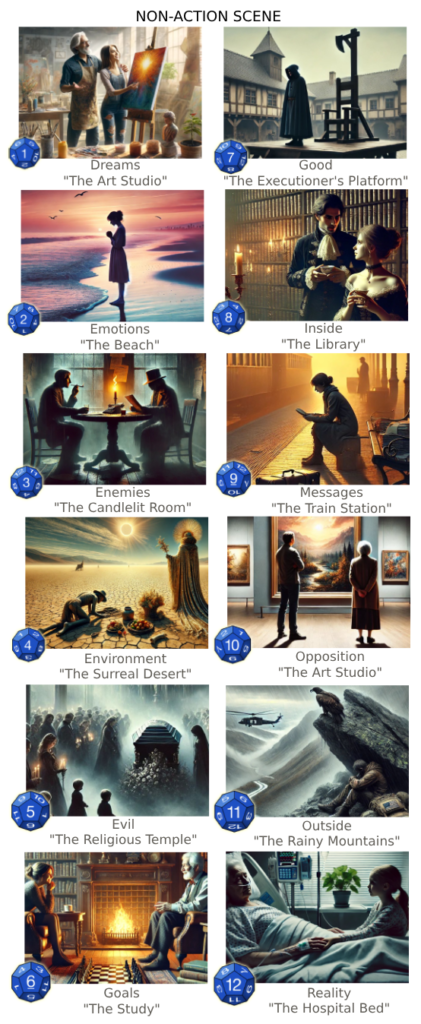
[1] Dreams – Non-Action Scene
[2] Emotions – Non-Action Scene
[3] Enemies – Action Scene
[4] Environment – Non-Action Scene
[5] Evil – Non-Action Scene
[6] Goals – Non-Action Scene
[7] Good – Non-Action Scene
[8] Inside – Non-Action Scene
[9] Messages – Non-Action Scene
[10] Opposition – Non-Action Scene
[11] Outside – Non-Action Scene
[12] Reality – Non-Action Scene
The Non-Action Scene Film Cells are used when the story does not currently demand immediate danger, violence, or some other dramatic burst of action. They are particularly useful for the quieter moments in which characters investigate, converse, travel, recover, make decisions, develop relationships, discover information, or simply experience the world around them. These scenes are important because a story cannot consist entirely of confrontations and crises; the quieter spaces between action often establish what the characters care about and give later conflicts their meaning. A Non-Action Scene Film Cell might inspire an unexpected conversation with an NPC, the discovery of a clue, a change in atmosphere, an emotional revelation, a new relationship, a moment of reflection, an intriguing location, or the introduction of something that will become important later. The Messages – Non-Action Scene: The Train Station, for example, might suggest that new information arrives, someone is preparing to leave, or the characters discover something that changes their plans, while Goals – Non-Action Scene: The Study could inspire a conversation with a mentor, the formulation of a new strategy, or the discovery of knowledge needed to pursue an objective. Non-Action Scene Film Cells can also help resist the temptation to answer every lull in a story with another enemy or catastrophe. Sometimes what happens next is not an attack, but a confession, a discovery, an invitation, a difficult decision, a moment of beauty, or a quiet event whose importance will not become apparent until much later.
Return to the Oracles page to select a different oracle or purchase a digital copy of The Lost Film Cells Game Master Oracle.